Israeli Minister Hints at Annexing Parts of Gaza

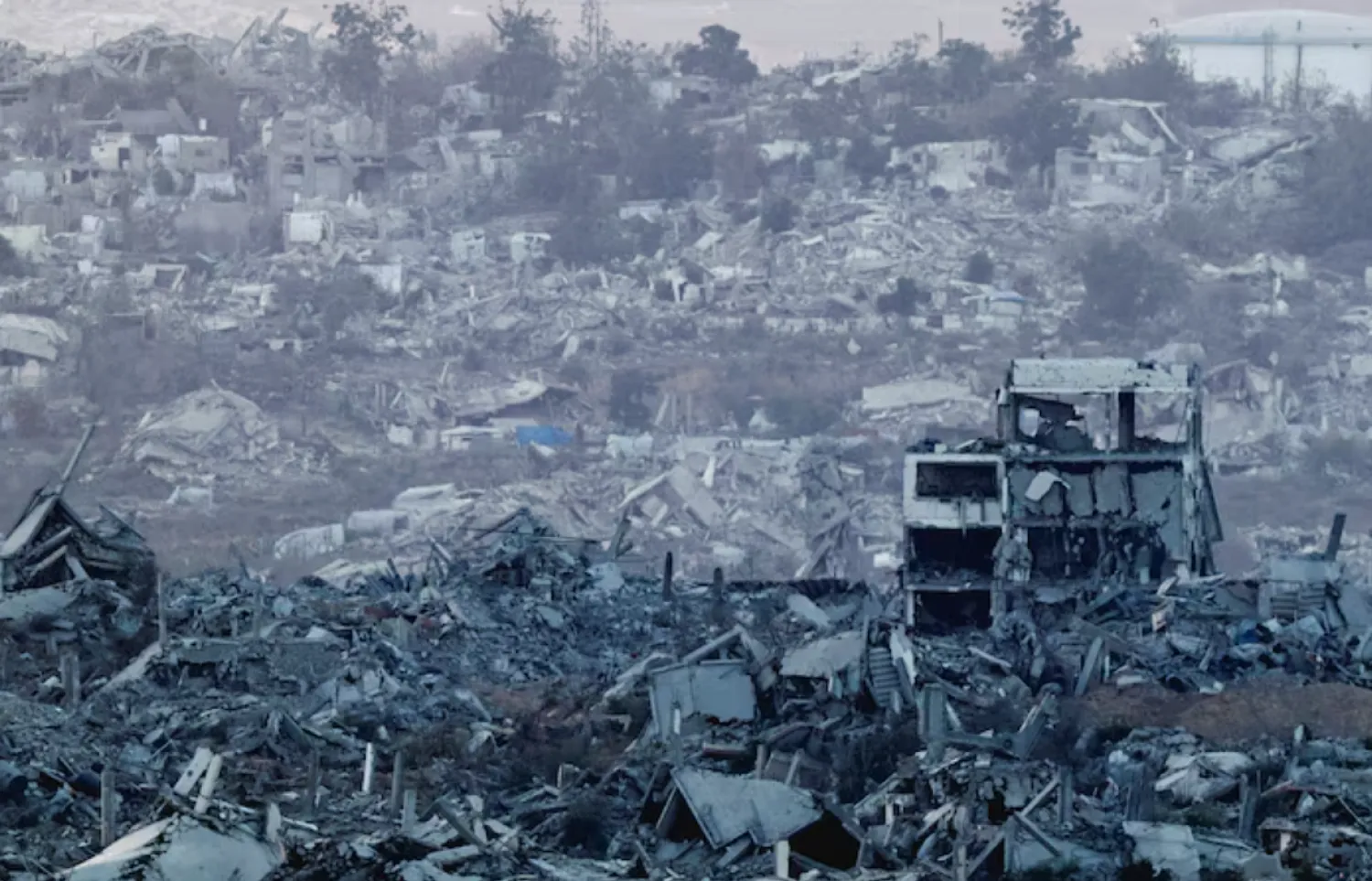
Destroyed buildings lie in Gaza, as seen from the Israeli side of the border, July 28, 2025. REUTERS/Amir Cohen
TT

Israeli Minister Hints at Annexing Parts of Gaza

Destroyed buildings lie in Gaza, as seen from the Israeli side of the border, July 28, 2025. REUTERS/Amir Cohen

Israel could threaten to annex parts of Gaza to increase pressure on the militant group Hamas, an Israeli minister said on Wednesday, an idea that would deal a blow to Palestinian hopes of statehood on land Israeli now occupies.

The comment by security cabinet member Zeev Elkin came a day after Britain said it would recognize a Palestinian state in September unless Israel takes steps to relieve suffering in Gaza and reaches a ceasefire in the war with Hamas, Reuters reported.

France, which said last week it will recognize a Palestinian state in September, and Saudi Arabia issued a declaration on Tuesday, also backed by Egypt, Qatar and the Arab League, outlining steps toward implementing a two-state solution. As part of an end to the Gaza war, they said Hamas "must end its rule in Gaza and hand over its weapons to the Palestinian Authority".

Israel has denounced moves to recognize a Palestinian state as rewarding Hamas for its October 2023 attack that precipitated the war.

POSSIBLE ULTIMATUM TO HAMAS

Accusing Hamas of trying to drag out ceasefire talks to gain Israeli concessions, Elkin told public broadcaster Kan that Israel may give the group an ultimatum to reach a deal before further expanding its military actions.

"The most painful thing for our enemy is losing lands," he said. "A clarification to Hamas that the moment they play games with us they will lose land that they will never get back would be a significant pressure tool."

Mediation efforts aimed at reaching a deal that would secure a 60-day ceasefire and the release of remaining hostages held by Hamas ground to a halt last week, with the sides trading blame for the impasse.

Israel is facing mounting international pressure over the situation in Gaza, where a global hunger monitor has warned that a worst-case scenario of famine is unfolding. The Gaza health ministry reported seven more hunger-related deaths on Wednesday, including a two-year-old girl with an existing health condition.


Sources to Asharq Al-Awsat: Meshaal Contacts Gaza Factions on Fate of Weapons

Fighters from Hamas’ Al-Qassam Brigades in Rafah, southern Gaza. (Reuters, file)
TT

Sources to Asharq Al-Awsat: Meshaal Contacts Gaza Factions on Fate of Weapons

Fighters from Hamas’ Al-Qassam Brigades in Rafah, southern Gaza. (Reuters, file)

Hamas is holding internal talks and consulting Palestinian factions on the fate of weapons in Gaza, an issue central to US President Donald Trump’s plan, which calls for full disarmament and links it to reconstruction.

Talks have slowed in recent weeks amid the US-Israeli war on Iran. Still, Hamas and faction sources told Asharq Al-Awsat that Khaled Meshaal, head of Hamas’ political bureau abroad and a contender to lead the movement, has contacted leaders in Gaza to discuss the weapons file.

A Hamas source said most contacts took place before the war on Iran, as part of ongoing coordination to forge a unified Palestinian position on “resistance weapons,” their future, and how to preserve core Palestinian principles.

A source from a Gaza faction involved in the consultations said leaders told Meshaal there are no longer “heavy weapons” as defined by Israel, including long or short-range rockets.

Remaining capabilities are limited, including small numbers of anti-armor rounds, improvised explosive devices, and light arms such as Kalashnikov rifles, as well as some DShK machine guns mounted on pickup trucks, which they said do not pose a threat.

The source said factions proposed handing over a limited number of pickup trucks fitted with DShK weapons, which Israel classifies as heavy arms. They also suggested exploring mechanisms with mediators to allow the “resistance” to retain light weapons under guarantees, with mediators overseeing the process in exchange for a long-term truce.

On tunnels, sources said most have been targeted and largely destroyed by Israeli forces, with only a few remaining that do not affect Israel.

Both sources said the ideas remain at the consultation stage, adding the weapons issue has not been formally raised by mediators, though informal contacts have taken place.

Israel insists on the surrender of all weapons. Prime Minister Benjamin Netanyahu recently said he wants Hamas to hand over 60,000 Kalashnikov rifles.

Palestinian sources said such numbers are not available in Gaza, calling the demand unrealistic after a two-year war that devastated the enclave.

Palestinian factions and mediators are awaiting a formal US proposal outlining its disarmament vision, but it has been delayed by the war on Iran. Limited recent contacts with mediators on humanitarian issues could revive discussions.

Leaders and field commanders in Gaza factions insist on discussing any approach to the weapons file and reject imposing terms on the “resistance.” A Hamas source said factions cannot easily give up their weapons after decades of sacrifices.

A Hamas delegation has been in Cairo for about a week discussing ways to ease Gaza’s dire humanitarian situation amid ongoing Israeli breaches, with expectations that mobilization could resume on issues related to a Gaza administrative committee and an international stabilization force.


Lebanon’s Electricity Authority Says Israeli Attack Put a Main Substation in South Out of Service

 Smoke rises from Khiam, a Lebanese village near the border with Israel, amid escalation between Iran-backed Hezbollah and Israel, and amid the US-Israeli conflict with Iran, as seen from northern Israel, March 18, 2026. (Reuters)
Smoke rises from Khiam, a Lebanese village near the border with Israel, amid escalation between Iran-backed Hezbollah and Israel, and amid the US-Israeli conflict with Iran, as seen from northern Israel, March 18, 2026. (Reuters)
TT

Lebanon’s Electricity Authority Says Israeli Attack Put a Main Substation in South Out of Service

 Smoke rises from Khiam, a Lebanese village near the border with Israel, amid escalation between Iran-backed Hezbollah and Israel, and amid the US-Israeli conflict with Iran, as seen from northern Israel, March 18, 2026. (Reuters)
Smoke rises from Khiam, a Lebanese village near the border with Israel, amid escalation between Iran-backed Hezbollah and Israel, and amid the US-Israeli conflict with Iran, as seen from northern Israel, March 18, 2026. (Reuters)

The Lebanese state electricity company said on Thursday that Israeli attacks in southern Lebanon earlier that day ‌had put ‌a main ‌power ⁠substation out of service, ⁠a sign of expanding Israeli attacks on Lebanese infrastructure.

In a ⁠statement carried ‌by ‌Lebanon’s state ‌media, the electricity ‌authority said the attack damaged various parts of the ‌station in Bint Jbeil, impacting ⁠power ⁠provision in the city and surrounding towns.

There was no immediate comment from the Israeli military.


Palestinians Were Bystanders to the Iran War. Now They’re Victims Too

Family members mourn the death of one of the three Palestinian women killed in Iranian missile attacks, in Beit Awa town near the occupied West Bank city of Hebron on March 19, 2026. (AFP)
TT

Palestinians Were Bystanders to the Iran War. Now They’re Victims Too

Family members mourn the death of one of the three Palestinian women killed in Iranian missile attacks, in Beit Awa town near the occupied West Bank city of Hebron on March 19, 2026. (AFP)

For nearly three weeks, Palestinians in the occupied West Bank have mostly been bystanders as Israel and Iran have exchanged airstrikes. But on Wednesday, four women became victims of the war.

In the town of Beit Awa, women and their daughters were inside a small beauty salon when an Iranian missile struck only steps away, sending shrapnel tearing through walls and shelves stacked with boxes of acrylic nails and bottles of turquoise and scarlet polish.

More than a dozen were injured and four were killed, including a single mother who was six months pregnant and her daughter, the Palestinian Red Crescent and eyewitnesses said.

The morning after the strike, hundreds of coffee cups and acrylic nails lay scattered across a floor red with dried blood. The salon — a business run out of a metal container in a family’s yard — was pocked with holes, with parts laying in debris piles beside a small crater where the strike hit.

Ambulances delayed in critical ‘golden hour’

Salon owner Hadeel Masalmeh lost friends and her business partner, Sahera Atileh. She said she heard sirens from the Israeli settlement of Negohot about 2 miles (3 kilometers) away. “We didn’t pay much attention and didn’t expect any shrapnel or anything like that to fall on us,” she said.

Much of life in Israel has been centered around those sirens and alerts since the war started, sending Israeli's running to shelters, often several times a day. But Palestinians, who have not been targeted by Iranian strikes, have gone about their business as usual throughout much of the last three weeks, barely pausing when distant sirens blare or the rare phone with Israeli service sounds a warning alert.

The drive to Beit Awa should have taken less than 10 minutes but stretched to 25, leaving the victims without medical care for crucial minutes, Abedullraziq Almasalmeh said. He heard rockets whoosh overhead and then fall, his house shaking as he reached to dial for ambulances after 10 p.m.

The Palestinian Red Crescent attributed delays to Israeli gates outside Beit Awa that forced ambulances to take a longer route.

Wednesday's victims were the first Palestinian fatalities in the West Bank since the start of the Iran war. But the Red Crescent had warned that the hundreds of new Israeli gates and roadblocks slicing up the territory were increasingly preventing them from reaching Palestinians in need of emergency care.

Qusai Jabr, the manager of the group’s disaster risk management department, told The Associated Press that in the first week of the war that included women in labor, elderly men having strokes and victims of a growing number of Israeli settler attacks.

“This forced closure caused significant delays, compelling ambulances to take long, rugged alternative routes, which critically impacted the ‘golden hour’ essential for life-saving interventions,” Palestinian Red Crescent said in a statement.

Israeli authorities have not imposed the kind of full lockdown seen during last year’s 12-day war with Iran. But for emergency crews like Palestinian Red Crescent, movement hasn't gotten easier and ambulances have found many gates often closed. Jabr said there were about 800 gates during last year’s war and now there are roughly 1,100, both manned and unmanned.

Palestinians lack shelters

The beauty salon strike underscored how Palestinians who live close enough to see Israel from their homes lack the shelters and medical assistance that have effectively minimized Israeli deaths and injuries throughout nearly three weeks of Iranian airstrikes.

Israel operates a system of sirens and phone alerts directing residents to fortified shelters that can protect them from incoming missiles or their remnants, which fall after being intercepted by Israel’s air defense systems.

Not all of Israel enjoys equal access to shelters, especially Arab-majority towns, but its building codes have required them in homes since the first Gulf War and public shelters are nearby for those who don't have them.

Palestinians in the occupied West Bank — both in crowded cities and rural areas — lack such protections. The West Bank isn't an Iranian target but had previously been hit by shrapnel pieces and debris.

Israel operates a system of sirens and phone alerts directing residents to fortified shelters that can protect them from incoming missiles or their remnants, which fall after being intercepted by Israel’s air defense systems.

The nature of the strike Wednesday was unclear. Israel’s military called it a direct hit, rather than debris or shrapnel that fell after being intercepted by Israel’s air defense system and said it was a submunition from a cluster bomb. Those missiles can explode midair and disperse smaller bomblets across wide areas, trading precision for coverage.