


New York Conference Sparks Political Push to Revive Two-State Solution

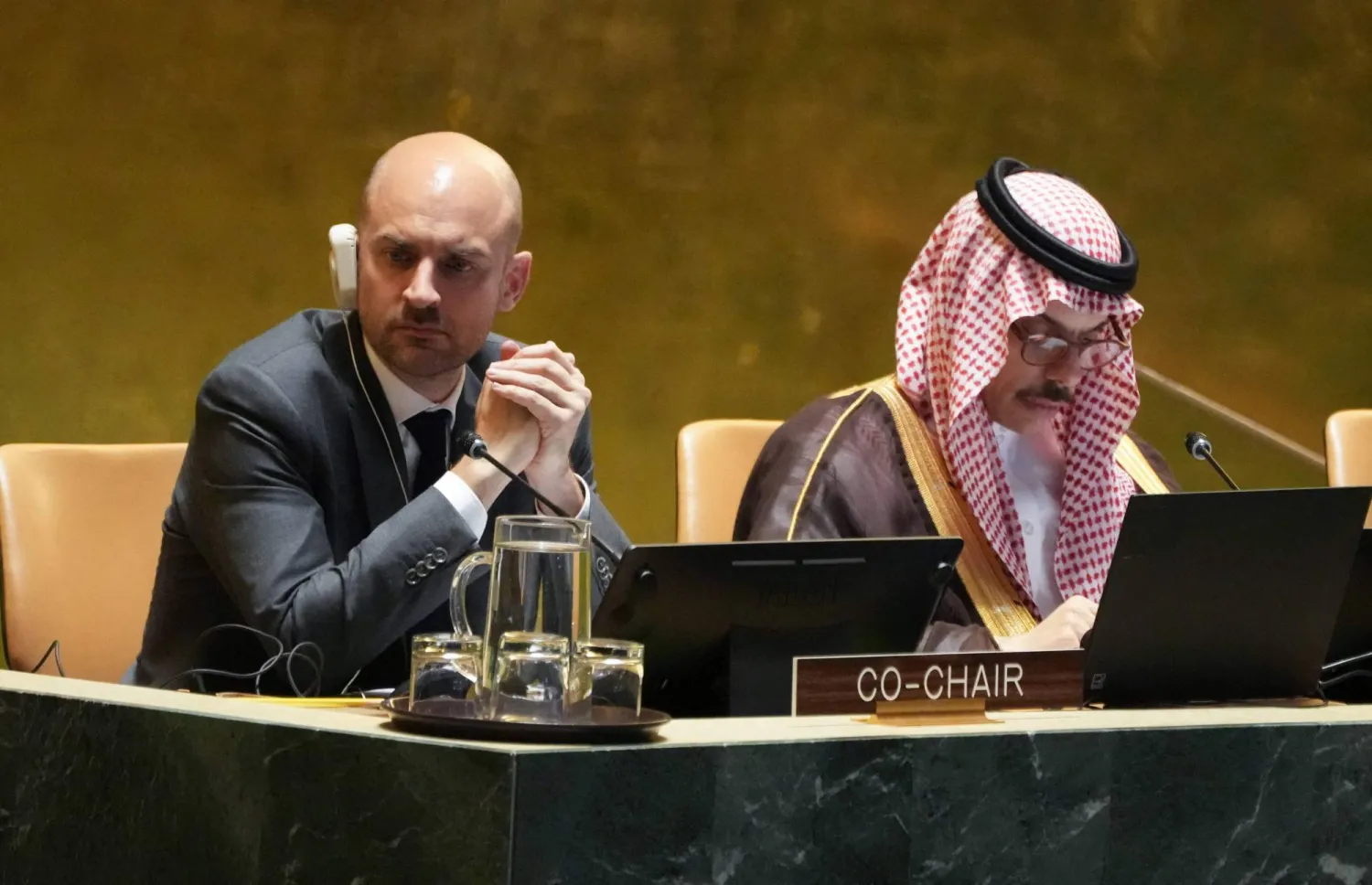
Co-chairs Saudi Foreign Minister Faisal bin Farhan Al-Saud (R) and French Foreign Minister Jean-Noel Barrot attend a conference on a two-state solution for Israel and the Palestinians at UN headquarters on July 28, 2025 in New York City. (Photo by TIMOTHY A. CLARY / AFP)
TT

New York Conference Sparks Political Push to Revive Two-State Solution

Co-chairs Saudi Foreign Minister Faisal bin Farhan Al-Saud (R) and French Foreign Minister Jean-Noel Barrot attend a conference on a two-state solution for Israel and the Palestinians at UN headquarters on July 28, 2025 in New York City. (Photo by TIMOTHY A. CLARY / AFP)

A Saudi-backed political initiative at the United Nations, held in coordination with France, has triggered renewed momentum for the two-state solution and spurred new pledges to recognize a Palestinian state, following Paris’s recent announcement of its intent to do so.

British Prime Minister Keir Starmer announced plans to follow French President Emmanuel Macron in recognizing Palestinian statehood as early as September, unless Israel takes tangible steps to improve the humanitarian situation in Gaza and engage in serious peace talks.

The announcement came after an emergency cabinet meeting in London and was reaffirmed by Foreign Secretary David Lammy during the conference in New York.

Facing mounting domestic and international pressure, Starmer warned that the UK would move ahead with recognition unless Israel halts its military campaign in Gaza, allows unimpeded humanitarian aid into the enclave, and commits to credible negotiations to end the Israeli-Palestinian conflict.

Recognition by the UK — historically tied to Israel’s creation through the 1917 Balfour Declaration — would mark a major diplomatic shift. It would make Britain the second G7 country, after France, to recognize a Palestinian state, and the fourth among the five permanent members of the UN Security Council to do so. It would also bolster a growing Western consensus, something Paris has been actively encouraging.

The New York conference’s closing statement, endorsed by 15 Western nations, called for recognizing Palestinian statehood as a key step toward a two-state solution. French Foreign Minister Jean-Noël Barrot described the move as “a geopolitical earthquake,” noting it was the first time such recognition was being considered collectively by Western powers.

The endorsing nations included Australia, Canada, Finland, France, Norway, Spain, Portugal, Ireland, Slovenia, Luxembourg, Malta, New Zealand, Iceland, San Marino, and Andorra. Malta has formally pledged recognition, while Canada, Finland, and Portugal are reportedly preparing to follow suit.

“We have recognized, expressed readiness, or hold a favorable view toward recognizing the State of Palestine as a crucial step toward a two-state solution,” the declaration read. “We call on all states that have not yet done so to join this effort.”

The document also outlined goals for post-war Gaza, including reconstruction, disarmament of Hamas, and the group’s exclusion from Palestinian governance — indicating a united Western vision for the day after the war.

Diplomacy Goes Viral

The tone of the joint statement reflects not only collective intent but also encouragement for others to act. Currently, 149 countries recognize the State of Palestine.

According to French diplomatic sources, Macron’s recent announcement served a dual purpose: to pressure hesitant European governments and give them time to align their positions ahead of a leaders' summit in New York, tentatively set for September 21.

France’s Foreign Ministry said Barrot told UN Secretary-General António Guterres that the recognition move was part of a broader political strategy backed by the conference — one that seeks to legitimize Palestinian statehood, normalize ties with Israel, reform Palestinian governance, and ensure Hamas’s disarmament and exclusion.

The closing section of the road map captures the core objective: “This is a historic opportunity. It is time for decisive, collective action to end the war, establish a Palestinian state, and secure peace and dignity for both peoples.”

Global Participation Defies Pressure

Despite Israeli and US pressure, the conference drew broad participation, with 125 countries and dozens of international and regional organizations — including the EU and Arab League — in attendance. More than 40 foreign ministers took part.

Macron’s decision to announce France’s plan to recognize Palestine during the high-level UN General Assembly week in September triggered a backlash at home. Critics warned it would be an empty gesture with little impact on the ground and could leave France diplomatically isolated, since no other major Western state had yet committed to a similar move.

Skeptics argued that the two-state solution had become a relic of the past due to political and military developments — and Israel’s outright rejection of a Palestinian state. Last year, the Israeli Knesset passed a resolution opposing Palestinian statehood, and just last week, it voted to urge the government to annex the West Bank, with 71 lawmakers in favor.

For many in Israel, recognizing Palestinian statehood equates to rewarding Hamas and terrorism, a stance frequently echoed by the government. Israeli officials have warned such moves undermine peace efforts and prolong the war in Gaza.

Yet, the opposite seems to have occurred.

Saudi-French Alliance Revives Two-State Vision

France and Saudi Arabia, co-sponsors of the conference, succeeded in reviving international focus on the two-state solution — long sidelined amid escalating violence and regional fragmentation.

In just two days, over two-thirds of UN member states turned their attention to a comprehensive road map, the product of weeks of work by eight co-chaired Arab and international working groups. The document offered actionable proposals on ending the conflict and steering the region toward security, economic integration, and humanitarian recovery.

Saudi Foreign Minister Prince Faisal bin Farhan described the seven-page final document as a “comprehensive, actionable framework for implementing the two-state solution and achieving peace and security for all.”

He urged states to endorse the document before the end of the 79th session of the General Assembly by notifying either the Saudi or French missions to the UN.


Israel Orders Gaza Families to Move in First Forced Evacuation Since Ceasefire

A Palestinian girl walks past the rubble of houses destroyed in Israeli strikes during the war, in Khan Younis, southern Gaza Strip, January 17, 2026. (Reuters)
TT

Israel Orders Gaza Families to Move in First Forced Evacuation Since Ceasefire

A Palestinian girl walks past the rubble of houses destroyed in Israeli strikes during the war, in Khan Younis, southern Gaza Strip, January 17, 2026. (Reuters)

Israeli forces have ordered dozens of Palestinian families in the southern Gaza Strip to leave their homes in the first forced evacuation since October's ceasefire, as residents and Hamas said on Tuesday the military was ​expanding the area under its control.

Residents of Bani Suhaila, east of Khan Younis, said the leaflets were dropped on Monday on families living in tent encampments in the Al-Reqeb neighborhood.

“Urgent message. The area is under Israeli army control. You must evacuate immediately,” said the leaflets, written in Arabic, Hebrew, and English, which the army dropped over the Al-Reqeb neighborhood in the town of Bani Suhaila.

In the two-year war before the US brokered ceasefire was signed in October, Israel dropped leaflets over areas that were subsequently raided or bombarded, forcing some families to move several times.

Residents and a source from the Hamas group said this was the first time they had been ‌dropped since then. ‌The Israeli military did not immediately respond to a request for comment.

SIDES FAR ‌APART ⁠ON ​NEXT PHASES

The ‌ceasefire has not progressed beyond its first phase, under which major fighting has stopped, Israel withdrew from less than half of Gaza, and Hamas released hostages in return for Palestinian detainees and prisoners.

Virtually the entire population of more than 2 million people are confined to around a third of Gaza's territory, mostly in makeshift tents and damaged buildings, where life has resumed under control of an administration led by Hamas.

Israel and Hamas have accused each other of major breaches of the ceasefire and remain far apart on the more difficult steps planned for the next phase.

Mahmoud, a resident from the ⁠Bani Suhaila area, who asked not to give his family name, said the evacuation orders impacted at least 70 families, living in tents and homes, ‌some of which were partially damaged, in the area.

"We have fled ‍the area and relocated westward. It is maybe the ‍fourth or fifth time the occupation expanded the yellow line since last month," he told Reuters by phone ‍from Khan Younis, referring to the line behind which Israel has withdrawn.

"Each time they move it around 120 to 150 meters (yards) inside the Palestinian-controlled territory, swallowing more land," the father-of-three said.

HAMAS CITES STATE OF HUMANITARIAN DISRUPTION

Ismail Al-Thawabta, director of the Hamas-run Gaza government media office, said the Israeli military had expanded the area under its control in eastern Khan Younis five times since ​the ceasefire, forcing the displacement of at least 9,000 people.

“On Monday, 19 January 2026, the Israeli occupation forces dropped warning leaflets demanding the forced evacuation of the Bani Suhaila area in eastern ⁠Khan Younis Governorate, in a measure that falls within a policy of intimidation and pressure on civilians,” Thawabta told Reuters.

He said the new evacuation orders affected approximately 3,000 people.

“The move created a state of humanitarian disruption, increased pressure on the already limited shelter areas, and further deepened the internal displacement crisis in the governorate,” Thawabta added.

Israel's military has previously said it has opened fire after identifying what it called "terrorists" crossing the yellow line and approaching its troops, posing an immediate threat to them.

It has continued to conduct air strikes and targeted operations across Gaza. The Israeli military has said it views "with utmost severity" any attempts by militant groups in Gaza to attack Israel.

Under future phases of the ceasefire that have yet to be hammered out, US President Donald Trump's plan envisages Hamas disarming, Israel pulling out further, and an internationally backed administration rebuilding Gaza.

More than 460 Palestinians and three Israeli soldiers have been reported killed since the ceasefire took ‌effect.

Israel launched its operations in Gaza in the wake of an attack by Hamas-led fighters in October 2023 which killed 1,200 people, according to Israeli tallies. Israel's assault has killed 71,000 people, according to health authorities in the enclave.


Syrian Interior Ministry: 120 ISIS Members Escape from Prison amid Clashes

Civilians cross a collapsed bridge linking Raqqa with its western countryside of Tabqa, northern Syria, 19 January 2026. EPA/AHMAD FALLAHA
TT

Syrian Interior Ministry: 120 ISIS Members Escape from Prison amid Clashes

Civilians cross a collapsed bridge linking Raqqa with its western countryside of Tabqa, northern Syria, 19 January 2026. EPA/AHMAD FALLAHA

Syria's ministry of interior said Tuesday that 120 ISIS members escaped from a prison in northeast Syria a day earlier, amid clashes between government forces and the Kurdish-led Syrian Democratic Forces, which guards the prison.

Security forces recaptured 81 of the escapees, “while intensive security efforts continue to pursue the remaining fugitives and take the necessary legal measures against them,” The Associated Press quoted the statement as saying.

The SDF and the government have traded blame over the escape at a prison in the town of Shaddadeh, amid the breakdown of a ceasefire deal between the two sides.

Also Tuesday, the SDF accused “Damascus-affiliated factions” of cutting off water supplies to the al-Aqtan prison near the city of Raqqa, which it called a “blatant violation of humanitarian standards.”

The SDF, the main US-backed force that fought ISIS in Syria, controls more than a dozen prisons in the northeast where some 9,000 ISIS members have been held for years without trial.

Under a deal announced Sunday, government forces were to take over control of the prisons from the SDF, but the transfer did not go smoothly.

On Monday, Syrian government forces and SDF fighters clashed around two prisons housing members of ISIS in Syria’s northeast.

The clashes came as SDF chief commander Mazloum Abdi was said to be in Damascus to attempt to solidify a ceasefire deal reached Sunday that ended days of deadly fighting during which government forces captured wide areas of northeast Syria from the SDF.

Abdi issued no statement after the meeting and the SDF later issued a statement calling for “all of our youth” to “join the ranks of the resistance," appearing to signal that the deal had fallen apart.

Interim President Ahmad al-Sharaa postponed a planned trip to Germany Tuesday amid the ongoing tensions in northeast Syria.


Egypt’s Sisi to Meet Trump on the Sidelines of Davos, Presidency Says

US President Donald Trump and Egyptian President Abdel Fattah al-Sisi meet ahead of a world leaders' summit on ending the Gaza war, amid a US-brokered prisoner-hostage swap and ceasefire deal between Israel and Hamas, in Sharm el-Sheikh, Egypt, October 13, 2025. (Reuters)
TT

Egypt’s Sisi to Meet Trump on the Sidelines of Davos, Presidency Says

US President Donald Trump and Egyptian President Abdel Fattah al-Sisi meet ahead of a world leaders' summit on ending the Gaza war, amid a US-brokered prisoner-hostage swap and ceasefire deal between Israel and Hamas, in Sharm el-Sheikh, Egypt, October 13, 2025. (Reuters)

Egypt's President Abdel ​Fattah al-Sisi will meet US President Donald Trump on the sidelines of the World Economic Forum in Davos, Egypt's presidency said on Tuesday.

This ‌will be ‌the first ‌meeting ⁠between ​the ‌two leaders since the US announced it was launching the second phase of its plan to end the war in Gaza.

Sisi and ⁠Trump met in the ‌Red Sea resort ‍of Sharm ‍el-Sheikh in October during a ‍summit convened by Egypt to sign a ceasefire deal aimed at ending the ​war.

On Friday, Trump said that he was also ⁠ready to restart US mediation between Egypt and Ethiopia to resolve the dispute over an Ethiopian dam, which both Egypt and Sudan consider a serious threat to vital water supplies.
