


'If the Baby Could Speak, She Would Scream': The Risky Measures to Feed Small Babies in Gaza

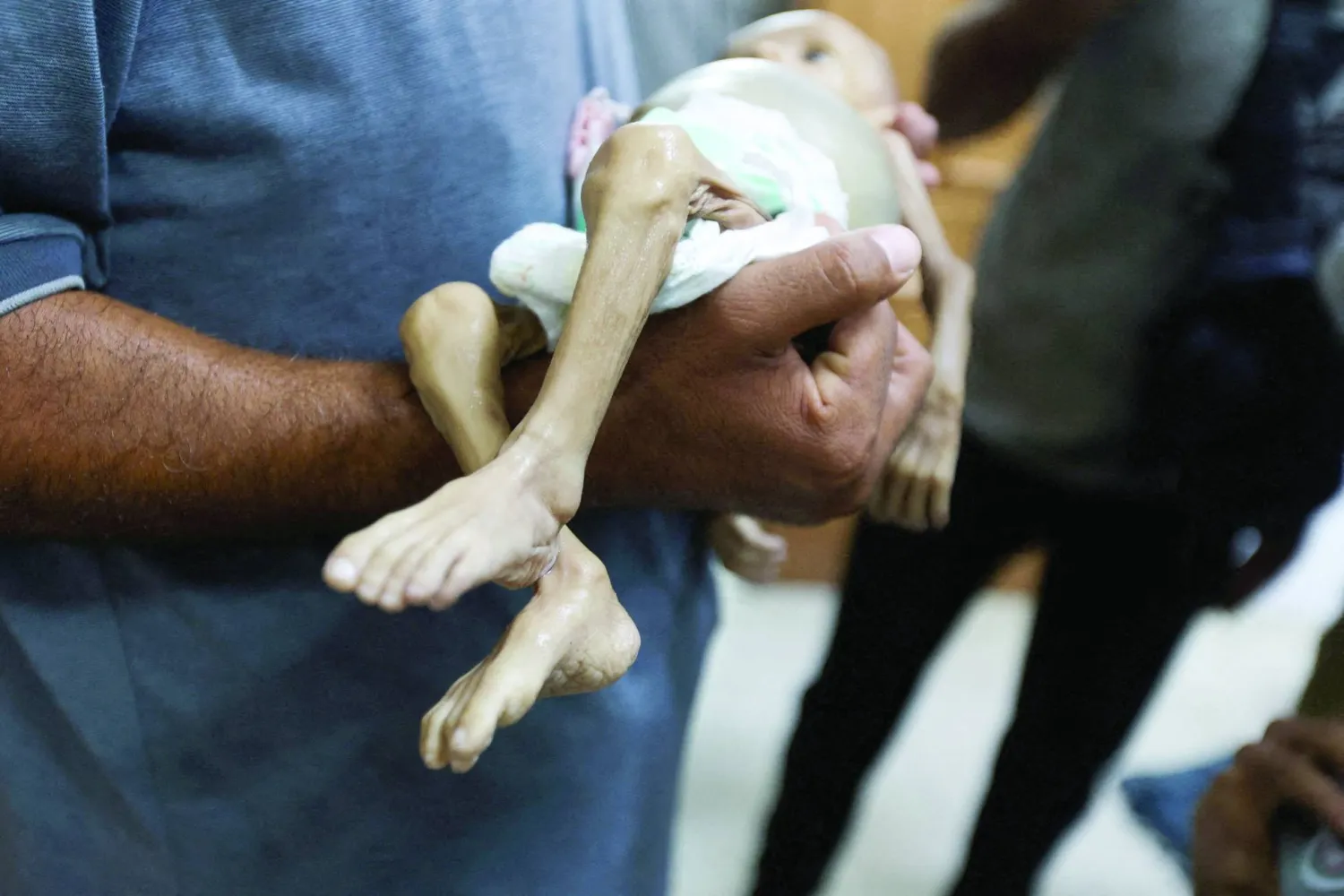
FILE PHOTO:  SENSITIVE MATERIAL. THIS IMAGE MAY OFFEND OR DISTURB    A man carries the body of Palestinian baby Zainab Abu Haleeb, who died due to malnutrition, according to health officials, at Nasser Hospital in Khan Younis, southern Gaza Strip, July 26, 2025. REUTERS/Ramadan Abed
FILE PHOTO: SENSITIVE MATERIAL. THIS IMAGE MAY OFFEND OR DISTURB A man carries the body of Palestinian baby Zainab Abu Haleeb, who died due to malnutrition, according to health officials, at Nasser Hospital in Khan Younis, southern Gaza Strip, July 26, 2025. REUTERS/Ramadan Abed
TT

'If the Baby Could Speak, She Would Scream': The Risky Measures to Feed Small Babies in Gaza

FILE PHOTO:  SENSITIVE MATERIAL. THIS IMAGE MAY OFFEND OR DISTURB    A man carries the body of Palestinian baby Zainab Abu Haleeb, who died due to malnutrition, according to health officials, at Nasser Hospital in Khan Younis, southern Gaza Strip, July 26, 2025. REUTERS/Ramadan Abed
FILE PHOTO: SENSITIVE MATERIAL. THIS IMAGE MAY OFFEND OR DISTURB A man carries the body of Palestinian baby Zainab Abu Haleeb, who died due to malnutrition, according to health officials, at Nasser Hospital in Khan Younis, southern Gaza Strip, July 26, 2025. REUTERS/Ramadan Abed

In a makeshift tent on a Gazan beach, three-month-old Muntaha's grandmother grinds up chickpeas into the tiniest granules she can to form a paste to feed the infant, knowing it will cause her to cry in pain, in a desperate race to keep the baby from starving.

"If the baby could speak, she would scream at us, asking what we are putting into her stomach," her aunt, Abir Hamouda said.

Muntaha grimaced and squirmed as her grandmother fed her the paste with a syringe, Reuters reported.

Muntaha's family is one of many in Gaza facing dire choices to try to feed babies, especially those below the age of six months who cannot process solid food.

Infant formula is scarce after a plummet in aid access to Gaza. Many women cannot breastfeed due to malnourishment, while other babies are separated from their mothers due to displacement, injury or, in Muntaha's case, death.

Her family says the baby's mother was hit by a bullet while pregnant, gave birth prematurely while unconscious in intensive care, and died a few weeks later. The director of the Shifa Hospital described such a case in a Facebook post on April 27, four days after Muntaha was born.

"I am terrified about the fate of the baby," said her grandmother, Nemah Hamouda. "We named her after her mother...hoping she can survive and live long, but we are so afraid, we hear children and adults die every day of hunger."

Muntaha now weighs about 3.5 kilograms, her family said, barely more than half of what a full-term baby her age would normally weigh. She suffers stomach problems like vomiting and diarrhoea after feeding.

Health officials, aid workers and Gazan families told Reuters many families are feeding infants herbs and tea boiled in water, or grinding up bread or sesame. Humanitarian agencies also reported cases of parents boiling leaves in water, eating animal feed and grinding sand into flour.

Feeding children solids too early can disrupt their nutrition, cause stomach problems, and risk choking, pediatric health experts say.

"It's a desperate move to compensate for the lack of food," said UNICEF spokesperson Salim Oweis. "When mothers can't breastfeed or provide proper infant formula they resort to grinding chickpeas, bread, rice, anything that they can get their hands on to feed their children... it is risking their health because these supplies are not made for infants to feed on."

BABY BOTTLES WITHOUT MILK

Gaza's spiraling humanitarian crisis prompted the main world hunger monitoring body on Tuesday to say a worst-case scenario of famine is unfolding and immediate action is needed to avoid widespread death. Images of emaciated Palestinian children have shocked the world.

Gazan health authorities have reported more and more people dying from hunger-related causes. The total so far stands at 154, among them 89 children, most of whom died in the last few weeks.

With the international furor over Gaza's ordeal growing, Israel announced steps over the weekend to ease aid access. But the UN World Food Program said on Tuesday it was still not getting the permissions it needed to deliver enough aid.

Israel and the US accuse the Hamas group of stealing aid - which the group deny - and the UN of failing to prevent it. The UN says it has not seen evidence of Hamas diverting much aid. Hamas accuses Israel of causing starvation and using aid as a weapon, which the Israeli government denies.

Humanitarian agencies say there is almost no infant formula left in Gaza. The cans available in the market cost over $100 – impossible to afford for families like Muntaha’s, whose father has been jobless since the war closed his falafel business and displaced the family from their home.

In the pediatric ward of Al-Aqsa Martyrs Hospital in the central Gaza city of Deir al-Balah, the infant formula supply is mostly depleted.

One mother showed how she poured thick tahini sesame paste into a bottle and mixed it with water.

"I am using this instead of milk, to compensate her for milk, but she won't drink it," said Azhar Imad, 31, the mother of four-month-old Joury.

"I also make her fenugreek, anise, caraway, any kind of herbs (mixed with water)," she said, panicked as she described how instead of nourishing her child, these attempts were making her sick.

Medical staff at the hospital spoke of helplessness, watching on as children's health deteriorated with no way to safely feed them.

"Now, children are being fed either water or ground hard legumes, and this is harmful for children in Gaza," said doctor Khalil Daqran.

"If the hunger continues ... within three or four days, if the child doesn't get access to milk immediately, then they will die," he said.



Turkey's PKK Says Will 'Not Abandon' Syrian Kurds

Kurdish children and their families fleeing a government advance through Kurdish-controlled areas arrive in the Kurdish Syrian city of Qamishli on January 19, 2026. (Photo by Delil SOULEIMAN / AFP)
TT

Turkey's PKK Says Will 'Not Abandon' Syrian Kurds

Kurdish children and their families fleeing a government advance through Kurdish-controlled areas arrive in the Kurdish Syrian city of Qamishli on January 19, 2026. (Photo by Delil SOULEIMAN / AFP)

Outlawed Kurdish militants in Türkiye will "never abandon" Kurds in Syria following an offensive by Damascus, a leader of the PKK armed group said, quoted by the Firat news agency Tuesday.

Syrian forces began an offensive nearly two weeks ago which pushed Kurdish-led SDF forces out of the northern city of Aleppo, and expanded over the weekend to push deep into territory that has been held by Kurdish forces for over a decade.

"You should know that we will not leave you alone. Whatever the cost, we will never leave you alone.. we as the entire Kurdish people and as the movement, will do whatever is necessary," Murat Karayilan of the Kurdistan Workers' Party (PKK) was quoted as saying by Firat.

A close ally of Syria's new leadership that overthrew Bashar al-Assad in December 2024, the Turkish government is simultaneously leading a drive to reach a settlement with the PKK -- listed as a terror group by Türkiye and its Western allies.

Karayilan said the Damascus-led offensive was an "attempt to nullify" the peace process in Türkiye.

"This decision by international powers to enable these attacks, will be a black mark for the US, the UK, Germany, France and other international coalition states," he said.

On Monday, at least 500 people rallied in Türkiye’s Kurdish-majority city of Diyarbakir against the Syrian offensive. Clashes erupted when police tried to break up the protest.

The pro-Kurdish DEM party, the third largest force in the Turkish parliament, called for a rally on Tuesday in the town of Nusaybin, located on the border with Syria.


Israel Begins Demolitions Inside UNRWA Headquarters in East Jerusalem

A photograph shows a demolished structure inside the headquarters of the United Nations Relief and Works Agency (UNRWA) in the Sheikh Jarrah neighborhood of Israeli-annexed east Jerusalem on January 20, 2026. (AFP)
TT

Israel Begins Demolitions Inside UNRWA Headquarters in East Jerusalem

A photograph shows a demolished structure inside the headquarters of the United Nations Relief and Works Agency (UNRWA) in the Sheikh Jarrah neighborhood of Israeli-annexed east Jerusalem on January 20, 2026. (AFP)

Israeli bulldozers began demolishing structures inside the headquarters of the UN agency for Palestinian refugees (UNRWA) in east Jerusalem on Tuesday, an AFP photographer saw, with the Israeli foreign ministry defending the move.

"UNRWA-Hamas had already ceased its operations at this site and no longer had any UN personnel or UN activity there. The compound does not enjoy any immunity and the seizure of this compound by Israeli authorities was carried out in accordance with both Israeli and international law," the foreign ministry said in a statement.

Israel has repeatedly accused UNRWA of providing cover for Hamas, claiming that some of its employees took part in the group's October 7, 2023 attack on Israel, which sparked the war in Gaza.


Hamas Leaders Prepare for 'Safe Exit' from Gaza, Amid Doubts Over Return

A Palestinian child is seen as fighters from Hamas’ Qassam Brigades search for the bodies of Israeli hostages in the Jabalia refugee camp in northern Gaza, last December. (EPA)
TT

Hamas Leaders Prepare for 'Safe Exit' from Gaza, Amid Doubts Over Return

A Palestinian child is seen as fighters from Hamas’ Qassam Brigades search for the bodies of Israeli hostages in the Jabalia refugee camp in northern Gaza, last December. (EPA)

Sources within Hamas in Gaza revealed that senior figures in the movement are preparing for a “safe exit” from the enclave following arrangements related to Gaza’s future under the second phase of the ceasefire agreement, which the United States announced had begun last week.

Three Hamas sources told Asharq Al-Awsat that several prominent political and military leaders who survived the war are preparing to leave the territory. One source said the departure would be voluntary and carried out under specific arrangements, with full coordination with the Hamas leadership abroad. Another source noted that other leaders, particularly military figures, categorically reject leaving Gaza under any circumstances.

Throughout nearly two years of war, Hamas officials have repeatedly stated their rejection of removing the movement’s leadership from the Strip.

The sources separately provided Asharq Al-Awsat with the names of several leaders believed likely to depart, though it is refraining from publishing them due to the inability to contact them promptly. Some of these figures were recently appointed to leadership positions in Hamas’ political bureau in Gaza as part of new organizational arrangements aimed at rebuilding and restructuring the movement.

According to the same sources, a number of former prisoners released in the 2011 exchange deal for Israeli soldier Gilad Shalit — who now oversee key portfolios within Hamas leadership — are expected to be among those traveling to Türkiye.

However, a senior Hamas leader based outside Gaza denied the reports, telling Asharq Al-Awsat that the issue of leaders leaving the Strip “has not been raised.”

Another source inside Gaza declined to comment, saying only that he had no knowledge of the matter.

Sources in Gaza said the exit would likely be “without return, at least for several years,” with those leaders likely to end up residing in several countries. Other sources said some leaders would leave temporarily to hold meetings in Egypt with security officials on critical issues related to Gaza’s governmental security forces and other key files, before returning to the Strip.

In September, Israeli Prime Minister Benjamin Netanyahu said in an interview with Fox News that Israel was considering providing safe passage for Hamas leaders to leave Gaza under certain conditions, as part of a plan being prepared by US President Donald Trump, which entered into force in October.

Israel’s public broadcaster reported that Hamas leaders would most likely head to Qatar or Türkiye if they left Gaza. Israel’s Channel 12 previously reported that Hamas officials told US officials they were prepared to accept a limited relocation of military leaders and some operatives from Gaza.

On Jan. 14, US envoy Steve Witkoff officially announced the launch of the second phase of the ceasefire, which includes Hamas relinquishing control of Gaza, establishing a Palestinian technocratic committee to administer the enclave, initiating a comprehensive disarmament process, and launching large-scale reconstruction projects.

Hamas welcomed the announcement, saying it had fulfilled all requirements for completing the first phase and moving to the second, while continuing discussions with mediators over options regarding its weapons and those of other Palestinian factions.