

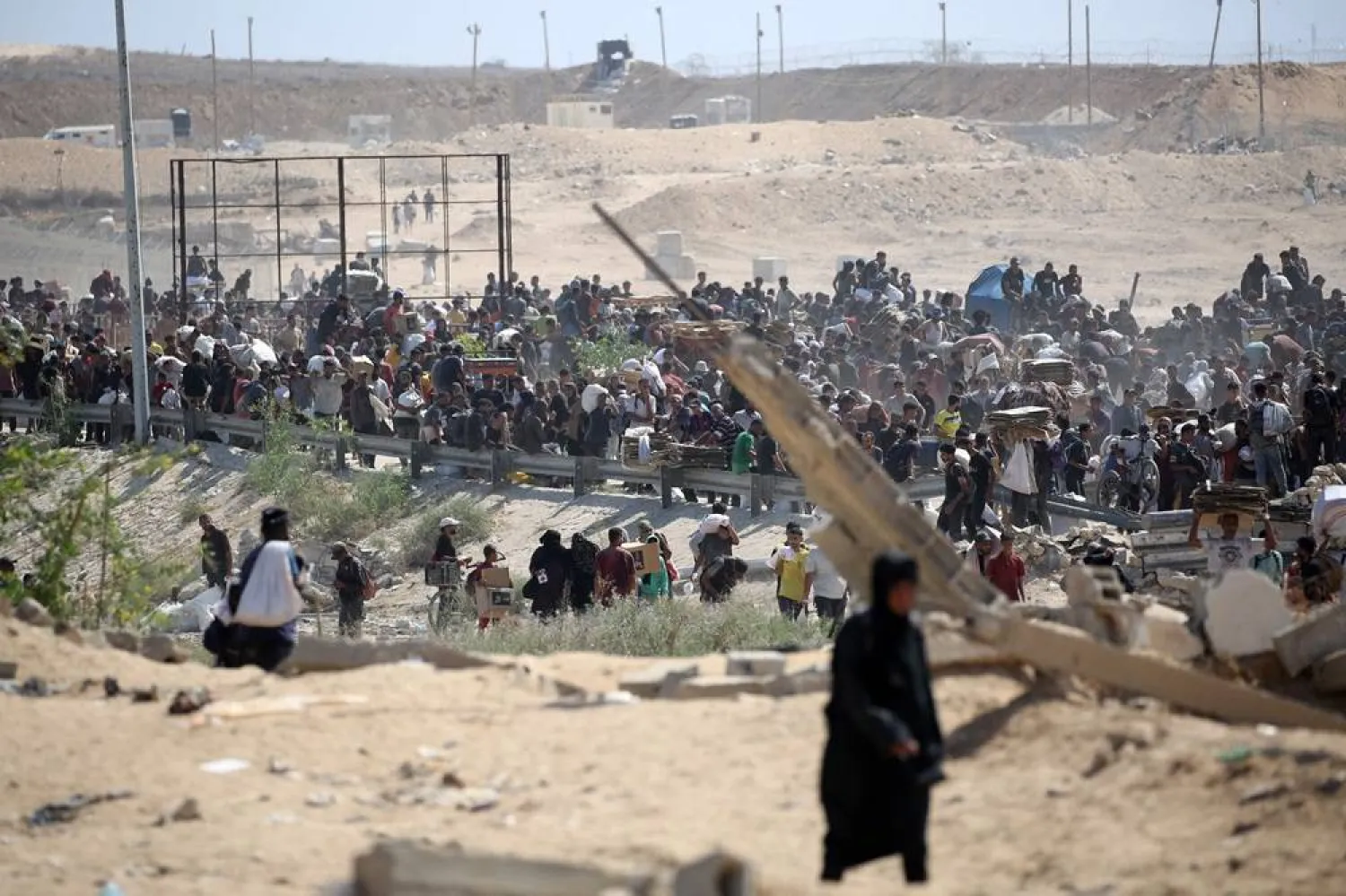

Israeli Forces Kills over 20 People Seeking Food in Gaza, Witnesses and Health Officials Say

Palestinians return with bags, boxes and wooden pallets from a food distribution point run by the US and Israeli-backed Gaza Humanitarian Foundation (GHF) group, near the Netsarim corridor in the central Gaza Strip on August 3, 2025. (AFP)
TT

Israeli Forces Kills over 20 People Seeking Food in Gaza, Witnesses and Health Officials Say

Palestinians return with bags, boxes and wooden pallets from a food distribution point run by the US and Israeli-backed Gaza Humanitarian Foundation (GHF) group, near the Netsarim corridor in the central Gaza Strip on August 3, 2025. (AFP)

Israeli forces killed at least 23 Palestinians seeking food on Sunday in the Gaza Strip, according to hospital officials and witnesses, who described facing gunfire as hungry crowds surged around aid sites as the malnutrition-related death toll surged.

Desperation has gripped the Palestinian territory of more than 2 million, which experts have warned is at risk of famine because of Israel’s blockade and nearly two-year offensive.

Yousef Abed, among the crowds en route to a distribution point, described coming under what he called indiscriminate fire, looking around and seeing at least three people bleeding on the ground.

“I couldn’t stop and help them because of the bullets,” he said.

Southern Gaza’s Nasser Hospital said they had received bodies from near multiple distribution sites, including eight from Teina, about three kilometers (1.8 miles) away from a distribution site in Khan Younis, which is operated by the Gaza Humanitarian Foundation, a private US and Israeli-backed contractor that took over aid distribution more than two months ago.

The hospital also received one body from Shakoush, an area hundreds of meters (yards) north of a different GHF site in Rafah. Another nine were also killed by troops near the Morag corridor, who were awaiting trucks entering Gaza through an Israeli border crossing, it said.

Three Palestinian eyewitnesses, seeking food in Teina and Morag, told The Associated Press the shootings occurred on the route to the distribution points, which are in military zones secured by Israeli forces. They said they saw soldiers open fire on hungry crowds advancing toward the troops.

Further north in central Gaza, hospital officials described a similar episode, with Israeli troops opening fire Sunday morning toward crowds of Palestinians trying to GHF’s fourth and northernmost distribution point.

“Troops were trying to prevent people from advancing. They opened fire and we fled. Some people were shot,” said Hamza Matter, one of the aid seekers.

At least five people were killed and 27 wounded at GHF’s site near Netzarim corridor, Awda Hospital said.

Eyewitnesses seeking food in the strip have reported similar gunfire attacks in recent days near aid distribution sites, leaving dozens of Palestinians dead.

The United Nations reported 859 people have been killed near GHF sites from May 27 to July 31 and that hundreds more have been slain along the routes of UN-led food convoys.

The GHF launched in May as Israel sought an alternative to the UN-run system, which had safely delivered aid for much of the war but was accused by Israel of allowing Hamas, which guarded convoys early in the war, to siphon supplies.

Israel has not offered evidence of widespread theft. The UN has denied it.

GHF says its armed contractors have only used pepper spray or fired warning shots to prevent deadly crowding. Israel’s military has said it only fires warning shots as well. Both claimed the death tolls have been exaggerated

Neither Israel’s military nor GHF immediately responded to questions about Sunday's reported fatalities.

Meanwhile, the Gaza health ministry also said six more Palestinian adults died of malnutrition-related causes in the Gaza Strip in the past 24 hours. This brings the death toll among Palestinian adults to 82 in the past five weeks since the ministry started counting deaths among adults in late June, it said.

Ninety-three children have also died of causes related to malnutrition since the war in Gaza started in 2023, the ministry said.

The war began when Hamas attacked southern Israel on Oct. 7, 2023, killing about 1,200 people, and abducted another 251. They are still holding 50 captives, around 20 believed to be alive, after most of the rest were released in ceasefires or other deals. Israel’s retaliatory military offensive has killed more than 60,400 Palestinians, according to Gaza’s Health Ministry.

The ministry, which doesn’t distinguish between civilians and combatants in its count, is staffed by medical professionals. The United Nations and other independent experts view its figures as the most reliable count of casualties. Israel has disputed its figures, but hasn’t provided its own account of casualties.



Lebanon's LF Urges State to Clarify Circumstances of Party Member’s Killing

Citizens call for uncovering the truth behind the killing of Elias al-Hasrouni in the town of Ain Ebel in South Lebanon in 2023 (File photo – Al-Markazia).
TT

Lebanon's LF Urges State to Clarify Circumstances of Party Member’s Killing

Citizens call for uncovering the truth behind the killing of Elias al-Hasrouni in the town of Ain Ebel in South Lebanon in 2023 (File photo – Al-Markazia).

The Lebanese Forces (LF) has called on the Lebanese state to clarify the circumstances surrounding the 2023 killing of party member Elias al-Hasrouni, after Israel announced that Hezbollah was responsible for his assassination.

Party sources told Asharq Al-Awsat that the claim “must be confirmed or denied by the Lebanese state, as al-Hasrouni was a Lebanese citizen.”
 
The Israeli military said Friday that Hezbollah killed al-Hasrouni in August 2023, a death initially reported as a traffic accident.

LF sources said the state’s security agencies were forced to verify the new information, noting that the party had demanded an investigation from the outset.

They argued that the inquiry stalled because “Hezbollah prevented the judicial process from reaching a conclusion,” despite what they described as strong indications of the group’s involvement.
 
They added that Israel’s announcement now compels the state to issue a clear position confirming or denying the claim, or declaring that investigations are ongoing.

“Al-Hasrouni was a Lebanese citizen, and it is the state’s responsibility to expose his killers and secure justice,” the sources said.
 
Elias al-Hasrouni, 72, was a senior member of the Lebanese Forces, led by Samir Geagea. His body was found on Aug. 2, 2023 in Ain Ebel, a Christian-majority village in southern Lebanon, which is a Hezbollah is stronghold.
 
Local media initially reported that al-Hasrouni had died in a car crash. Days later, the Lebanese Forces said he had been abducted, beaten, and killed before his body was placed back in his car.
 
On Aug. 20, 2023, Geagea insisted that Hezbollah was behind his death, saying: “Our comrade was murdered; he did not die in an accident.”

In September, Geagea said repeated inquiries to security agencies produced one answer: the investigation could not advance because authorities were “being prevented” from doing so.
 
Israeli army spokesperson Avichay Adraee said on X that al-Hasrouni, “known for his strong opposition to Hezbollah,” was assassinated by Unit 121, which he described as Hezbollah’s special operations and internal security arm.
 
According to Adraee, members of the unit ambushed al-Hasrouni near his home on the night of Aug. 1, 2023, abducted him, and killed him by poisoning and breaking his ribs. They then placed his body in his car and staged a crash to conceal the operation.
 
Adraee added that Unit 121 conducts assassinations targeting journalists, officers, politicians, and other critics of Hezbollah. He also noted that Salim Ayyash, identified as the unit’s commander, was convicted in 2020 by the UN-backed Special Tribunal for Lebanon for leading the team that assassinated former Prime Minister Rafik Hariri.


Lebanon: Berri Asks Political Parties to Unite Against Israeli Violations, Schemes

Speaker Nabih Berri meets with the Council of the Order of Press Editors led by Joseph Kossaifi in Ain El-Tineh. (Parliament Office)
TT

Lebanon: Berri Asks Political Parties to Unite Against Israeli Violations, Schemes

Speaker Nabih Berri meets with the Council of the Order of Press Editors led by Joseph Kossaifi in Ain El-Tineh. (Parliament Office)

Speaker Nabih Berri on Saturday called on political parties to show unity against ongoing Israeli violations, and expressed surprise at the absence of a unified stance.

“What is neither understandable nor justifiable is that the Lebanese people do not have a unified stance regarding what Israel has done and is doing, and what it intends to do to Lebanon and the Lebanese people,” Berri said during a meeting with the Council of the Order of Press Editors led by Joseph Kossaifi in Ain El-Tineh.

“Give me unity, and then Lebanon will have nothing to fear, no matter the challenges and from whatever direction they come from,” he noted.

“Lebanon has done everything required regarding the ceasefire agreement in southern Litani, where the Lebanese army has deployed more than 9,000 soldiers and is carrying out its full duties in this area.”

“But, where and when has Israel adhered to a single clause of this agreement?” he asked. “This is the aggressive nature of Israel.”

Asked about Israeli claims that Hezbollah is rebuilding and reorganizing its structure, Berri said: “It is entirely normal for any party, movement, or political entity to rebuild and reorganize itself. After the Israeli aggression, Hezbollah is fully entitled to do so.”

As for allegations of weapons smuggling by sea, land, or air, they are false and baseless, he noted.

On the renewed Saudi and Arab engagement with Lebanon, the Speaker said: “Lebanon belongs to all Arabs. Our hand has always been, and remains, extended to all our Arab brothers.”

Berri affirmed that his relationship with Saudi Arabia has never been severed.

The Speaker revealed that for over 12 years, some parties have been inciting Washington to impose sanctions on him. “So be it,” he said.

Berri also stressed that parliamentary elections scheduled for May 2026 will be held on schedule, with no postponement or extension, and that there is absolutely no fear of internal strife.

He said the electoral law is a fundamental issue mentioned four times in the Constitution, and that such law can only be reached through consensus.

While the majority of Lebanon’s political parties have kicked off their preparations for next year's parliamentary elections, debate continues to rage over how many MPs expatriates will be able to vote for.

During the 2022 elections, the expats were able to cast their vote for 128 candidates, while their options for the 2026 elections are being limited to six.

Asked about the depositors' funds and what is expected from the Parliament in terms of legislation, Berri assured that “deposits are sacred,” and that “no law that undermines anyone's deposit can pass.”


Gaza Stabilization Force: Will UN Talks Yield a Breakthrough?

Palestinians amid rubble of destroyed buildings in Jabalia, northern Gaza Strip (AFP)
TT

Gaza Stabilization Force: Will UN Talks Yield a Breakthrough?

Palestinians amid rubble of destroyed buildings in Jabalia, northern Gaza Strip (AFP)

New developments have emerged in UN Security Council consultations on deploying a “stabilization force in the Gaza Strip,” after Arab and Islamic states signaled support for a US draft resolution, a day after Moscow circulated a similar proposal, amid fears that the effort could collapse under a Russian or Chinese veto.

Experts told Asharq Al-Awsat that the Arab-Islamic backing, which followed Egyptian talks with Palestine, Pakistan and the United States over the text expected to be put to a vote on Monday, is likely to remain suspended between a potential breakthrough driven by Arab-Islamic alignment with Washington’s proposal and the chance of winning Russian support, and a possible collapse if Moscow rejects any US influence and seeks to use the issue as a bargaining chip in the Russia–Ukraine crisis.

The second phase of the Gaza ceasefire agreement, which has yet to begin, includes establishing an international security force in Gaza, disarming Hamas, an additional Israeli withdrawal from the Strip and the appointment of an administration to run the territory.

A source familiar with the talks told Asharq Al-Awsat that the Arab-Islamic group “leaned toward supporting the US draft because Washington is the only party capable of enforcing its resolution on the ground and pressuring Israel to implement it.”

The source said there is “firm American intent to deploy forces soon, even if that requires sending a multinational force should Moscow use its veto.”

Egyptian Foreign Minister Badr Abdelatty discussed the draft resolution on Saturday in separate phone calls with his Pakistani counterpart Ishaq Dar and Palestinian Vice President Hussein al-Sheikh, according to two statements from the Egyptian Foreign Ministry.

The United States, Saudi Arabia, Qatar, Egypt, the United Arab Emirates, Indonesia, Pakistan, Jordan and Türkiye said in a joint statement on Friday that they “jointly support” the US resolution, which would authorize the creation of an international stabilization force, among other provisions. They expressed hope it would be adopted “swiftly.”

The diplomatic activity comes ahead of Monday’s Security Council vote on the draft, which has been under discussion for about a week, diplomatic sources told Agence France Presse on Friday.

The resolution would allow member states to form a “temporary international stabilization force” working with Israel, Egypt and newly trained Palestinian police to help secure border areas and remove weapons from Gaza. Unlike earlier drafts, it also refers to the possibility of a future Palestinian state, according to the AFP report.

Ambassador Mohamed Orabi, former Egyptian foreign minister and head of the Egyptian Council for Foreign Affairs, said the draft “faces difficulties,” adding that he hoped it would not “cement the division of the Strip.”

He noted that Arab support grew after US amendments that included moving toward a political track for the establishment of a Palestinian state.

Palestinian political analyst Dr. Ayman al-Raqab said the Arab-Islamic group’s support for the US draft, despite a competing Russian proposal, suggests the possibility of understandings and amendments, including references to future talks on a Palestinian state. He described the development as a cautious opening, given the continued risk of a Russian veto.

The US proposal challenges a rival Russian draft circulated to Council members on Thursday.

According to the text seen by AFP on Friday, the Russian draft does not call for establishing a peace council or for the immediate deployment of an international force in Gaza. It welcomes the initiative that led to the ceasefire.

The Russian resolution calls on the UN secretary-general to “identify options for implementing the provisions” of the peace plan and to report immediately, including on the feasibility of deploying an international stabilization force in Gaza.

US Ambassador to the United Nations Mike Waltz wrote in The Washington Post that any refusal to support this resolution is a vote to continue Hamas rule or to return to war with Israel, condemning the region and its people to perpetual conflict.

He added that any deviation from this path, whether by those seeking to play political games or revive the past, will come at a real human cost.

Obstacles may not come from a Russian veto alone.

According to Yedioth Ahronoth on Friday, key elements alarming Israel in the latest draft include language paving the way toward “Palestinian self-determination,” an expanded UN role in overseeing aid distribution and broader powers for the proposed “transitional governing authority” for Gaza.

Security Council resolutions require at least nine votes in favor and no veto from Russia, China, the United States, Britain or France.

Orabi said the Russian draft is more aligned with Palestinian aspirations but ultimately cannot compel Israel to implement anything.

He predicted that despite efforts to secure a UN mandate, Russia may veto the US text and China may abstain as part of broader tensions with Washington, prompting the United States to move toward deploying a multinational force.

Such an approach, he said, aligns with Israel’s preference to avoid implementing UN resolutions.

Al-Raqab said that if Moscow insists on using its veto to block any US influence or to employ the proposal as leverage in the Ukraine crisis, Washington would move immediately to create a multinational force without Security Council authorization.