


Israeli Security Officials Object to ‘Gaza Occupation’ Plan

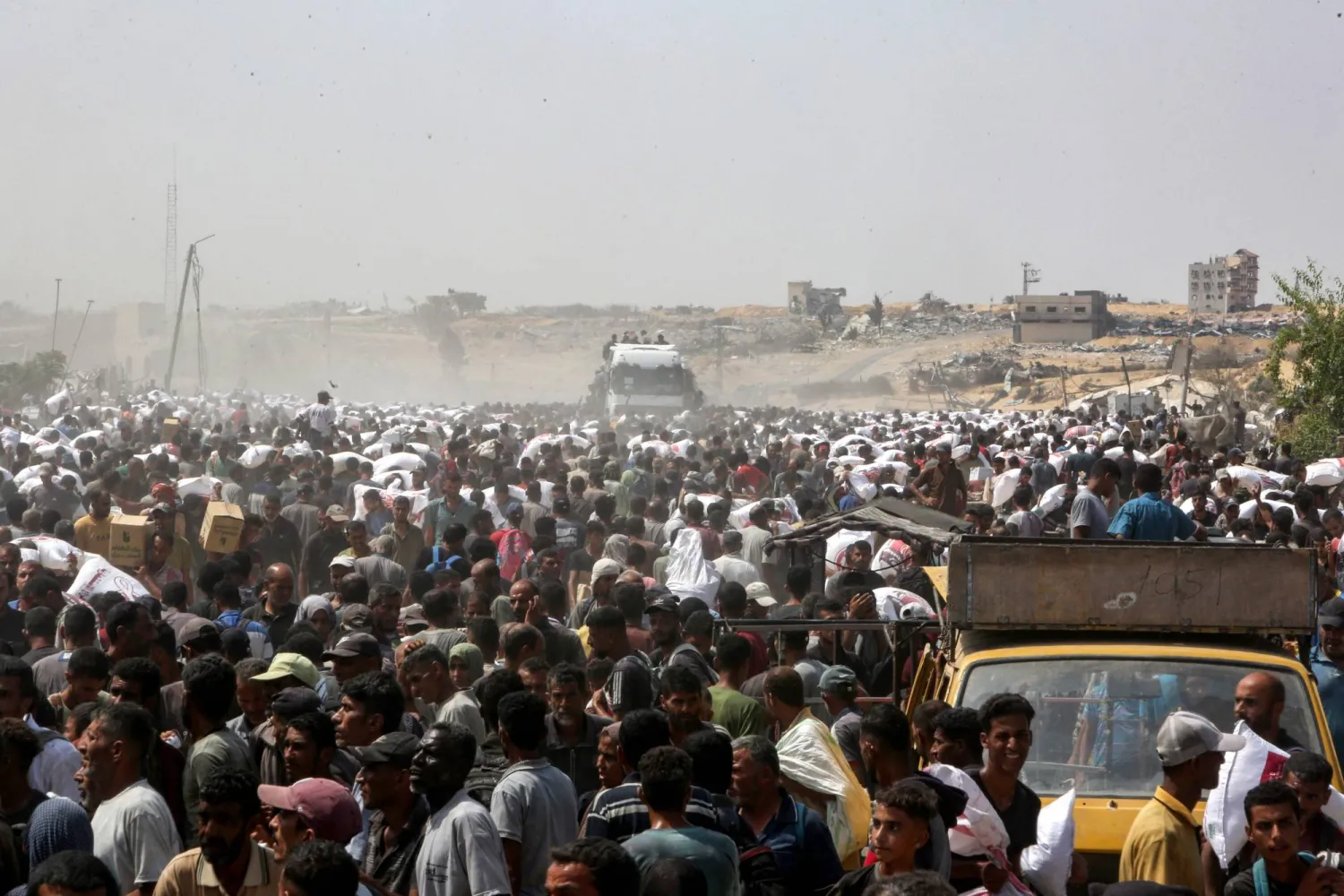
Displaced Palestinians carry food parcels as they raid trucks carrying humanitarian aid in Khan Yunis, in the southern Gaza Strip on August 9, 2025. (Photo by AFP)
TT

Israeli Security Officials Object to ‘Gaza Occupation’ Plan

Displaced Palestinians carry food parcels as they raid trucks carrying humanitarian aid in Khan Yunis, in the southern Gaza Strip on August 9, 2025. (Photo by AFP)

During a heated 10-hour cabinet meeting on Thursday, several security chiefs in Israel rejected Prime Minister Benjamin Netanyahu’s plan to occupy Gaza, the Israeli newspaper Yedioth Ahronoth reported on Saturday.

The newspaper said the objections were made by Israeli Army Chief of Staff Eyal Zamir and several senior security officials, including National Security Council head Tzachi Hanegbi, Mossad chief David Barnea and Maj. Gen. Nitzan Alon, a key negotiator in the hostage recovery efforts.

The officials argued for “safer and more suitable alternatives.” They also cautioned that the move would “greatly endanger” Israeli captives in Gaza and harm prospects for a deal with Hamas. When Netanyahu was not convinced, the government voted on a plan to gradually take control of Gaza City in the first place, while moving on later to other phases, and to provide humanitarian aid to the civilian population outside combat zones.

At the meeting, Hanegbi said: “I don’t understand how someone who has watched the videos of Evyatar and Rom, and all those released before them, can support the statement 'all or nothing.' That means giving up the chance to rescue at least 10 hostages immediately, because Hamas won’t respond to that demand.”

Hanegbi backed Zamir, who expressed his firm opposition to Netanyahu’s proposal. “I fully agree with the chief of staff that taking control of Gaza City jeopardizes the lives of the hostages, which is why I oppose the prime minister's proposal,” he said.

Despite the objection of senior security officials, Yedioth Ahronoth said the Security Cabinet voted early Friday to approve the plan for a full takeover of Gaza City.

Germany, the UK, Australia and other countries have rejected the decision of the Israeli security cabinet to launch an additional large-scale military operation in Gaza.

The newspaper said that the German government decision to not approve any exports to Israel of military equipment that could be used in the Gaza Strip until further notice, marks a significant shift for one of Israel’s staunchest allies in Europe.

Security sources told the Yedioth Ahronoth news site that the Israeli cabinet did not use the word “occupy,” and instead referred to “taking over,” due to legal reasons pertaining to Israel’s responsibility for civilian matters in Gaza.

Families of hostages held in Gaza called for a general strike on Saturday and urged the public to join their effort to save their loved ones and bring them back home.

The families said the government has given up on the hostages.

In a related development, the Palestinian presidency condemned Netanyahu's announcement that Israel intends to seize full control of Gaza.

Presidential spokesperson Nabil Abu Rudeineh warned that Israel's policies, including the reoccupation of Gaza, attempts to annex the West Bank, and the Judaization of Jerusalem, will close all doors to achieving security and stability both regionally and globally.

He denounced Israel's rejection of international criticism and warnings from world powers regarding the escalation of war against the Palestinian people, describing such actions as an unprecedented challenge and provocation to the international will to achieve peace and stability in accordance with the resolutions of international legitimacy and international law, embodied in the New York Declaration and successive recognitions of the State of Palestine.

“The Gaza Strip is an integral part of the State of Palestine, just like Jerusalem and the West Bank. Without it, there will be no Palestinian state,” the spokesperson said.

He further called on the international community, led by the UN Security Council, to urgently compel the occupying state to cease its aggression, allow the entry of aid, and work diligently to enable the State of Palestine to assume its full responsibilities in the Gaza Strip.

Abu Rudeineh also called on the US administration to assume its responsibilities by preventing Israel from expanding the war and halting colonist terrorism in the West Bank, in order to achieve security and stability in the region.



UN Says It Risks Halting Somalia Aid Due to Funding Cuts 

A Somali trader marks watermelons for sale at an open-air grocery market as Muslims start the fasting month of Ramadan, the holiest month in the Islamic calendar, within Bakara market in Mogadishu, Somalia, February 18, 2026. (Reuters)
TT

UN Says It Risks Halting Somalia Aid Due to Funding Cuts 

A Somali trader marks watermelons for sale at an open-air grocery market as Muslims start the fasting month of Ramadan, the holiest month in the Islamic calendar, within Bakara market in Mogadishu, Somalia, February 18, 2026. (Reuters)

The UN's World Food Program (WFP) warned Friday it would have to stop humanitarian assistance in Somalia by April if it did not receive new funding.

The Rome-based agency said it had already been forced to reduce the number of people receiving emergency food assistance from 2.2 million in early 2025 to just over 600,000 today.

"Without immediate funding, WFP will be forced to halt humanitarian assistance by April," it said in a statement.

In early January, the United States suspended aid to Somalia over reports of theft and government interference, following the destruction of a US-funded WFP warehouse in the capital Mogadishu's port.

The US announced a resumption of WFP food distribution on January 29.

However, all UN agencies have warned of serious funding shortfalls since Washington began slashing aid across the world following President Donald Trump's return to the White House last year.

"The situation is deteriorating at an alarming rate," said Ross Smith, WFP Director of Emergency Preparedness and Response, in Friday's statement.

"Families have lost everything, and many are already being pushed to the brink. Without immediate emergency food support, conditions will worsen quickly.

"We are at the cusp of a decisive moment; without urgent action, we may be unable to reach the most vulnerable in time, most of them women and children."

Some 4.4 million people in Somalia are facing crisis-levels of food insecurity, according to the WFP, the largest humanitarian agency in the country.

The Horn of Africa country has been plagued by conflict and also suffered two consecutive failed rainy seasons.


Hamas Says Path for Gaza Must Begin with End to ‘Aggression’ 

Makeshift tents of displaced Palestinian families among the ruins of their homes at sunset during the holy month of Ramadan in Jabaliya northern Gaza Strip on, 19 February 2026. (EPA)
TT

Hamas Says Path for Gaza Must Begin with End to ‘Aggression’ 

Makeshift tents of displaced Palestinian families among the ruins of their homes at sunset during the holy month of Ramadan in Jabaliya northern Gaza Strip on, 19 February 2026. (EPA)

Discussions on Gaza's future must begin with a total halt to Israeli "aggression", the Palestinian movement Hamas said after US President Donald Trump's Board of Peace met for the first time.

"Any political process or any arrangement under discussion concerning the Gaza Strip and the future of our Palestinian people must start with the total halt of aggression, the lifting of the blockade, and the guarantee of our people's legitimate national rights, first and foremost their right to freedom and self-determination," Hamas said in a statement Thursday.

Trump's board met for its inaugural session in Washington on Thursday, with a number of countries pledging money and personnel to rebuild the Palestinian territory, more than four months into a fragile ceasefire between Israel and Hamas.

Israeli Prime Minister Benjamin Netanyahu has insisted however that Hamas must disarm before any reconstruction begins.

"We agreed with our ally the US that there will be no reconstruction of Gaza before the demilitarization of Gaza," Netanyahu said.

The Israeli leader did not attend the Washington meeting but was represented by his foreign minister Gideon Saar.

Trump said several countries had pledged more than seven billion dollars to rebuild the territory.

Muslim-majority Indonesia will take a deputy commander role in a nascent International Stabilization Force, the unit's American chief Major General Jasper Jeffers said.

Trump, whose plan for Gaza was endorsed by the UN Security Council in November, also said five countries had committed to providing troops, including Morocco, Kazakhstan, Kosovo and Albania.


Official Contacts Aim to Keep Lebanon out of War on Iran as Israel Raises Readiness on Northern Front 

This photograph shows a memorial for slain Lebanese Hezbollah longtime leader Hassan Nasrallah at the entrance of the southern village of Qannarit on February 16, 2026. (AFP)
TT

Official Contacts Aim to Keep Lebanon out of War on Iran as Israel Raises Readiness on Northern Front 

This photograph shows a memorial for slain Lebanese Hezbollah longtime leader Hassan Nasrallah at the entrance of the southern village of Qannarit on February 16, 2026. (AFP)

Israel has raised the alert level of its military along the border with Lebanon, raising questions that Lebanon’s south may again be involved in a regional confrontation should the US attack Iran.

Given the heightened tensions between the US and Iran, questions have been asked over whether Hezbollah will become involved in a new war. Its Secretary-General Sheikh Naim Qassem had recently announced that the party will not remain on the side if Iran is attacked.

On the ground, Israel blew up houses in southern Lebanon border towns and carried out air strikes in the south. Israeli military spokesman Avichay Adraee said the raids targeted “Hezbollah infrastructure,” including arms caches and rocket launchers.

Their presence in the south is a violation of current agreements, he added.

Amid the high regional tensions, Israel’s Maariv quoted a military source as saying that the army has come up with plans, including a preemptive strike against Hezbollah, which would drag the south and the whole of Lebanon into a new war.

Ministerial sources told Asharq Al-Awsat that the presidency has been carrying out internal and foreign contacts since Thursday morning to keep Lebanon out of any escalation.

Hezbollah had launched a “support front” war against Israel a day after Hamas’ October 7, 2023 attack. In 2024, the war spiraled into an all-out conflict, with Israel decimating the Hezbollah leadership and severely weakening the party.

Israel believes that Hezbollah has been rebuilding its capabilities since the ceasefire that was struck in November 2024.

Kassim Kassir, a political analyst who is close to Hezbollah, told Asharq Al-Awsat: “No one knows what Hezbollah will do because the situation is tied the extent of the attack, should it happen.”

He noted that Qassem was ambiguous when he said the party will decide what to do when the time is right, but at any rate, he stressed that the party will not remain on the sidelines or abandon Iran.

“No one knows what Hezbollah’s abilities are, so everything is possible,” Kassir said.

Riad Kahwaji, a security and defense affairs expert, said he does not rule out the possibility that Hezbollah would join the war should the US attack Iran.

Speaking to Asharq Al-Awsat, he stressed that Iran is now the United States’ main target, when previously it used to confront its proxies.

It has now taken the fight directly to the heart of the problem, which is the Iranian regime, he remarked.

The extent of the military mobilization in the region and the frequent American statements about regime change all indicate that a major military operation may be imminent, he added.

Israel’s military also favors preemptive operations, so it is watching Hezbollah, which remains Iran’s most powerful regional proxy despite the blows it received in 2024 war, Kahwaji said.

Hezbollah still possesses a rocket arsenal that can threaten Israel, he remarked.

Israel’s high level of alert on the border with Lebanon could be in readiness for any development. Should Tel Aviv receive word from Washington that it intends to attack Iran, then it could launch operations against Hezbollah as part of preemptive strikes aimed at preventing the party from launching attacks against it, Kahwaji said.

“As long as Hezbollah possesses heavy weapons, such as rockets, and drones, that it has not handed over to the army, then Lebanon will continue to be vulnerable to attacks in the next confrontation. It will be exposed to Israeli strikes as long as this issue remains unresolved,” he added.