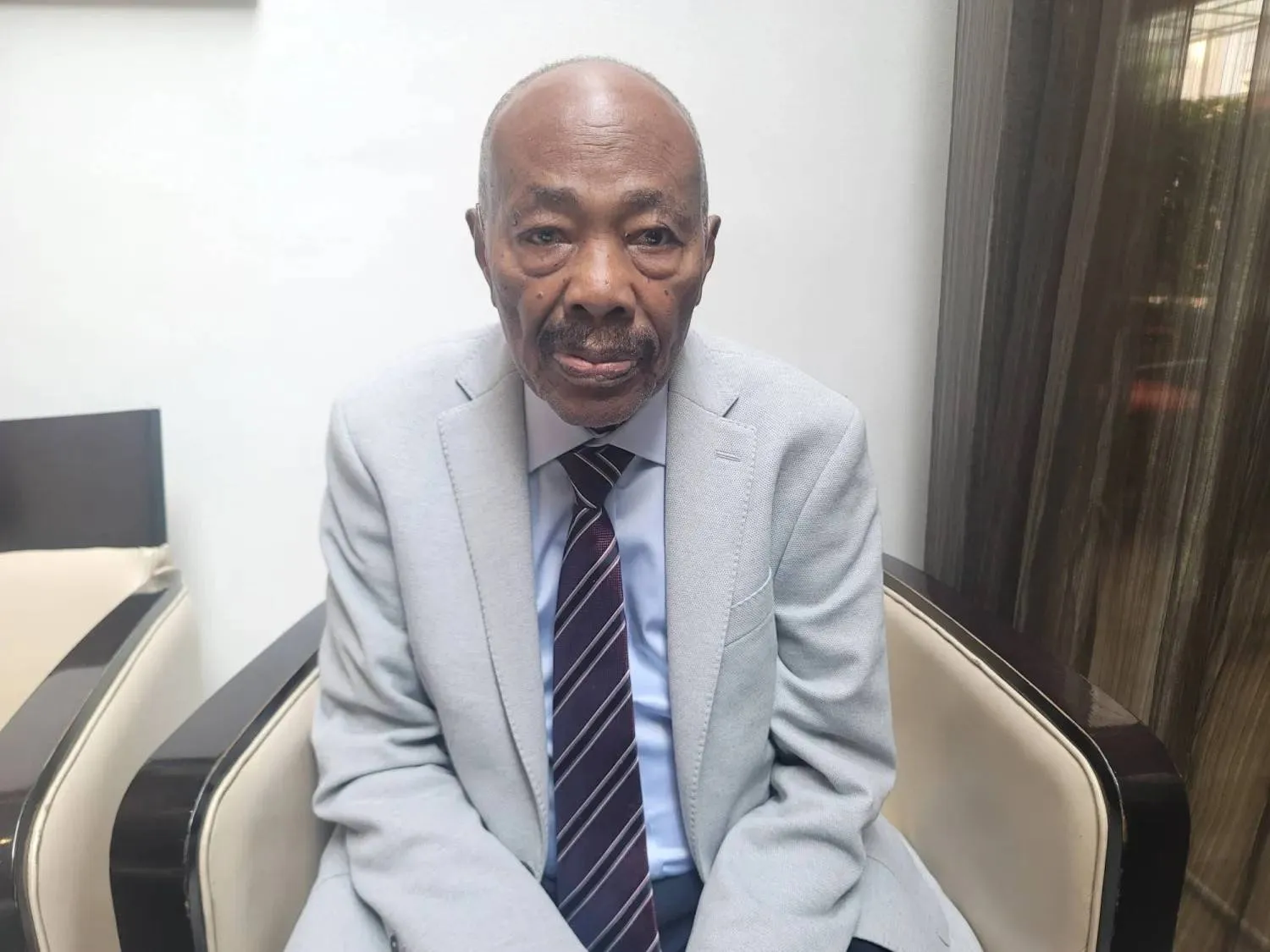

Sudan’s “Founding Sudan Alliance” and the paramilitary Rapid Support Forces (RSF) will not negotiate with the Islamist movement or its affiliates, but will only engage with the Sudanese army, Umma Party leader Fadlallah Burma Nasser said, stressing that the 22-month war would end only through a combination of military and political action.
“The basic condition for talks with the army is to exclude the Islamists who ignited this war,” Nasser told Asharq Al-Awsat in an interview in Nairobi.
“They cannot be rewarded for the crimes they committed against the Sudanese people by allowing them to join negotiations,” he said, adding that any settlement must incorporate the Founding Alliance’s political charter and draft transitional constitution.
Nasser, a retired general whose Umma Party is one of Sudan’s largest, described the conflict that erupted on April 15, 2023 as “unprecedented,” saying its toll had surpassed that of Sudan’s longest civil wars – the first and second southern wars and the Darfur conflict – combined. “All those wars together did not cause the destruction we are witnessing today,” he said.
Citing a previous statement by Ibrahim Ghandour, a senior figure in the now-banned National Congress Party, Nasser accused the Islamist movement of triggering the conflict by attacking an RSF base in Khartoum and killing more than 4,000 fighters in Omdurman’s al-Merkhiat camp.
Nasser said the war would only stop if “a rifle faces a rifle” alongside a political campaign to mobilize regional, international and domestic support. Without that, he warned, the fighting would continue until one side is defeated.
He recalled that former prime minister Abdalla Hamdok, then head of the now-defunct “Tagadom” coalition, had written to army chief Abdel Fattah al-Burhan and RSF commander Mohamed Hamdan Dagalo (Hemedti) urging a ceasefire.
Hemedti signed the Addis Ababa Declaration in January 2024, but Burhan “showed no response,” Nasser said.
“Every Sudanese wants to stop the war – except the Islamists, who control the army,” Nasser said, estimating that more than 100,000 fighters on both sides had been killed, with millions displaced and facing hunger.
Nasser defended his party’s alliance with the RSF in the Founding Sudan Alliance, saying its primary goal was to end the war. The bloc has formed a government to engage the world diplomatically while fighting continues on the ground, he said.
He claimed the RSF and alliance forces were advancing in Darfur and Kordofan, home to more than 80% of Sudan’s population, but insisted they remained open to peace.
Nasser accused Islamists allied with the army and the Port Sudan-based government of seeking to fragment the country by issuing a new currency, denying identity papers to residents of RSF-held areas and enforcing a “foreign faces” law targeting specific communities.
He rejected the idea that the army leadership alone opposed talks, noting that Burhan’s deputy Shams al-Din Kabashi had signed a principles agreement with RSF deputy chief Abdelrahim Dagalo in Bahrain, only for Islamists to derail regional and international peace efforts.
Nasser acknowledged disputes inside the Umma Party, with one faction siding with the Port Sudan government. He said they had been given time to reverse their stance or face expulsion.
Another group aligned with Hamdok’s “Samood” bloc shared the same goals as the Founding Alliance but disagreed over tactics, arguing that forming a government in Nyala would split the country.
Nasser said the Umma Party would join the Founding Alliance government at all levels but he personally would not take a cabinet post, focusing instead on uniting Sudan’s political forces. He predicted the new government would win international recognition by establishing “facts on the ground” while presenting a vision for peace.