

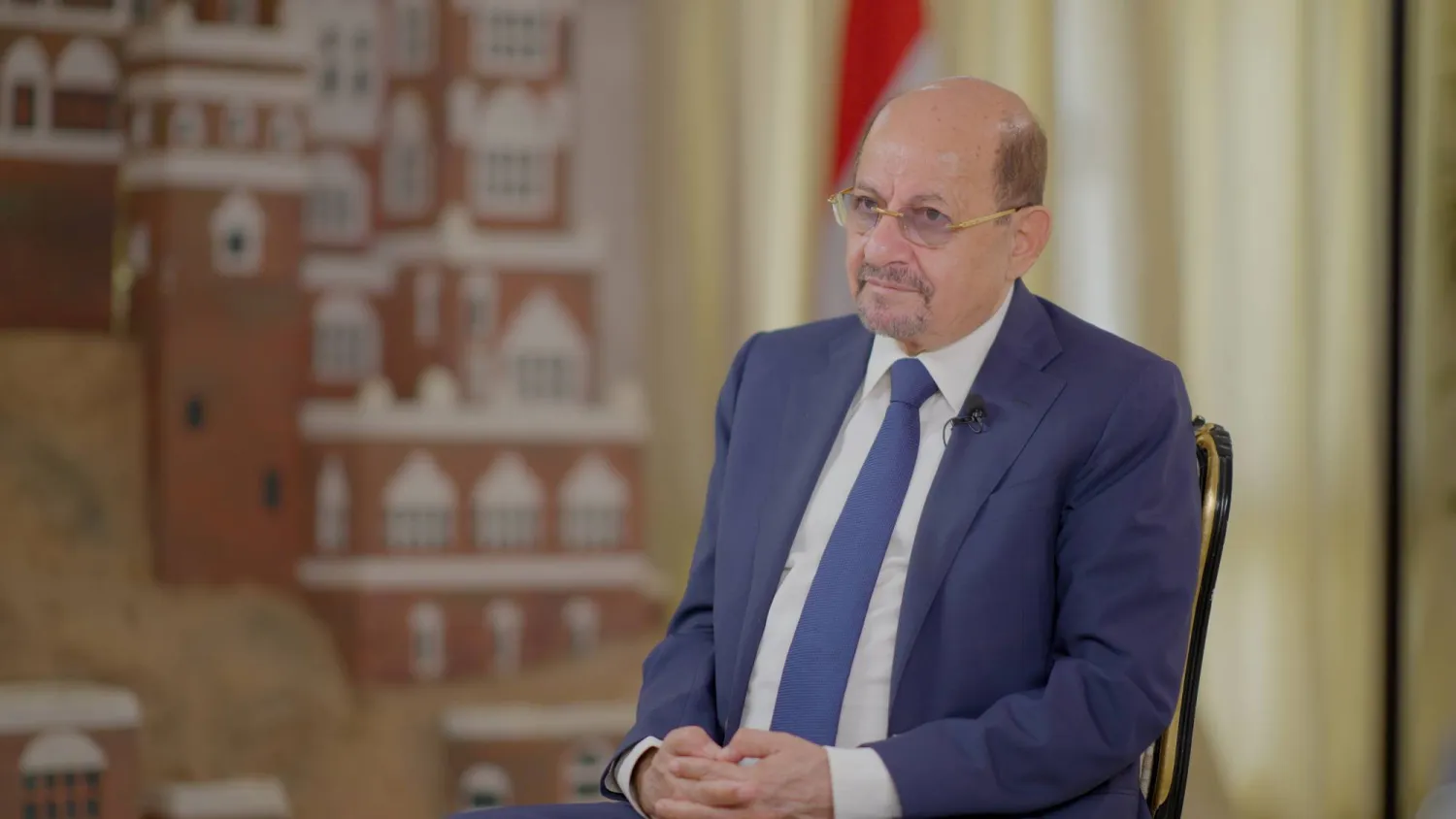

Yemen FM to Asharq Al-Awsat: Iran Encouraging Houthis to Prolong War, Reject Peace 

Yemeni Foreign Minister Dr. Shaya al-Zindani. (Turki Al-Aqaili)
TT

Yemen FM to Asharq Al-Awsat: Iran Encouraging Houthis to Prolong War, Reject Peace 

Yemeni Foreign Minister Dr. Shaya al-Zindani. (Turki Al-Aqaili)

Yemeni Foreign Minister Dr. Shaya al-Zindani accused the Iran-backed Houthi militias of obstructing the efforts of United Nations envoy Hans Grundberg to achieve peace in the country.

In an interview with Asharq Al-Awsat, he said the militants were seeking to stoke chaos in Yemen, while the peace process is effectively frozen because Iran is pushing the Houthis to reject peace and prolong the war.

“Unfortunately, as part of the government, we do not sense that the Houthis have a desire to achieve peace and end the war. They live for war,” he added.

The legitimate government “has agreed to all initiatives that have been presented by friends and brothers, but the Houthis have not been receptive to them.”

He blamed Iran for encouraging the Houthis to maintain their intransigence.

On reports about an attempt on Grundberg’s life, Zindani said: “There are efforts to thwart his work and plunge us in chaos.”

This all benefits the Houthis, he went on to say. “We, on the other hand, believe that the envoy represents the voice of international legitimacy and UN Security Council resolutions. It is in our interest to support him despite his shortcomings in some areas,” the minister stated.

Asked if the Security Council was preparing a resolution on Yemen, he replied that he had no information about that yet. He acknowledged, however, that some parties are starting to believe that resolution 2216 was no longer applicable.

Media sources have said that the US and Britian were seeking to issue two Security Council resolutions on Yemen in the coming weeks.

Zindani remarked that based on his experience, resolutions are rarely amended; rather, new ones are adopted.

“The government, in line with international, regional and national legitimacy, is showing openness and being reasonable with all efforts aimed at resolving Yemen’s plight,” he stressed.

The new resolutions, he said, will likely complement resolution 2216 and take measures against the Houthis because they have ignored other resolutions.

“The Houthis don’t believe in peace or national partnership; they don’t even have a political platform,” he charged.

“They are a close-minded group that operates according to its sectarian ideology, and it believes it has the right to rule the Yemeni people,” the FM told Asharq Al-Awsat.

The military option against the Houthis will “always remain on the table” as long as Yemen continues to be threatened, he added.

Arms smuggling

On Iran’s role in Yemen, Zindani lamented that the international community “had not seriously dealt with the issue of arms smuggling to the Houthis.”

Security Council resolutions have been clear about this, but not a single measure has been taken since 2016, he noted.

This has allowed Iran to deliver drones, ballistic missiles and even hypersonic missiles to the Houthis, he added.

“One can smuggle a rifle undetected, but sending rockets and drones without detection is suspicious,” Zindani said.

He said that some form of leniency in dealing with this issue allowed Iran to continue to support the Houthis.

“Should Iran fail in changing its policies and outlook and agree to establishing good ties with its neighbors and concern itself with its own people, then it will continue to meddle with Yemen’s internal affairs, which will only harm it and countries in the region,” he warned.

On the recent seizure weapons off the coast of Aden, he said the government “will not stand idle.” It will uncover the source of these weapons and act on the diplomatic level as soon as it has evidence.

Reports have said that authorities busted a shipment of drones and advanced equipment from China.

The FM said Yemen and China enjoy “historic and close ties” and that his country will bring up the issue with it should it receive any confirmed information related to the shipment.

“We know that it isn’t easy for any company to export military gear without the knowledge of the Chinese government,” he explained.

“We are keen on our relations with Beijing and we will bring up this issue with our friends there if we receive any evidence that connects the shipment to China,” Zindani said, revealing that the issue was already brought up with Chinese Charge d’Affaires.

On relations with Saudi Arabia, the FM said the Kingdom is Yemen’s main backer. Its support extends to all Yemeni sectors, such as development, reconstruction and humanitarian work through the King Salman Humanitarian Aid and Relief Center.

He also noted Saudi Arabia’s ongoing financial deposits and grants, stressing that the Kingdom is a “priority in our foreign policy. We are keen on excellent ties we share with it and we constantly aspire to coordinate our efforts on the international arena.”



Israel Says Hezbollah Trying to Rebuild, Smuggle in Arms from Syria

Smoke rises after an Israeli airstrike on Tayr Debba town in southern Lebanon, 06 November 2025. (EPA)
TT

Israel Says Hezbollah Trying to Rebuild, Smuggle in Arms from Syria

Smoke rises after an Israeli airstrike on Tayr Debba town in southern Lebanon, 06 November 2025. (EPA)

The Israeli military accused Lebanese armed group Hezbollah on Tuesday of seeking to rebuild its combat abilities in south Lebanon to the point of threatening Israel's security and undoing last year's ceasefire deal.

Military spokesman Nadav Shoshani said Iranian-backed Hezbollah was operating south of the Litani River in violation of the truce accord and that Israeli forces were conducting strikes on Hezbollah targets in that area. Hezbollah says it is committed to the ceasefire deal.

Lebanon's President Joseph Aoun and Prime Minister Nawaf Salam say Israel is violating the truce deal, pointing to the occupation of five hilltop positions in southern Lebanon by Israeli troops as well as Israeli air strikes and deadly ground incursions into Lebanese territory.

TENSION OVER DISARMAMENT PUSH

Shoshani told a news briefing that Hezbollah was also trying to smuggle in weapons from Syria and via other routes to Lebanon. "We are working to prevent that from happening and to block the ground routes from Syria into Lebanon to a high level of success, but they still pose a threat to us," Shoshani said.

"We are committed to the agreement but it must be held. We will not return to the reality of October 7 (2023) with a threat of thousands of terrorists on our border within walking distance of our civilians."

Hezbollah denies it is rebuilding its military capabilities in south Lebanon. It has not fired at Israel since the ceasefire came into force, and Lebanese security officials told Reuters that Hezbollah has not obstructed Lebanese army operations to find and confiscate the group's weapons in the country's south.

In a televised speech on Tuesday, Hezbollah head Sheikh Naim Qassem said Hezbollah remained committed to the 2024 ceasefire and that there was "no alternative" to that deal.

He said if Israel withdrew, stopped its attacks on Lebanon and released Lebanese nationals detained in Israel, then northern Israeli towns would have "no problem" with security.

But he reiterated Hezbollah's rejection of full disarmament and said Israel's destructive and deadly strikes "cannot continue", adding: "There is a limit to everything."

Israel has been pressing Lebanon's army to be more aggressive in disarming Hezbollah by searching private homes in the south for weaponry, according to Lebanese and Israeli officials.

The army is confident it can declare Lebanon's south free of Hezbollah arms by the end of 2025, but has refused to search private dwellings for fear of reigniting civil strife and derailing a disarmament strategy seen by the army as cautious but effective, Lebanese security officials told Reuters.

Hezbollah was severely weakened in a year-long war that saw an Israeli incursion into south Lebanon backed by heavy air strikes, but still wields considerable power among Shiites in Lebanon's fragile sectarian-based system of governance.


For Many Syrians, Sharaa's US Visit Marks New Beginning

 A Syrian flag is displayed outside the White House following the meeting of US President Donald Trump and Syrian President Ahmed al-Sharaa in the Oval Office of the White House in Washington, DC, US, November 10, 2025. (Reuters)
A Syrian flag is displayed outside the White House following the meeting of US President Donald Trump and Syrian President Ahmed al-Sharaa in the Oval Office of the White House in Washington, DC, US, November 10, 2025. (Reuters)
TT

For Many Syrians, Sharaa's US Visit Marks New Beginning

 A Syrian flag is displayed outside the White House following the meeting of US President Donald Trump and Syrian President Ahmed al-Sharaa in the Oval Office of the White House in Washington, DC, US, November 10, 2025. (Reuters)
A Syrian flag is displayed outside the White House following the meeting of US President Donald Trump and Syrian President Ahmed al-Sharaa in the Oval Office of the White House in Washington, DC, US, November 10, 2025. (Reuters)

On the streets of Damascus on Tuesday, Syrians viewed their leader's visit to Washington as a shift towards the West that could pave the way to reviving the country's war-battered economy.

On Monday, Donald Trump received Ahmed al-Sharaa, a first for a Syrian head of state since independence in 1946.

"God willing, this visit will be a new beginning for Syria and an opening to the world after years of isolation," law student Boushra Abdel Bari said.

"We hope that this visit... will facilitate the reconstruction of Syria with the United States and the rest of the world."

As Sharaa made his historic visit to Washington, the State Department announced a pause of US sanctions under the Caesar Act, pending their possible permanent lifting by Congress.

The law imposed wide-ranging sanctions on investment in Syria in an effort to ensure accountability over abuses under Assad, banning the country from the global banking system.

Historically, Syria has been in the orbit of first the Soviet Union then Russia, which was autocratic leader Bashar al-Assad's main ally during more than 13 years of civil war.

But since overthrowing Assad in December 2024, the interim Syrian president has made numerous overtures to the West and Gulf, while being careful not to burn his bridges with Moscow.

For Abdel Bari, Assad's ally Russia "has brought us nothing but ruin and destruction."

Omar Nassar, a 36-year-old printer, also welcomed Syria's move towards the Western camp.

"Syria paid the price for aligning itself with the socialist camp in the past... and was isolated from its Arab and international environment," he said.

"We are very optimistic after this visit. We expect positive repercussions in the economic and diplomatic spheres."

Saddam Hajjar, who runs a coffee kiosk in the Syrian capital, also believed that "things are getting better".

"We hope to be part of the new Middle East in the future," he said. "The Syrian people deserve a better life after making so many sacrifices."

Assad's fall ended a civil war that lasted more than 13 years, which broke out after the government cracked down on a peaceful uprising in 2011.

The war killed more than half a million people, displaced or forced millions of Syrians into exile, and brought the economy to its knees.

Layal Kaddour, a 25-year-old NGO worker, thought the visit to Washington was "a bold political move" that broke years of isolation.

"The possible repercussions are an easing of sanctions and the opening up of economic prospects," she said.

But she wondered if her country will now be "subject to international pressure that would influence independent political decision-making," alluding to concerns about US pressure on Syria to make peace with Israel, which has long been an enemy.


UN Aid Chief Hails Talks with Sudan Army Leader

A Sudanese refugee speaks on the phone at the Tine transit camp in Chad on November 8, 2025. (AFP)
TT

UN Aid Chief Hails Talks with Sudan Army Leader

A Sudanese refugee speaks on the phone at the Tine transit camp in Chad on November 8, 2025. (AFP)

UN humanitarian chief Tom Fletcher held Tuesday what he called "constructive" talks with Sudan's army chief Abdel Fattah al-Burhan to ensure life-saving aid reaches all corners of the war-ravaged country.

Since April 2023, the war between Sudan's army and the paramilitary Rapid Support Forces (RSF) has killed tens of thousands and displaced millions, creating one of the world's largest humanitarian crises.

"I very much welcome the constructive conversations with President Burhan this afternoon, aimed at ensuring we can continue to operate everywhere across Sudan to deliver in a neutral, independent and impartial way for all those in such dire need," Fletcher said in a video released by Sudan's Transitional Sovereignty Council.

The UN official's comments came after he met with Burhan in Port Sudan, the de facto capital.

During the meeting, Burhan asserted "Sudan's keenness on cooperating with the United Nations and its various agencies," according to the army-backed council.

Fletcher, who arrived in Sudan on Tuesday for a week-long mission, said on X he would work "to stop the atrocities, back peace efforts, uphold the UN charter, and push for our teams to get the access and funding they need to save lives across the battle lines."

The talks come two weeks after the RSF captured el-Fasher, the last army stronghold in western Darfur.

Burhan had previously vowed his forces would "take revenge" and fight "until this land is purified."

On Tuesday, Fletcher also met top Egyptian and Sudanese diplomats in Port Sudan, according to a statement from Cairo's foreign ministry.

Egyptian Foreign Minister Badr Abdelatty called for "strengthening the international response to the current crisis and ensuring humanitarian aid reaches the most affected groups."

Despite the RSF agreeing to a truce mediated by the US, Saudi Arabia, UAE, and Egypt last Thursday, attacks have continued.

On the day paramilitaries agreed to the truce, the Sudanese Doctors' Union said the RSF shelled a hospital in South Kordofan, killing five, while explosions were heard in Khartoum the following day.