120 Aid Workers Killed in Sudan Since War Began

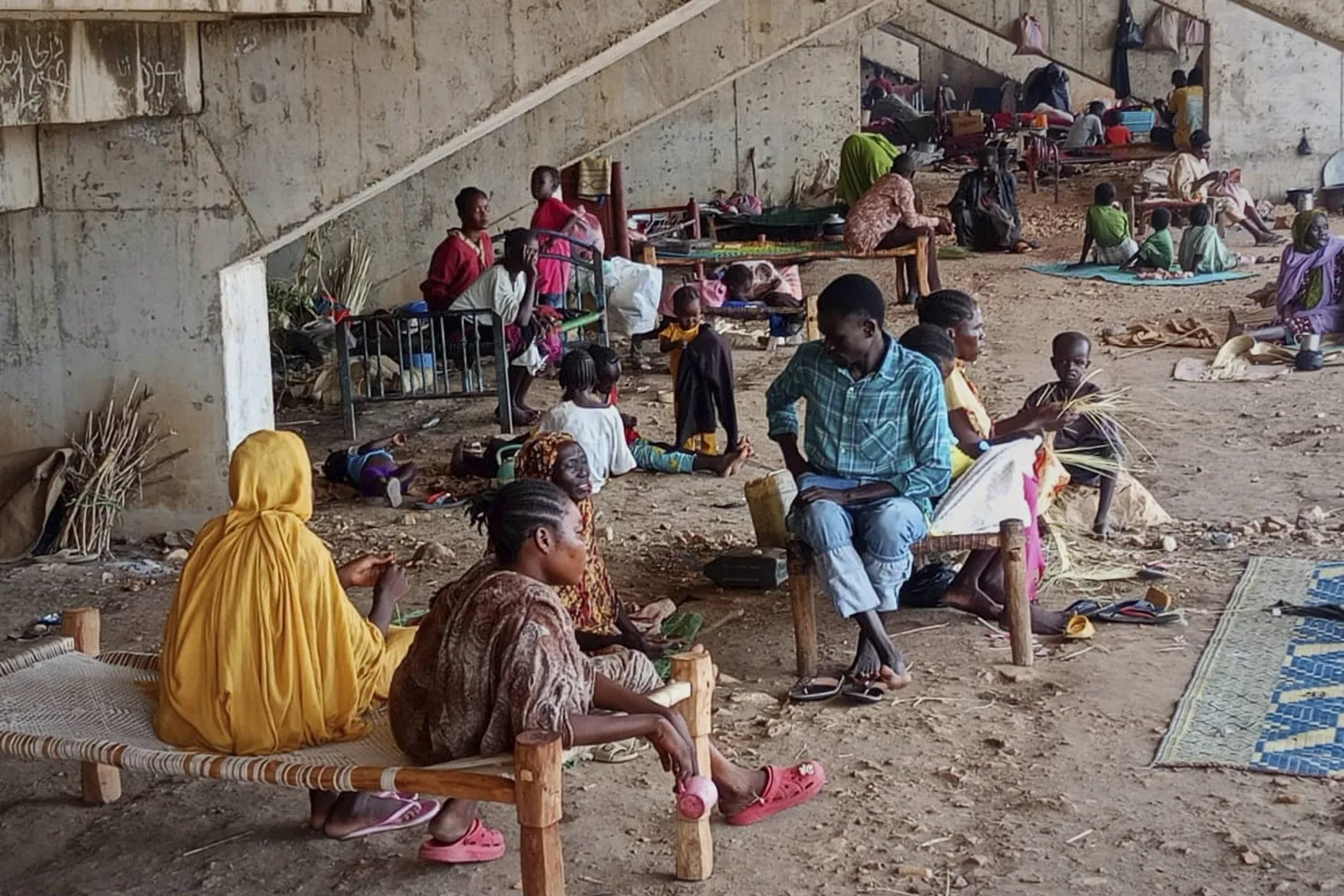
In this photo released by the NGO Mercy Corps, Sudanese families displaced by RSF attacks in Kordofan take shelter in a football stadium in Kadugli, South Kordofan province, Sudan, May 27, 2025. (Mercy Corps via AP)
TT

120 Aid Workers Killed in Sudan Since War Began

In this photo released by the NGO Mercy Corps, Sudanese families displaced by RSF attacks in Kordofan take shelter in a football stadium in Kadugli, South Kordofan province, Sudan, May 27, 2025. (Mercy Corps via AP)

The United Nations Office for the Coordination of Humanitarian Affairs (OCHA) described on Tuesday the war in Sudan as one of the deadliest for aid workers anywhere in the world.

“Since the current conflict began in April 2023, more than 120 humanitarian personnel have been killed — nearly all of them Sudanese,” said OCHA coordinator in Sudan Luca Renda.

As the agency marks World Humanitarian Day, Renda warned that violations of international humanitarian law have become disturbingly common.

Humanitarian aid workers in Sudan have faced increased threats, including arbitrary detention, kidnapping, and attacks that result in injury and death.

Despite these threats, Renda said, Sudanese humanitarians continue to deliver. “They cross frontlines. They navigate insecurity and bureaucracy. They risk everything to reach people in need. They have not given up — and neither must we.”

The victims, Renda noted, include medics, drivers, volunteers and other staff members who showed up every day to serve their communities with courage and compassion.

“Their deaths are a stain on our collective conscience and a stark reminder of the growing dangers faced by those who deliver life-saving aid,” he stressed.

Renda explained that violations of international humanitarian law have become disturbingly common. “Every red line crossed is met with impunity, indifference and failure to act. This must stop.”

He called on all those engaged in the conflict in Sudan to meet their obligations under international law, protect civilians, uphold the rules of war, guarantee safe and unimpeded access, and ensure that humanitarian personnel can operate safely, independently and without interference.

In view of the massive humanitarian needs in Sudan, he also urged donors to increase flexible funding to sustain and scale up life-saving operations across the country.

In its third year, the war in Sudan displaced more than 12.4 million people from their homes– including over 3.3 million refugees who have fled to neighboring countries.


Al-Sharaa: Israel’s Push for a Buffer Zone in Southern Syria Puts the Region at Risk

Syrian President Ahmad al-Sharaa speaks during the 23rd annual Doha Forum (Reuters). 
TT

Al-Sharaa: Israel’s Push for a Buffer Zone in Southern Syria Puts the Region at Risk

Syrian President Ahmad al-Sharaa speaks during the 23rd annual Doha Forum (Reuters). 

Syrian President Ahmad al-Sharaa warned on Saturday that Israel’s effort to establish a demilitarized buffer zone in southern Syria risks pushing the country into a “dangerous place.”

Speaking on the sidelines of the Doha Forum, al-Sharaa said US-mediated negotiations with Israel remain underway to address the “security concerns” of both sides.

Following the ouster of Bashar al-Assad on Dec. 8, Israel has carried out hundreds of airstrikes on Syrian military positions, saying its goal is to prevent the new authorities from seizing the former army’s weapons arsenal.

Over the past year, Israel has repeatedly publicized ground operations and arrests of individuals it accuses of “terrorist” activity in southern Syria. Israeli forces have also entered the Golan Heights disengagement zone established under the 1974 cease-fire agreement.

Al-Sharaa said all major international actors back Syria “in its demand that Israel withdraw and reposition to the lines of Dec. 8.” He emphasized that Damascus insists on full respect for the 1974 accord, describing it as a durable, internationally supported agreement.

“Tampering with this agreement, while proposing alternatives such as a new buffer zone, could drive us into dangerous territory,” he said.

Al-Sharaa accused Israel of “fighting ghosts” and “searching for enemies” in the wake of the Gaza war, adding that since assuming office a year ago he has sent “positive messages about peace and regional stability.”

Thirteen people were killed in late November during an Israeli incursion into the southern town of Beit Jin, a raid Damascus denounced as a “war crime.” Israel said the operation targeted suspects linked to the ISIS group.

Though Syria and Israel maintain no diplomatic relations and remain technically at war, several US-brokered ministerial meetings have been held in recent months.

“Negotiations are ongoing, and the United States is fully engaged,” al-Sharaa said, noting broad international support for addressing “legitimate security concerns so both sides can feel secure.”

He asked: “Syria is the one under attack, so who should be demanding a buffer zone and withdrawal?”

In September, al-Sharaa warned in New York of the risk of renewed Middle East instability if Damascus and Tel Aviv fail to reach a security arrangement, accusing Israel of “delaying negotiations and continuing to violate our airspace and territory.”

Israeli Prime Minister Benjamin Netanyahu visited Israeli forces deployed in the buffer zone outside the occupied Golan Heights in November, a move Damascus condemned as “illegitimate.”

Domestically, al-Sharaa said all segments of Syrian society are now represented in government “on the basis of competence, not sectarian quotas.” Syria, he said, is charting a “new path” for post-conflict governance. He acknowledged the country inherited “deep problems” from the former regime and said investigative bodies are working to address alleged crimes in the coastal region and Sweida.

He stressed that Syria is “a state of law, not a collection of sects,” and that accountability and institutional reform are essential to rebuilding the state.

The Syrian president added that economic revitalization is crucial for lasting stability, which is why Damascus continues to argue for the lifting of the Caesar Act sanctions.


Arab Parliament Backs UNRWA Mandate Renewal, Reaffirms Support for Palestinian Rights

Arab Parliament Backs UNRWA Mandate Renewal, Reaffirms Support for Palestinian Rights
TT

Arab Parliament Backs UNRWA Mandate Renewal, Reaffirms Support for Palestinian Rights

Arab Parliament Backs UNRWA Mandate Renewal, Reaffirms Support for Palestinian Rights

Speaker of the Arab Parliament Mohamed Alyammahi welcomed the UN General Assembly’s decision to renew the mandate of the United Nations Relief and Works Agency for Palestine Refugees in the Near East (UNRWA) for another three years, saying the vote reflects broad international support for Palestinian rights and a clear rejection of efforts to undermine their cause.

Alyammahi stressed that the mandate’s renewal is particularly critical amid the continued aggression and blockade facing Palestinians, ensuring the agency can maintain its essential services. He noted the strong backing for related resolutions calling for an end to the occupation and the establishment of an independent Palestinian state with Jerusalem as its capital.

The speaker urged leveraging this growing international consensus to halt the assault on Gaza, facilitate the entry of humanitarian aid, intensify legal and diplomatic action against the occupation, and advance a credible political process that can help ease the suffering of the Palestinian people.


Israeli Soldiers Kill 55-Year-Old Palestinian and Teenager in West Bank

28 November 2025, Palestinian Territories, Hebron: Israeli forces block Palestinian farmers trying to access to their agricultural fields in the town of Tarqumiyah. (dpa)
TT

Israeli Soldiers Kill 55-Year-Old Palestinian and Teenager in West Bank

28 November 2025, Palestinian Territories, Hebron: Israeli forces block Palestinian farmers trying to access to their agricultural fields in the town of Tarqumiyah. (dpa)

Israeli soldiers killed a Palestinian teenager who was driving a car towards them as well as a Palestinian bystander in the West Bank on Saturday, according to an Israeli security official.

The military said that an "uninvolved person" was hit in addition to the driver of the car who had "accelerated" towards soldiers at a checkpoint in West Bank city of Hebron.

In an earlier statement, the military said two "terrorists" were killed, before later clarifying that only one person was involved.

An Israeli security official, speaking on condition of anonymity, said a 17-year-old was driving the car and a 55-year-old was the bystander.

Palestinian state news agency WAFA reported that 55-year-old Ziad Naim Abu Dawood, a municipal street cleaner, was killed while working. It said another Palestinian was killed but did not report the circumstances that led the soldiers to open fire.

The Palestinian health ministry identified the second Palestinian as 17-year-old Ahmed Khalil Al-Rajabi.

The military did not report any injuries to the soldiers.

The motive for the 17-year-old's actions was not immediately clear, and no armed group claimed responsibility.

Since January, 51 Palestinian minors, aged under 18, have been killed in the West Bank by Israeli forces, according to the Palestinian health ministry.

Violence has surged this year in the Israeli-occupied West Bank. Israeli settler attacks on Palestinians have risen sharply, while the military has tightened movement restrictions and carried out sweeping raids in several cities.

Palestinians have also carried out attacks on Israeli soldiers and civilians, some of them deadly.