


Lebanon Awaiting Syria’s Official Response to US Proposals

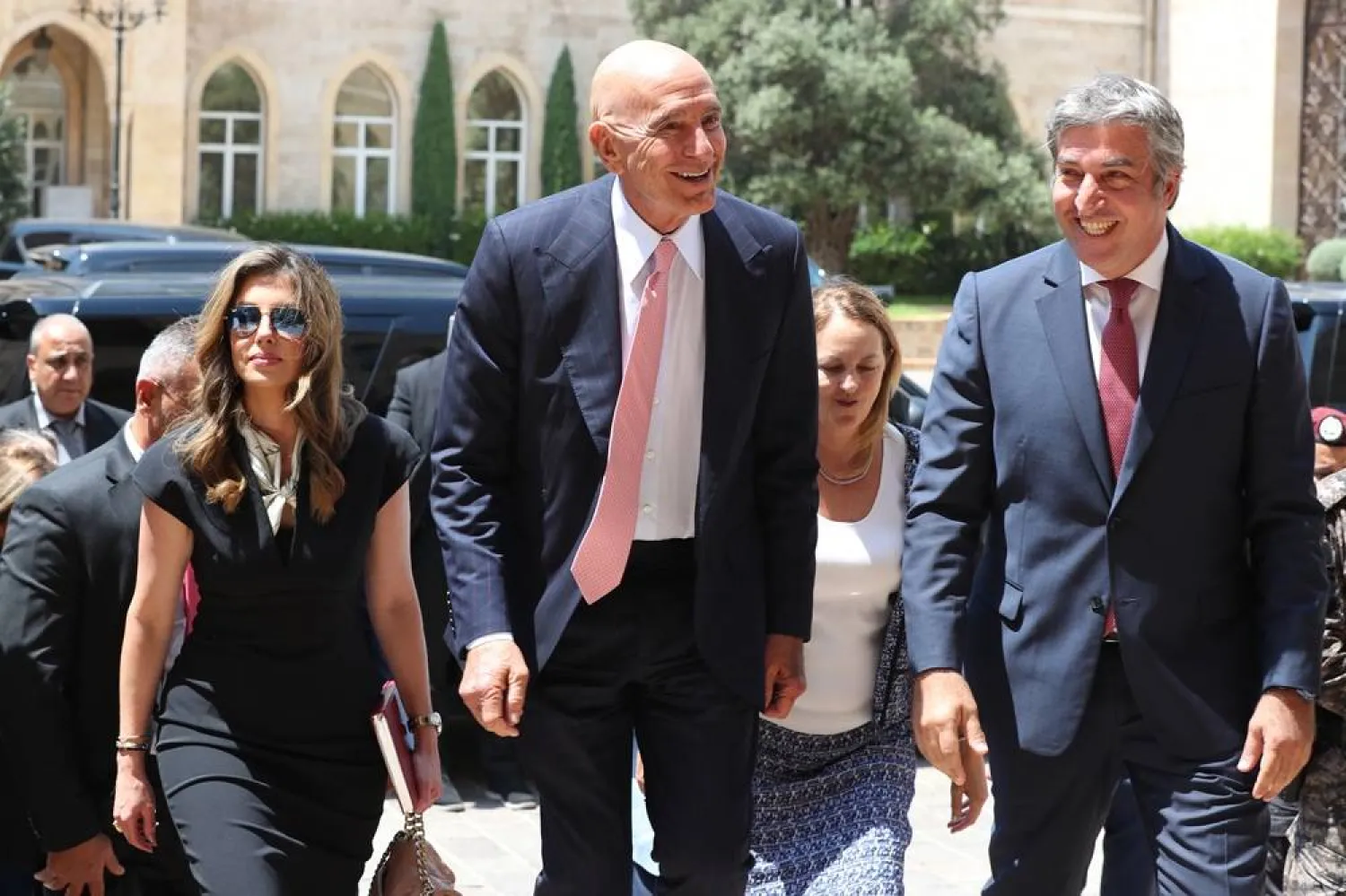
US Ambassador to Türkiye and Special Envoy to Syria Tom Barrack (C), and US Deputy Special Envoy for the Middle East Morgan Ortagus (L) arrive for a meeting with Lebanese Prime Minister Nawaf Salam at the government palace in Beirut, Lebanon, 18 August 2025. (EPA)
TT

Lebanon Awaiting Syria’s Official Response to US Proposals

US Ambassador to Türkiye and Special Envoy to Syria Tom Barrack (C), and US Deputy Special Envoy for the Middle East Morgan Ortagus (L) arrive for a meeting with Lebanese Prime Minister Nawaf Salam at the government palace in Beirut, Lebanon, 18 August 2025. (EPA)

Lebanon is not only waiting for Israel’s response to its stance on the US proposals related to a ceasefire, limiting the possession of arms to the state and the demarcation of the border, but it is also awaiting an official position from Syria.

Two out of the 30 articles of the “US document” concern Syria. They cover the demarcation of their shared land and sea borders and determining exclusive economic zones. The second article focuses on jointly combating drug smuggling.

Implementing the first article calls for forming a tripartite committee of Lebanese and Syrian representatives and United Nations experts, as well as assistance from the US, Saudi Arabia and France.

The document says the proposals will be effective as of August 1 as soon as they are approved by Lebanon, Israel and Syria. Lebanon is the only party to have so far approved them.

A government source told Asharq Al-Awsat that Lebanese official channels have yet to receive any official Syrian position on the US document.

US Ambassador to Türkiye and Special Envoy to Syria Tom Barrack was in Lebanon this week to further discuss the proposals. He met with President Joseph Aoun, parliament Speaker Nabih Berri and Prime Minister Nawaf Salam before traveling to Israel.

Aoun had informed Barrack that Lebanon demands a response from both Israel and Syria. Barrack said he will ensure that Damascus makes its position clear.

At the moment, contacts between Lebanon and Syria are taking place through security and military channels.

The source said a Syrian official delegation is set to travel to Lebanon next week to discuss pending files between the countries, most notably border demarcation, drug smuggling and Syrian refugees and detainees in Lebanon. Damascus has notably not yet appointed an ambassador to Beirut.

Saudi Arabia had in March sponsored an agreement in Jeddah between the Lebanese and Syrian defense ministers that stresses the need to demarcate the border between the two neighbors, form dedicated legal committees to tackle pending files and activate coordination mechanisms to handle security and military challenges.

Cold relations

The Lebanese-Syrian border has witnessed fierce clashes between clans and Hezbollah, before developing into clashes between the Lebanese army and Syrian forces.

Director of the Levant Institute for Strategic Affairs Dr. Sami Nader doubted that the articles tied to Lebanon and Syria can be implemented.

He told Asharq Al-Awsat that the situation is complex and compounded by the presence of Hezbollah members along the Lebanese side of the border.

So, the article related to the Lebanese state having monopoly over arms needs to be implemented so that the articles related to Syria can in turn be implemented, he explained.

Saudi Arabia and the US are playing a key role in border demarcation, but real progress there can only be achieved once the army carries out its plan to limit the possession of arms to the state, Nader said.

The military is expected to send its plan to the cabinet.

As it stands, relations between Lebanon and Syria's new authorities can be described as “cold” despite visits by former PM Najib Mikati and current PM Salam to Damascus after the fall of the Assad regime in December.

Syria’s Foreign Minister Asaad al-Shaibani was expected to visit Beirut at some point, but a date was never set.

Former MP Moeen al-Merehbi told Asharq Al-Awsat that Beirut and Damascus have to exert more efforts to forge warm ties, especially since they both evidently want to.

The new Syrian authorities have an interest in demarcating the marine and land borders with Lebanon, as opposed to the Assad regime that did not even allow anyone to broach the subject, he remarked.


EU Chief von der Leyen to Visit Syria, Lebanon This Week

European Commission President Ursula von der Leyen, addresses journalists during a visit to Sarajevo, Bosnia and Herzegovina, January 23, 2024. (Reuters)
TT

EU Chief von der Leyen to Visit Syria, Lebanon This Week

European Commission President Ursula von der Leyen, addresses journalists during a visit to Sarajevo, Bosnia and Herzegovina, January 23, 2024. (Reuters)

EU chief Ursula von der Leyen will visit Syria later this week on a first trip to the country since the fall of Bashar al-Assad, a spokeswoman said Monday.

Von der Leyen will head to Syria as part of a tour of the Middle East that will also see her visit Jordan and Lebanon, spokeswoman Paula Pinho said.


Israel Says Ban on Gaza Media Access Should Stay

A Palestinian woman holds her child beside piles of rubble while heading toward Gaza City on Friday. (AFP)
TT

Israel Says Ban on Gaza Media Access Should Stay

A Palestinian woman holds her child beside piles of rubble while heading toward Gaza City on Friday. (AFP)

Israeli authorities have told the Supreme Court that a ban on international media access to Gaza should remain in place, arguing it is necessary for security reasons, according to a government submission filed by the public prosecutor. 

Since the outbreak of the Gaza war in October 2023, triggered by an attack on Israel by the Palestinian group Hamas, Israeli authorities have barred foreign journalists from independently entering the devastated territory, said AFP. 

Instead, Israel has allowed only a limited number of reporters to enter Gaza on a case-by-case basis, embedded with its military forces inside the blockaded territory. 

The Foreign Press Association (FPA), which represents hundreds of foreign journalists working in Israel and the Palestinian territories, filed a petition with the Supreme Court in 2024 seeking immediate and unrestricted access for international media to the Gaza Strip. 

Since then the court has given several extensions to the Israeli authorities to come up with a plan, but at a hearing last month it set January 4 as a final deadline. 

Late on Sunday, the Israeli authorities filed their response with the court, a copy of which was obtained by AFP. 

In the submission, the government said the ban on media access to Gaza should continue, citing security risks in the territory. 

"Even at this time, entry of journalists into the Gaza Strip without escort, as requested in the petition, should not be permitted," said the government submission. 

"This is for security reasons, based on the position of the defense establishment, which maintains that a security risk associated with such entry still exists." 

The Israeli authorities said the ceasefire in Gaza, which came into effect on October 10, continues to face regular threats. 

At least 420 Palestinians have been killed in Gaza by Israeli forces since the ceasefire took effect, according to Gaza's health ministry. 

The Israeli military said three of its soldiers have also been killed by militants during the same period. 

The Israeli authorities said in their submission that the search for the remains of the last hostage held in Gaza is ongoing, suggesting that allowing journalists into the territory at this stage could hinder the operation. 

The remains of Ran Gvili, whose body was taken to Gaza after he was killed during the Hamas attack on October 7, 2023, have still not been recovered despite the ceasefire. 

All other 250 hostages seized on that day - both the living and the deceased - have been returned to Israel. 

The Supreme Court is expected to issue a ruling on the matter, though it is unclear when a decision will be handed down. 


Calls in Lebanon for Immediate Action Against ‘Remnants’ of Assad Regime

The Masnaa border crossing between Lebanon and Syria. (AFP)
TT

Calls in Lebanon for Immediate Action Against ‘Remnants’ of Assad Regime

The Masnaa border crossing between Lebanon and Syria. (AFP)

Reports about the presence of “remnants of the former Syrian regime” in Lebanon have raised concerns that they could destabilize internal security or turn Lebanese territory into a platform for targeting Syria’s security and stability.

Authorities and security agencies have launched a broad campaign to verify these reports as voices across Lebanon warned of the presence of former Syrian officers in certain regions, particularly in the North and Bekaa Valley in the east.

The Lebanese Army Command regularly announces raids and security operations against suspects. The latest such operation was announced on Sunday, when dozens were detained, mostly Syrians, in northern Lebanon and the Bekaa.

In a statement, the Army Command said it carried out operations against wanted suspects, arresting nine Lebanese citizens and 35 Syrians in the regions of Akkar, Tripoli, Batroun, Baalbek and Hermel on charges including opening fire, possession of weapons, drug use, and human smuggling.

The army added that weapons, ammunition, drugs and military equipment were seized, and that investigations had begun under the supervision of the relevant judiciary.

Previously, a number of municipalities in northern Lebanon had issued statements urging security agencies to tighten measures in their areas, saying several former regime members have sought safety in their towns. They also spoke of the daily movement of suspicious vehicles.

Similar warnings have since emerged from the Bekaa. Dar al-Fatwa in Rashaya issued a statement on Sunday calling on the state to take “immediate, swift and decisive action to arrest the remnants of the Syrian regime in Lebanon and return them to Syria for trial.”

MP Wael Abou Faour, a member of the Democratic Gathering bloc, called on “the Lebanese security agencies to fulfill their duties with regard to the large number of officers from the remnants of the regime of former Syrian president Bashar al-Assad who are present in Lebanon.”

He stressed that despite the fall of the regime, “Lebanese-Syrian relations are governed by the Taif Agreement, which clearly stipulates that Lebanon must not be a base or a transit point for any attack on Syria’s security, and vice versa.”

“The Lebanese state must therefore act to uncover the truth and arrest officers from the remnants of the regime who are hiding in Lebanon.”
