
Doctors in Gaza Say Patients’ Protruding Ribs and Bony Limbs Offer Evidence of Malnutrition

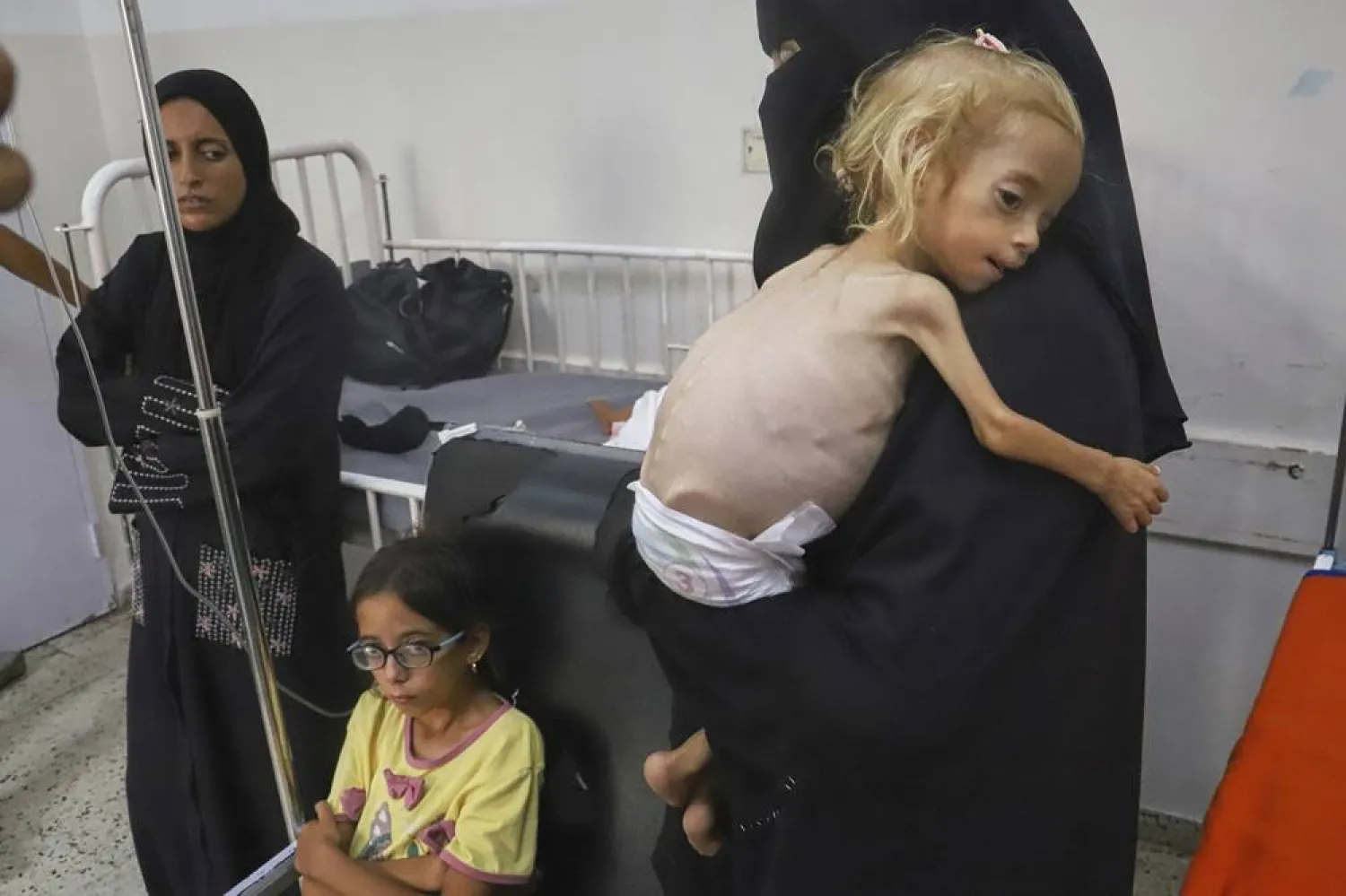
Islam Qudeih holds her shirtless, severely malnourished 2-year-old daughter, Shamm, at Nasser Hospital in Khan Younis, southern Gaza Strip, Saturday, Aug. 9, 2025. (AP)
TT

Doctors in Gaza Say Patients’ Protruding Ribs and Bony Limbs Offer Evidence of Malnutrition

Islam Qudeih holds her shirtless, severely malnourished 2-year-old daughter, Shamm, at Nasser Hospital in Khan Younis, southern Gaza Strip, Saturday, Aug. 9, 2025. (AP)

Not long after Texas surgeon Mohammed Adeel Khaleel arrived at a Gaza City hospital in early August, a 17-year-old was brought in with gunshot wounds to both legs and one hand, sustained when he went to collect food at an aid site.

In the emergency room, Khaleel said he noted the ribs protruding from the teen's emaciated torso, an indication of severe malnutrition. When doctors at Al-Ahli Hospital stabilized the patient, he raised his heavily bandaged hand and pointed to his empty mouth, Khaleel said.

“The level of hunger is really what’s heartbreaking. You know, we saw malnutrition before, back in November, already starting to happen. But now the level is just, it’s beyond imagination,” Khaleel, a spinal surgeon on his third volunteer stint in Gaza, said in an interview.

On Friday, the Integrated Food Security Phase Classification, or IPC, the leading authority on global hunger crises, said for the first time that parts of Gaza are in famine and warned that it is spreading. For months, UN agencies, aid groups and experts had warned that Israel's blockade and ongoing offensive were pushing the territory to the brink.

In the 24 hours following the famine announcement, eight people in Gaza died of malnutrition-related causes, bringing the overall toll of such deaths during the war to 281, according to Gaza's Health Ministry, which is part of the Hamas-run government and staffed by medical professionals. A US medical nonprofit working in Gaza says one in six children under 5 is affected by acute malnutrition.

Israel rejected the famine announcement, calling it an “outright lie” and pointing to its recent efforts to allow in more food after it eased a complete 2½ month blockade in May. It has accused Hamas of siphoning off aid — allegations disputed by the United Nations, which says Israeli restrictions and a breakdown of law and order make it extremely difficult to deliver food to the most vulnerable.

Khaleel, who spoke to The Associated Press ahead of the announcement, said the evidence of deprivation was already clear.

“Just the degree of weight loss, post-operative complications and starvation that we’re seeing. That wouldn’t surprise me at all if it was called famine,” said Khaleel, who traveled to Gaza as an independent volunteer via the World Health Organization.

At Gaza City’s Shifa Hospital earlier in the week, nutrition director Dr. Mohammad Kuheil led an AP journalist to the bedside of a thin-limbed girl. Aya Sbeteh, 15, was wounded in an airstrike. But her recovery has been set back by weakness from lack of food that her family says has reduced her weight by more than a third.

“All we have are grains like lentils, sometimes,” said her father, Yousef Sbeteh, 44. “Even flour is unaffordable."

The sick, wounded and young are most vulnerable

Another patient, Karam Akoumeh, lay with sunken cheeks, his thin skin stretched like plastic wrap across his rib cage. His intestines were seriously damaged when he was shot while going out to collect flour, his family said, compromising his digestive system.

Now he is one of 20 people at Shifa brought in for abdominal wounds and increasingly malnourished because of a shortage of intravenous nutritional supplements, the doctor said.

Akoumeh’s father, Atef, said the lack of supplements compounded the hunger that reduced Karam's weight from 62 kilograms (136 pounds) to just 35 kilos (77 pounds).

“I checked throughout all Gaza’s hospitals for it (the supplements), but I have not found any,” he said.

Israeli officials have pointed out that some of those said to have died from malnutrition had preexisting conditions. But doctors and other experts say that is to be expected, as famine first preys on the most vulnerable, including babies and small children.

Doctors and others see signs of hunger everywhere

Outside the hospital, the shortage of nutrients is equally dire, doctors and civilians say.

“There are no protein sources, only plant-based protein from legumes. Meat and chicken are not available. Dairy products are not available, and fruits are also unavailable,” said Kuheil, the doctor in charge of nutrition at Shifa.

In Gaza City on Friday, Palestinians displaced from elsewhere recounted a desperate search for food.

“We’re starving. We eat once a day. Will we be more hungry than we are now? There’s nothing left,” said Dalia Shamali, whose family has been repeatedly displaced from their home in nearby Shijaiyah.

She said they spent most of their money over the last two years moving from one part of Gaza to another as the Israeli military issued evacuation orders. With Israel allowing more food in recently, the price of flour and other food items has been dropping, but the family still can't afford them, Shamali said.

Hunger agency says famine is expected to spread

In its announcement Friday, the IPC said famine in Gaza City is likely to spread across the territory without a ceasefire and a flood of humanitarian aid.

Some of the IPC's conclusions were echoed in a report by a group that organizes medical missions to Gaza, which described a “catastrophic rise in severe malnutrition” among children and pregnant women.

One of every six children in Gaza under 5 is now affected by acute malnutrition, said the report by US nonprofit MedGlobal, based on observations by its staff in four of Gaza’s five governorates. The group warned that all young children in Gaza are at risk of starving without intervention.

Khaleel, the Texas doctor, said he would leave it to others with more expertise to measure exactly what constitutes famine.

But he knows what he saw in three weeks of treating patients in Gaza, most of the time at the hospital in Gaza City. Again and again, medical workers cut open patients' clothing to treat injuries, revealing a loss of muscle and fat caused by hunger that left skin stretched tight over protruding bones.

“These patients, a number of them that we’re seeing are just exposed ribs, severely skinny extremities,” he said. “And you know that they’re just not getting calories in.”


Hezbollah Raises Civil War Threat Over Disarmament Plan

Hezbollah members take an oath in front of a monument to Iranian General Qassem Soleimani in Beirut in 2022 (AP file photo)
TT

Hezbollah Raises Civil War Threat Over Disarmament Plan

Hezbollah members take an oath in front of a monument to Iranian General Qassem Soleimani in Beirut in 2022 (AP file photo)

Hezbollah escalated its response to Lebanese President Joseph Aoun and Prime Minister Nawaf Salam over plans to press ahead with restricting weapons to the state and extending the move to areas north of the Litani River, raising the specter of civil war as tensions over the issue intensify.

Mahmoud Qamati, vice president of Hezbollah’s political council, said in a televised interview that statements by the president and prime minister on confining weapons north of the Litani meant the government was heading toward chaos and instability, and toward an internal situation that no one would accept, possibly even a civil war.

The government last week tasked the Lebanese army commander, during a cabinet session, with preparing a plan to restrict weapons north of the Litani, after announcing that the objectives of the first phase of the plan to confine arms to the state south of the river had been achieved.

Qamati’s Position

Hezbollah says that before any discussion begins on the fate of its weapons outside the area south of the river, Israel must stop violating Lebanese sovereignty, withdraw from points it occupies, and release prisoners.

Qamati said on Tuesday that some parties were insisting on implementing foreign dictates and offering concessions to Israel for free and without any return.

He added that the army’s role was not to protect Israel from any military action from Lebanon, but to confront Israel, which he said occupies Lebanese territory.

Accusing some members of the government of collusion to implement a US-Israeli plan for personal calculations, Qamati called for a return to reason, wisdom, and “Lebanese-Lebanese dialogue”.

War Against Whom?

Lebanese Industry Minister Joe Issa El-Khoury expressed surprise at Hezbollah’s threat of a civil war, asking between whom such a war would take place, between an illegitimate armed group and the legitimate army.

Civil wars, he said, usually erupt between illegitimate armed groups, warning that if Hezbollah did not hand over its weapons, other unarmed groups might rearm on the grounds that the army was unable to protect them.

Speaking to Asharq Al-Awsat, El-Khoury said it was unacceptable for one group alone to be armed to fight Israel, adding that Lebanon either builds a state together or looks for other projects. While the region was moving forward with strong momentum, he said, Lebanon was moving backward.

El-Khoury said the army’s forthcoming plan to restrict weapons north of the Litani should not include multiple phases, but rather a single phase running until the end of March.

He stressed that linking implementation to the army’s capabilities and resources was misplaced.

He recalled that the strongest militia after the civil war was the Lebanese Forces, which later committed to building the state and handed over its weapons to the army, thereby eliminating the need for army deployment in areas where the group had been present.

That, he said, was what should happen today with Hezbollah.

Party Warning

Sources familiar with Hezbollah’s internal thinking told Asharq Al-Awsat that the group did not want a clash with the army, and that the army did not intend to seize weapons by force.

The warning issued by Qamati, they said, was directed at political forces pushing for disarmament by force. The sources added that the current moves were an attempt to create the right conditions to reach a consensus solution to the issue.

Remarks by Rajji

Hezbollah’s veiled threats of civil war coincided with a fierce campaign by lawmakers from the Shiite duo, Amal and Hezbollah, against Lebanese Foreign Minister Youssef Rajji.

In a televised interview, Rajji said that the ceasefire declaration approved by the government provided for Hezbollah’s weapons to be confined in return for a halt to Israeli attacks, and that as long as the weapons were not fully confined, Israel, unfortunately, had the right to continue its attacks.

Hezbollah lawmaker Ali Ammar described the remarks as dangerous, saying they required a clear and firm stance from the president and prime minister, as well as a halt to such statements, which he said inflamed internal divisions and served only to benefit the enemy.

Qassem Hashem, a member of the Development and Liberation bloc, said Rajji’s comments went beyond impropriety to justifying Israeli aggression against Lebanon, calling it a violation of sovereignty and a blow to national dignity.

He said the remarks should not pass without accountability in cabinet, and that in a fully sovereign state, the minister would be dismissed.

Another lawmaker from the bloc, Mohammed Khawaja, asked the president and prime minister whether Rajji was truly Lebanon’s foreign minister, accusing him of focusing on finding justifications for Israel.

In response, El-Khoury told Asharq Al-Awsat that Rajji’s remarks reflected the government’s position, not a personal view.

He said the agreement approved by Hezbollah listed the parties authorized to carry weapons and did not include Hezbollah, meaning that the group’s insistence on keeping its arms constituted a breach of the agreement and provided Israel with a pretext to refuse to implement its provisions.


Sources to Asharq Al-Awsat: Gaza Committee Members to Meet Mladenov at US Embassy in Cairo

Palestinian Ali Shaath, a leading candidate to head the Gaza Administration Committee, in a photo released by his family.
TT

Sources to Asharq Al-Awsat: Gaza Committee Members to Meet Mladenov at US Embassy in Cairo

Palestinian Ali Shaath, a leading candidate to head the Gaza Administration Committee, in a photo released by his family.

Palestinian sources reported that figures nominated to lead a temporary Gaza Administration Committee are scheduled to meet on Thursday with Bulgarian diplomat Nickolay Mladenov, the nominee to head the executive body of the Board of Peace, at the US embassy in Cairo.

Sources from civil society and Palestinian factions, who spoke to Asharq Al-Awsat on condition of anonymity, said that meetings of some factions in Cairo on Wednesday would discuss several issues related to the second phase, including agreement on the names put forward for the Gaza Administration Committee.

They added that there was preliminary acceptance of these names.

The sources said that despite reservations by the Palestinian Authority over the committee, some of its members, and the fact that its work would report to the Board of Peace to be announced by US President Donald Trump, assessments suggest there will be no opposition to it given the current internal Palestinian situation and the urgent need for Hamas to exit the governance scene in Gaza.

The Palestinian Authority had hoped that a minister from the government led by Mohammad Mustafa would assume responsibility for the committee, but Israel and the United States opposed that option.

Arrangements for travel

Regarding travel for committee members based inside Gaza, the sources said arrangements were underway, though the mechanism had not yet been finalized as of Wednesday afternoon. They said members based outside the enclave, in European countries or in Ramallah, including Ali Shaath, who is seen as the likely head of the committee, were expected to arrive in Cairo on Wednesday.

The sources said those already in Egypt were prepared, and that members inside Gaza could be included virtually if travel proved impossible, though that scenario was not expected.

Meetings with Mladenov

The meeting will focus on the committee’s mandate to administer Gaza.

An announcement is expected once agreement is reached on the members and their responsibilities, either on Wednesday or Thursday, ahead of Trump’s anticipated announcement of the Board of Peace. Mladenov would head the board’s executive body and oversee the technocratic committee.

Several meetings between committee members and Mladenov are planned, all at the US embassy, according to some sources, who added that a dedicated financial fund had been designated to support the committee’s work.

Multiple sources said the committee would assume full governmental responsibilities in Gaza and that Hamas would expedite the handover of authority and provide all necessary support.

Asharq Al-Awsat reported on Tuesday evening some of the names expected to join the new committee, which is set to comprise between 15 and 18 members. Most are from Gaza, comprising mainly businessmen, economists, civil society leaders, and academics.

Names obtained by Asharq Al-Awsat include Ali Shaath, a former deputy transport minister in the Palestinian Authority; Abdel Karim Ashour, head of the Agricultural Relief Committees and a civil society activist; Aed Yaghi, head of the Medical Relief Society; Aed Abu Ramadan, head of the Gaza Chamber of Commerce; Jabr al-Daour, president of Palestine University; Bashir al-Rais, an engineering consultant; Omar Shomali, head of Palestinian Telecommunications in Gaza; Ali Barhoum, an engineer and consultant at Rafah municipality, and lawyer Hanaa Terzi.

A civil society source said there was broad agreement on these names so far, adding it was not yet known whether Israel had approved them. Changes could still be made if disputes emerge over any of the nominees.


US Says Gaza ‘Phase Two’ Beginning with Goal of Hamas Demilitarization

 A tent camp for displaced Palestinians stretches across the Zeitoun neighborhood of Gaza City, Wednesday, Jan. 14, 2026. (AP)
A tent camp for displaced Palestinians stretches across the Zeitoun neighborhood of Gaza City, Wednesday, Jan. 14, 2026. (AP)
TT

US Says Gaza ‘Phase Two’ Beginning with Goal of Hamas Demilitarization

 A tent camp for displaced Palestinians stretches across the Zeitoun neighborhood of Gaza City, Wednesday, Jan. 14, 2026. (AP)
A tent camp for displaced Palestinians stretches across the Zeitoun neighborhood of Gaza City, Wednesday, Jan. 14, 2026. (AP)

President Donald Trump's envoy said Wednesday that a plan to end the Gaza war was now moving to Phase Two with a goal of disarming Hamas, despite a number of Israeli strikes during the ceasefire.

"We are announcing the launch of Phase Two of the President's 20-Point Plan to End the Gaza Conflict, moving from ceasefire to demilitarization, technocratic governance, and reconstruction," envoy Steve Witkoff wrote on X.

The second phase will also include the setup of a 15-person Palestinian technocratic committee to administer post-war Gaza. Its formation was announced earlier Wednesday by Egypt, a mediator.

Phase Two "begins the full demilitarization and reconstruction of Gaza, primarily the disarmament of all unauthorized personnel."

"The US expects Hamas to comply fully with its obligations, including the immediate return of the final deceased hostage. Failure to do so will bring serious consequences," he said.