
Israeli Strikes and Gunfire Kill 33 as Gaza City Becomes Focus of Famine and a Military Offensive

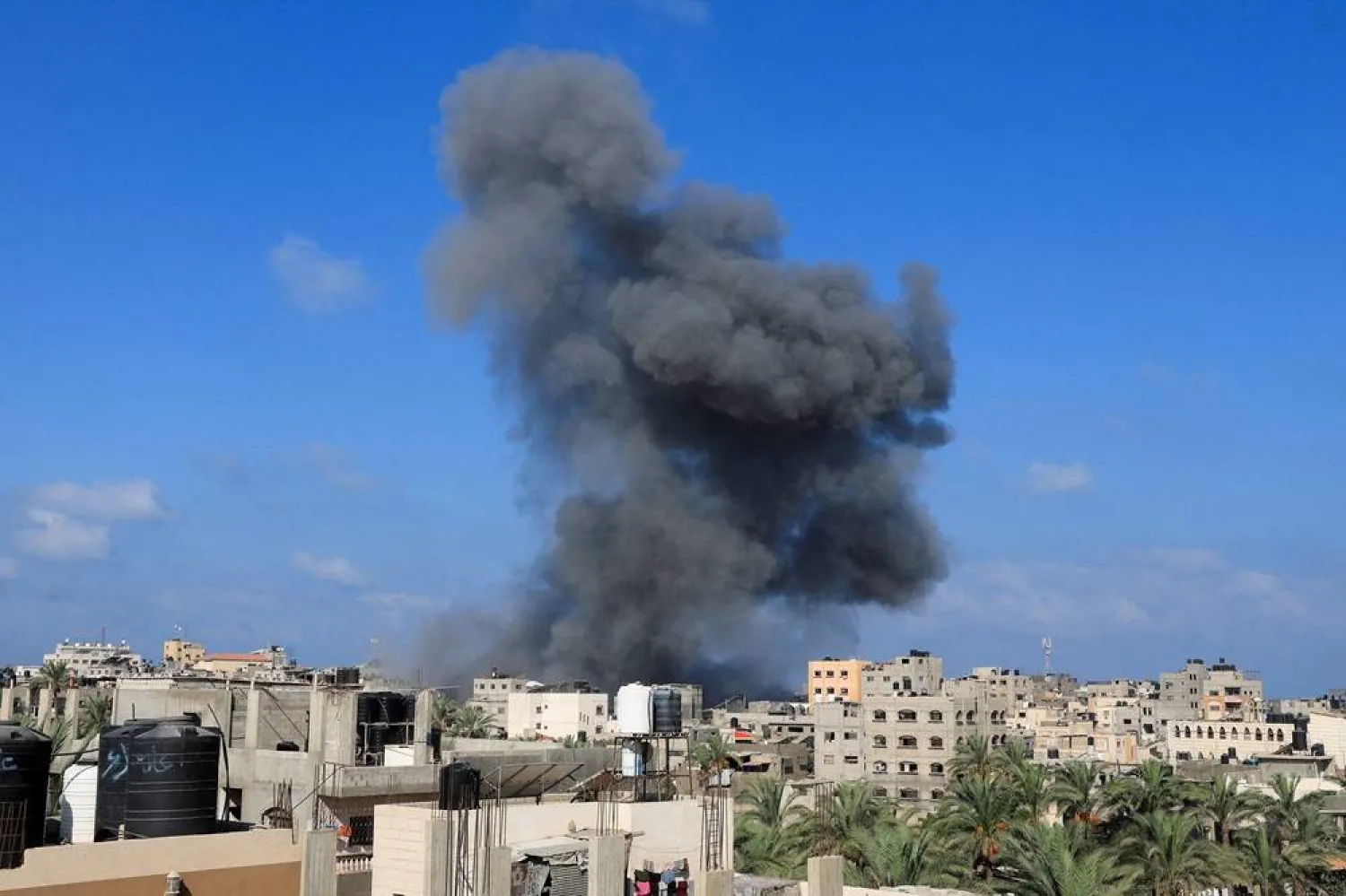
Smoke rises following an Israeli strike, in Deir al-Balah, in the central Gaza Strip, August 23, 2025. (Reuters)
TT

Israeli Strikes and Gunfire Kill 33 as Gaza City Becomes Focus of Famine and a Military Offensive

Smoke rises following an Israeli strike, in Deir al-Balah, in the central Gaza Strip, August 23, 2025. (Reuters)

Israeli strikes and gunfire killed at least 33 Palestinians in Gaza on Saturday, including people sheltering in tents or seeking scarce food, local hospitals said as a famine in Gaza’s largest city puts new pressure on Israel over its 22-month offensive.

Israel's defense minister has warned that Gaza City could be destroyed in a new military operation perhaps just days away, even as famine spreads there.

Aid groups have long warned that the war, sparked by Hamas’ Oct. 7, 2023, attack, and months of Israeli restrictions on food and medical supplies entering Gaza are causing starvation.

Israel has rejected the data-based famine declaration as "an outright lie." Ceasefire efforts are on hold as mediators await Israel’s next steps.

Women and children struck and killed in tents

Israeli strikes killed at least 14 people in southern Gaza, more than half of them women and children, according to morgue records and health officials at Nasser Hospital. The officials said the strikes targeted tents sheltering displaced people in Khan Younis.

"Awad, why did you leave me?" a small boy asked his brother's plastic-wrapped body.

Another grieving relative, Hekmat Foujo, pleaded for a truce.

"We want to rest," Foujo said through her tears. "Have some mercy on us."

In northern Gaza, Israeli gunfire killed at least five aid-seekers near the Zikim crossing with Israel, where UN and other agencies' truck convoys enter the territory, health officials at the Sheikh Radwan field hospital told the AP.

Six people were killed in attacks elsewhere, according to hospitals and the Palestinian Red Crescent.

Israel's military said it was not aware of a strike in Khan Younis at that location and was looking into the other incidents.

Braving gunfire and crowds for food

Mohamed Saada was among thousands of people who sought food from a delivery in the Zikim area on Saturday and one of many who left empty-handed.

"I came here to bring food for my children but couldn’t get anything, due to the huge numbers of people and the difficulty of the situation between the shootings and the trucks running over people," he said.

Some carried sacks of food like lentils and flour. Others carried the wounded, including on a wooden pallet. They navigated fetid puddles and the rubble of war as temperatures reached above 92 degrees Fahrenheit (33 Celsius).

Friday's report by the Integrated Food Security Phase Classification said Gaza City is gripped by famine that is likely to spread if fighting and restrictions on aid continue. It said nearly half a million people in Gaza — about one-fourth of the population — face catastrophic hunger.

The rare pronouncement came after Israel imposed a 2 1/2-month blockade on Gaza earlier this year, then resumed some access with a focus on a new US-backed private aid supplier, the Gaza Humanitarian Foundation.

In response to global outrage over images of emaciated children, Israel has also allowed airdrops and a new influx of aid by land, but the UN and others say it's still far from enough.

AP journalists have seen chaos on roads leading to aid deliveries, and there have been almost daily reports of Israeli troops firing toward aid-seekers. Israel's military says it fires warning shots if people approach troops or pose a threat.

Israeli Prime Minister Benjamin Netanyahu’s office asserts it has allowed enough aid to enter during the war, while accusing Hamas of starving the Israeli hostages it holds.

An increase in Israeli airstrikes this month

With ground troops already active in strategic areas, the military operation in Gaza City could start within days in an area that has hundreds of thousands of civilians.

Aid group Doctors without Borders, or MSF, said its clinics around Gaza City are seeing high numbers of patients as people flee. Caroline Willemen, MSF project coordinator in the city, noted a marked increase in airstrikes since early August.

"Those who have not moved are wondering what they should do," she told the AP. "People want to stay, they have been displaced endlessly before, but they also know that at some point it will become very dangerous to remain."

Israel's military has said troops are operating on the outskirts of Gaza City and in the city’s Zeitoun neighborhood. Israel says Gaza City is still a Hamas stronghold, with a network of militant tunnels.

Ceasefire efforts await Israel's response

Many Israelis fear the assault on Gaza City could doom the 20 hostages who are believed to have survived captivity since 2023. A further 30 are thought to be dead. Hundreds of thousands of Israelis protested a week ago for a deal to end the war and bring everyone home.

Netanyahu said Thursday he had instructed officials to begin immediate negotiations to release hostages and end the war on Israel’s terms. It was unclear if Israel would return to talks mediated by the United States, Egypt and Qatar after Hamas said earlier this week it accepted a new proposal from Arab mediators.

Hamas has said it will release hostages in exchange for ending the war, but rejects disarming without the creation of a Palestinian state.

US President Donald Trump has expressed frustration with Hamas’ stance, suggesting the group is less interested in making deals with few hostages left alive.

"I actually think (the hostages are) safer in many ways if you went in and you really went in fast and you did it," Trump told reporters Friday.

Gaza's Health Ministry said at least 62,622 Palestinians have been killed in the war, including missing people now confirmed dead by a special ministry judicial committee.

The total number of malnutrition-related deaths rose by eight to 281, the ministry said.

Israeli protest against far-right minister

A small group of Israelis protested against the far-right national security minister, Itamar Ben-Gvir, as he walked to a synagogue in Kfar Malal, north of Tel Aviv. Videos showed the minister arguing with the protesters.

"We don’t want him in our village. Our message is to bring back the hostages," one of the protesters, Boaz Levinstein, told the AP.

Ben-Gvir is a key partner in Netanyahu’s political coalition and a staunch opponent of reaching a deal with Hamas, which hostages’ families see as the only way to secure the release of loved ones.

Will Lebanon Be the Biggest Loser After the Ceasefire?

Smoke rises after an Iranian missile is intercepted over the Sahel Alma area in Mount Lebanon. (Reuters)
TT

Will Lebanon Be the Biggest Loser After the Ceasefire?

Smoke rises after an Iranian missile is intercepted over the Sahel Alma area in Mount Lebanon. (Reuters)

Political sources in Beirut warned Lebanon could emerge as the biggest loser when the current regional war ends, outlining their concerns to Asharq Al-Awsat.

Lebanon is heading toward a severe internal crisis, the sharpest in its modern history with the dispute centering on Hezbollah’s weapons.

The majority of Shiites in the country insists on keeping them, while most other segments say Lebanon’s survival depends on implementing government decisions to limit arms to the state, in line with Lebanese, Arab, and international positions.

The sources noted that Hezbollah has again entered a regional war it cannot influence, risking burdens Lebanon cannot bear.

Hefty price

The war is proving costly for those involved and for countries hit by its spillover.

A ceasefire would likely show Iran suffered heavy damage to its defense, industrial sectors, and infrastructure, potentially setting it back decades. But its size, energy resources, and experience with economic hardship may help it manage the aftermath, unless losses destabilize the system.

Iranian missiles are expected to have caused damage to Israeli institutions and infrastructure, despite a high interception rate. The cost of interception is steep, but Israel appears ready to absorb it, calling the conflict an existential war and relying on strong US support.

Lebanon will struggle the most. Its economy is already near collapse. The country faces a catastrophic situation, with about one million displaced and heavy destruction along the border with Israel.

Israel has said it intends to establish a “buffer zone” inside Lebanese territory, signaling a return of occupation to parts of the country “pending guarantees for the safety of Galilee residents.”

The most dangerous scenario is that Israel’s campaign on the Lebanese front continues even if a ceasefire is reached between the US and Israel on one side and Iran on the other.

The fallout is worsened by a deepening rift among Lebanon’s components, raising the risk of internal conflict.

The role of parliament Speaker Nabih Berri appears diminished as the conflict widens. The current crisis over the expulsion of the Iranian ambassador reflects a deeper divide between the Shiite camp and others over weapons, the war, and Lebanon’s regional role.

Hezbollah described the expulsion as a “sin”, demanding that the government reverse it.

‘Impossible to coexist’

Voices are rising in Lebanon, warning that it was “impossible to coexist” between a “quasi-state” and a “Hezbollah’s statelet.”

Countries that once backed Lebanon’s reconstruction, especially in the Gulf, are now focused on their own losses from Iranian attacks. They have also made clear that they will not help unless the Lebanese state takes full control over decisions of war and peace.

The sources reiterated their warning that Lebanon risks being the biggest loser, especially if Israel expands its ground offensive and internal divisions deepen to the point of questioning the country’s very formula of coexistence.


Netanyahu Says Israel Is Expanding ‘Buffer Zone’ in Lebanon

Smoke billows from an Israeli strike on Marjeyoun in southern Lebanon on Wednesday. (AFP)
TT

Netanyahu Says Israel Is Expanding ‘Buffer Zone’ in Lebanon

Smoke billows from an Israeli strike on Marjeyoun in southern Lebanon on Wednesday. (AFP)

Israeli Prime Minister Benjamin Netanyahu said on Wednesday that his country's forces were expanding a "buffer zone" in southern Lebanon as the military pressed ahead with its campaign against Hezbollah.

"We have created a genuine security zone preventing any infiltration toward the Galilee and the northern border," Netanyahu said in a video statement.

"We are expanding this zone to push the threat from anti-tank missiles further away and to establish a broader buffer zone."

Netanyahu said that dismantling Hezbollah "remains central" to Israel's objectives in Lebanon.

"It is connected to the broader confrontation with Iran," he said.

"We are determined to profoundly transform the situation in Lebanon," he added.

Lebanon was pulled into the Middle East war when Iran-backed Hezbollah began firing rockets into Israel on March 2 to avenge the killing of Iran's supreme leader Ali Khamenei.


Strike on Western Iraq Kills Seven Security Personnel

Members of Iraq's PMF carry the coffin of the PMF operations commander for Al-Anbar, Saad Dawai alongside others during a mass funeral in Baghdad on March 24, 2026. (AFP)
TT

Strike on Western Iraq Kills Seven Security Personnel

Members of Iraq's PMF carry the coffin of the PMF operations commander for Al-Anbar, Saad Dawai alongside others during a mass funeral in Baghdad on March 24, 2026. (AFP)

A strike on a base in western Iraq killed seven security personnel, the defense ministry said Wednesday, a day after an attack on the same base targeted the Popular Mobilization Forces.

"This resulted in the death of seven of our heroic fighters and the injury of 13 others," the ministry said of the strike in Anbar province, saying it specifically targeted the base's military healthcare clinic.

Rescue operations were ongoing, it added.

The base hosts Iraqi police, soldiers from the regular army and PMF, a security official told AFP.

It was hit by a deadly strike on Tuesday that the former paramilitaries blamed on the United States.

Iraq said late on Tuesday it would summon the US charge d'affaires and the Iranian ambassador after deadly strikes blamed on their countries, as Iraqi authorities granted the targeted groups the "right to respond".

Iraq has been pulled into the war sparked by US and Israeli strikes on Iran on February 28, and which has since engulfed much of the region.

Iraq has long been a proxy battleground for the United States and Iran, and has struggled to balance diplomatic ties with both countries.

Since the war began, pro-Iran armed groups have claimed responsibility for attacks on US interests in Iraq and across the region, while strikes have also targeted these groups, including state-linked positions.

In the statement from the prime minister's office, however, Iraq granted former paramilitaries within the official armed forces the right to "respond to military attacks" by drones and aircraft that targeted their headquarters.