


Israel’s Netanyahu Warns Gaza City Residents to Leave Now

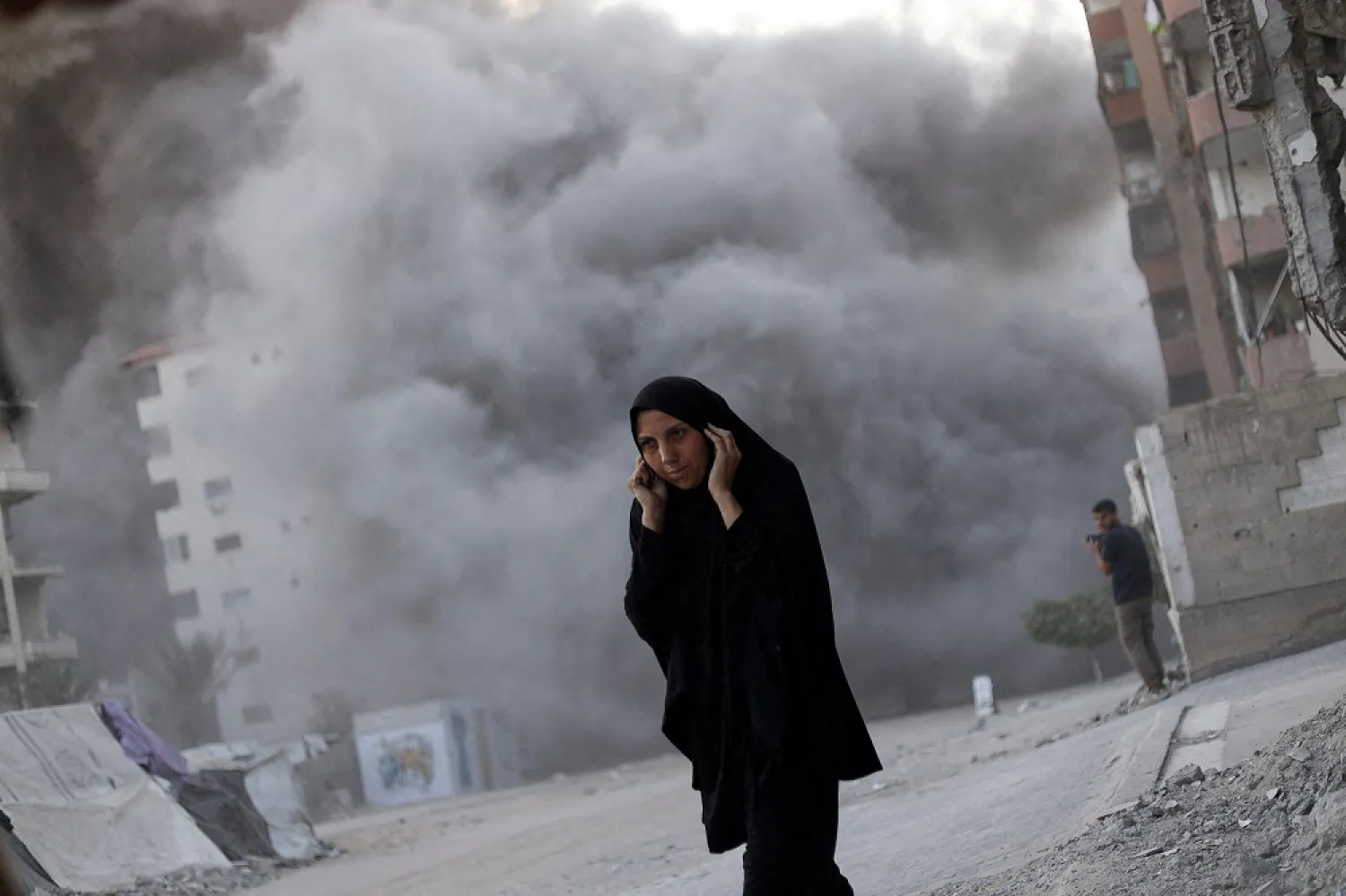
A Palestinian woman reacts as smoke rises, while a residential building collapses after an Israeli air strike, in Gaza City, September 7, 2025. (Reuters)
TT

Israel’s Netanyahu Warns Gaza City Residents to Leave Now

A Palestinian woman reacts as smoke rises, while a residential building collapses after an Israeli air strike, in Gaza City, September 7, 2025. (Reuters)

Israeli Prime Minister Benjamin Netanyahu warned on Monday residents of Gaza City to leave now, hours after Israel said it would ramp up airstrikes on the enclave. 

He said: "I say to the residents of Gaza, I take this opportunity and listen to me carefully: you have been warned — leave now!” 

Netanyahu said forces are now organizing and assembling into Gaza City for a ground "maneuver". 

Earlier on Monday, Israel's defense minister told Hamas to lay down its arms or face annihilation, after US President Donald Trump said the group must accept a deal to release hostages in Gaza.  

The warnings came as the Israeli military intensified its bombings and operations around Gaza City, which it has vowed to capture in a bid to finally defeat Hamas after nearly two years of devastating conflict.  

At least 48 people were killed in Israeli attacks in Gaza on Sunday, while another 10 were killed in strikes around Gaza City overnight, the civil defense agency reported. AFP has contacted the Israeli military for comment. 

Hamas, whose unprecedented October 2023 attack on Israel sparked the war, said shortly after Trump's comments that it was ready for immediate talks, but the terms it gave for a deal appeared largely unchanged from previous rounds of negotiations. 

"This is a final warning to the Hamas murderers and rapists in Gaza and in luxury hotels abroad: Release the hostages and put down your weapons -- or Gaza will be destroyed and you will be annihilated," Israeli Defense Minister Israel Katz said on X.  

"Today, a massive hurricane will hit the skies of Gaza City and the roofs of the terror towers will tremble," he wrote, adding that the military was "preparing to expand" operations to conquer Gaza City.  

Israel has not publicly announced the start of its offensive to seize the city, but on Sunday it bombed a third high-rise in as many days, saying it was being used by Hamas "to monitor the location of... troops in the area".  

Hamas has denied using residential buildings for military purposes.  

Trump said Sunday he was issuing a "last warning" to the group, insisting it accept a deal to release the hostages seized during fighters' October 2023 attack. The Israeli military says 47 hostages remain in Gaza, including 25 believed to be dead.  

"The Israelis have accepted my terms. It is time for Hamas to accept as well. I have warned Hamas about the consequences of not accepting. This is my last warning," Trump said on social media, without elaborating further.  

- Ready to negotiate -  

In a statement released shortly after Trump's, Hamas said it was ready to "immediately sit at the negotiating table" following what it described as "some ideas from the American side aimed at reaching a ceasefire agreement".  

In exchange, it said it wanted "a clear declaration of the end of the war, a full withdrawal from the Gaza Strip, and the formation of a committee of independent Palestinians to manage the Gaza Strip, which would begin its duties immediately".  

US news outlet Axios reported that White House envoy Steve Witkoff sent a new proposal for a Gaza hostage and ceasefire deal to Hamas last week.  

The White House has not released any details about the proposal, but late Sunday Trump said "you'll be hearing about it pretty soon", portraying the negotiations in a positive light.  

"I think we're going to have a deal on Gaza very soon," he told reporters.  

In early March, Trump issued a similar ultimatum to Hamas, demanding it free all living hostages immediately and turn over the bodies of the dead, saying if not, "it is OVER for you".  

Hamas agreed last month to a ceasefire proposal that involved a 60-day truce and staggered hostage releases. 

Israel, however, has demanded the group release all the hostages at once, disarm and relinquish control of Gaza, among other conditions.  

Hamas's October 7, 2023 attack on Israel resulted in the deaths of 1,219 people, mostly civilians, according to an AFP tally based on Israeli figures.  

Israel's retaliatory offensive has killed at least 64,368 Palestinians, most of them civilians, according to figures from the health ministry in Hamas-run Gaza that the United Nations considers reliable.  

Media restrictions in Gaza and difficulties in accessing many areas mean AFP is unable to independently verify the tolls and details provided by the civil defense agency or the Israeli military. 


Iran’s Araqchi to Visit Beirut After Lebanese FM Declines Trip to Tehran

Iranian Foreign Minister Abbas Araqhchi looks on during a press conference in Istanbul, Türkiye, June 22, 2025. REUTERS/Umit Bektas/File Photo
TT

Iran’s Araqchi to Visit Beirut After Lebanese FM Declines Trip to Tehran

Iranian Foreign Minister Abbas Araqhchi looks on during a press conference in Istanbul, Türkiye, June 22, 2025. REUTERS/Umit Bektas/File Photo

Iran's foreign minister, Abbas Araqchi, said on Thursday he would travel to Beirut for talks after receiving a formal invitation from his Lebanese counterpart, who a day earlier had declined to visit Tehran for direct talks.

On Wednesday, Lebanese Foreign Minister Youssef Raji said "current conditions" prevented him from travelling to Tehran, but stressed that the move did not mean rejection of dialogue with Iran.

Raji told Reuters late on Wednesday that he had invited Araqchi "in a formal diplomatic letter to come to Beirut to hold talks."

Araqchi said on X that he would "gladly accept the invitation to come to Beirut," although he said he found Raji's position "bemusing." He said foreign ministers of countries with "full diplomatic relations" did not need a neutral venue to meet.

"Subjected to Israeli occupation and blatant 'ceasefire' violations, I fully understand why my esteemed Lebanese counterpart is not prepared to visit Tehran," Araqchi added.

Raji said on Wednesday that Lebanon was ready to open a new phase of relations with Iran based on mutual respect, sovereignty and non-interference.

He added that no strong state could be built unless the government held the exclusive right to bear arms, in an apparent reference to calls to disarm Hezbollah, the Iran-aligned Lebanese armed group.


Berri Rejects Threats to Lebanese, Stands Firm on ‘Constants’ in Israel Talks

Lebanon Speaker Berri Receives United States Ambassador Michel Issa (Parliament)
TT

Berri Rejects Threats to Lebanese, Stands Firm on ‘Constants’ in Israel Talks

Lebanon Speaker Berri Receives United States Ambassador Michel Issa (Parliament)

Lebanon’s Parliament Speaker Nabih Berri dismissed what he called efforts to intimidate the Lebanese and underscored the "fundamental constants” that he says anchor negotiations with Israel via the Mechanism Committee.

He insisted that the May parliamentary elections will go ahead as scheduled and described his personal relationship with Saudi Arabia as “very good”, adding that ties between Lebanon and the kingdom were “good”.

Berri made the remarks during a meeting with senior Lebanese journalists from the Press Syndicate headed by Aouni Al-Kaaki.

His comments coincided with his second meeting in 24 hours with the United States ambassador to Beirut, Michel Issa.

According to a statement from the Speaker’s office, the talks reviewed “developments in the general situation and the latest events, as well as bilateral relations”.

Barrack’s “mistake”

Responding to a question from the syndicate on “threats voiced by some diplomats, especially repeated remarks by United States envoy Tom Barrack about joining Lebanon to Syria”, Berri said: “No one threatens the Lebanese."

"It is inconceivable to address the Lebanese in such language, especially from diplomats, let alone from someone like Ambassador Tom Barrack. What he said about annexing Lebanon to Syria is a big mistake that is completely unacceptable,” he added.

Berri said the Lebanese have “no alternative and no escape” from facing risks, repercussions and threats from any side except through unity, adding, “With unity we can liberate the land.”

Turning to the ceasefire agreement and negotiations, Berri asked, “Is the Mechanism Committee not a negotiating framework?”

“There are constants we negotiate through this committee, namely Israeli withdrawal, deployment of the Lebanese Army, and limiting weapons in the area south of the Litani to the hands of the Lebanese Army,” he explained, adding that the committee operates under American, French and United Nations sponsorship.

He added, “I have said more than once that there is no objection to bringing in any civilian or technical figure if needed, provided the agreement is implemented.”

Berri said Lebanon has fulfilled all required steps since November 2024. He said the Lebanese Army has deployed more than 9,300 officers and soldiers with the support of UNIFIL, which confirmed in its latest reports Lebanon’s compliance with all its obligations.

He added that Israel has violated the agreement with about 11,000 breaches.

Berri said the Lebanese Army has implemented 90 percent of the ceasefire provisions south of the Litani and will fully complete the remaining steps by the end of the year.

He said this was confirmed by UNIFIL, the Mechanism Committee and Army Commander General Rodolf Haykal.

“It is unfortunate that no one is asking whether Israel has complied with even a single clause of the ceasefire agreement. Instead, it has expanded its occupation of Lebanese territory,” he said.

No cancellation of parliamentary elections

On calls by some parliamentary blocs to amend the electoral law regarding expatriate voting, Berri said the existing law is in force and the elections will be held according to it.

“There will be no cancellation and no postponement. Everyone wants elections,” he said.

He added that he remains open to any formula leading to consensus on outstanding issues that divide political forces, especially the question of expatriates.

“No one wants to exclude expatriates. Even so, I have said and will repeat that we should implement the Taif Agreement in its provisions related to the electoral law and the establishment of a Senate. But are they willing?” he asked.

Berri reiterated that Lebanese bank deposits are “sacred rights” and warned that these rights must not be compromised, surrendered or accepted as lost.


Talks Fail on Transfer Mechanism for Syrian Prisoners in Lebanon

Prisoners stroll through a yard inside Roumieh prison, northeast of Beirut, on April 7, 2006. AFP
TT

Talks Fail on Transfer Mechanism for Syrian Prisoners in Lebanon

Prisoners stroll through a yard inside Roumieh prison, northeast of Beirut, on April 7, 2006. AFP

A Lebanese judicial delegation has returned from Damascus empty-handed, failing to secure the breakthrough it sought on a new treaty governing the transfer of Syrian prisoners held in Lebanon.

The talks instead laid bare deep rifts between the two sides, with Syria rejecting most of the proposed text and arguing that it fell short of even the minimum required to ensure the return of its nationals.

No agreement on all points

Even so, the Lebanese delegation sought to play down the gaps. A source close to the team said the atmosphere was positive but that there was no agreement on all points.

The source told Asharq Al-Awsat that Lebanon was cooperating with Damascus on the Syrian detainee file and appreciated Syria’s desire to complete the trials of those held in Lebanon or allow convicts to serve their sentences on Syrian territory.

The source acknowledged that the draft treaty applied only to convicts and did not include those still on trial, since handing over detainees requires a law issued by the Lebanese parliament, which is not currently possible.

Lebanon’s efforts to show flexibility did not receive a similar response in Damascus. Sources familiar with the meeting held in the Syrian capital described the draft agreement as loaded with problematic provisions and said it was unacceptable.

They said the two sides remained locked in disputes over two articles that Damascus viewed as attempts by Lebanon to sidestep understandings reached during talks in Damascus last month.

One article states that the transferring state, Lebanon, may refuse to hand over any convict or detainee without providing justification, based on considerations specific to it.

The sources said this effectively gave Lebanon the right to refuse the transfer of any Syrian prisoner without being required to present legal grounds.

The second, more sensitive, provision for the Syrians concerned what they saw as interference in the powers of Syrian authorities.

The sources said Article 10 of the treaty, which Lebanon intended to model after its agreement with Pakistan, stipulated that Syria, as the receiving state, may not grant amnesty to any convict or detainee handed over by Lebanon.

The agreement with Pakistan does not prohibit Islamabad from granting amnesty to its nationals returned from Lebanon.

The sources said Syria had already discussed all aspects of the agreement during its delegation’s visit to Beirut and had expressed a desire for Lebanon to facilitate the transfer of convicts and detainees under a clear mechanism that respects Lebanese sovereignty and applicable laws.

This mechanism would ban any Syrian who had been detained or convicted in Lebanon from reentering the country, and would allow Lebanese authorities to arrest and prosecute anyone who violates the ban.

Syrian dissatisfaction

Sources who followed Wednesday’s meeting in Damascus said the Syrian side was deeply dissatisfied with what it saw as Lebanese intransigence and a lack of flexibility, particularly since some of the convicts covered by the treaty have spent more than 11 years in Lebanese prisons.

Others remained in pretrial detention for years before their sentences were issued.

Damascus also informed the Lebanese delegation that it would not request the return of anyone proven to have killed Lebanese soldiers or carried out bombings that caused civilian casualties.

Tensions around the file heightened after the Lebanese delegation left Damascus without setting a date for another round of negotiations.

The sources expressed concern that Syria’s rejection of the draft could halt the dialogue altogether and strain bilateral relations.

Damascus has repeatedly said that establishing stable and strong ties requires a final resolution to the Syrian prisoners’ file in Lebanon, especially since most Syrians detained or convicted on terrorism charges had been part of the Syrian uprising, and their arrest and prosecution in Lebanon stemmed from their political choices.
