


Rubio Arrives in Israel as Israeli Strikes Intensify in Northern Gaza

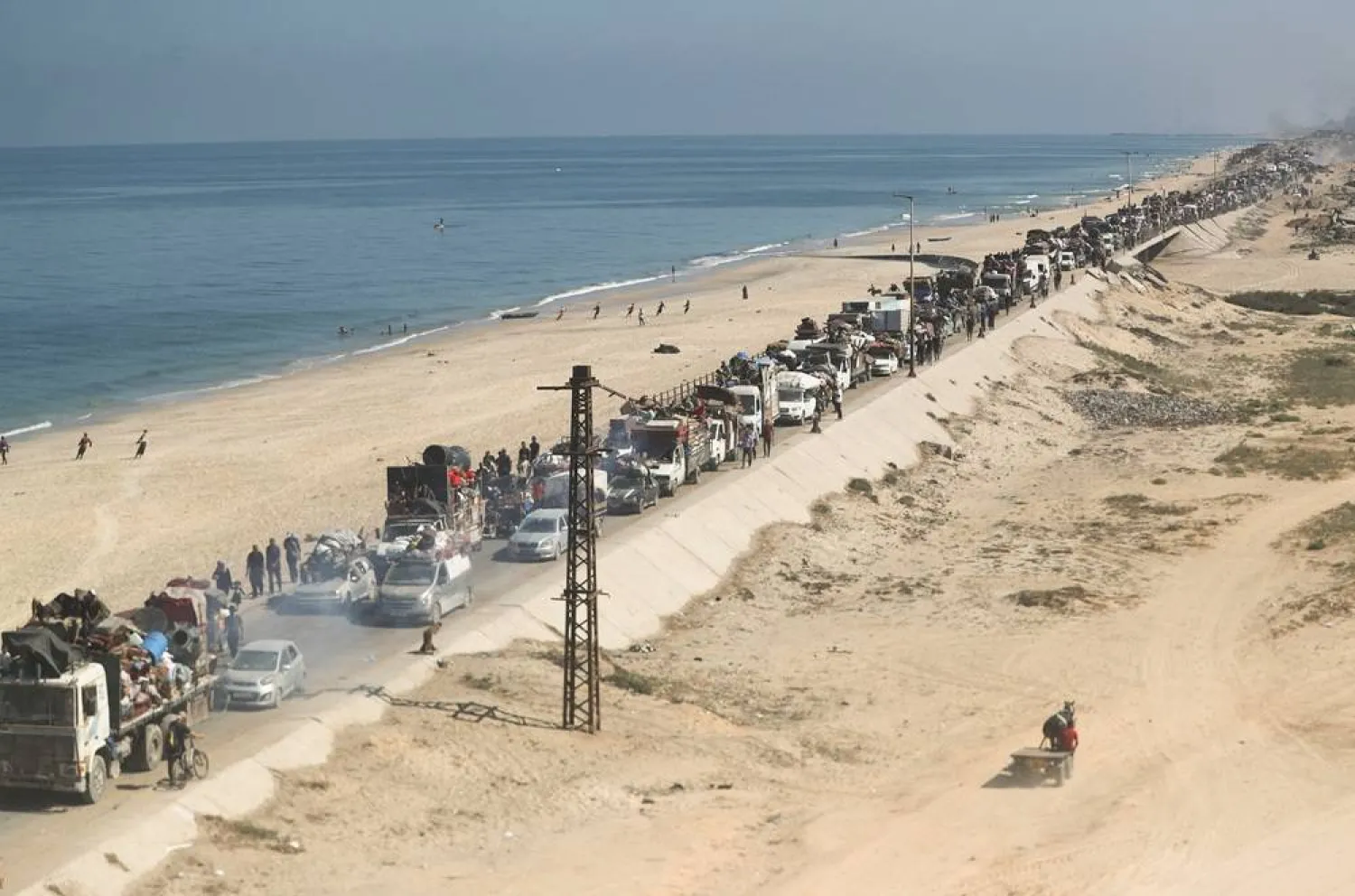
 Displaced Palestinians, fleeing northern Gaza due to an Israeli military operation, move southward after Israeli forces ordered residents of Gaza City to evacuate to the south, in the central Gaza Strip September 14, 2025. (Reuters)
Displaced Palestinians, fleeing northern Gaza due to an Israeli military operation, move southward after Israeli forces ordered residents of Gaza City to evacuate to the south, in the central Gaza Strip September 14, 2025. (Reuters)
TT

Rubio Arrives in Israel as Israeli Strikes Intensify in Northern Gaza

 Displaced Palestinians, fleeing northern Gaza due to an Israeli military operation, move southward after Israeli forces ordered residents of Gaza City to evacuate to the south, in the central Gaza Strip September 14, 2025. (Reuters)
Displaced Palestinians, fleeing northern Gaza due to an Israeli military operation, move southward after Israeli forces ordered residents of Gaza City to evacuate to the south, in the central Gaza Strip September 14, 2025. (Reuters)

US Secretary of State Marco Rubio arrived in Israel on Sunday, as Israel intensified its attacks against northern Gaza, flattening another high-rise building and killing at least 12 Palestinians.

Rubio said ahead of the trip that he will be seeking answers from Israeli officials about how they see the way forward in Gaza following Israel’s attack on Hamas operatives in Qatar last week that upended efforts to broker an end to the conflict.

His two-day visit is also a show of support for the increasingly isolated Israel as the United Nations holds what is expected to be a contentious debate on commitment to the creation of a Palestinian state. Israeli Prime Minister Benjamin Netanyahu strongly opposes the recognition of a Palestinian state.

Attack on Qatar

Rubio's visit went ahead despite President Donald Trump’s anger at Netanyahu over the Israeli strike against Hamas leaders in Doha, which he said the United States was not notified of beforehand.

On Friday, Rubio and Trump met with Qatar’s prime minister to discuss the fallout from the Israeli operation. The dual, back-to-back meetings with Israel and Qatar illustrate how Trump administration is trying to balance relations between key Middle East allies despite the attack’s widespread international condemnation.

The Doha attack also appears to have ended attempts to secure an Israel-Hamas ceasefire and the release of hostages ahead of the upcoming UN General Assembly session, at which the Gaza war is expected to be a primary focus.

Deadly airstrikes mount

On Sunday, at least 13 Palestinians were killed and dozens were wounded in multiple Israeli strikes across Gaza, according to local hospitals.

Local hospitals said Israeli strikes targeted a vehicle near Shifa hospital and a roundabout in Gaza City, and a tent in the city of Deir al-Balah that killed at least six members of the same family.

Two parents, their three children and the children’s aunt were killed in that strike, according to the Al-Aqsa hospital. The family was from the northern town of Beit Hanoun, and arrived in Deir al-Balah last week after fleeing their shelter in Gaza City

The Israeli military did not have immediate comment on the strikes.

As part of its expanding operation in Gaza City, the Israeli military destroyed a high-rise residential building on Sunday morning, less than an hour after an evacuation order posted online by the military spokesman Avichay Adraee.

Residents said the Kauther tower in the Rimal neighborhood was flattened to the ground. There were no immediate reports of casualties.

“This is part of the genocidal measures the (Israeli) occupation is carrying out in Gaza City,” said Abed Ismail, a Gaza City resident. “They want to turn the whole city into rubble, and force the transfer and another Nakba.”

The word Nakba is Arabic for catastrophe and refers to when some 700,000 Palestinians were expelled by Israeli forces or fled their homes in what is now Israel, before and during the 1948 war that surrounded its creation.

Israeli strongly denies accusations of genocide in Gaza.

Starvation in Gaza

Separately, two Palestinian adults died of causes related to malnutrition and starvation in the Gaza Strip over the last 24 hours, the territory’s health ministry reported Sunday.

That has brought the death toll from malnutrition-related causes to 277 since late June, when the ministry started to count fatalities among this age category, while another 145 children died of malnutrition-related causes since the start of the war in October 2023, the ministry said.

The war in Gaza began when Hamas-led fighters stormed into southern Israel on Oct. 7, 2023, abducting 251 people and killing some 1,200, mostly civilians. There are still 48 hostages remaining in Gaza, of whom 20 Israel believes are still alive.

Israel’s retaliatory offensive has killed at least 64,803 Palestinians, according to Gaza’s Health Ministry, which does not say how many were civilians or combatants. It says around half of those killed were women and children. Large parts of major cities have been completely destroyed and around 90% of some 2 million Palestinians have been displaced.



Israeli Forces Kill Two West Bank Teenagers

Israeli soldiers ride in the Merkava main battle tank at a position in northern Israel along the border with southern Lebanon on November 6, 2025. (Photo by Jalaa MAREY / AFP)
TT

Israeli Forces Kill Two West Bank Teenagers

Israeli soldiers ride in the Merkava main battle tank at a position in northern Israel along the border with southern Lebanon on November 6, 2025. (Photo by Jalaa MAREY / AFP)

The Israeli military said Friday it had killed two suspects it said threw Molotov cocktails in the occupied West Bank village of Judeira overnight.

The Palestinian health ministry identified the dead as two 16-year-old boys.

The military said in a statement that a unit deployed in the area "eliminated" the individuals, a word Israeli officials generally use when suspects are killed.

The army published a surveillance camera video in which two individuals are seen throwing a burning object over a wall matching the appearance of the one separating the area near Judeira from a road used by Israelis.

Though located in the West Bank, which Israel has occupied since 1967, Judeira is surrounded by roads and lands that are effectively annexed by Israel.

The Ramallah-based Palestinian health ministry identified the two individuals as Mohammed Ateem and Mohammed Qasim, both 16.

In a statement, the ministry added that the Israeli army had retrieved the two teenagers' bodies.

On Wednesday, the military killed another teenager who it said had thrown an explosive device at Israeli troops.

In a statement Friday, the military said it had killed three militants and arrested 60 "wanted individuals" this week in the occupied West Bank.

Violence in the West Bank has soared since the war in Gaza broke out in October 2023.


Piles of Garbage and Seeping Sewage Pollute Devastated Gaza

Displaced Palestinians sit next to their destroyed homes in Khan Yunis camp in the southern Gaza Strip, 05 November 2025. EPA/HAITHAM IMAD
TT

Piles of Garbage and Seeping Sewage Pollute Devastated Gaza

Displaced Palestinians sit next to their destroyed homes in Khan Yunis camp in the southern Gaza Strip, 05 November 2025. EPA/HAITHAM IMAD

Stinking mounds of fly-covered garbage lie strewn throughout Gaza amid the rubble from Israel's devastating military campaign, spilling out along roadsides and between the tents where most of the shattered enclave's people live. Government services such as rubbish collection ceased as soon as the war began and although they are partially returning since the truce last month, the massive extent of destruction means any more thorough cleanup lies far in the future, said Reuters.

"I don't smell any fresh air. I smell a foul odor in my tent. I can't sleep. My children wake up in the morning coughing," said Mahmoud Abu Reida, gesturing at the dumpster by the tent he shares with his wife and four children in Khan Younis.

Rotting garbage, sewage-filled pools, hazardous waste from bomb sites and noxious smoke from burning cloth and plastic have birthed a fetid environment for Gazans.

"The scale of the waste problem in Gaza is huge," said Alessandro Mrakic, head of the Gaza office of the UN development agency UNDP.

Waste landfill sites were already full before the start of the war and three major dump sites were located along the border with Israel in areas that are now off limits to Palestinians, he said. "We're talking about 2 million tons of waste - untreated - all across Gaza," Mrakic said, adding that the risks to the environment, to the aquifer that much of Gaza's water comes from, and to the population's health were "immense".

Many people complain of gastric diseases and skin complaints from diarrhea to rashes, sores, lice and scabies, and doctors in the tiny, crowded Palestinian territory say pollution is to blame.

"Skin diseases have spread a lot because of overcrowding in tents and the tents are next to garbage dumps," said Sami Abu Taha, a dermatologist at the Kuwaiti field hospital in Khan Younis, lamenting the lack of medicine to treat such ailments.

One of Abu Reida's children has been repeatedly to the hospital, he said, where doctors had told him the boy was suffering from a bacterial infection that likely came from the rubbish container by the tent.

BOMBARDMENTS SMASH INFRASTRUCTURE

In another part of Khan Younis, Mahmoud Helles was sitting in his tent with his children - a sewage-filled pond standing nearby.

"We find nowhere to stay but in such places," he said, showing a rash of red spots on his arm and hand.

"This place is very, very difficult - it is full of diseases and epidemics because of war remnants, piles of garbage, and the lack of sewage treatment," he said.

Much of Gaza's wastewater and sewage infrastructure was badly damaged by Israel's bombardment and ground operations, leaving people to use open latrines that flood when it rains.

The United Nations is developing plans to deal with the waste problem, including considering options for processing plants that can generate electricity from waste, Mrakic said.

"Immediate action is needed, mainly through access of machinery, equipment, that will allow us to properly perform the job on the ground," he added.


Britain Removes Sanctions on Syria’s President, Interior Minister 

29 March 2025, Syria, Damascus: Syria's President Ahmed al-Sharaa speaks during the ceremony announcing the new Syrian government at the People's Palace. (dpa)
TT

Britain Removes Sanctions on Syria’s President, Interior Minister 

29 March 2025, Syria, Damascus: Syria's President Ahmed al-Sharaa speaks during the ceremony announcing the new Syrian government at the People's Palace. (dpa)

Britain removed sanctions on Syrian interim President Ahmed al-Sharaa on Friday, after the United Nations Security Council did the same ahead of his meeting with US President Donald Trump on Monday.

Britain said in the same statement that it was also lifting sanctions on Syria's interior minister Anas Khattab.

Both men had formerly been subject to financial sanctions targeted at ISIS and al-Qaeda.

"I think he's doing a very good job," Trump said on Thursday of Sharaa. "It's a tough neighborhood, and he's a tough guy, but I got along with him very well. And a lot of progress has been made with Syria."

"We did take the sanctions off Syria in order to give them a fighting shot," he told reporters in Washington.