


Rubio Meets Syria's Leader in New York as the Country's Isolation Eases Further

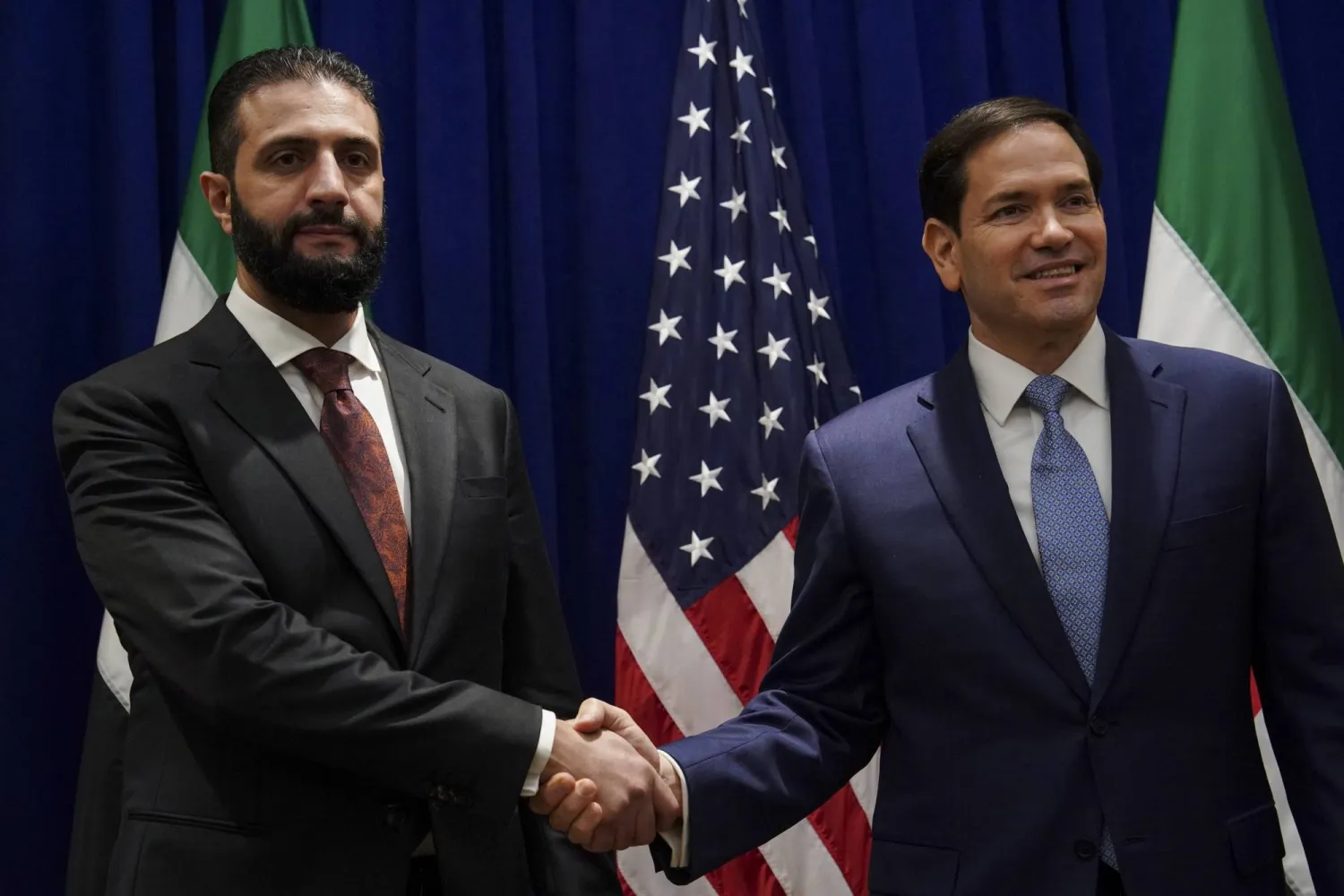
Secretary of State Marco Rubio shakes hands with Syrian interim President Ahmad al-Sharaa at the Lotte New York Palace Hotel, on the sidelines of the 80th United Nations General Assembly at the United Nations headquarters, Monday, Sept. 22, 2025. (Bing Guan/Pool Photo via AP)
TT

Rubio Meets Syria's Leader in New York as the Country's Isolation Eases Further

Secretary of State Marco Rubio shakes hands with Syrian interim President Ahmad al-Sharaa at the Lotte New York Palace Hotel, on the sidelines of the 80th United Nations General Assembly at the United Nations headquarters, Monday, Sept. 22, 2025. (Bing Guan/Pool Photo via AP)

Syrian President Ahmad al-Sharaa met Monday with US Secretary of State Marco Rubio in New York, expanding relations with the West and further easing his country's isolation as he becomes Syria's first leader to take part in a UN high-level meeting in nearly 60 years.

The last time a Syrian head of state attended the UN General Assembly gathering of world leaders was in 1967 — before the 50-year rule of the Assad family dynasty. A lightning opposition offensive led by al-Sharaa ousted Bashar Assad in December and brought nearly 14 years of civil war to an end.

Since then, al-Sharaa has sought to restore ties with Arab countries and the West.

President Donald Trump's administration has eased sanctions long imposed on Syria in a bid to ensure the country becomes a stable player in the Middle East following its global isolation under Assad.

Rubio “underscored this opportunity for Syria to build a stable and sovereign nation following President Trump’s historic announcement earlier this year on sanctions relief for the Syrian people,” the State Department said in a statement.

“They discussed ongoing counterterrorism efforts, efforts to locate missing Americans, and the importance of Israel-Syria relations in achieving greater regional security,” the department said.

However, al-Sharaa again expressed doubt that Syria would join the Abraham Accords, which saw several Arab states normalize relations with Israel during Trump's first term. That is even as Syria is in talks with the US and Israel over a potential security arrangement that could be finalized as early as this week.

“There’s a big difference between Syria and those members in the Abraham Accords,” he said earlier Monday at the Concordia Annual Summit, a global affairs forum in New York. “Syria is different. And those who are part of the Abraham Accords are not neighbors to Israel. Therefore, Syria as a neighbor has been subjected to over 1,000 raids, strikes and Israeli incursions.”

He added that “Syria has to be respected in this new era. There are different phases of negotiations with Israel to go back to the truce of 1974.”

The comments from al-Sharaa came in a conversation with retired Gen. David Petraeus, who commanded troops in the wars in Afghanistan and Iraq and previously served as CIA director.

They met in a New York conference hall after fighting on opposite sides of the US-led war in Iraq two decades ago.

At the forum, al-Sharaa praised Trump, whom he met in Saudi Arabia in May, for taking a “bold decision” on lifting many sanctions against Syria. “I think Syria deserves a new opportunity,” al-Sharaa said.

However, some sanctions remain, and the State Department had to waive Assad-era visa restrictions on Syria for al-Sharaa and his delegation so they could participate in the UN meeting of world leaders, which kicks off Tuesday.

Al-Sharaa urged the United States to remove the remaining sanctions, saying Syria needs help as it comes out of war and crisis.

“The Syrian people should not be killed another time through the sanctions,” he said. “The Syrian people love work. Lift the sanctions, and don’t worry about them.”

He also met in New York with Sen. Jeanne Shaheen and Rep. Gregory Meeks, ranking Democrats on the foreign relations committees, and Shaheen emphasized that Congress should pass legislation she is co-sponsoring to lift penalties still in place, according to a statement from the Senate committee.

Asked about incidents in the coastal region and the southern province of Sweida that have caused alarm in the US and elsewhere, al-Sharaa said “there was major chaos and everyone made mistakes.”

He noted that for the first time in 60 years, Syria has allowed international fact-finding teams into the country.

“The Syrian state will work on accountability against those found guilty even if they were the closest people to us,” he said.



Jordan Says King Abdullah Received Invitation to Join Gaza Peace Board

Palestinian girls walk past the rubble of residential buildings destroyed during the war, in Gaza City, January 16, 2026. REUTERS/Dawoud Abu Alkas
TT

Jordan Says King Abdullah Received Invitation to Join Gaza Peace Board

Palestinian girls walk past the rubble of residential buildings destroyed during the war, in Gaza City, January 16, 2026. REUTERS/Dawoud Abu Alkas

Jordan's foreign ministry said on Sunday that King Abdullah received an invitation from ‌US President ‌Donald ‌Trump ⁠to join ‌the so-called "Board of Peace" for Gaza.

The foreign ministry said it was ⁠currently reviewing ‌related documents ‍within ‍the country's ‍internal legal procedures.

The board is set to supervise the temporary governance of Gaza, ⁠which has been under a shaky ceasefire since October.

On Friday, the White House announced some members of a so-called "Board of Peace" that is to supervise the temporary governance of Gaza, which has been under a fragile ceasefire since October.

The names include US Secretary of State Marco Rubio, President Donald Trump's special envoy Steve Witkoff, former British Prime Minister Tony Blair and Trump's son-in-law, Jared Kushner. Trump is the chair of the board, according to a plan his White House unveiled in October.

The White House did not detail the responsibilities of each member of the "founding Executive board." The names do not include any Palestinians. The White House said ⁠more members will be announced over the coming weeks.

The board will also include private equity executive and billionaire ‌Marc Rowan, World Bank President Ajay Banga and Robert Gabriel, ‍a Trump adviser, the White House ‍said, adding that Nickolay Mladenov, a former UN Middle East envoy, will be the ‍high representative for Gaza.

Army Major General Jasper Jeffers, a US special operations commander, was appointed commander of the International Stabilization Force, the White House said. A UN Security Council resolution, adopted in mid-November, authorized the board and countries working with it to establish that force in Gaza.

The White House also named an 11-member "Gaza Executive Board" that will include Turkish Foreign Minister Hakan Fidan, the UN special coordinator for the Middle East ⁠peace process, Sigrid Kaag, the United Arab Emirates minister for international cooperation, Reem Al-Hashimy, and Israeli-Cypriot billionaire Yakir Gabay, along with some members of the executive board.

This additional board will support Mladenov's office and the Palestinian technocratic body, whose details were announced this week, the White House said.


Türkiye’s Kurdish Leader Calls Syria Clashes 'Sabotage'

American soldiers from the U.S.-led coalition against the ISIS organization stand on alert during a meeting with the Syrian Democratic Forces in Deir Hafir, Syria, the day before yesterday (AP).
TT

Türkiye’s Kurdish Leader Calls Syria Clashes 'Sabotage'

American soldiers from the U.S.-led coalition against the ISIS organization stand on alert during a meeting with the Syrian Democratic Forces in Deir Hafir, Syria, the day before yesterday (AP).

Recent deadly clashes in Syria between government forces and Kurdish fighters seek to "sabotage" the peace process between Türkiye and the Kurdistan Workers' Party (PKK), the jailed leader of the Kurdish militant group said.

Abdullah Ocalan, who has led the unfolding Turkish peace process from prison, "sees this situation (in Syria) as an attempt to sabotage the peace process" in Türkiye, a delegation from the pro-Kurdish DEM party said after visiting him in jail on Saturday.

The PKK leader last year called for the group to lay down its weapons and disband, after more than four decades of conflict that claimed at least 50,000 lives.

The delegation that visited him at Imrali prison island near Istanbul, where he has been held in solitary confinement since 1999, said he had "reaffirmed his commitment to the process of peace and democratic society" and called to "take the necessary steps to move forward".

The PKK made a similar warning earlier this month, saying the Syria clashes "call into question the ceasefire between our movement and Türkiye ".

The clashes in Syria erupted after negotiations stalled on integrating the Kurds' de facto autonomous administration and forces into the country's new government, which took over after the fall of longtime ruler Bashar al-Assad in 2024.

The Syrian army has seized swathes of the country's north, dislodging Kurdish forces from territory where they had held effective autonomy for more than a decade.

Türkiye, which views Kurdish fighters in Syria as a terror group affiliated with the PKK, has praised Syria's operation as fighting "terrorist organizations".


Aidarous al-Zubaidi Faces Corruption, Land-Grabbing Investigations

 Aidarous al-Zoubaidi (AFP) 
 Aidarous al-Zoubaidi (AFP) 
TT

Aidarous al-Zubaidi Faces Corruption, Land-Grabbing Investigations

 Aidarous al-Zoubaidi (AFP) 
 Aidarous al-Zoubaidi (AFP) 

Yemen’s Attorney General, Qaher Mustafa, has ordered the formation of a judicial committee to investigate allegations of corruption, illicit enrichment, and related crimes attributed to Aidarous al-Zubaidi, according to a decision issued on Saturday. The committee has been instructed to proceed in accordance with the law.

The probe will examine accusations including abuse of power, land seizures, illicit oil trading, and involvement in commercial companies. Observers say these practices have deepened political and social divisions in Yemen’s southern governorates, fueling public anger over financial and administrative corruption.

Dr. Fares al-Bayl, head of the Future Center for Yemeni Studies, told Asharq Al-Awsat that al-Zubaidi “lacks political capital and administrative experience,” but rose to senior positions amid Yemen’s worst economic and political crisis. He alleged that al-Zubaidi exploited these posts to seize public funds, undermine state institutions, and conspire with external actors.

Al-Bayl said al-Zubaidi diverted large budgets - estimated at 10 billion Yemeni riyals monthly - under the name of the Southern Transitional Council, without legal authorization. He accused him of withholding revenues from the Port of Aden, customs, and taxes from the Central Bank, and channeling funds to armed formations outside state control.

Additional claims include the imposition of illegal levies on traders and citizens, the creation of multiple revenue-collection checkpoints, and the failure to transfer taxes on qat, fuel, cement, transport, tourism projects, and private investments to the state treasury.

Administratively, al-Bayl alleged that al-Zubaidi dismantled state institutions, replaced qualified personnel with loyalists, paralyzed essential services such as electricity, water, and the judiciary, and established parallel security bodies, creating administrative chaos and a lack of accountability. He also cited documented allegations of secret prisons, torture, enforced disappearances, and unlawful detentions of political opponents and journalists.

Security analyst Ibrahim Jalal described the alleged corruption as a reflection of power dominance and the monopolization of wealth and authority, often through illegal means and at the expense of citizens’ livelihoods.

Economist Adel Shamsan said the swift move by the Attorney General to open investigations carries important political and legal implications, reinforcing accountability and the rule of law. He noted that the action could help contain political fallout, ease polarization, and reassure markets and donors, supporting financial stability and reducing uncertainty.

According to documents reviewed by Asharq Al-Awsat, al-Zubaidi allegedly seized vast tracts of land in Aden. Many of these properties were reportedly registered in the names of relatives or close associates.

Additional allegations include oil shipments through Qena Port in Shabwa and corruption cases involving exchange and furniture companies based in Aden.