

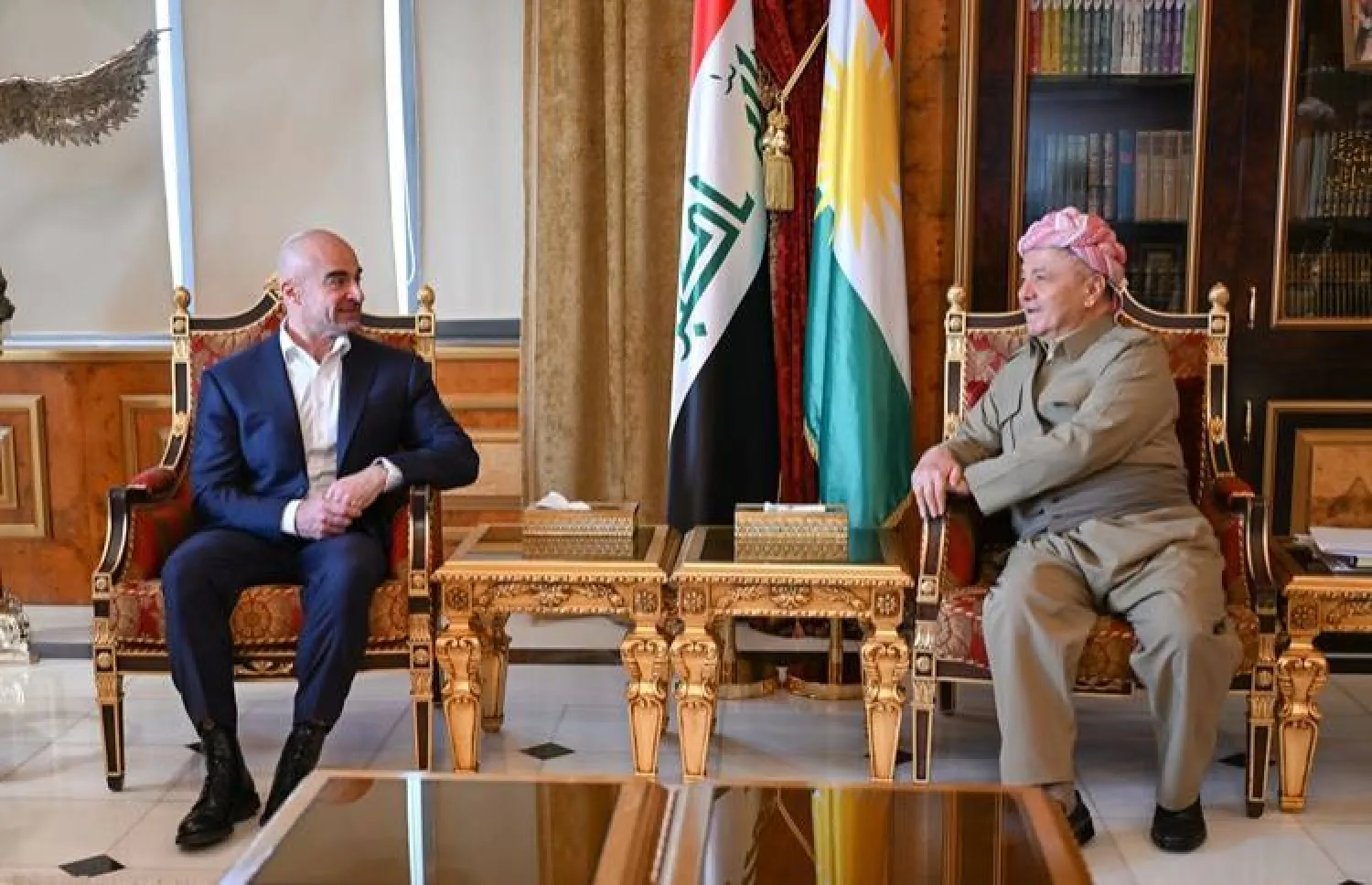

Iraqi Kurdistan without a Govt Nearly One Year Since Parliamentary Elections

Kurdistan Democratic Party (KDP) leader Masoud Barzani and Patriotic Union of Kurdistan (PUK) leader Bafel Talabani meet. (Rudaw)
TT

Iraqi Kurdistan without a Govt Nearly One Year Since Parliamentary Elections

Kurdistan Democratic Party (KDP) leader Masoud Barzani and Patriotic Union of Kurdistan (PUK) leader Bafel Talabani meet. (Rudaw)

The Iraqi Kurdistan Region remains without a government nearly a year since parliamentary elections were held in the region. The influential parties have been unable to agree on a cabinet lineup, reflecting the extent of the political divisions and complications even as Iraq prepares to hold its own elections in November.

The Kurdish polls on October 20, 2024, led to the election of 100 lawmakers with the dominant Kurdistan Democratic Party (KDP), led by Masoud Barzani, winning 39 seats and its rival the Patriotic Union of Kurdistan (PUK), led by Bafel Talabani, winning 23.

The two parties, which enjoy a simple majority in parliament, could have easily formed a new government, but complicated disputes have hampered their efforts.

They have been holding intense talks in recent days to form a cabinet, but observers believe they won’t lead anywhere. Rather, the KDP and PUK will likely await the results of the general elections in Iraq and reach some form of deal with the federal authorities before forming a new government in Kurdistan.

The presidency of Kurdistan and position of its prime minister have often gone to the KDP, while the president of the federal republic has often gone to a figure from the PUK.

On Saturday, Barzani and Talabani held talks in an effort to overcome the political deadlock.

A senior source from the KDP told Kurdistan 24 that they have made progress in efforts to form a new government. He expected the Kurdish parliament to meet in the next two weeks, while sources from both parties said they will hold more talks ahead of agreeing on a lineup.

Should they succeed, it will be the Kurdistan Region’s tenth government after it separated from Baghdad in the 1990s.

Kurdish sources have tied the progress in government talks to Talabani’s visit to Washington last week.

They told Asharq Al-Awsat that the United States has been pressuring the KDP and PUK to form a new government.

Observers have said that the deadlock has been negatively impacting Kurdistan and drawing the ire of voters as elections draw near.

A report by the STOP Organization for Monitoring and Development, an NGO in Kurdistan, said this has been the longest government deadlock witnessed in the region.

The caretaker government has continued to issue decisions and sign strategic contracts since October 2022, which is when it started to operate in a caretaker capacity, it noted.

Moreover, it said Kurdish lawmakers have been earning a full salary, without performing their parliamentary duties, which is a waste of public funds.

Media aide to the KDP leader Kifah Mahmoud told Asharq Al-Awsat that the Kurdish parties have “delayed in forming a new government for several reasons,” which he mostly blamed on the PUK and the political situation in Iraq, as well as malign meddling by parties he did not name.

He noted that the delay has not impacted the overall performance of the caretaker government, adding that the cooperation between the KDP and PUK leaderships has given the cabinet additional support.

He did acknowledge that government formation efforts are in their final stages and that a lineup may be announced before the November elections.

Leading member of the PUK Soran Dawde stressed that the party is keen on the formation of a government as soon as possible.

Talabani’s frequent visits to the Kurdistan capital Erbil are evidence of his determination to end the impasse, he told Asharq Al-Awsat.

Furthermore, he dismissed accusations that the PUK was behind the delay, hoping that the intense meetings between Barzani and Talabani were a sign that a new government will be formed soon.

Meanwhile, political analyst Kadhim Yawer said the “high demands” by both parties are one of the reasons for the delay.

Each one wants more government seats and they are eyeing the seats allocated to the Kurdish parties in the federal government, which is creating complications and obstacles, he told Asharq Al-Awsat.

The federal government will be formed after the November elections.


Israeli Settlers Forcibly Enter Palestinian Home and Kill Sheep in Latest West Bank Attack

 This picture shows sheep grazing on a field in Kafr al-Labad with the Israeli settlement of Avnei Hefetz seen in the background, near the city of Tulkarem in the occupied West Bank on December 18, 2025. (AFP)
This picture shows sheep grazing on a field in Kafr al-Labad with the Israeli settlement of Avnei Hefetz seen in the background, near the city of Tulkarem in the occupied West Bank on December 18, 2025. (AFP)
TT

Israeli Settlers Forcibly Enter Palestinian Home and Kill Sheep in Latest West Bank Attack

 This picture shows sheep grazing on a field in Kafr al-Labad with the Israeli settlement of Avnei Hefetz seen in the background, near the city of Tulkarem in the occupied West Bank on December 18, 2025. (AFP)
This picture shows sheep grazing on a field in Kafr al-Labad with the Israeli settlement of Avnei Hefetz seen in the background, near the city of Tulkarem in the occupied West Bank on December 18, 2025. (AFP)

Israeli settlers attacked a Palestinian home in the south of the Israeli-occupied West Bank overnight, breaking in and killing sheep, a Palestinian official said Tuesday. It was the latest in a surge of attacks by settlers against Palestinians in the territory in recent months.

Israeli police said they arrested five settlers.

The settlers killed three sheep and injured four more, smashed a door and a window of the home, and fired tear gas inside, sending three Palestinian children under the age of 4 to the hospital, said Amir Dawood, who directs an office documenting such attacks within a Palestinian governmental body called the Wall and Settlement Resistance Commission.

Police said they arrested the five settlers on suspicion of trespassing onto Palestinian land, damaging property and dispensing pepper spray, not tear gas. They said they are investigating.

CCTV video from the attack in the town of As Samu’, shared by the commission, showed five masked settlers in dark clothing, some with batons, approaching the home and appearing to enter. Sounds of smashing are heard, as well as animal noises. Another video from inside shows masked figures appearing to strike sheep in the stable.

Photos of the aftermath, also shared by the commission, show smashed car windows and a shattered front door. Bloodied sheep lie dead as others stand with blood staining their wool. Inside the home, photos show broken glass and the furniture ransacked.

Dawood said it was the second settler attack on the family in less than two months. He called it “part of a systematic and ongoing pattern of settler violence targeting Palestinian civilians, their property and their means of livelihood, carried out with impunity under the protection of the Israeli occupation.”

During October’s olive harvest, settlers across the territory launched an average of eight attacks daily, the most since the United Nations humanitarian office began collecting data in 2006. The attacks continued in November, with the UN recording at least 136 by Nov. 24.

Israel captured the West Bank, east Jerusalem and Gaza — areas claimed by the Palestinians for a future state — in the 1967 war. It has settled over 500,000 Jews in the West Bank, in addition to over 200,000 in contested east Jerusalem.

Israel’s government is dominated by far-right proponents of the settler movement, including Finance Minister Bezalel Smotrich and Cabinet Minister Itamar Ben-Gvir, who oversees the nation’s police force. Earlier this week, Smotrich said the Israeli cabinet had approved a proposal for 19 new Jewish settlements, another blow to the possibility of a Palestinian state.


Palestinian Authority Says Israel Tightening Control Over West Bank with New Settlements

Israeli bulldozers level land at the evacuated Israeli settlement of Sanur, near the West Bank city of Jenin, 23 December 2025. (EPA)
TT

Palestinian Authority Says Israel Tightening Control Over West Bank with New Settlements

Israeli bulldozers level land at the evacuated Israeli settlement of Sanur, near the West Bank city of Jenin, 23 December 2025. (EPA)

The Palestinian Authority condemned on Tuesday Israel's recent approval of 19 settlements in the occupied West Bank, accusing it of tightening its control over Palestinian land.

On Sunday, Israel's far-right Finance Minister Bezalel Smotrich announced the authorities had greenlit the settlements, saying the move was aimed at preventing the establishment of a Palestinian state.

The Ramallah-based Palestinian foreign ministry decried the approval as a "dangerous step aimed at tightening colonial control over the entirety of Palestinian land", calling it a continuation of "apartheid, settlement, and annexation policies that undermine the inalienable rights of the Palestinian people".

"The decision provides political cover for accelerating the plunder of Palestinian lands, expanding settlement infrastructure... alongside an escalating pace of settler terrorism against members of our people and their properties," it said in a statement.

The latest move brings the total number of settlements approved over the past three years to 69, Smotrich's office said.

Excluding east Jerusalem, which was occupied and annexed by Israel in 1967, more than 500,000 Israelis live in the West Bank, along with about three million Palestinian residents.

Smotrich's office said the 19 newly approved settlements were located in what it described as "highly strategic" areas, adding that two of them -- Ganim and Kadim in the northern West Bank -- would be re-established after being dismantled two decades ago.

Five of the 19 settlements already existed but had not previously been granted legal status under Israeli law, the statement said.

Israel's decision came days after the United Nations said the expansion of Israeli settlements in the West Bank -- all of which are illegal under international law -- had reached its highest level since at least 2017.

US President Donald Trump recently warned that Israel "would lose all of its support from the United States" if it annexed the West Bank.

Israel has occupied the territory since 1967, and violence there has surged following the outbreak of the Gaza war in October 2023 with Hamas's attack on Israel.

Israeli troops or settlers have killed at least 1,028 Palestinians in the West Bank -- both fighters and civilians -- since the start of the fighting in Gaza, according to an AFP tally based on Palestinian health ministry figures.

At least 44 Israelis have been killed in the West Bank in Palestinian attacks or Israeli military operations during the same period, according to Israeli data.


Germany Deports Man to Syria for First Time Since 2011

People attend a protest against reelection of Syria's president Bashar al-Assad, near Syria's embassy, Berlin, Germany May 26, 2021. (Reuters)
TT

Germany Deports Man to Syria for First Time Since 2011

People attend a protest against reelection of Syria's president Bashar al-Assad, near Syria's embassy, Berlin, Germany May 26, 2021. (Reuters)

Germany deported a man to Syria for the first time since the civil war began in that country in 2011, the interior ministry in Berlin announced on Tuesday.

A Syrian immigrant previously convicted of criminal offences in Germany was flown to Damascus and handed over to Syrian authorities on Tuesday morning, the ministry said.
