


Report: Hamas Has Reservations over Some Clauses in Trump’s Gaza Plan, Wants them Changed

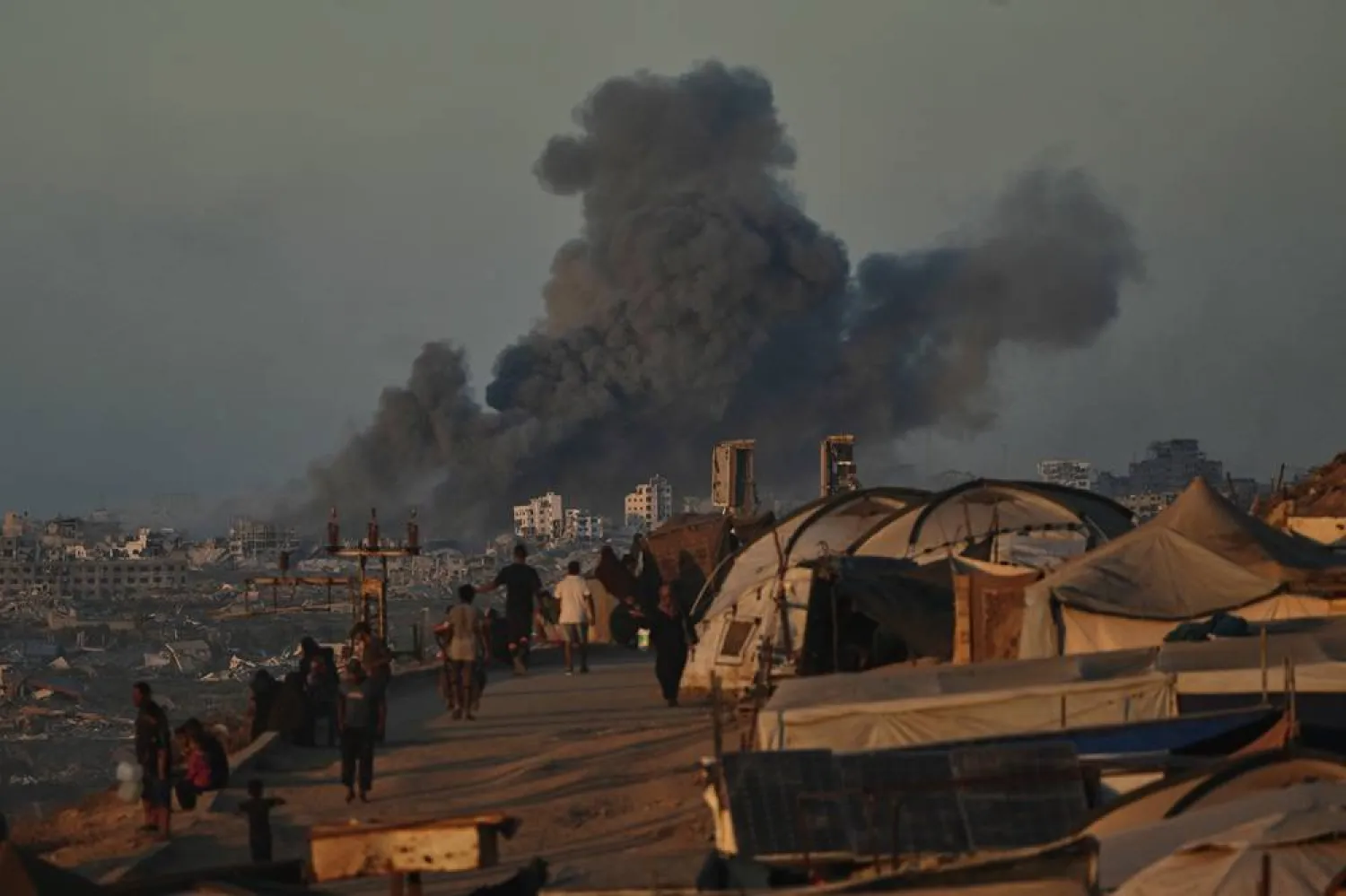
 Smoke rises following an Israeli military strike in Gaza City, as seen from the central Gaza Strip, Wednesday, Oct, 1, 2025. (AP)
Smoke rises following an Israeli military strike in Gaza City, as seen from the central Gaza Strip, Wednesday, Oct, 1, 2025. (AP)
TT

Report: Hamas Has Reservations over Some Clauses in Trump’s Gaza Plan, Wants them Changed

 Smoke rises following an Israeli military strike in Gaza City, as seen from the central Gaza Strip, Wednesday, Oct, 1, 2025. (AP)
Smoke rises following an Israeli military strike in Gaza City, as seen from the central Gaza Strip, Wednesday, Oct, 1, 2025. (AP)

Hamas is holding intensive talks with regional mediators over a US proposal to end the war in Gaza, but the group has raised objections to several clauses and is pressing for changes, sources familiar with the discussions said.

The plan was unveiled by US President Donald and endorsed by Israeli Prime Minister Benjamin Netanyahu after they met at the White House on Monday. Trump gave Hamas “three to four days” to respond.

Senior Hamas leaders met officials from Qatar, Egypt and Türkiye in Doha on Tuesday to discuss the plan and possible modifications.

The sources told Asharq Al-Awsat that the Hamas delegation objected to provisions on Israel’s withdrawal from Gaza, citing a lack of binding guarantees or a timetable. They also flagged the requirement to hand over Israeli hostages – alive or dead – within 72 hours as unrealistic given conditions on the ground.

Hamas negotiators also demanded clarity on issues of governance and weapons in Gaza. During the talks, they voiced opposition to the involvement of former British Prime Minister Tony Blair, whom they said was not a neutral figure.

One clause in the 20-point plan calls for an interim technocratic Palestinian administration overseen by an international “Board of Peace” chaired by Trump and including Blair.

Mediators told Hamas that the council would monitor governance remotely and that Palestinians themselves would run Gaza.

Diplomatic sources said envoys from the three Arab states urged Hamas to treat the plan as a real chance to end the conflict, stressing that Washington had offered guarantees to Arab and Muslim governments over Israel’s compliance, including withdrawal commitments.

“Hamas’ leadership has promised to study the proposal with seriousness, responsibility and positivity,” sources told Asharq Al-Awsat.

Parallel consultations are underway within Hamas and with other Palestinian factions to try to produce a “unified Palestinian response.”

But direct meetings with some factions remain unlikely due to security concerns following assassination attempt by Israel on Hamas leaders in Doha last month, the sources said.

Islamic Jihad may send one or two officials to the Qatari capital for joint talks.

Scope for amendments

For now, Hamas is expected to respond positively but with reservations aimed at securing amendments, sources said. How Washington and Israel react remains unclear, though Arab and Muslim governments could press them to accommodate Hamas’ remarks if they do not fundamentally alter the plan.

US officials have signaled openness to limited changes but not wholesale revisions.

Hamas sources described the proposal as “unjust and biased towards Israel,” arguing it offers little to Palestinians beyond symbolic concessions. Still, they said the group will approach it constructively, noting many clauses are “vague” and lack enforceable guarantees, especially on Israel’s phased withdrawal.

The group may seek longer deadlines for hostage releases and transfers, citing difficulties in locating remains under Gaza’s rubble and coordinating movements amid Israeli bombardment. They also deemed the 72-hour timeframe “illogical” under current conditions.

At the same time, Hamas is prepared to accept Israel's release of 250 Palestinian prisoners serving life terms, which it views as a reasonable trade-off, the sources added.



Syria’s Interior Minister Warns Remnants of Former Regime

FILE PHOTO: Members of the Syrian Security forces stand guard near military vehicles on the day people protest in Latakia, Syria, December 28, 2025. REUTERS/Karam al-Masri/File Photo
TT

Syria’s Interior Minister Warns Remnants of Former Regime

FILE PHOTO: Members of the Syrian Security forces stand guard near military vehicles on the day people protest in Latakia, Syria, December 28, 2025. REUTERS/Karam al-Masri/File Photo

Syrian Interior Minister Anas Khattab has warned the remnants of the former regime against efforts to lead chaos, killing, and destruction as his ministry announced the arrest of several people in Latakia and Tartus for involvement in war crimes and instigations that threaten civil peace.

Khattab stressed on Wednesday that the state is the sole guarantor for all citizens, ensuring their security, preserving their dignity, and safeguarding their rights.

The minister said in a statement on X that since the early days following Syria’s liberation, the ministry has positioned itself as a central force in restoring order and safety across the country.

This effort has been carried out in coordination with other government agencies and local communities to confront a wide range of security challenges.

Khattab stressed that the ministry’s new approach to policing prioritizes public safety over intimidation. “Our goal is to protect citizens, not to frighten them,” he said, adding that a formal code of conduct has been introduced to ensure law enforcement operates within clear legal and ethical boundaries.

Despite these reforms, remnants of the deposed regime who have aligned themselves with wanted criminals have misinterpreted the ministry’s ethical approach as weakness. “We will protect the oppressed and hold accountable anyone who threatens our country’s security,” he said.

The minister warned the remnants of the defunct regime and their criminal gangs, who insist on continuing the path of chaos, killing, and destruction to “await their inevitable fate.”

“Let this message serve as a final warning to them to cease their actions,” he added.

Meanwhile, the ministry said on its Telegram channel that several people were arrested in operations in Latakia and Tartus after external calls by instigators have led to sectarian chaos and left many people dead and injured.

“The operation came in response to external inciting calls of a sectarian nature, which led to a state of chaos, the death of a number of people, the injury of others, and assaults on public and private property,” it said, noting that “operations are ongoing against these corrupt individuals.”

The ministry said in its statement that it has played an active role in restoring the social fabric and strengthening civil peace. However, “some parties have sought to exploit this stage to spread chaos, undermine security, and threaten stability.”


This Is Our Story, Mohammed

The late Mohammed al-Shafei in his office. (Asharq Al-Awsat)
TT

This Is Our Story, Mohammed

The late Mohammed al-Shafei in his office. (Asharq Al-Awsat)

This is our story, Mohammed. We fell in the trap early. We were lured by the beautiful, but deceitful, ink. We chose a thorny profession. We chose a long tunnel. No breaks and no truces. It is the hot pursuit of the news that takes up most of our lives. The reader is insatiable. The journalist pursues stories for so long, until they become the story. A story in their own newspaper. A story about a death. A story about farewell.

We were preparing to say farewell to the year, not say farewell to you. You took part in our meeting on Tuesday. You always made it to our daily meetings. You always brought your experience with you, your kind way of speaking. It was as if you were trying to tell us a message. The old warrior never retires. He would rather fall in the ring. Hours after the meeting, we received the painful news. Your heart betrayed you, as it is likely to do.

The nature of our profession had it so this calm man would occupy himself with thorny files and tough men. Afghanistan took up his interests. He used to travel there when it was teeming with al-Mujahideen. He would return from those arduous journeys with news, investigations and interviews. Even as old age took its toll, Mohammed al-Shafei never abandoned his passion. News intrigued him.

He joined Asharq Al-Awsat nearly four decades ago. He loved the Asharq Al-Awsat family and it loved him back. As in all love stories, he never hesitated, never backed down and was never withholding. I say Asharq Al-Awsat family, while it is a garden of news and headlines, investigations and articles. The family is composed of various nationalities and experiences. They are united under one roof and one passion. He was proud of being part of a trusted newspaper that has preserved its spirit over the years.

How difficult it is to face death. For it to take away a dear son and a valued teacher. How difficult the loss will be. We were used to arguing with you, asking you questions and learning from you. How difficult it will be to pass by your empty office. How difficult it will be to not see you at our meetings.

This is our story, Mohammed. We live between the lines and die between the lines. We will finally rest in the archives of the newspaper. The warmth of our colleagues. Asharq Al-Awsat, with its diversity and generations, embraces everyone who was a part of the family and enriched the experience of its readers. Your heart betrayed you, as it is likely to do, but friendships know no betrayals.


Asharq Al-Awsat's Mohammed al-Shafei Passes Away Leaving Behind Long Career in Pursuing the Toughest Files

Mohammed al-Shafei on board a military jet on his way to Afghanistan. (Asharq Al-Awsat)
TT

Asharq Al-Awsat's Mohammed al-Shafei Passes Away Leaving Behind Long Career in Pursuing the Toughest Files

Mohammed al-Shafei on board a military jet on his way to Afghanistan. (Asharq Al-Awsat)

Mohammed al-Shafei, one of Asharq Al-Awsat's most prominent journalists, passed away at 74 on Wednesday, leaving behind a career that spanned over 40 years during which he tackled the thorniest and most complex files.

Al-Shafei specialized in extremist groups and was among the first journalists to have written about these issues in Arab press. He pursued his stories with strict professionalism, seeking out sources. He joined Asharq Al-Awsat in 1982, kicking off a long, dedicated career, marked by accuracy, commitment and high professionalism.

Al-Shafei was born in Egypt in 1951. He earned a Bachelor of Islamic Archeology from the University of Cairo in 1974. He traveled to London in 1977 and earned a Postgraduate Diploma in translation from the University of Westminster. He pursued further studies in journalistic translation at the School of Oriental and African Studies (SOAS) in the mid-1980s, forging his unique skills in handling foreign sources, complex documents and sensitive security and political texts.

Mohammed al-Shafei at his Asharq Al-Awsat office in, as photographed by his colleague Adil al-Salmi.

He kicked off his journalism career in London in the 1980s. He worked at several Arabic newspapers published abroad, including “Al-Muslimoon” newspaper that was published by the Saudi Research & Publishing Company (SRMG) and the London-based “Al-Arab” newspaper. He returned to SRMG by working for the “Al-Zahira” newspaper that was established after the Iraqi invasion of Kuwait. The years he will spend at the newspaper will shape his deep knowledge of regional conflicts and their complexities.

He joined Asharq Al-Awsat newspaper in 1991, starting off in the sports section, where he worked for 15 years, during which he showed high professionalism and a remarkable ability to follow up and analyze news before moving on to the next step in his career by handling the terrorism file. He became a pioneer in Arab journalism, relying on accurate documentation and deep analyses while steering clear of sensationalism in tackling the most sensitive issues.

Mohammed al-Shafei with former British Ambassador to Afghanistan Mark Sedwill. (Asharq Al-Awsat)

His accomplishments include holding direct interviews with senior al-Qaeda leaders, including Mullah Omar. He traveled to Afghanistan where he interviewed Taliban leaders during times of heightened tensions. The rare insights offered by his interviews became a main reference for researchers and journalists interested in jihadists groups.

During the war on al-Qaeda, al-Shafei made several field visits to American bases in Afghanistan, joined international forces in conflict zones and carried out investigative reports from the battlefield, offering a glimpse of developments on the ground, the nature of the operations and the complexities of the scene, which was rare in Arab journalism at the time.

Mohammed al-Shafei interviews former Afghan Vice President Abdul Karim Khalili. (Asharq Al-Awsat)

Al-Shafei also carried out several interviews of Osama bin Laden’s son, presenting a humanitarian angle of the news and underscoring his professional ability to reach what were perceived as inaccessible sources, all without losing his professionalism and objectivity.

He was among the few Arab journalists who carried out interviews from Guantanamo prison where al-Qaeda members were being detained. The interviews offered yet another rare insight into terrorism issues and how these groups operate.

Al-Shafei helped in writing the book, “Al-Qaeda’s Men in Iran... A Safe Haven and Suspicious Alliance”, which was a result of years of research. It is seen as one of the first Arab publications about Iran’s ties to al-Qaeda, revealing that they had existed for years and were based on mutual interests.

Mohammed al-Shafei with an American soldier in Afghanistan. (Asharq Al-Awsat)

Al-Shafei married a Turkish woman in London in the late 1970s. They have a son and daughter. His son, Mahmoud, followed in his father’s footsteps, pursuing a career in journalism. He worked for Asharq Al-Awsat for three years.

Hours before his passing, al-Shafei remained dedicated to his profession. He wrote several articles that he sent to Asharq Al-Awsat and was in touch with his colleague by telephone to follow up on his work as was his habit throughout his career. With his passing, Arab journalism loses a calm and hardworking journalist, who was known by his colleagues for his discipline and humility.