


Syria’s Foreign Minister Visits Lebanon as Both Nations Seek to Rebuild Ties After Assad’s Ouster 

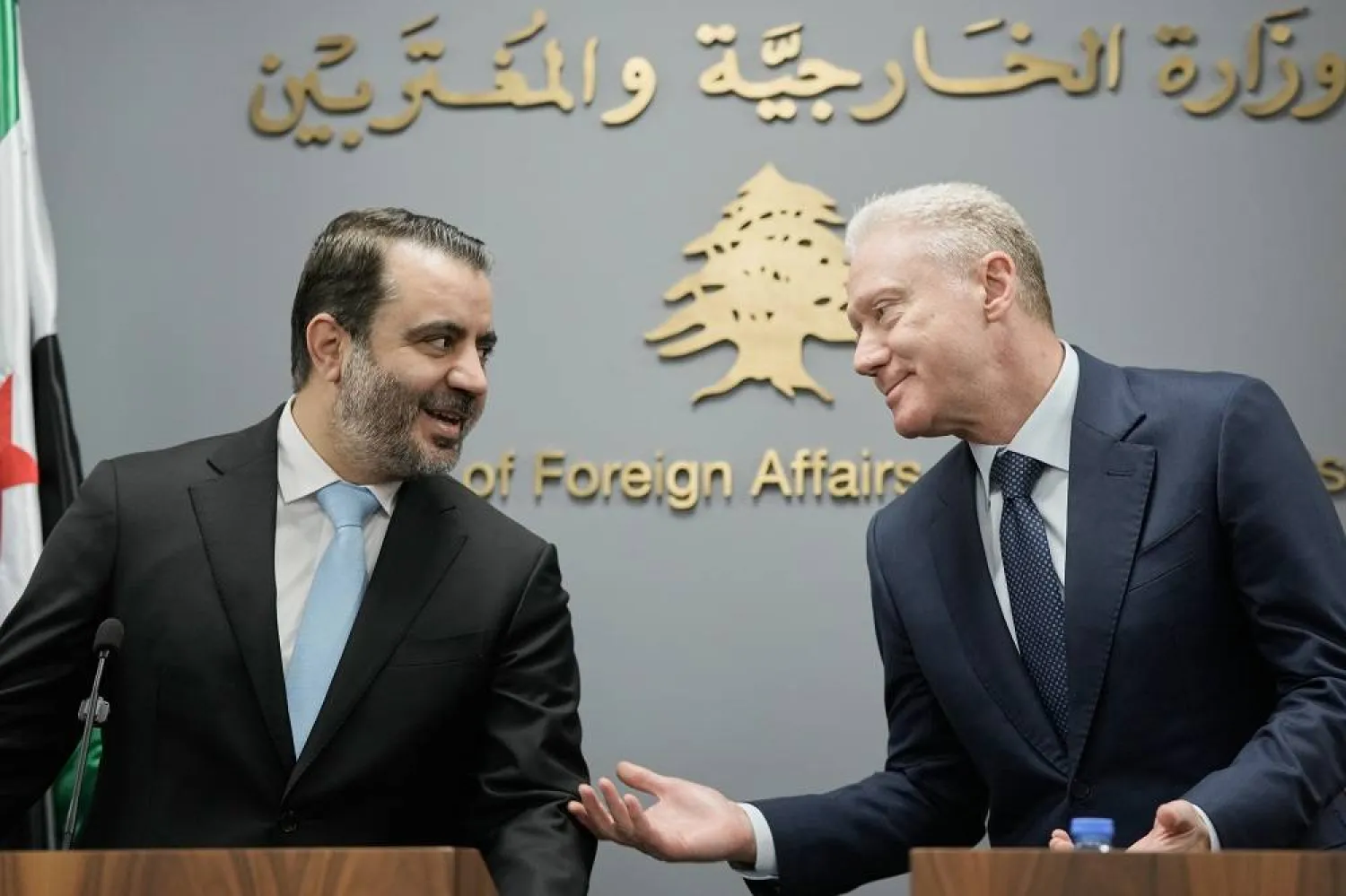
Syrian Foreign Minister Asaad al-Shaibani, left, speaks with Lebanese Foreign Minister Youssef Rajji, right, before a briefing for journalists following their meeting in Beirut, Lebanon, Friday, Oct. 10, 2025. (AP)
TT

Syria’s Foreign Minister Visits Lebanon as Both Nations Seek to Rebuild Ties After Assad’s Ouster 

Syrian Foreign Minister Asaad al-Shaibani, left, speaks with Lebanese Foreign Minister Youssef Rajji, right, before a briefing for journalists following their meeting in Beirut, Lebanon, Friday, Oct. 10, 2025. (AP)

Syria's foreign minister arrived in Lebanon's capital on Friday in what observers say could mark a breakthrough in relations between the two neighbors, which have been tense for decades.

Foreign Minister Asaad al-Shaibani held talks with his Lebanese counterpart and is expected to meet with President Joseph Aoun and Prime Minister Nawaf Salam. It was the first high-profile Syrian visit to Lebanon since opposition groups overthrew President Bashar al-Assad’s government in early December 2024.

Lebanon and Syria have been working to rebuild strained ties, focusing on the status of roughly 2,000 Syrian nationals detained in Lebanese prisons, border security, locating Lebanese nationals missing in Syria for years and facilitating the return of Syrian refugees.

The current Syrian leadership resents Lebanon’s Iran-backed Hezbollah group for taking part in Syria’s civil war, fighting alongside Assad’s forces, while many Lebanese still grudge Syria’s 29-year domination of its smaller neighbor, where it had a military presence for three decades until 2005.

Following their meeting, al-Shaibani and Lebanese Foreign Minister Youssef Rajji announced at a news conference that the Lebanese-Syrian Higher Council has been suspended and all dealings will be restricted to official diplomatic channels.

Created in 1991, the council symbolized Syria’s influence over Lebanon. Its role declined after Syria’s 2005 withdrawal, the assassination of Lebanese Prime Minister Rafik Hariri and the 2008 opening of the Syrian Embassy in Beirut, which marked Syria’s first official recognition of Lebanon as an autonomous state since it gained independence from France in 1943. In recent years, the council was largely inactive, with only limited contact between officials.

In early September, a Syrian delegation, which included two former Cabinet ministers and the head of Syria’s National Commission for Missing Persons, visited Beirut. Lebanon and Syria also agreed at the time to establish two committees to address outstanding key issues.

These efforts are part of a broader regional shift following Assad’s ouster and Hezbollah’s significant losses during its recent war with Israel.

Al-Shaibani reiterated Syria’s “respect for Lebanon’s sovereignty,” saying Damascus seeks to “move past previous obstacles and strengthen bilateral ties.”

“My visit to Beirut is meant to reaffirm the depth of Syrian-Lebanese relations,” he said.

Many of the Syrians held in Lebanon remain in jail without trial — about 800 are detained for security-related reasons, including involvement in attacks and shootings.

Al-Shaibani’s delegation included the Syria's justice minister, Mazhar al-Louais al-Wais; the head of Syrian intelligence, Hussein al-Salama; and the assistant interior minister, Maj. Gen. Abdel Qader Tahan, according to the Lebanese state-run National News Agency.

Lebanon hosts an estimated 1.5 million Syrian refugees who fled the uprising-turned-civil war that erupted more than 14 years ago. Since Assad’s fall in December, around 850,000 refugees have returned to Syria from neighboring countries as of September, with the number expected to rise, according to UNHCR Deputy High Commissioner Kelly T. Clements. Lebanese authorities granted an exemption to Syrians staying illegally if they left by the end of August.

Syria’s conflict, which began in March 2011, has killed nearly 500,000 people and displaced half the country’s prewar population of 23 million. More than 5 million Syrians fled the country as refugees, most of them to neighboring countries, including Lebanon, which has the highest number of refugees per capita in the world.

Although many Syrians initially hoped for stability after Assad was ousted, sectarian killings against members of Assad’s Alawite minority sect in Syria’s coastal region in March and against the Druze minority in the southern province of Sweida in July claimed hundreds of lives and revived security concerns.

Meanwhile, the Lebanon-Syria border has long been a flashpoint for clashes, with periodic exchanges of fire and infiltration attempts, particularly in the northeastern Bekaa Valley. In March 2025, the two countries signed an agreement to demarcate the border and enhance security coordination, aiming to prevent disputes and curb smuggling and other illicit activities.

Hezbollah has been heavily involved in cross-border smuggling, primarily to move weapons and military supplies, leading to tensions and violent confrontations along the border. Syrian security forces have repeatedly intercepted Hezbollah-linked trucks carrying weapons into Lebanon.

Since the fall of Assad, two Lebanese prime ministers have visited Syria. Aoun and Syrian President Ahmed al-Sharaa also held talks on the sidelines of an Arab summit in Egypt in March.



Israeli Soldiers Kill Palestinian Teen in West Bank

Israeli Soldiers Kill Palestinian Teen in West Bank
TT

Israeli Soldiers Kill Palestinian Teen in West Bank

Israeli Soldiers Kill Palestinian Teen in West Bank

Israeli soldiers shot dead a Palestinian hurling a rock at them in the occupied West Bank, the military said on Friday, and the Palestinian health ministry said the person killed was a 14-year-old boy.

There was no further comment from Palestinian officials about the fatal incident in the village of ⁠Al-Mughayyir. Official Palestinian news agency WAFA said the teen was killed during an Israeli military raid that led to confrontations, Reuters reported.

The Israeli military said its forces were called to the area after ⁠receiving reports that Palestinians were throwing stones at Israelis and blocking a road with burning tires.

The soldiers fired warning shots in an attempt to repel a person who was running at them with a rock, the military said, and then shot and killed him to eliminate the ⁠danger.

Violence has surged over the past year in the West Bank. Attacks by Israeli settlers on Palestinians have risen sharply, while the military has tightened movement restrictions and carried out sweeping raids in several cities.

Palestinians have also carried out attacks on Israeli soldiers and civilians, some of them deadly.


Israeli Strikes in South Lebanon Kill Two

Smoke rises from the site of an Israeli airstrike that targeted the village of Sohmor, in southern Lebanon on January 15, 2026. (Photo by Rabih DAHER / AFP)
TT

Israeli Strikes in South Lebanon Kill Two

Smoke rises from the site of an Israeli airstrike that targeted the village of Sohmor, in southern Lebanon on January 15, 2026. (Photo by Rabih DAHER / AFP)

An Israeli strike on south Lebanon killed one person on Friday, the health ministry in Beirut said a day after raids that Israel said had targeted Hezbollah.

Israel has kept up regular strikes in Lebanon despite a November 2024 ceasefire that sought to end more than a year of hostilities with Hezbollah, usually saying it is targeting members of the group or its infrastructure.

In a statement, the health ministry said an "Israeli enemy strike" on a vehicle in Mansuri in south Lebanon killed one person.

According to AFP, it also said that a strike on Mayfadun in south Lebanon the previous night killed one person.

Israel said Thursday's attack killed a Hezbollah member it alleged "took part in attempts to reestablish Hezbollah's infrastructure in the Zawtar al-Sharqiyah area.”

The attacks come a week after Lebanon's military said it had completed disarming Hezbollah south of the Litani River, the first phase of a nationwide plan, although Israel has called those efforts insufficient.

On Thursday, Israel carried out several strikes against eastern Lebanon's Bekaa region, north of the Litani, after issuing warnings to evacuate.

United Nations peacekeepers, deployed in the south to separate Lebanon from Israel, said on Friday that an Israeli drone "dropped a grenade" on its troops.

On Monday, the peacekeeping force said an Israeli tank fired near its troops, and warned that such incidents were becoming "disturbingly common".


Syria's Leader Sharaa in Berlin on Tuesday, Says German Presidency

Syria's President Ahmed al-Sharaa.
TT

Syria's Leader Sharaa in Berlin on Tuesday, Says German Presidency

Syria's President Ahmed al-Sharaa.

Syria's President Ahmed al-Sharaa will be visiting Berlin next Tuesday and meet his German counterpart Frank-Walter Steinmeier, the German presidency said.

The office of Chancellor Friedrich Merz has yet to announce whether they would also hold talks during the visit, which comes at a time when the German government is seeking to step up repatriations of Syrians to their homeland.