Sisi and Burhan Reaffirm Commitment to Quad Mechanism for Ending Sudan Conflicthttps://english.aawsat.com/arab-world/5197846-sisi-and-burhan-reaffirm-commitment-quad-mechanism-ending-sudan-conflict
Sisi and Burhan Reaffirm Commitment to Quad Mechanism for Ending Sudan Conflict
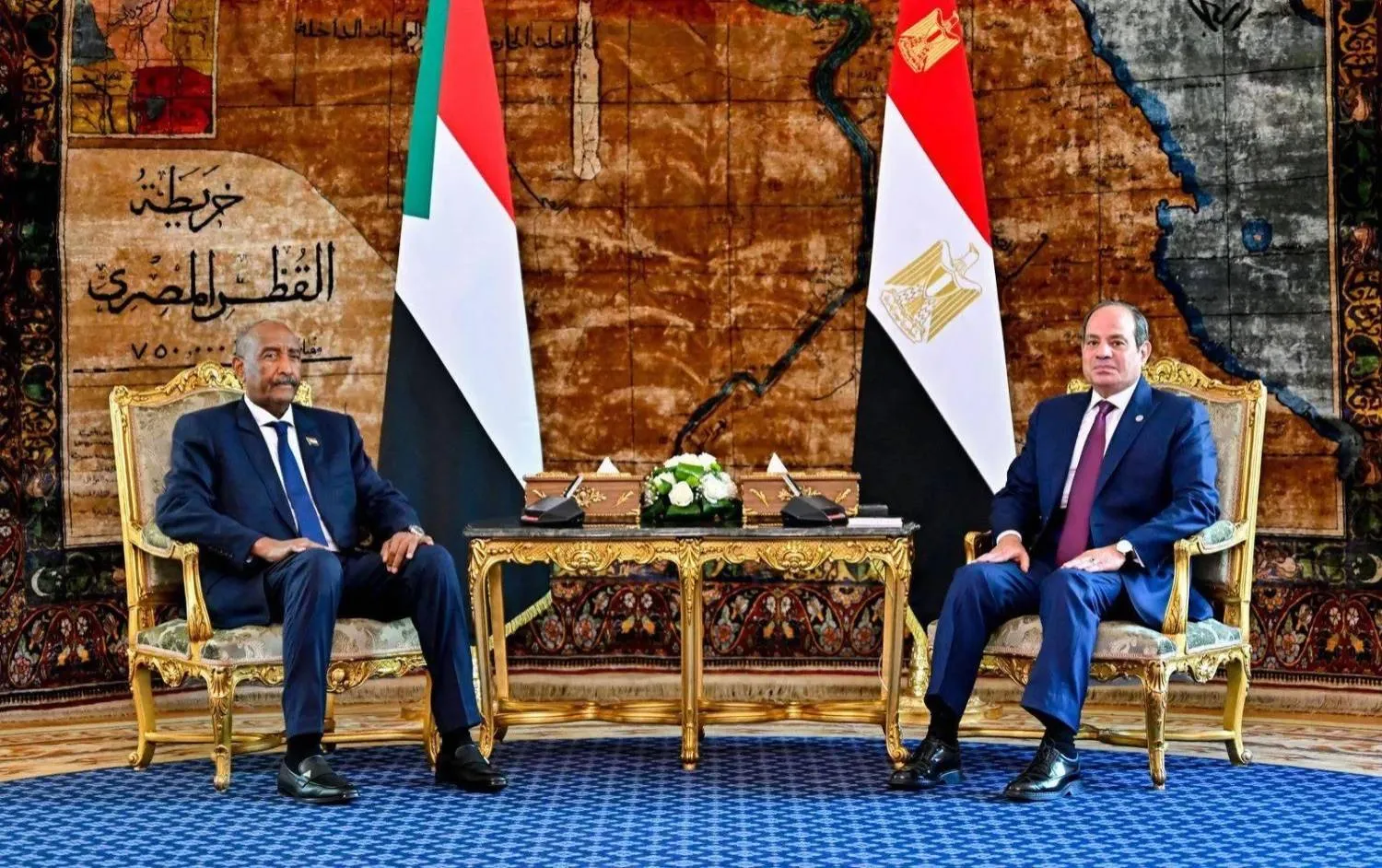
El-Sisi and Al-Burhan affirmed their unified stance on the issue of the Ethiopian Dam (Egyptian Presidency)
Egypt’s President Abdel Fattah el-Sisi and the head of Sudan’s Transitional Sovereignty Council, Abdel Fattah al-Burhan, on Wednesday renewed their support for the “Quad Mechanism,” comprising Saudi Arabia, Egypt, United States, and United Arab Emirates, describing it as a key framework for achieving a ceasefire and reaching a political settlement to the conflict in Sudan.
Meeting in Cairo, the two leaders underscored the “unity of stance” between Egypt and Sudan and stressed their shared interests regarding the Grand Ethiopian Renaissance Dam. They agreed to step up consultations and joint coordination to protect their respective water rights.
Last month, the Quad held a ministerial meeting in Washington, where participants stressed the need to intensify efforts to end the armed conflict in Sudan, protect civilians, safeguard infrastructure, ensure humanitarian access, and maintain stability in the Red Sea region.
Cairo and Khartoum voiced hopes that the next Quad meeting, set to take place in Washington later this month, would deliver tangible progress toward ending the war.
The talks between el-Sisi and al-Burhan addressed developments in Sudan, as well as international and regional mediation efforts. El-Sisi reiterated Egypt’s firm support for Sudan’s unity, sovereignty, and territorial integrity, rejecting any attempts to undermine its stability or create parallel authorities.
Egypt has previously rejected the “parallel government” announced by Rapid Support Forces, which Cairo considers a militia. In March, the Egyptian Foreign Ministry expressed its opposition to any moves that threaten Sudan’s unity or sovereignty.
The Quad members have repeatedly pledged their commitment to restoring peace in Sudan, alleviating the suffering of its people, and working with African, Arab, and international partners to achieve these goals.
Both leaders expressed their expectation that the upcoming Washington meeting in October would help pave the way for a ceasefire and lasting stability. On the bilateral front, they reaffirmed their rejection of any unilateral measures on the Blue Nile in violation of international law and emphasized their aligned positions on the Ethiopian dam, agreeing to deepen coordination to defend their water interests.
Ethiopia inaugurated the dam on September 9, amid strong objections from Egypt and Sudan, which are demanding a legally binding agreement on its operation.
El-Sisi has criticized what he called “reckless management” of the dam, saying irregular water releases have harmed downstream countries. He called for stronger international and African efforts to reach a binding legal deal on filling and operating the dam.
Commuters drive past Baghdad's Shorja market on October 13, 2026. (Photo by AHMAD AL-RUBAYE / AFP)
Iraq has lost around $60 billion during the Middle East war, Foreign Minister Fuad Hussein said on Thursday, with Iran blockading the Strait of Hormuz that is crucial to global energy flows, AFP reported.
Iraq was producing about four million barrels of oil per day before the conflict, exporting about 3.5 million bpd -- mostly shipped from the country's south via the strait.
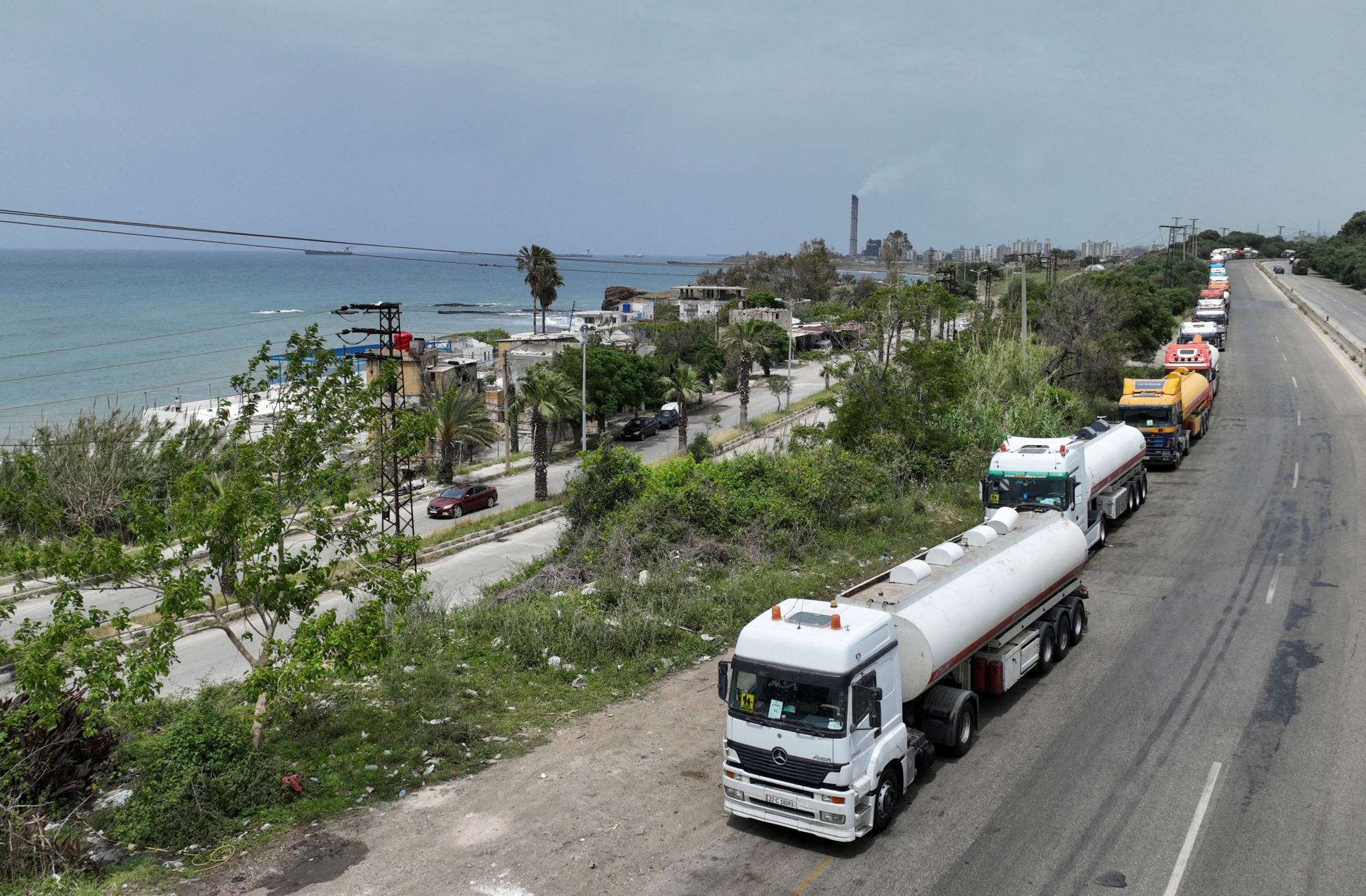
But Iran's stranglehold on the waterway forced Iraq, lacking storage capacity, to halt most production and fall back on limited exports via Syria and Türkiye, by truck and pipeline respectively.
FILE PHOTO: Oil trucks from Iraq on their way to the Baniyas oil terminal, Syria, May 14, 2026. REUTERS/Mahmoud Hassano/File Photo
"Iraq has suffered losses estimated at around 60 billion dollars during the recent war between the United States and the Islamic Republic of Iran," Hussein told his Italian counterpart in Rome, according to a statement from the Iraqi foreign ministry.
After a heavy drop in production, Iraqi oil exports, which provide about 90 percent of the country's revenues, recovered modestly last month, reaching 2.6 million barrels per day between September 1 and 21, according to the oil ministry.
But at the same time, Iraq's foreign currency reserves have shrunk by 20 billion dollars and consumer prices have risen sharply, plunging it into economic crisis.
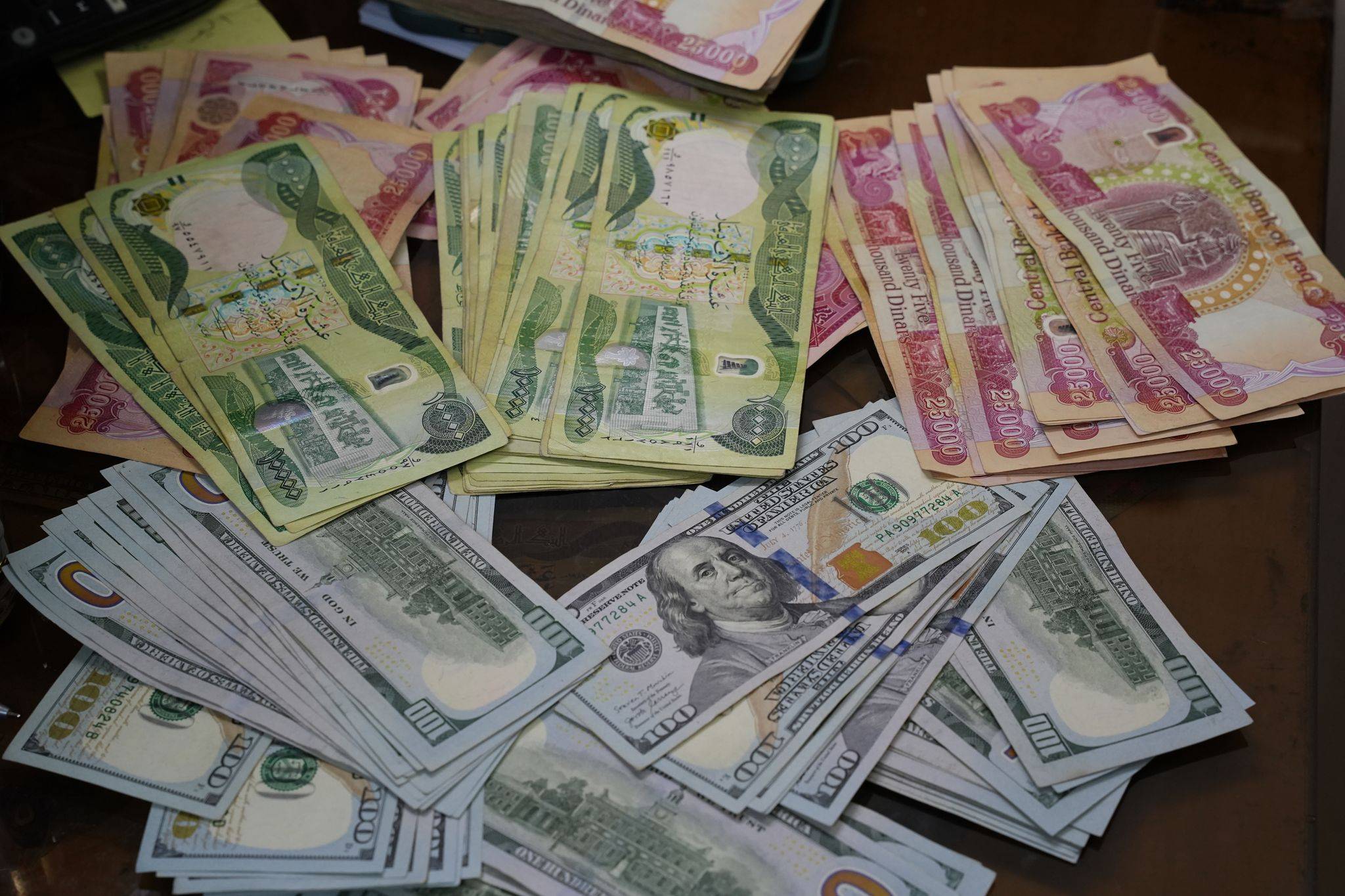
To try to contain the fallout, the Central Bank of Iraq last week devalued the dinar against the dollar for the first time in more than three years.
07 October 2026, Iraq, Duhok: Iraqi dinar and US dollar banknotes are displayed at a currency exchange shop in Duhok in Iraq's Kurdistan region. Photo: Ismael Adnan/dpa
Iraq relies heavily on foreign currency generated by oil sales to finance imports, stabilize the dinar, and pay the salaries of public sector employees and retirees.
According to the authorities, Iraq is seeking to diversify its economic resources and raise non-oil revenues from 10 percent to 45 percent by 2037.
Hezbollah’s Support Base Dismayed Over Limited Compensationhttps://english.aawsat.com/arab-world/5330248-hezbollah%E2%80%99s-support-base-dismayed-over-limited-compensation
Hezbollah’s Support Base Dismayed Over Limited Compensation
A Lebanese soldier inspects destruction in the city of Nabatieh caused by Israeli airstrikes in southern Lebanon on June 21, 2026 (Reuters)
The financial assistance Hezbollah said it would provide to people displaced from southern Lebanon and Beirut’s southern suburbs because of the war with Israel has sparked dismay within its southern support base, with some describing the sums as “meager” and saying they “do not even cover six months’ rent.”
Others have criticized the payments as “unfair” and said they reinforce disparities between residents of the southern suburbs and those of southern Lebanon.
Ali Damoush, head of Hezbollah’s Executive Council, announced on Tuesday a housing assistance program for displaced people and for those whose homes have been destroyed or severely damaged by Israel and are no longer habitable. He set the maximum assistance at $14,000 for housing units in Beirut and its southern suburbs, and $12,000 for homes outside those areas.
Damoush said the money would be paid in four installments, with each payment amounting to $3,500 for displaced residents in Beirut and the southern suburbs and $3,000 for those in other areas.
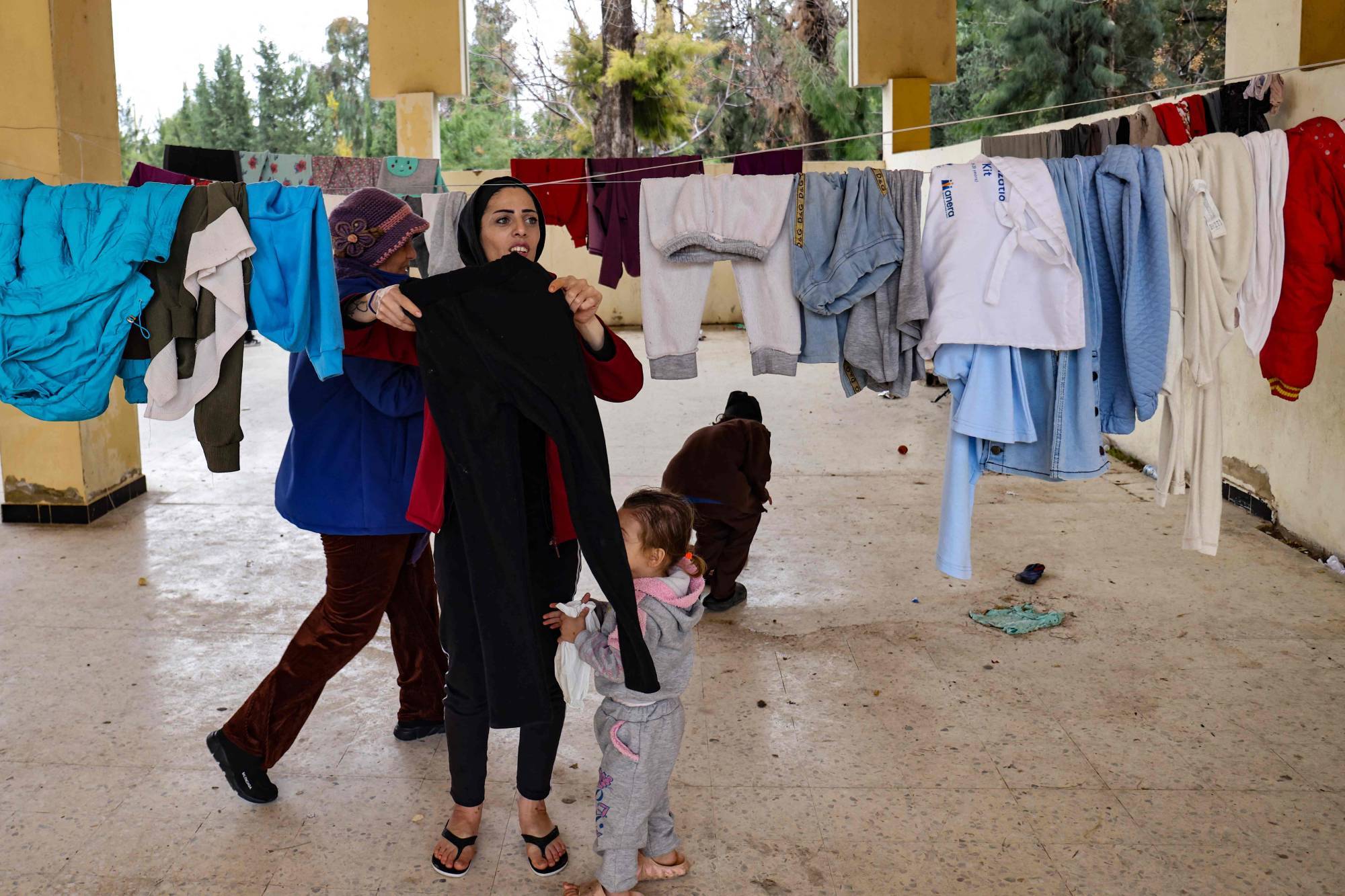
A girl displaced from southern Lebanon at a school in the city of Tyre that was converted into a shelter for displaced people (File photo - AFP)
Rent Payments Fall Short
No sooner had Damoush announced the payments than discontent spread among residents of southern Lebanon, who described the amounts as “unfair.”
A local source in Nabatieh told Asharq Al-Awsat that the money would “barely cover six months of monthly rent.”
“At the very lowest estimate, rent for a house outside the city is $500 a month, while anyone wishing to rent in the city will have to pay $800,” the source said. “Is this amount enough to cover rent?”
“We waited six months. The state paid nothing and paid no attention to us, while Hezbollah has now announced meager payments that would not even be enough to buy a bed or a refrigerator,” the source added, describing the announced assistance as essentially pointless.
The United Nations Development Programme estimates that around 17,900 housing units have been completely destroyed in southern Lebanon, while approximately 5,200 buildings have been damaged by the war.
Heavy Losses
The same source in Nabatieh said war-related losses were “extremely heavy,” ranging from destroyed buildings and rental costs to businesses and livelihoods brought to a halt. This comes on top of six months during which residents have had to pay rent out of their own pockets without receiving assistance.
“The initiative undertaken by Hezbollah cannot be relied upon because the amount is extremely small and does not take into account people’s suffering and needs,” said the source, who requested anonymity.
The frustration extends to residents currently living in the city of Tyre after being displaced from occupied and destroyed border villages, particularly Naqoura, Aita al-Shaab, Marwahin, Umm al-Tout and Tayr Harfa.
One displaced resident living in Tyre told Asharq Al-Awsat that they have been paying rent for nearly three years, “and now we will receive a payment that does not even cover three months’ rent in the city,” where average residential rents stand at around $700.
“Hezbollah is applying double standards to displaced people,” he said. “We live in a city, and residents of the southern suburbs live in a city too. Why are they receiving $3,500 while people from the south are receiving $3,000?”
He described the proposed payments as “meager,” saying they appeared to represent “an attempt to shirk responsibility while promoting assistance that falls short of people’s growing needs.”
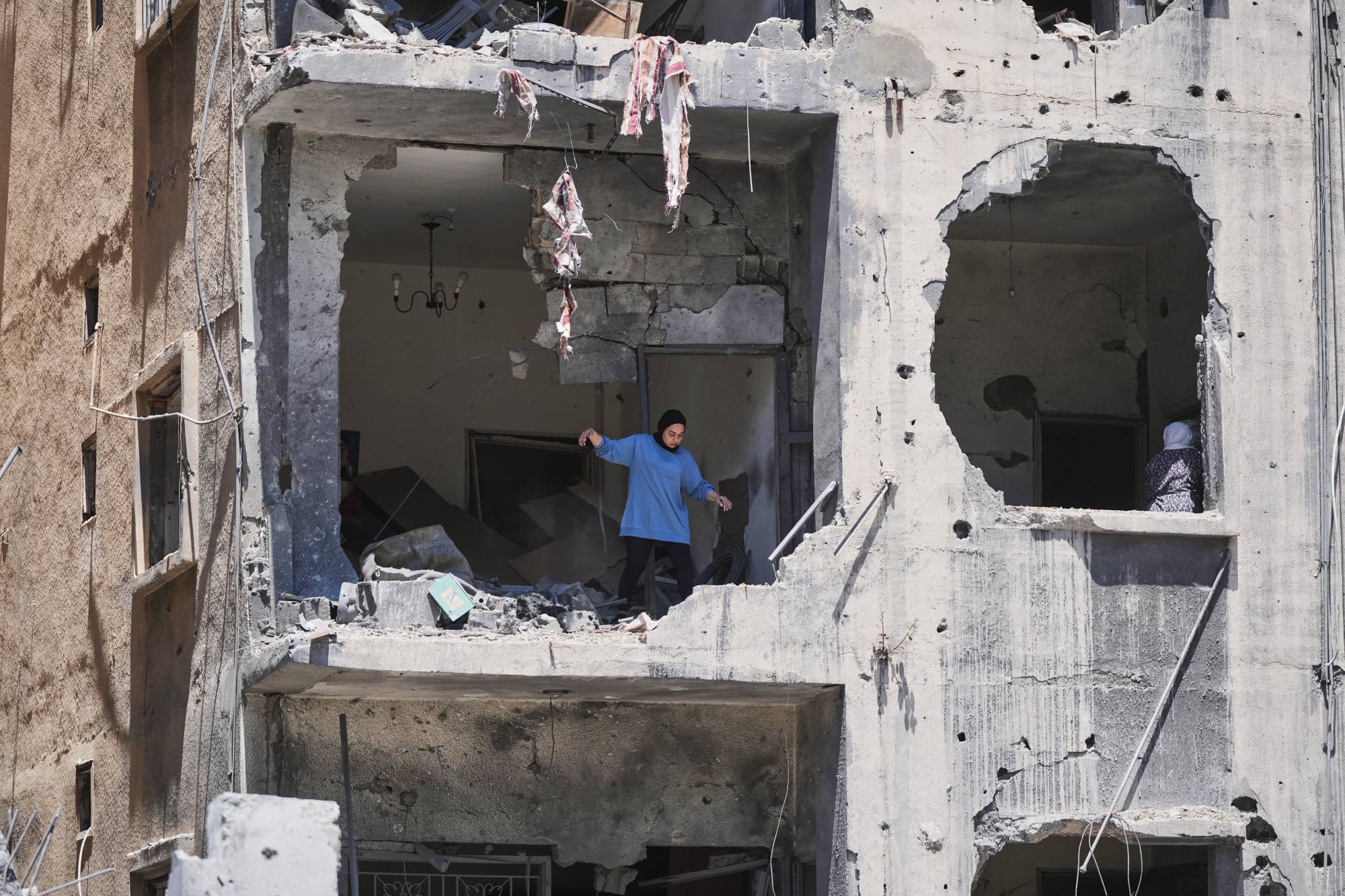
A woman walks through her apartment, which was damaged by Israeli airstrikes in the southern Lebanese city of Tyre on June 17, 2026 (AP)
No Compensation for Repairs
Hezbollah is facing financial difficulties as a result of restrictions imposed on the flow of funds from Iran. Its supporters, however, say the group “is doing what it can under the current circumstances,” noting that the money to be distributed now is only a first payment and that additional payments will follow.
That has done little to dispel the frustration repeatedly expressed by displaced southerners.
Their dissatisfaction is not limited to the modest sums involved or what they describe as “discrimination between the south and the southern suburbs.” It also extends to thousands of people whose homes were damaged in the war but who will receive no money from Hezbollah to repair them.
A resident of a village in the Tyre area told Asharq Al-Awsat: “For four months, I kept plastic sheeting over the windows, hoping Hezbollah would provide repair assistance so I could install glass windows, but that did not happen. With winter approaching, I will have to borrow $1,000 to install glass windows to replace those shattered during the war.”
“It seems Hezbollah has its priorities, and those of us whose homes were damaged by the war are at the bottom of its list,” the source added. “If money is being provided to people displaced from their homes, why is there no money for those whose homes have been damaged?”
Discontent in Beirut’s Southern Suburbs as Well
Despite the frustration in southern Lebanon, residents of Beirut’s southern suburbs also appear dissatisfied. A significant number of buildings surrounding those that were destroyed have themselves sustained heavy damage, yet Hezbollah will not provide any financial assistance to their residents, unlike what happened following the 2024 war.
Residents of the southern suburbs say Hezbollah has not provided any payments, preventing hundreds of families from returning to their damaged homes. Other families have been forced to pay for repairs out of their own pockets, while some have opted to cover shattered windows with plastic sheeting and carry out only “the bare minimum of repairs needed to allow us to return home.”
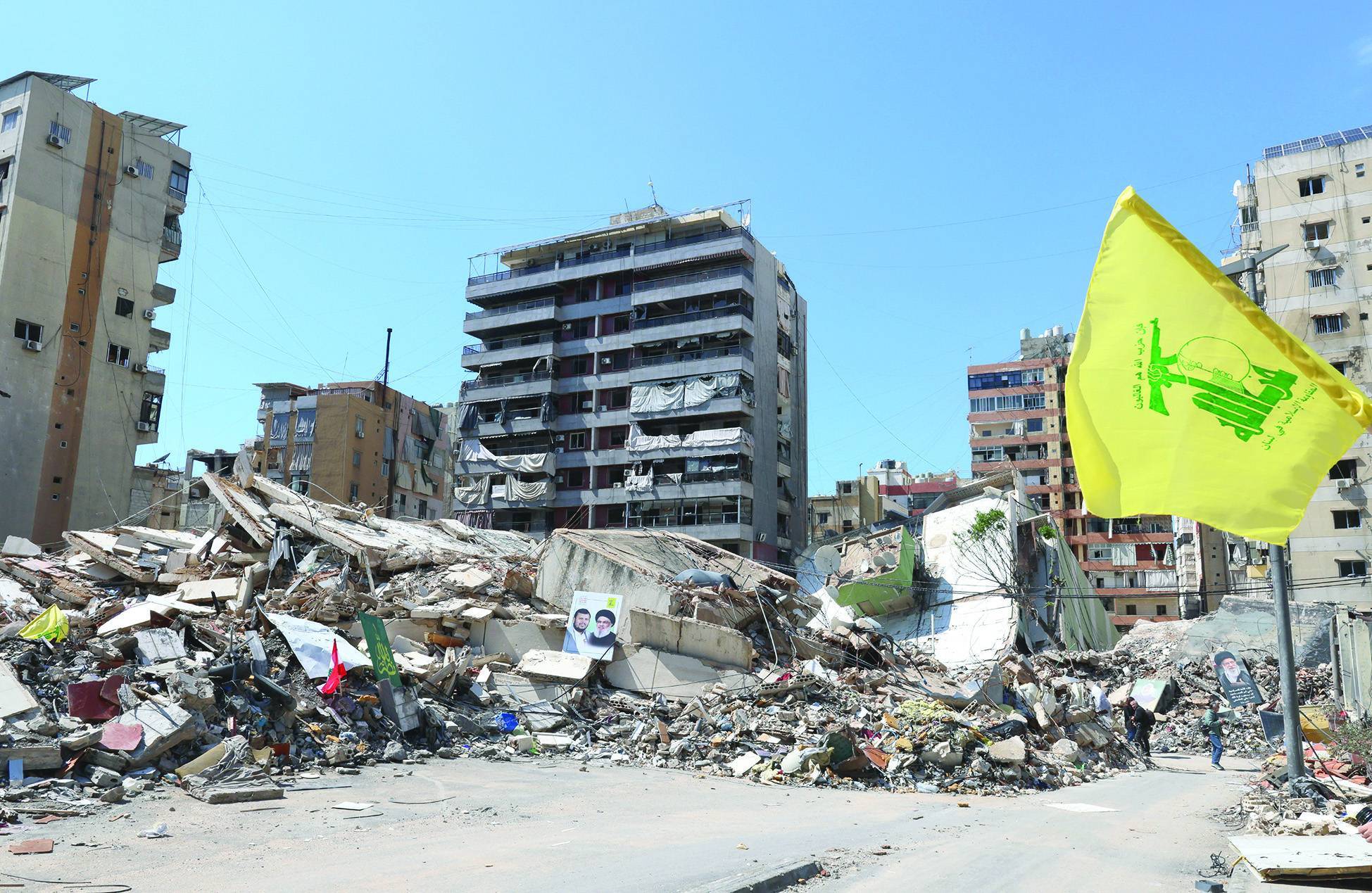
Buildings destroyed by Israeli bombardment in Beirut’s southern suburbs, where a Hezbollah flag flies, on May 6, 2026 (EPA)
A study conducted by the United Nations Development Programme in coordination with Lebanon’s National Council for Scientific Research, and in cooperation with the Lebanese Army and the United Nations Department of Safety and Security, found that 146 buildings were completely destroyed in the Beirut and Mount Lebanon governorates, while 264 buildings were partially damaged.
At the housing-unit level, the study recorded the complete destruction of 3,168 residential units, while another 4,437 units sustained partial damage.
Israeli Settlers Attack Palestinians During Olive Harvesthttps://english.aawsat.com/arab-world/5330246-israeli-settlers-attack-palestinians-during-olive-harvest
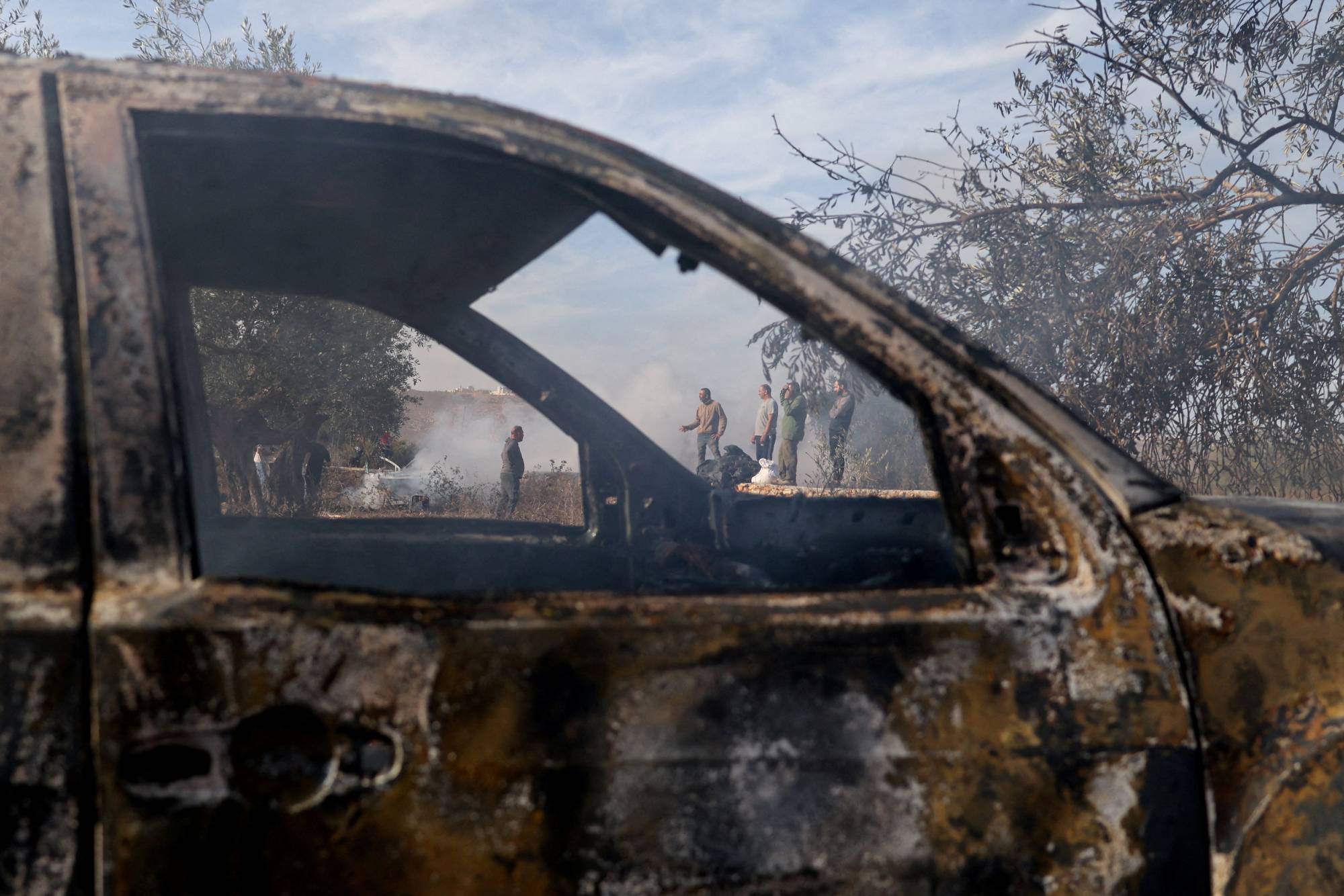
Firefighters douse a burnt car with water after Israeli militant settlers attacked a group of Palestinians harvesting olives near Turmus Ayya in the Israeli-occupied West Bank, October 16, 2026. REUTERS/Ammar Awad
Israeli Settlers Attack Palestinians During Olive Harvest
Firefighters douse a burnt car with water after Israeli militant settlers attacked a group of Palestinians harvesting olives near Turmus Ayya in the Israeli-occupied West Bank, October 16, 2026. REUTERS/Ammar Awad
Israeli settlers attacked Palestinians in multiple villages across the occupied West Bank on Friday and trees and cars were set on fire, according to local officials and emergency responders with the Palestinian Red Crescent Society.
The Palestinian Red Crescent Society said six people were injured in two attacks it responded to in the town of Abu Falah outside Ramallah. A 63-year-old woman and a 40-year-old man were taken to a hospital after being beaten by settlers, The Associated Press quoted the Red Crescent as saying.
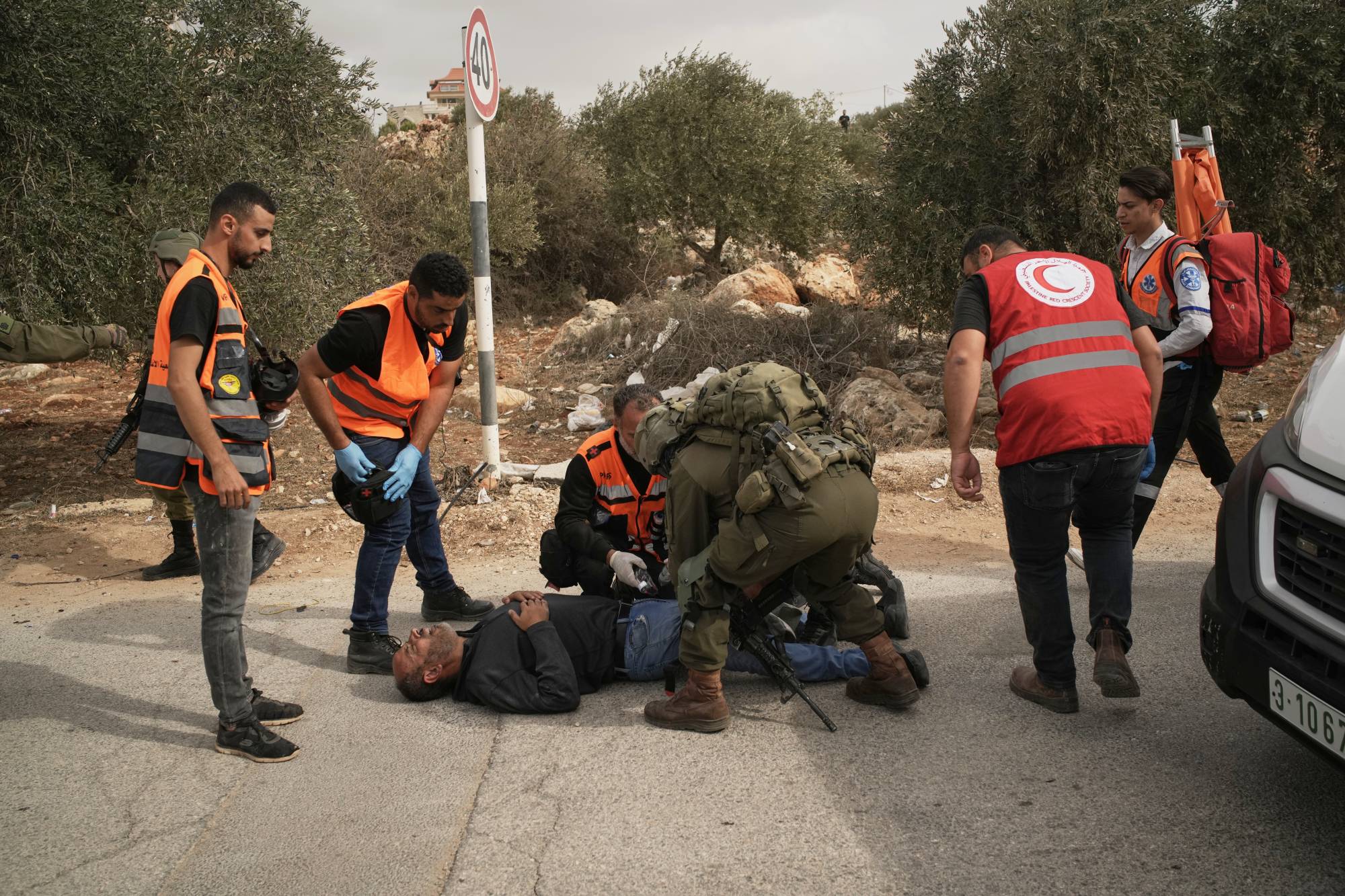
Palestinian medics and an Israeli soldier attend to a Palestinian man shot by Israeli soldiers following a settler attack on Palestinians harvesting olives in the West Bank village of Abu Falah, Friday, Oct. 16, 2026. (AP Photo/Leo Correa)
"The settlers want to attack us and force us from our homes," said Moutaz Abdelhadi, 42, a farmer who witnessed the attack in Abu Falah.
Partway through the attack, at least two Israeli military jeeps sped through the area, kicking up dust as villagers ran out of their way.
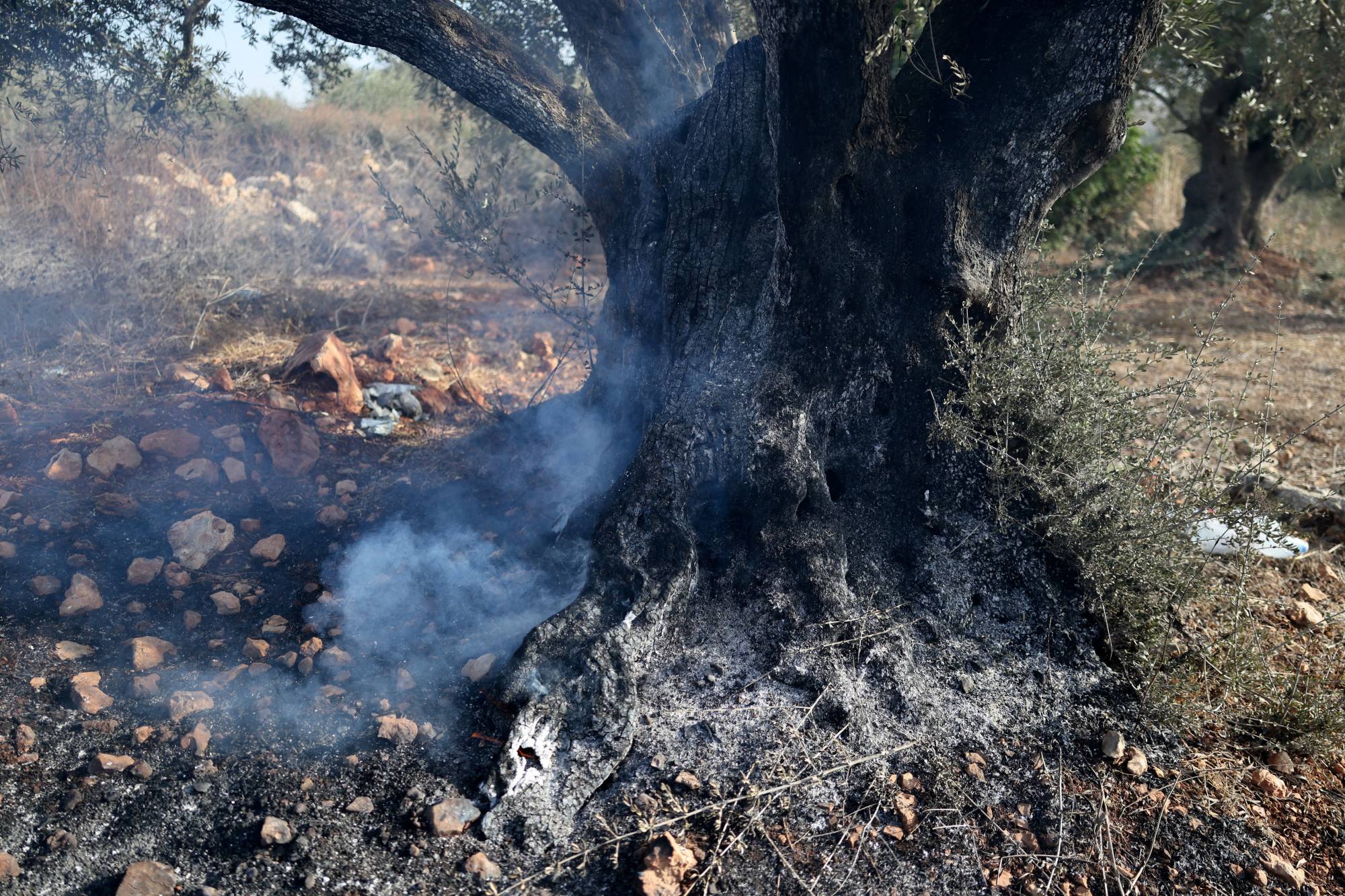
A burnt olive tree after Israeli militant settlers attacked a group of Palestinians while they were harvesting olives near Turmus Ayya in the Israeli-occupied West Bank, October 16, 2026. REUTERS/Ammar Awad
The attack continued after the military's arrival, with Israeli soldiers firing tear gas in the direction of the Palestinians who had dodged the jeeps. The sound of live gunfire could be heard in the area, and a Reuters photographer saw at least one armed settler fire a gun.
Among the injured was Heidi Levine, a photojournalist with the Washington Post. The newspaper did not immediately respond to a request for comment.
Israel has imposed new rules on the olive harvest this year, prohibiting Palestinians from working in what’s known as Area C, which is under Israeli security control and encompasses the majority of the territory’s agricultural land.
At least four Palestinians have been killed and more than 100 injured since the harvest season began earlier this month, according to Palestinian officials.
They say thousands of trees have been damaged, costing farmers hundreds of thousands of dollars.
Palestinians stand near a burnt-out car after Israeli militant settlers attacked a group of Palestinians while they were harvesting olives near Turmus Ayya in the Israeli-occupied West Bank, October 16, 2026. REUTERS/Ammar Awad
Israel’s police and army did not immediately respond to questions about the attacks.
The Abu Falah attack followed a similar attack on Friday morning in the area of Turmus Ayya village, where settlers burned three cars after attacking a group of farmers harvesting olives.
Salah Abu Niswa, who witnessed the attack in Turmus Ayya, said the settlers "snuck up like thieves, they caught someone by himself and began to beat him."
لم تشترك بعد
انشئ حساباً خاصاً بك لتحصل على أخبار مخصصة لك ولتتمتع بخاصية حفظ المقالات وتتلقى نشراتنا البريدية المتنوعة