

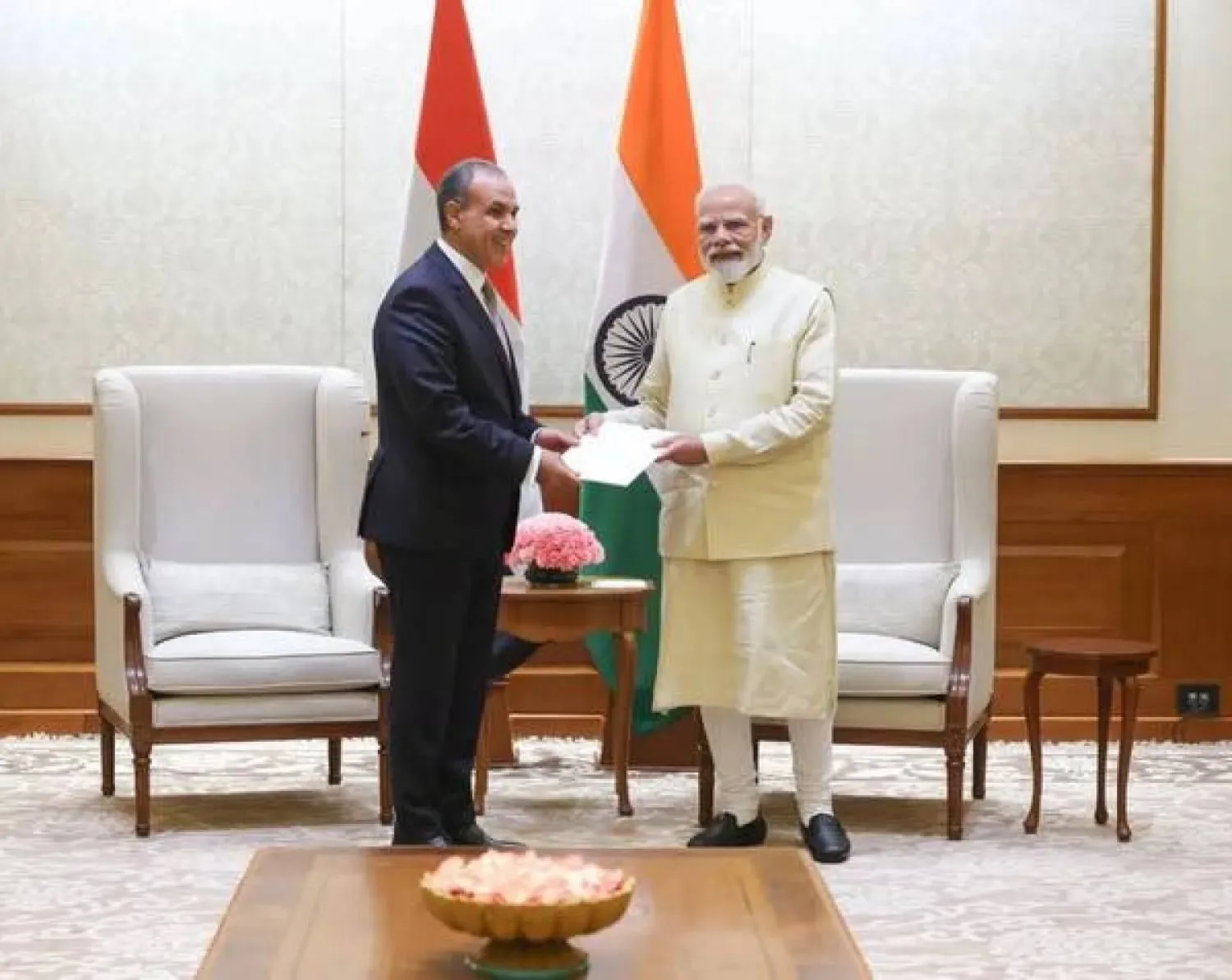

Egypt and India Move to Strengthen Strategic Partnership

Egyptian Foreign Minister delivers a written message from President al-Sisi to the Prime Minister of India (Egyptian Foreign Ministry) 
TT

Egypt and India Move to Strengthen Strategic Partnership

Egyptian Foreign Minister delivers a written message from President al-Sisi to the Prime Minister of India (Egyptian Foreign Ministry) 

Egypt and India are stepping up efforts to deepen their “strategic partnership” as Cairo seeks to expand economic, political, and security cooperation with New Delhi.

On Friday, Egyptian Foreign Minister Badr Abdelatty delivered a written message from President Abdel Fattah al-Sisi to Indian Prime Minister Narendra Modi, outlining ways to advance bilateral relations and strengthen the strategic partnership between the two countries.

Abdelatty also co-chaired the first round of the Strategic Dialogue in New Delhi with Indian External Affairs Minister Subrahmanyam Jaishankar.

During the meeting with Modi, the minister expressed Egypt’s appreciation for the rapid development of bilateral ties, reflected in high-level visits and the elevation of relations to the level of a strategic partnership. He also highlighted Egypt’s readiness to host the eighth session of the Egyptian-Indian Joint Committee in the first half of 2026 to further expand cooperation in various fields.

Abdelatty underscored Egypt’s interest in increasing cooperation in economy, trade, and investment, to raise the trade volume between the two countries to $12 billion over the next five years. The talks also focused on enhancing international trade connectivity, leveraging Egypt’s advanced infrastructure linking the Red Sea and the Mediterranean, and the strategic importance of the Suez Canal.

Modi, for his part, praised the strong friendship between India and Egypt and commended Cairo’s efforts to support peace and stability in the Middle East. He welcomed the outcomes of the Sharm El-Sheikh Peace Summit, which produced an agreement to halt the war in Gaza.

According to Foreign Ministry spokesperson Tamim Khallaf, the first round of the Strategic Dialogue reflects the rapid progress in bilateral relations since the elevation of ties during Modi’s June 2023 visit to Cairo. Both sides reaffirmed their commitment to implementing memoranda of understanding and joint initiatives to advance mutual interests.

The talks reviewed opportunities to boost economic, trade, investment, and technology cooperation, strengthen defense partnerships through joint training and defense industries, and expand counterterrorism and intelligence-sharing collaboration. They also exchanged views on regional and international issues.

Abdelatty highlighted Egypt’s economic reforms since 2016, including a flexible exchange rate policy that improved economic performance and credit ratings, making the country more attractive to investors. He invited Indian companies to invest in the Suez Canal Economic Zone, offering major incentives and tax exemptions.

Abdelatty and Jaishankar also agreed that the current multilateral system faces a crisis of credibility and effectiveness, pointing to the UN Security Council’s failure to address conflicts such as in Gaza and Sudan. They called for urgent reform to restore the system’s role in maintaining global peace and security.


Gaza Ceasefire Enters Phase Two Despite Unresolved Issues

 Palestinians walk amid buildings destroyed by Israeli air and ground operations in Gaza City Thursday, Jan. 15, 2026. (AP)
Palestinians walk amid buildings destroyed by Israeli air and ground operations in Gaza City Thursday, Jan. 15, 2026. (AP)
TT

Gaza Ceasefire Enters Phase Two Despite Unresolved Issues

 Palestinians walk amid buildings destroyed by Israeli air and ground operations in Gaza City Thursday, Jan. 15, 2026. (AP)
Palestinians walk amid buildings destroyed by Israeli air and ground operations in Gaza City Thursday, Jan. 15, 2026. (AP)

A US-backed plan to end the war in Gaza has entered its second phase despite unresolved disputes between Israel and Hamas over alleged ceasefire violations and issues unaddressed in the first stage.

The most contentious questions remain Hamas's refusal to publicly commit to full disarmament, a non-negotiable demand from Israel, and Israel's lack of clarity over whether it will fully withdraw its forces from Gaza.

The creation of a Palestinian technocratic committee, announced on Wednesday, is intended to manage day-to-day governance in post-war Gaza, but it leaves unresolved broader political and security questions.

Below is a breakdown of developments from phase one to the newly launched second stage.

- Gains and gaps in phase one -

The first phase of the plan, part of a 20-point proposal unveiled by US President Donald Trump, began on October 10 and aimed primarily to stop the fighting in the Gaza Strip, allow in aid and secure the return of all remaining living and deceased hostages held by Hamas and allied Palestinian armed groups.

All hostages have since been returned, except for the remains of one Israeli, Ran Gvili.

Israel has accused Hamas of delaying the handover of Gvili's body, while Hamas has said widespread destruction in Gaza made locating the remains difficult.

Gvili's family had urged mediators to delay the transition to phase two.

"Moving on breaks my heart. Have we given up? Ran did not give up on anyone," his sister, Shira Gvili, said after mediators announced the move.

Israeli Prime Minister Benjamin Netanyahu said efforts to recover Gvili's remains would continue but has not publicly commented on the launch of phase two.

Hamas has accused Israel of repeated ceasefire violations, including air strikes, firing on civilians and advancing the so-called "Yellow Line," an informal boundary separating areas under Israeli military control from those under Hamas authority.

Gaza's Hamas-run health ministry said Israeli forces had killed 451 people since the ceasefire took effect.

Israel's military said it had targeted suspected fighters who crossed into restricted zones near the Yellow Line, adding that three Israeli soldiers were also killed by fighters during the same period.

Aid agencies say Israel has not allowed the volume of humanitarian assistance envisaged under phase one, a claim Israel rejects.

Gaza, whose borders and access points remain under Israeli control, continues to face severe shortages of food, clean water, medicine and fuel.

Israel and the United Nations have repeatedly disputed figures on the number of aid trucks permitted to enter the Palestinian territory.

- Disarmament, governance in phase two -

Under the second phase, Gaza is to be administered by a 15-member Palestinian technocratic committee operating under the supervision of a so-called "Board of Peace," to be chaired by Trump.

"The ball is now in the court of the mediators, the American guarantor and the international community to empower the committee," Bassem Naim, a senior Hamas leader, said in a statement on Thursday.

Mediators Egypt, Türkiye and Qatar said Ali Shaath, a former deputy minister in the Ramallah-based Palestinian Authority, had been appointed to lead the committee.

Shaath, in an interview, said the committee would rely on "brains rather than weapons" and would not coordinate with armed groups.

US Middle East envoy Steve Witkoff said phase two aims for the "full demilitarization and reconstruction of Gaza," including the disarmament of all unauthorized armed factions.

Witkoff said Washington expected Hamas to fulfill its remaining obligations, including the return of Gvili's body, warning that failure to do so would bring "serious consequences".

The plan also calls for the deployment of an International Stabilization Force to help secure Gaza and train vetted Palestinian police units.

For Palestinians, the central issue remains Israel's full military withdrawal from Gaza - a step included in the framework but for which no detailed timetable has been announced.

With fundamental disagreements persisting over disarmament, withdrawal and governance, diplomats say the success of phase two will depend on sustained pressure from mediators and whether both sides are willing - or able - to move beyond long-standing red lines.


Lebanon Charges Four Accused of Kidnapping for Israel’s Mossad

A handout photo from Israeli television made available on July 13, 2008, shows a photograph of Ron Arad, an Israeli Air Force navigator who was captured after his fighter jet was shot down in Lebanon in 1986. (Handout / AFP)
TT

Lebanon Charges Four Accused of Kidnapping for Israel’s Mossad

A handout photo from Israeli television made available on July 13, 2008, shows a photograph of Ron Arad, an Israeli Air Force navigator who was captured after his fighter jet was shot down in Lebanon in 1986. (Handout / AFP)

Four people accused of a kidnapping in Lebanon for Israel's Mossad spy agency last month have been charged, a judicial official said on Thursday, after a retired security officer whose brother was linked to an Israeli airman's disappearance went missing.

Israel has apprehended suspects in Lebanon before and Mossad is accused of regularly attempting to contact Lebanese people to facilitate its operations, while Lebanon has arrested dozens of people on suspicion of collaborating with Israel over the years.

Lebanese authorities believe the agency known for espionage operations outside of Israel's borders was behind the disappearance of retired security officer Ahmad Shukr last month.

Shukr, whose brother Hassan is suspected of involvement in the 1986 capture of Israeli air force navigator Ron Arad, disappeared in the Bekaa region of eastern Lebanon.

Authorities have arrested and charged one Lebanese man and charged three more who remain at large.

The four were charged with "communicating with and working for Mossad within Lebanon in exchange for money, and carrying out the kidnapping of Ahmad Shukr", a judicial official told AFP on condition of anonymity.

The three are "a Lebanese woman, a Lebanese-French man, and a Syrian-Swedish man," the official said.

The Israeli airman Ron Arad, whose plane went down in southern Lebanon during the country's civil war between 1975 and 1990, is now presumed dead and his remains were never returned.

Hassan Shukr was killed in 1988 in a battle between Israeli forces and local fighters, including from the Iran-backed Hezbollah group, a source close to the family told AFP last month, requesting anonymity.


Israeli Strikes Kill Five in Gaza, Say Local Health Authorities

 Makeshift tents shelter displaced Palestinians stand among buildings destroyed by Israeli air and ground operations in Gaza City Thursday, Jan. 15, 2026. (AP)
Makeshift tents shelter displaced Palestinians stand among buildings destroyed by Israeli air and ground operations in Gaza City Thursday, Jan. 15, 2026. (AP)
TT

Israeli Strikes Kill Five in Gaza, Say Local Health Authorities

 Makeshift tents shelter displaced Palestinians stand among buildings destroyed by Israeli air and ground operations in Gaza City Thursday, Jan. 15, 2026. (AP)
Makeshift tents shelter displaced Palestinians stand among buildings destroyed by Israeli air and ground operations in Gaza City Thursday, Jan. 15, 2026. (AP)

Two Israeli airstrikes killed five people, including a 16-year-old, in Deir al-Balah on Thursday, said local health authorities.

The Israeli military did not immediately respond to a Reuters request for comment on the incident.

It was not immediately clear what triggered the attacks, which were in areas outside the control of Israeli forces in the strip.

More than 400 Palestinians ‌and three Israeli ‌soldiers have been reported ‌killed ⁠since a ‌fragile ceasefire took effect in October.

Israel has razed buildings and ordered residents out of more than half of Gaza where its troops remain. Nearly all of the territory's more than 2 million people now live in ⁠makeshift homes or damaged buildings in a sliver of ‌territory where Israeli troops have withdrawn ‍and Hamas has ‍reasserted control.

The United Nations children agency ‍said on Tuesday that over 100 children have been killed in Gaza since the ceasefire, including victims of drone and quadcopter attacks.

Israel and Hamas have traded blame for violations of the ceasefire and remain far apart ⁠from each other on key issues, despite the United States announcing the second phase of the ceasefire on Wednesday.

Israel launched its operations in Gaza in the wake of an attack by Hamas-led fighters on October, 2023 which killed 1,200 people, according to Israeli tallies. Israel's assault has killed 71,000 people, according to health authorities in the strip, ‌and left much of Gaza in ruins.
