


Abbas Paves Way for Hussein al-Sheikh to Lead Through Critical Transition

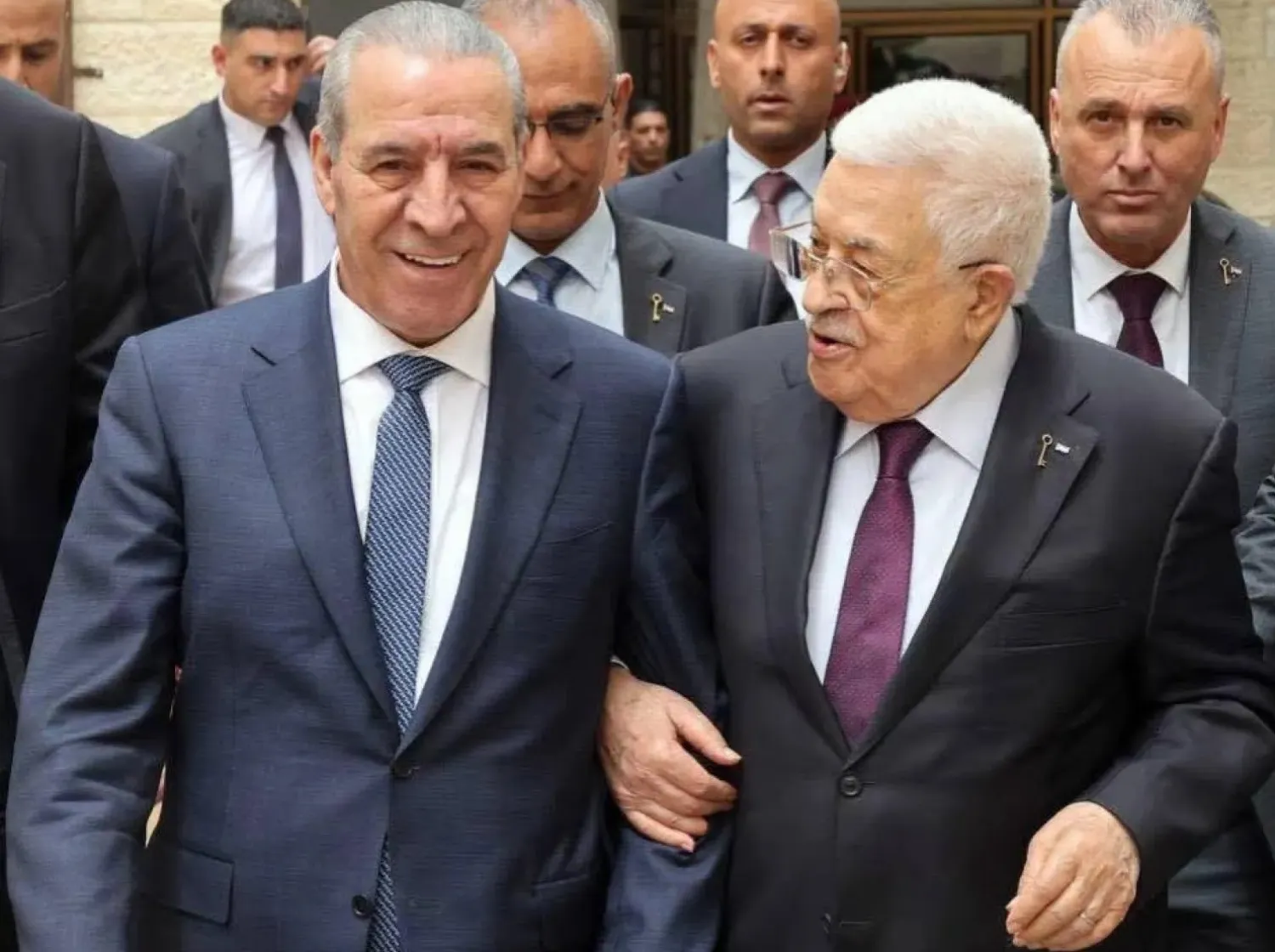
  File photo of Palestinian President Mahmoud Abbas and his deputy Hussein al-Sheikh (Fatah media)
File photo of Palestinian President Mahmoud Abbas and his deputy Hussein al-Sheikh (Fatah media)
TT

Abbas Paves Way for Hussein al-Sheikh to Lead Through Critical Transition

  File photo of Palestinian President Mahmoud Abbas and his deputy Hussein al-Sheikh (Fatah media)
File photo of Palestinian President Mahmoud Abbas and his deputy Hussein al-Sheikh (Fatah media)

Palestinian President Mahmoud Abbas has cleared the way for his deputy, Hussein al-Sheikh, to temporarily assume the presidency in the event of a vacancy.

The move, described by political observers as deliberate and carefully timed, aims to ensure a smooth transfer of power and prevent the emergence of rival leadership structures.

In a constitutional declaration issued on Sunday, Abbas stated that if the office of the president becomes vacant in the absence of the Palestinian Legislative Council, the deputy chairman of the Palestine Liberation Organization’s Executive Committee - also the deputy president of the State of Palestine - will temporarily assume the presidency of the Palestinian Authority for up to 90 days, during which elections must be held. If circumstances prevent elections within that timeframe, the Palestinian Central Council may grant a one-time extension.

Abbas said the decision was made “out of faith and awareness of the sensitivity of this critical moment in the history of the homeland and the Palestinian cause, and in fulfillment of our constitutional and historic responsibility to protect the Palestinian political system, safeguard the homeland, preserve its security, and ensure the continuity of its constitutional institutions.”

While Abbas did not publicly explain why the decision was made at this time, Israeli media reported that it followed American pressure. However, sources in Ramallah told Asharq Al-Awsat the decision was “necessary” given the complexity of the current political environment.

“This was done for several reasons,” one source explained. “First, the situation is extremely sensitive and requires a figure of Sheikh’s stature at the helm if anything unexpected occurs. Second, it preempts internal or external attempts to bypass the PLO or establish alternative leadership structures. And third, it is part of the reform and restructuring commitments the Authority has made.”

The constitutional announcement comes amid heightened international activity by the United States, Europe, and Arab states to shape Gaza’s postwar arrangements.

The Palestinian leadership has made clear it will not accept any administrative body or international force operating in the territory without its mandate, insisting that governance and security in Gaza must remain under Palestinian Authority control.

After recent Palestinian faction meetings in Cairo, which Fatah did not attend, the movement issued a statement reaffirming that the State of Palestine and the PLO remain “the sole legitimate framework capable of protecting the national project.”

The statement rejected “attempts to bypass national legitimacy,” stressed that sovereignty over Palestinian land belongs exclusively to the Palestinian people and their institutions, and warned against any form of foreign trusteeship or mandate.

Fatah also reiterated that disarmament and security must be addressed through “a unified national vision that guarantees one authority, one weapon, and one law,” ensuring stability and denying Israel any pretext to prolong occupation or deepen division.

Hussein al-Sheikh has become one of Abbas’s closest confidants in recent years, frequently leading negotiations with Israel, the United States, and Arab states on critical political and security issues.

On Sunday, Egyptian Foreign Minister Badr Abdelatty held a phone call with Sheikh to discuss reconciliation efforts among Palestinian factions.

Cairo reaffirmed its “full support for the Palestinian Authority and its efforts to achieve unity and rebuild Gaza.”



EU Exploring Support for New Gaza Administration Committee, Document Says

Palestinians push a cart past the rubble of residential buildings destroyed during the two-year Israeli offensives, in Gaza City, February 17, 2026. REUTERS/Mahmoud Issa
TT

EU Exploring Support for New Gaza Administration Committee, Document Says

Palestinians push a cart past the rubble of residential buildings destroyed during the two-year Israeli offensives, in Gaza City, February 17, 2026. REUTERS/Mahmoud Issa

The European Union is exploring possible support for a new committee established to take over the civil administration of Gaza, according to a document produced by the bloc's diplomatic arm and seen by Reuters.

"The EU is engaging with the newly established transitional governance structures for Gaza," the European External Action Service wrote in a document circulated to member states on Tuesday.

"The EU is also exploring possible support to the National Committee for the Administration of Gaza," it added.

European foreign ministers will discuss the situation in Gaza during a meeting in Brussels on February 23.


Israel Military Says Soldier Killed in Gaza 

A drone view shows the destruction in a residential neighborhood, after the withdrawal of the Israeli forces from the area, amid a ceasefire between Israel and Hamas in Gaza, in Gaza City, October 21, 2025. (Reuters)
TT

Israel Military Says Soldier Killed in Gaza 

A drone view shows the destruction in a residential neighborhood, after the withdrawal of the Israeli forces from the area, amid a ceasefire between Israel and Hamas in Gaza, in Gaza City, October 21, 2025. (Reuters)

The Israeli military announced that one of its soldiers had been killed in combat in southern Gaza on Wednesday, but a security source said the death appeared to have been caused by "friendly fire".

"Staff Sergeant Ofri Yafe, aged 21, from HaYogev, a soldier in the Paratroopers Reconnaissance Unit, fell during combat in the southern Gaza Strip," the military said in a statement.

A security source, however, told AFP that the soldier appeared to have been "killed by friendly fire", without providing further details.

"The incident is still under investigation," the source added.

The death brings to five the number of Israeli soldiers killed in Gaza since a ceasefire took effect on October 10.


Syria: SDF’s Mazloum Abdi Says Implementation of Integration Deal May Take Time

People sit outdoors surrounded by nature, with the Tigris river flowing in the background, following a long atmospheric depression, near the Syrian-Turkish border in Derik, Syria, February 16, 2026 REUTERS/Orhan Qereman
TT

Syria: SDF’s Mazloum Abdi Says Implementation of Integration Deal May Take Time

People sit outdoors surrounded by nature, with the Tigris river flowing in the background, following a long atmospheric depression, near the Syrian-Turkish border in Derik, Syria, February 16, 2026 REUTERS/Orhan Qereman

Mazloum Abdi, commander of the Syrian Democratic Forces, said the process of merging the SDF with Syrian government forces “may take some time,” despite expressing confidence in the eventual success of the agreement.

His remarks came after earlier comments in which he acknowledged differences with Damascus over the concept of “decentralization.”

Speaking at a tribal conference in the northeastern city of Hasakah on Tuesday, Abdi said the issue of integration would not be resolved quickly, but stressed that the agreement remains on track.

He said the deal reached last month stipulates that three Syrian army brigades will be created out of the SDF.

Abdi added that all SDF military units have withdrawn to their barracks in an effort to preserve stability and continue implementing the announced integration agreement with the Syrian state.

He also emphasized the need for armed forces to withdraw from the vicinity of the city of Ayn al-Arab (Kobani), to be replaced by security forces tasked with maintaining order.