Syria Announces Seizure of 11 Million Captagon Pills from Lebanon

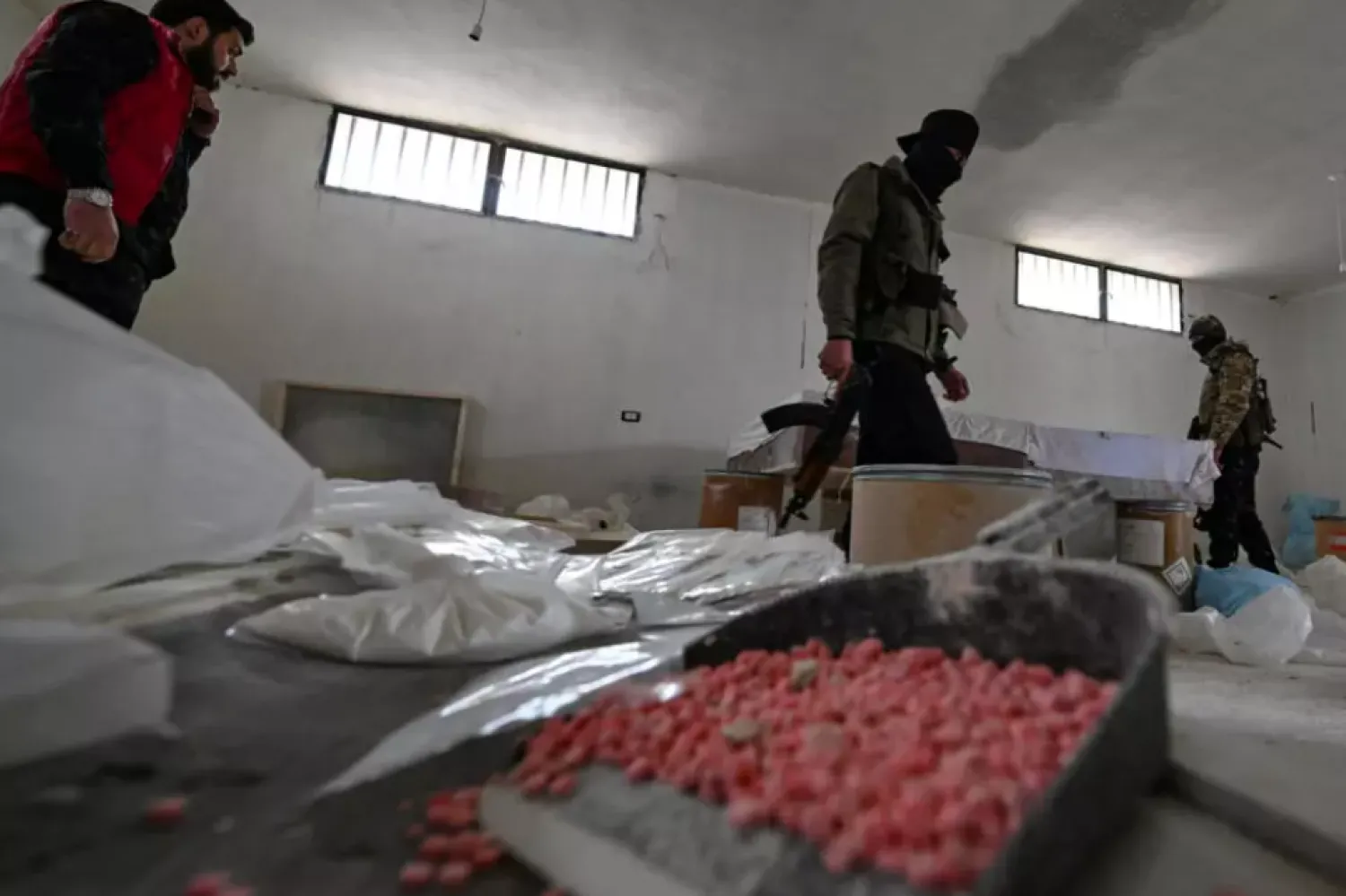
In the building raided by Syrian border security, AFP correspondents saw large bags of captagon pills © LOUAI BESHARA / AFP
TT

Syria Announces Seizure of 11 Million Captagon Pills from Lebanon

In the building raided by Syrian border security, AFP correspondents saw large bags of captagon pills © LOUAI BESHARA / AFP

The Syrian interior ministry said that it had seized about 11 million captagon stimulant pills that entered the country from neighboring Lebanon in one of the largest busts since the fall of former ruler Bashar al-Assad.

In a statement, the interior ministry said "the anti-narcotics branch in Homs province seized a vehicle coming from Lebanon containing approximately 11 million captagon pills".

The statement added that the authorities are continuing to "conduct the necessary investigations to uncover the identities of those involved and identify the criminal networks linked to the operation".

Captagon, which is similar to amphetamines, became Syria's largest export during the civil war that erupted in 2011, with its trade serving as a key funding source for the government of ousted president Assad, AFP reported.

Since his fall in December, the new authorities have reported numerous major seizures of captagon across the country. However, neighboring countries continue to report the interception of large shipments.

In Lebanon, Assad's ally Hezbollah also faced accusations of using the captagon trade to finance itself.

The Lebanese military announced in September the seizure of 64 million captagon pills in the east in one of the largest operations against the illicit stimulant in the country.

The synthetic drug has flooded the region, with neighboring countries occasionally announcing seizures and asking Lebanon and Syria to ramp up efforts to combat the trade.


Organizers Say New Civilian-led Aid Flotilla with over 100 Boats will Sail to Gaza in March

South African member of parliament and Nelson Mandela's grandson Mandla Mandela joins a press conference held by the Global Sumud Flotilla about its upcoming Spring 2026 mission Thursday, Feb. 5, 2026, at the Nelson Mandela Foundation in Johannesburg, South Africa. (AP Photo/Jerome Delay)
TT

Organizers Say New Civilian-led Aid Flotilla with over 100 Boats will Sail to Gaza in March

South African member of parliament and Nelson Mandela's grandson Mandla Mandela joins a press conference held by the Global Sumud Flotilla about its upcoming Spring 2026 mission Thursday, Feb. 5, 2026, at the Nelson Mandela Foundation in Johannesburg, South Africa. (AP Photo/Jerome Delay)

Organizers of an international flotilla of boats carrying humanitarian aid to Gaza on Thursday announced plans for another mission with more than 100 boats in March.

Campaigners, who organized a similar aid flotilla last year, described the upcoming mission as the biggest civilian-led mobilization against Israel's actions in Gaza. They called on the international community to prevent Israeli forces from intercepting the operation.

The announcement was made at the Nelson Mandela Foundation in South Africa and speakers included Mandla Mandela, grandson of the late former South African president, The AP news reported.

The United Nations said that hundreds of thousands of pallets of humanitarian supplies have been offloaded and collected at various crossings into Gaza since a fragile ceasefire was announced in October.

But Israel has suspended more than two dozen humanitarian organizations from operating in the Gaza Strip for failing to comply with new registration rules, and the territory's population of over 2 million Palestinians still face a humanitarian crisis.

Mandela was part of the flotilla that embarked on a mission to Gaza last year and was detained along with other activists when their boat was intercepted by Israeli forces before they could reach Gaza shores.

According to organizers, more than 1,000 activists including medical doctors, war crimes investigators and engineers will form part of the new flotilla. It will be supported by a land convoy that is expected to attract thousands more activists across countries including Tunisia and Egypt.

The boats are expected to sail from Spain, Tunisia and Italy toward Gaza.

“This time around we expect hundreds and thousands to sign up and to mobilize entry through Egypt, through Lebanon, through Jordan and every other border that is feasible for us to get into occupied Palestine and to Gaza," Mandela said. “We want to mobilize the entire global community to join forces with us."

Activists said they were aware that they might be confronted by Israeli forces but that they were protected by international law.

“The International Court of Justice in the provisional ruling in the case opened by South Africa against the genocide state of Israel, states very clearly that Israel or any other nation are prohibited to hinder any type of humanitarian mission on the way to Gaza," said Thiago Avila, a Brazilian activist who is part of the steering committee.

Mandela said they had chosen to host the briefing at the Nelson Mandela Foundation to highlight Nelson Mandela's support for the Palestinian cause. They also welcomed the country's decision to expel Israel's deputy ambassador to South Africa.

Last year's mission mobilized about 50 vessels and 500 activists. Organizers said Israeli vessels approached the boats while they sailed in international waters, spraying some with water canons.

An estimated 443 participants were detained, including Mandela, activist Greta Thunberg and European Parliament member Rima Hassan.


France Tells Syria Anti-ISIS Fight is Its 'Absolute Priority'

People sit in a truck after being evacuated out of the last territory held by ISIS militants, outside Baghouz, Syria, Monday, March 4, 2019. (AP Photo/Andrea Rosa)
TT

France Tells Syria Anti-ISIS Fight is Its 'Absolute Priority'

People sit in a truck after being evacuated out of the last territory held by ISIS militants, outside Baghouz, Syria, Monday, March 4, 2019. (AP Photo/Andrea Rosa)

France's foreign minister said Thursday that sustaining the fight against the ISIS group is an "absolute priority" for Paris, after meeting his Syrian counterpart in Damascus.

Jean-Noel Barrot is on the first stop of a regional tour as France reassesses how to tackle militants after Kurdish allies in Syria, who were guarding detained ISIS militants, were forced to disband under pressure from Damascus, AFP reported.

Barrot will move on to Iraq on Thursday afternoon before heading to Lebanon on Friday, according to the French foreign ministry.

In the Syrian capital, he met his counterpart Asaad al-Shaibani, with the pair discussing how to prevent a resurgence of ISIS militants after the Kurdish forces' withdrawal from swathes of northern Syria.

"For 10 years, France has fought relentlessly and mercilessly against the terrorists of ISIS in Iraq as well as in Syria," said Barrot.

"I have come to reaffirm this absolute priority of France here in Syria."

Until now, the Kurdish-led Syrian Democratic Forces had been the main partner on the ground of a western anti-militant coalition, but under military pressure from Damascus they are to integrate into the Syrian army.

"This tour stems from the convergence of two crises," a French diplomatic source told AFP, referring to Barrot's trip.

"One that erupted very recently in northeastern Syria, with clashes between the Syrian authorities in Damascus and the Kurdish-dominated SDF, and the ever-present threat of a military escalation between the United States and Iran."

Other issues on Barrot's agenda will be the question of integrating Syria's myriad minorities into its new political landscape.

France has positioned itself as an advocate of Kurdish rights and will be pushing Damascus to comply with an agreement announced last week aimed at integrating Kurdish institutions and forces into the Syrian state.

The agreement dashed the Kurds' hopes of retaining an autonomous zone they had established in northern and northeastern Syria during a civil war that ravaged Syria between 2011 and 2024.


Lebanon: Israel Sprayed Glyphosate Along Southern Border

Lebanese army soldiers inspect the site of an Israeli strike in Kfardounine, southern Lebanon (EPA)
TT

Lebanon: Israel Sprayed Glyphosate Along Southern Border

Lebanese army soldiers inspect the site of an Israeli strike in Kfardounine, southern Lebanon (EPA)

Laboratory tests have identified the chemical sprayed by Israeli aircraft in southern Lebanon as glyphosate, a widely used herbicide that can destroy vegetation when applied intensively, Lebanon’s agriculture minister, Nizar Hani, told Asharq Al-Awsat, saying the substance was used at abnormally high concentrations along the border with Israel.

The spraying of unidentified chemical substances by Israeli aircraft has triggered widespread condemnation.

Lebanese President Joseph Aoun denounced “in the strongest terms the Israeli aircraft’s spraying of toxic pesticides on farmland and orchards in several southern border villages.”

He described the act as “a flagrant violation of Lebanese sovereignty and an environmental and health crime against Lebanese citizens and their land, and a continuation of Israel’s repeated attacks on Lebanon and its people.”

Aoun said the practices, which target agricultural land and citizens’ livelihoods and threaten public health and the environment, require the international community and relevant United Nations bodies to assume their responsibilities to halt the attacks and protect Lebanese sovereignty.

He said he had asked the Foreign Ministry to prepare a documented file, in coordination with the agriculture, environment, and public health ministries, as a prelude to taking all necessary legal and diplomatic steps, including filing complaints with relevant international forums.

High-concentration glyphosate

Lebanese authorities launched an investigation into the substances and subjected samples to scientific testing.

Hani said laboratory results showed the sprayed material was glyphosate, a commonly used herbicide marketed in many countries, but added that it had been applied at “extremely high concentrations, exceeding normal levels by about 20%-30%.”

He said glyphosate, like other herbicides, eliminates vegetation when used at such high levels, directly affecting soil and water and causing negative repercussions for human health.

He noted that the substance is classified as having carcinogenic effects and poses serious risks, particularly to agriculture and plant ecosystems.

Hani said the incident was consistent with known practices along the border, where such substances are used to create vegetation-free zones, effectively resulting in systematic desertification.

State measures: reports and an international file

Hani said the Agriculture Ministry immediately initiated the required procedures and prepared official reports to be submitted to the Foreign Ministry, which will determine the appropriate course of action, including filing complaints or submitting reports to the UN.

He recalled that the ministry had previously prepared a detailed report in cooperation with the Food and Agriculture Organization on agricultural damage caused by Israeli attacks, quantifying direct losses as well as indirect losses linked to production and farming seasons. The report was formally submitted to the Foreign Ministry for the necessary steps to be taken.

Health implications

The use of the substance also carries health consequences. Abdul Rahman Al-Bizri, a member of parliament’s health committee, told Asharq Al-Awsat that glyphosate is a chemical herbicide widely used worldwide to eliminate unwanted weeds.

He condemned spraying the substance in populated civilian areas and on land containing fruit-bearing crops essential for food, noting that glyphosate works by disrupting an enzyme plants need for growth, causing them to wither and die within a short period.

Al-Bizri said the conventional use of the substance is limited to roadside areas or the removal of unwanted vegetation.

Spraying it in these locations, he said, could fall within attempts to remove vegetation for military and security purposes, as well as render land unsuitable for agricultural use in the near term, hindering residents’ return.

Scientific debate and aerial spraying

Al-Bizri pointed to the scientific controversy surrounding the substance, noting that glyphosate is classified by the International Agency for Research on Cancer as “probably carcinogenic to humans,” in addition to its direct and indirect health effects, particularly with repeated or uncontrolled exposure.

He said one of the most dangerous aspects was aerial spraying, a method rarely used for such substances because of its high risks, as it can reach food crops, water sources, and residential areas. He said what is happening appears to be deliberate spraying of the inhabited regions and food crops.

Symptoms and health risks

Al-Bizri said short-term symptoms appear quickly after direct exposure and include skin irritation, rashes, and itching, eye irritation with burning and temporary blurred vision, and respiratory irritation when inhaling the spray, causing coughing and shortness of breath.

He said symptoms may also include nausea, vomiting, and diarrhea in cases of accidental ingestion, along with headaches, fatigue, and general weakness, adding that such effects are more dangerous in children.

He said chronic exposure has been linked to higher rates of lymphoma, blood and blood cell disorders, hormonal disruptions affecting fertility, growth, pregnancy, and overall hormonal balance, as well as potential effects on the nervous system, such as chronic headaches, impaired concentration, and neurological fatigue, and possible links to certain neurological disorders.

While the substance is not immediately lethal, he said, it poses a real health and environmental risk with repeated, unregulated exposure, given its adverse effects on human, animal, and plant health, as well as on ecological balance in general.

Scientific and legal files under Foreign Ministry supervision

The Foreign Ministry has begun procedures to document Israeli attacks involving the spraying of toxic substances and pesticides on agricultural land and orchards in several Lebanese villages.

In a statement, the ministry said it would coordinate with the agriculture, environment, and public health ministries, as well as scientific and research bodies, to prepare a comprehensive scientific and legal file documenting the violations.

The file will identify the substances used and verify whether they violate international law by comparing them with lists of internationally prohibited materials under relevant conventions and treaties.

It will also document affected areas and assess the health, environmental, and agricultural damage resulting from their use, including impacts on humans, soil, vegetation, and water resources.

Once the file is completed, the Foreign Ministry will submit a formal complaint to the United Nations Security Council against Israel.