
Israel Hands Over Bodies of 30 Palestinians, Gaza Hospital Officials Say

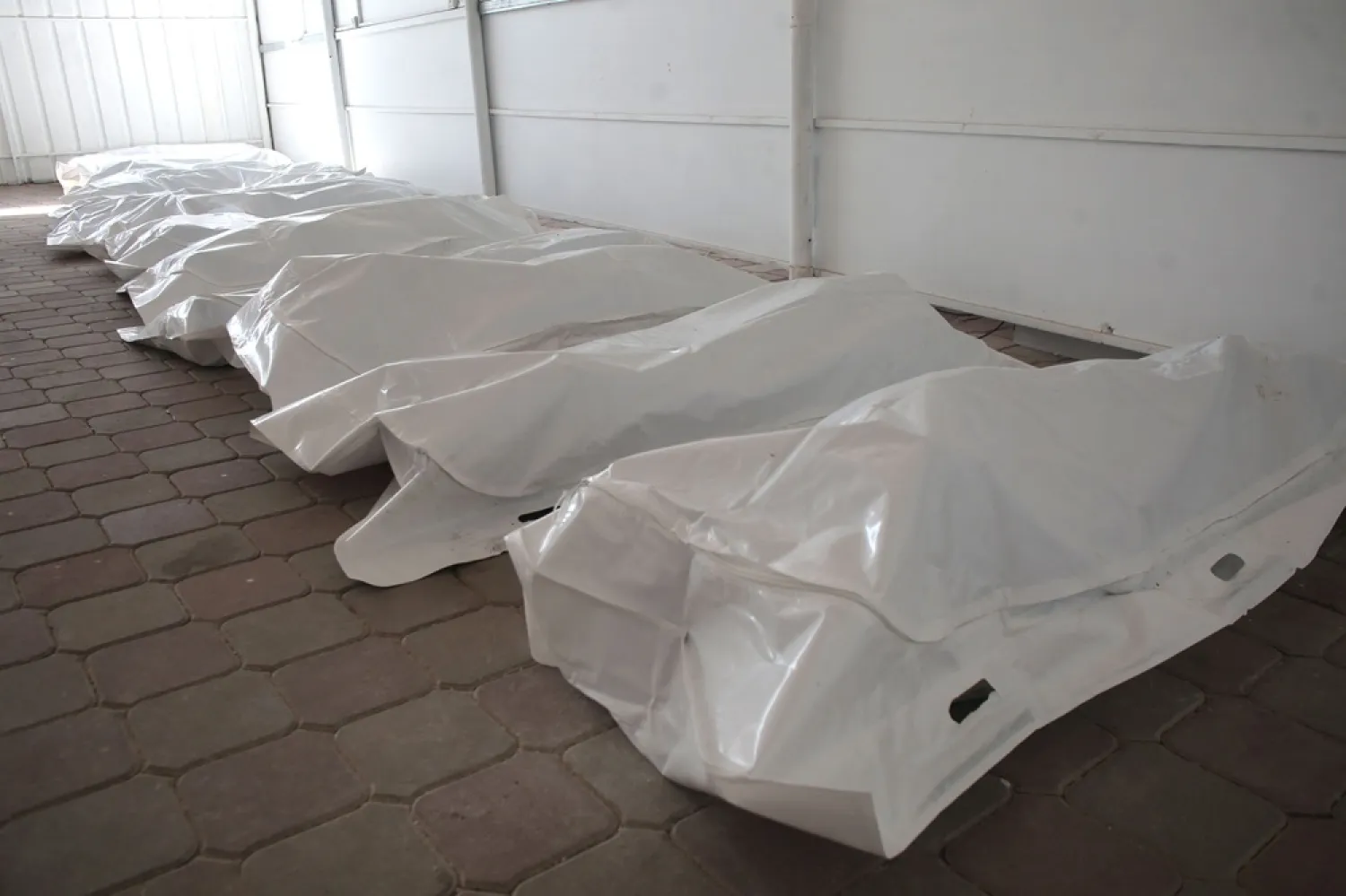
Some of the thirty body bags containing the corpses of Palestinian prisoners detained by Israel and released as part of the hostage exchange deal, are laid out in the grounds of the Nasser Medical Complex, in Khan Younis, in the southern Gaza Strip, on October 31, 2025. (AFP)
TT

Israel Hands Over Bodies of 30 Palestinians, Gaza Hospital Officials Say

Some of the thirty body bags containing the corpses of Palestinian prisoners detained by Israel and released as part of the hostage exchange deal, are laid out in the grounds of the Nasser Medical Complex, in Khan Younis, in the southern Gaza Strip, on October 31, 2025. (AFP)

Israel has handed over the bodies of 30 Palestinians, Red Cross and hospital officials in Gaza said Friday, a day after Palestinian militants returned the remains of two hostages to Israel. 

A doctor at Nasser Hospital in the southern city of Khan Younis confirmed receiving the bodies and said they were all unidentified. The Red Cross said that its teams had facilitated the transfer. 

The exchange was the latest indication that the fraught Israel-Hamas ceasefire agreement is moving forward, despite Israeli strikes on Gaza this week that killed more than 100 people following the killing of an Israeli soldier. 

Gaza and Israel grapple with latest exchange of bodies

Ahmed al-Farra, head of the pediatric unit at Nasser Hospital, confirmed to The Associated Press on Friday morning that the hospital received the unidentified bodies of 30 Palestinians from Israel. 

Photos showed the remains, in white body bags, arranged in rows inside the grounds of Nasser Hospital. Health officials have struggled to identify bodies without access to DNA kits. 

The return brings the number of Palestinian bodies returned by Israel to 225, only 75 of which have been identified by families, according to Gaza's Health Ministry. It is unclear if those returned were killed in Israel during the Oct. 7, 2023, attack that triggered the war, died in Israeli custody as detainees or were recovered from Gaza by troops during the war. 

The bodies returned had been “torn apart and exhumed,” Munir al-Bursh, director general of Gaza’s Health Ministry, said in a post on X. 

“Their flesh had melted, their faces erased by fire, leaving behind only bones and teeth,” he said. 

The Israeli military has previously told The Associated Press that all bodies returned so far are those of combatants, a claim the AP was unable to verify. The military has said it operates in accordance with international law. 

Al-Bursh said recently that many of the bodies handed over appear to be fighters or others killed during the 2023 attack. Several relatives who have identified the bodies of family members said they weren’t fighters. 

In Israel, Prime Minister Benjamin Netanyahu’s office said late Thursday that the remains returned by Palestinian fighters had been confirmed as those of Sahar Baruch and Amiram Cooper, both taken hostage during the 2023 attack. 

Hamas has now returned the remains of 17 hostages since the start of the ceasefire, with 11 others still in Gaza and set to be turned over under the terms of the agreement. 

On Friday a small crowd of Israelis gathered in the plaza known as Hostages Square, praying together for the return of the dead hostages still in Gaza. 

“We cannot give up until everybody, all the bodies, will be here," said Rimona Velner, a Tel Aviv resident who joined the gathering. “It’s very important to the families and for us ... to close this circle.” 

Warning to Hamas  

A senior US official and a second source familiar with negotiations said that in messages passed to Hamas by mediators on Wednesday, Israel warned the group that its fighters had 24 hours to leave the yellow zone or face strikes. 

That deadline passed Thursday evening, after which the senior US official said that “Israel will enforce the ceasefire and engage Hamas targets behind the yellow line.” Hamas did not respond to a request for comment. 

On Friday, Shifa hospital director Mohamed Abu Selmiya said that one person had been killed by Israeli gunfire in northern Gaza. Israel's military said its troops had fired after the person approached troops in a way that posed a threat. 

Government officials from eight Arab and Muslim nations will gather in Istanbul on Monday to discuss the next steps for Gaza, Turkish Foreign Minister Hakan Fidan said Friday. 

The talks follow a meeting between the countries' leaders and President Donald Trump on the sidelines of the United Nations Security Council, preceding the ceasefire agreement. They mark the latest effort to create an International Stabilization Force in Gaza, outlined in a 20-point US plan. 

The ceasefire, which began Oct. 10, is aimed at winding down a war that is by far the deadliest and most destructive of those ever fought between Israel and Hamas. 

In the October 2023 attack on Israel, Hamas-led fighters killed about 1,200 people and took 251 others hostage. 

In the two years since, Israel’s military offensive has killed more than 68,600 Palestinians in Gaza, according to Gaza’s Health Ministry, which doesn’t distinguish between civilians and combatants. The ministry, which is part of the Hamas-run government and is staffed by medical professionals, maintains detailed records viewed as generally reliable by independent experts. 

Israel, which some international critics have accused of committing genocide in Gaza, has disputed the figures without providing its own tally. 

Israeli fire kills teen in West Bank 

In the central West Bank town of Silwad on Friday, mourners thronged the streets for the funeral of Yamen Hamed, 15, who Palestinian health officials say was shot by an Israeli soldier overnight. Samed Yousef Hamed kissed his son goodbye. 

Samed said his son left home Thursday to hang out with friends. Soon after, he learned the teen had been injured and Israel's army was preventing an ambulance from reaching him.  

Ahed Smirat, the ambulance driver who tried to reach Hamed following the shooting, told the AP that troops held him up multiple times. By the time they let him through, troops told him the teen had died, he said. 

Israel’s military called the teen a “terrorist” and said troops had fired believing that he was holding an explosive, but did not provide any evidence to support that characterization. Hamed's funeral was Friday. 

The shooting is the latest in a surge of military killings of Palestinian children in the West Bank that has accompanied a general upswing in violence in the territory since the start of the Israel-Hamas war. Some were killed during Israeli military raids in dense neighborhoods, others by sniper fire in peaceful areas. 

The killings have risen as the Israeli military has stepped up operations in the occupied West Bank since the war’s onset in what it calls a crackdown on fighters. 


Lebanon PM Says Won’t Allow Country to Be Dragged into New Conflict

Smoke and flames rise from a building after an Israeli airstrike in Ain Qana village, in southern Lebanon, 02 February 2026. (EPA)
TT

Lebanon PM Says Won’t Allow Country to Be Dragged into New Conflict

Smoke and flames rise from a building after an Israeli airstrike in Ain Qana village, in southern Lebanon, 02 February 2026. (EPA)

Lebanon's prime minister said Tuesday he will not allow his country to be dragged into a new conflict, after Hezbollah warned any attack on its Iranian backer would be an attack on the group.

"We will never allow anyone to drag the country into another adventure," Nawaf Salam said during the World Governments Summit in Dubai, in response to a question about comments made by Hezbollah chief Sheikh Naim Qassem last week.

Qassem had responded to American threats of military action against Iran, saying: "We will choose at that time how to act... but we are not neutral."

Salam said Hezbollah's decision to enter the Gaza war in support of its ally Hamas had "very big" consequences for Lebanon and that "no one is willing to expose the country to adventures of this kind".


Syria Kurds Impose Curfew in Qamishli Ahead of Govt Forces Entry

02 February 2026, Syria, Saran: Syrian internal security forces are preparing near the village of Saran to enter the Kobane region northeast of Aleppo, following an agreement between the SDF and the Syrian government stipulating the entry of a number of Syrian security forces into the cities of Hasakeh, Qamishli, and Kobane to take over government institutions. (dpa)
TT

Syria Kurds Impose Curfew in Qamishli Ahead of Govt Forces Entry

02 February 2026, Syria, Saran: Syrian internal security forces are preparing near the village of Saran to enter the Kobane region northeast of Aleppo, following an agreement between the SDF and the Syrian government stipulating the entry of a number of Syrian security forces into the cities of Hasakeh, Qamishli, and Kobane to take over government institutions. (dpa)

Kurdish forces imposed a curfew on Kurdish-majority Qamishli in northeastern Syria on Tuesday, ahead of the deployment of government troops to the city, an AFP team reported.

The curfew came after Syrian security personnel entered the mixed Kurdish-Arab city of Hasakeh and the countryside around the Kurdish town of Kobane on Monday, as part of a comprehensive agreement to gradually integrate the Kurds' military and civilian institutions into the state.

The Kurds had ceded territory to advancing government forces in recent weeks.

An AFP correspondent saw Kurdish security forces deployed in Qamishli and found the streets empty of civilians and shops closed after the curfew came into effect early on Tuesday.

It will remain in force until 6:00 am (0300 GMT) on Wednesday.

The government convoy is expected to enter the city later on Tuesday and will include a limited number of forces and vehicles, according to Marwan al-Ali, the Damascus-appointed head of internal security in Hasakeh province.

The integration of Kurdish security forces into the interior ministry's ranks will follow, he added.

Friday's deal "seeks to unify Syrian territory", including Kurdish areas, while also maintaining an ongoing ceasefire and introducing the "gradual integration" of Kurdish forces and administrative institutions, according to the text of the agreement.

It was a blow to the Kurds, who had sought to preserve the de facto autonomy they exercised after seizing vast areas of north and northeast Syria in battles against the ISIS extremist group during the civil war, backed by a US-led coalition.

Mazloum Abdi, head of the Kurdish-led Syrian Democratic Forces (SDF), had previously said the deal would be implemented on the ground from Monday, with both sides to pull forces back from frontline positions in parts of the northeast, and from Kobane in the north.

He added that a "limited internal security force" would enter parts of Hasakeh and Qamishli, but that "no military forces will enter any Kurdish city or town".


Sudan Army Breaks Siege on Key Southern City of Kadugli

A volunteer fills water containers at a free distribution point, due to water outages in Khartoum, Sudan, Friday, Jan. 30, 2026. (AP Photo/Marwan Ali)
TT

Sudan Army Breaks Siege on Key Southern City of Kadugli

A volunteer fills water containers at a free distribution point, due to water outages in Khartoum, Sudan, Friday, Jan. 30, 2026. (AP Photo/Marwan Ali)

Sudanese army forces broke Tuesday a siege by the Rapid Support Forces on the South Kordofan state capital Kadugli, two army sources told AFP.

"Our forces have entered Kadugli and lifted the siege," one said on condition of anonymity because they were not authorized to brief the media.

Famine-hit Kadugli was long besieged by the RSF and their local allies, at war with Sudan's regular army since April 2023.