


Hamas Says Body of Israeli Soldier Hostage Found in Gaza, Will Be Handed Over

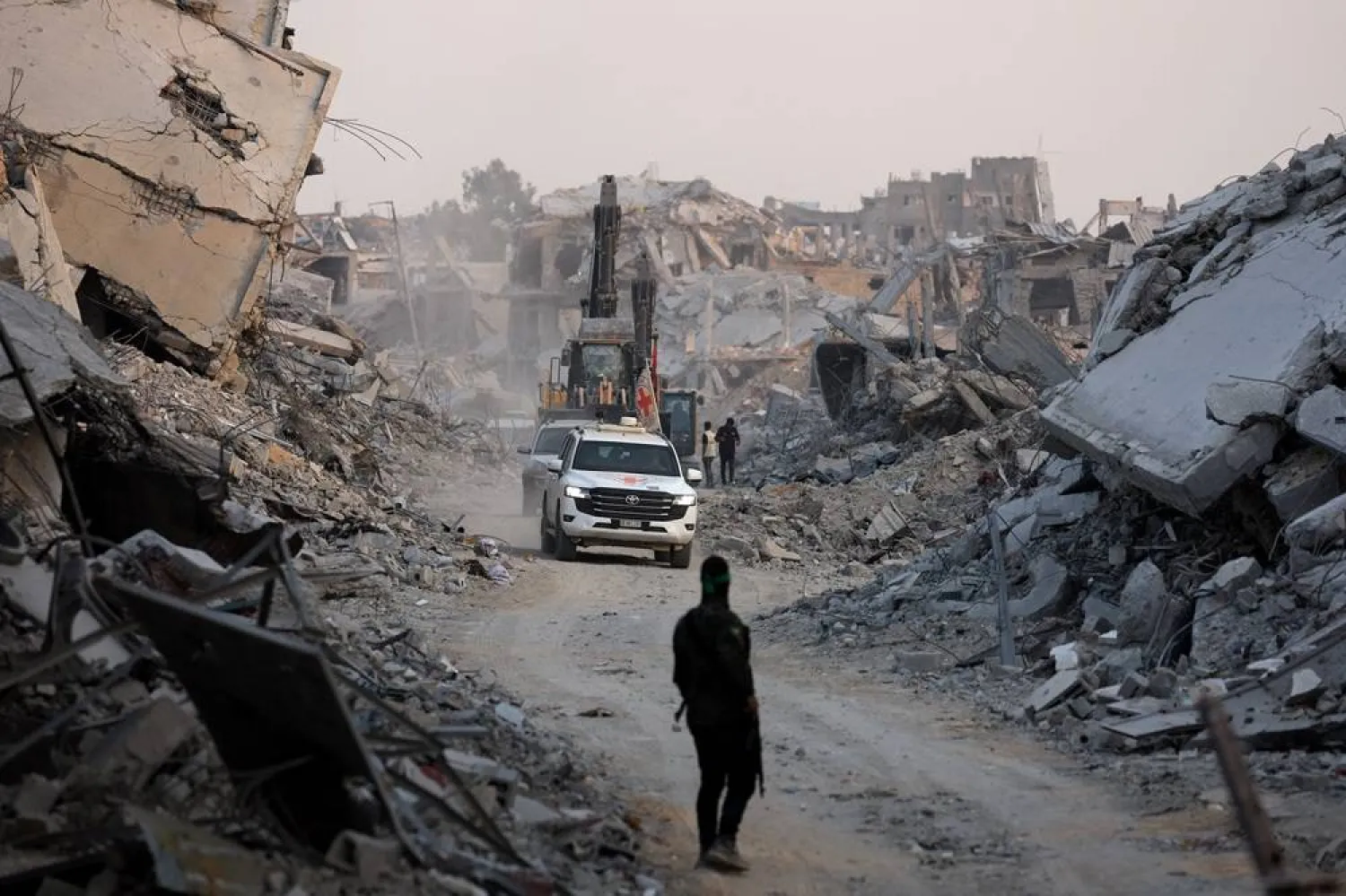
 Red Cross vehicles drive, after Hamas said that it found the body of an Israeli hostage soldier on Tuesday and prepares to return it to Israel through the Red Cross, in Gaza City, November 4, 2025. (Reuters)
Red Cross vehicles drive, after Hamas said that it found the body of an Israeli hostage soldier on Tuesday and prepares to return it to Israel through the Red Cross, in Gaza City, November 4, 2025. (Reuters)
TT

Hamas Says Body of Israeli Soldier Hostage Found in Gaza, Will Be Handed Over

 Red Cross vehicles drive, after Hamas said that it found the body of an Israeli hostage soldier on Tuesday and prepares to return it to Israel through the Red Cross, in Gaza City, November 4, 2025. (Reuters)
Red Cross vehicles drive, after Hamas said that it found the body of an Israeli hostage soldier on Tuesday and prepares to return it to Israel through the Red Cross, in Gaza City, November 4, 2025. (Reuters)

The armed wing of Hamas said on Tuesday it had found the body of an Israeli soldier who had been held hostage by Palestinian militants in Gaza, and that it would hand over the body at 8 p.m. (1800 GMT).

Hamas said the body was found in Shejaia, an eastern suburb of Gaza City in an area still occupied by Israeli forces, after Israel granted access to the location for teams from Hamas and the International Committee of the Red Cross.

Under a ceasefire deal that took effect on October 10, Hamas turned over all 20 living hostages held in Gaza in return for nearly 2,000 Palestinian convicts and wartime detainees held in Israel. Hamas also promised to turn over the remains of deceased hostages but says Gaza's war devastation has made locating bodies difficult. Israel accuses Hamas of stalling.

Before Tuesday, Hamas had returned 20 of the 28 bodies of hostages that had been buried in Gaza. In return, Israel handed over 270 bodies of Palestinians it had killed since the war began in October 2023, Gaza health authorities said.

Hamas-led fighters killed 1,200 people and took 251 hostages in their cross-border attack on Israel on October 7, 2023, according to Israeli tallies. Israel's retaliatory offensive in the Gaza Strip killed over 68,000 Palestinians, health officials in the enclave say.

The US-brokered ceasefire has broadly held through repeated incidents of violence. Palestinian health authorities say Israeli forces have killed 239 people in strikes since the truce took effect, nearly half of them in a single day last week when Israel retaliated for a militant attack on its troops.

Israel says three of its soldiers have been killed and it has targeted scores of gunmen it says have approached lines behind which Israeli troops have withdrawn under the truce.

Earlier on Tuesday, Gaza health authorities said Israeli fire killed a man in Jabalia in northern Gaza. Israel's military said it killed a "terrorist" who crossed into areas the army continues to occupy and posed an imminent threat.




Syrian Army Tells Kurdish Forces to Withdraw from Area East of Aleppo City

Buses carrying displaced residents drive past a building in ruins as they return to the Achrafieh neighborhood after days of fighting between government forces and Kurdish fighters in the northern city of Aleppo, Syria, Monday, Jan. 12, 2026. (AP)
TT

Syrian Army Tells Kurdish Forces to Withdraw from Area East of Aleppo City

Buses carrying displaced residents drive past a building in ruins as they return to the Achrafieh neighborhood after days of fighting between government forces and Kurdish fighters in the northern city of Aleppo, Syria, Monday, Jan. 12, 2026. (AP)

Syria's army told Kurdish forces on Tuesday to withdraw from an area they control east of Aleppo after dislodging fighters from two neighborhoods in the city in deadly clashes last week.

State television published an army statement with a map declaring a large area a "closed military zone" and said "all armed groups in this area must withdraw to east of the Euphrates" River.

The area begins near Deir Hafer, around 50 kilometers (30 miles) east of Aleppo city and extends to the Euphrates further east, as well as towards the south.

On Monday, Syria accused the US-backed, Kurdish-led Syrian Democratic Forces of sending reinforcements to Deir Hafer and said it sent its own personnel there in response.

The SDF denied any build-up of its forces in the region.

An AFP correspondent saw government forces bringing military reinforcements including artillery to the Deir Hafer area on Tuesday.

On the weekend, Syria's government took full control of Aleppo city after taking over its Kurdish neighborhoods and evacuating fighters there to Kurdish-controlled areas in the country's northeast following days of clashes.

The violence started last Tuesday after negotiations stalled on integrating the Kurds' de facto autonomous administration and forces into the country's new government.

The SDF controls swathes of the country's oil-rich north and northeast, much of which they captured during Syria's civil war and the fight against the ISIS group.


Syrian Interior Ministry Details Results of Security Campaigns in Latakia, Damascus Countrysides

Security personnel inside the Imam Ali bin Abi Talib Mosque in the Wadi al-Dhahab neighborhood of Homs following a bombing . (AFP)
TT

Syrian Interior Ministry Details Results of Security Campaigns in Latakia, Damascus Countrysides

Security personnel inside the Imam Ali bin Abi Talib Mosque in the Wadi al-Dhahab neighborhood of Homs following a bombing . (AFP)

Syria’s Interior Ministry has announced the results of a series of security operations carried out in recent days in Homs, Latakia, and the Damascus countryside, including the arrest of two alleged ISIS members accused of involvement in the bombing of the Imam Ali bin Abi Talib Mosque in Homs last month.

The ministry said the operations led to the arrest of three senior figures in a cell known as “Lieutenant Abbas,” affiliated with the “Coastal Shield Brigade” led by Miqdad Fteiha, a prominent figure loyal to the former regime.

Security forces also detained an armed group in the al-Wuroud neighborhood of Damascus that was allegedly planning “acts of sabotage.”

The operations form part of broader efforts to dismantle armed groups and restore the state’s exclusive authority over weapons.

Interior Minister Anas Khattab vowed to continue pursuing ISIS operatives and bringing them to justice.

In a post on X, he said security and intelligence services had conducted a “highly precise operation” resulting in the arrest of those involved in the December 26 attack on the Imam Ali bin Abi Talib Mosque in the Wadi al-Dhahab district of Homs, which killed eight people and wounded 18 others.

According to the Interior Ministry, security units in Homs, in coordination with the General Intelligence Service, arrested two persons identified as ISIS members. Authorities said explosive devices, various weapons, ammunition, documents, and digital evidence allegedly linking the suspects to terrorist activities were seized.

The two were referred to the Counterterrorism Directorate to complete investigations ahead of prosecution.

In a separate statement earlier Monday, the Interior Ministry said a “valuable catch” was detained by security and intelligence forces in Latakia. It said he was a key figures in the “Lieutenant Abbas” cell. Initial investigations indicated the cell had targeted internal security and army positions in the province.

Meanwhile, in the Damascus countryside, the ministry said security forces carried out a “preemptive operation” in the al-Wuroud neighborhood of Qudsaya city, arresting three individuals accused of planning armed attacks.

The ministry said security services would continue pursuing remaining members of the groups, pledging to “eradicate them completely” to ensure security and stability.


Gaza Deal: Cairo Talks Aim to Settle Sector’s ‘Administrative Committee’

Displaced Palestinians stand beside a pool of rainwater amid makeshift shelters at the Bureij refugee camp in central Gaza (AFP). 
TT

Gaza Deal: Cairo Talks Aim to Settle Sector’s ‘Administrative Committee’

Displaced Palestinians stand beside a pool of rainwater amid makeshift shelters at the Bureij refugee camp in central Gaza (AFP). 

Cairo is hosting renewed consultations on the Gaza ceasefire agreement, which entered into force on Oct. 10, following the arrival of a delegation from Hamas and amid anticipation of an announcement on the committee that will administer the territory.

Experts told Asharq Al-Awsat that the talks provide an important boost at a critical moment for the second phase of the Gaza agreement, which has been stalled for some time. They stressed that moving forward hinges largely on US will and pressure on Israel.

A Palestinian source said Monday that a Hamas delegation headed by the movement’s leader, Khalil al-Hayya, arrived in Cairo to discuss the second phase and push ahead with the ceasefire deal. The source added that indications suggest the Gaza administration committee will be finalized during the Cairo round, with factions briefed on the names, particularly after recent changes prompted by Israeli objections.

Hamas Political Bureau member Mohammed Nazzal said in televised remarks Sunday night that the delegation would discuss follow-up on implementing the ceasefire amid “major difficulties hindering its application and continued Israeli violations.”

He said the delegation would hold meetings with Palestinian factions and forces, as well as with Egyptian officials, to discuss several files linked to the agreement.

These include ways to consolidate the ceasefire and move to subsequent phases, alongside key issues - foremost the formation of a Palestinian technocratic committee to administer Gaza - aimed at preventing Israeli Prime Minister Benjamin Netanyahu from reneging on or delaying the deal.

Former Egyptian assistant foreign minister and member of the Egyptian Council for Foreign Affairs, Ambassador Rakha Ahmed Hassan, said the Cairo consultations are highly significant and could revive the stalled agreement.

He pointed to anticipation surrounding US President Donald Trump’s announcement of a Peace Council, followed by the Gaza administration committee, adding that discussions would also cover approaches to dealing with weapons in Gaza to undercut Netanyahu’s justifications.

He suggested Hamas would press for full implementation of the first phase first, including opening the Rafah crossing from the Palestinian side, increasing aid, maintaining the ceasefire, and Israel’s withdrawal from Gaza in parallel with any later steps.

On the Egyptian front, Foreign Minister Badr Abdelatty stressed, during a Cairo meeting with Irish Minister for Migration, Trade and Defense Helen McEntee, the importance of announcing a temporary Palestinian technocratic committee to manage daily affairs in Gaza and forming an international stabilization force.