


Lebanon Reaffirms Negotiations as Path to Resolve Dispute with Israel

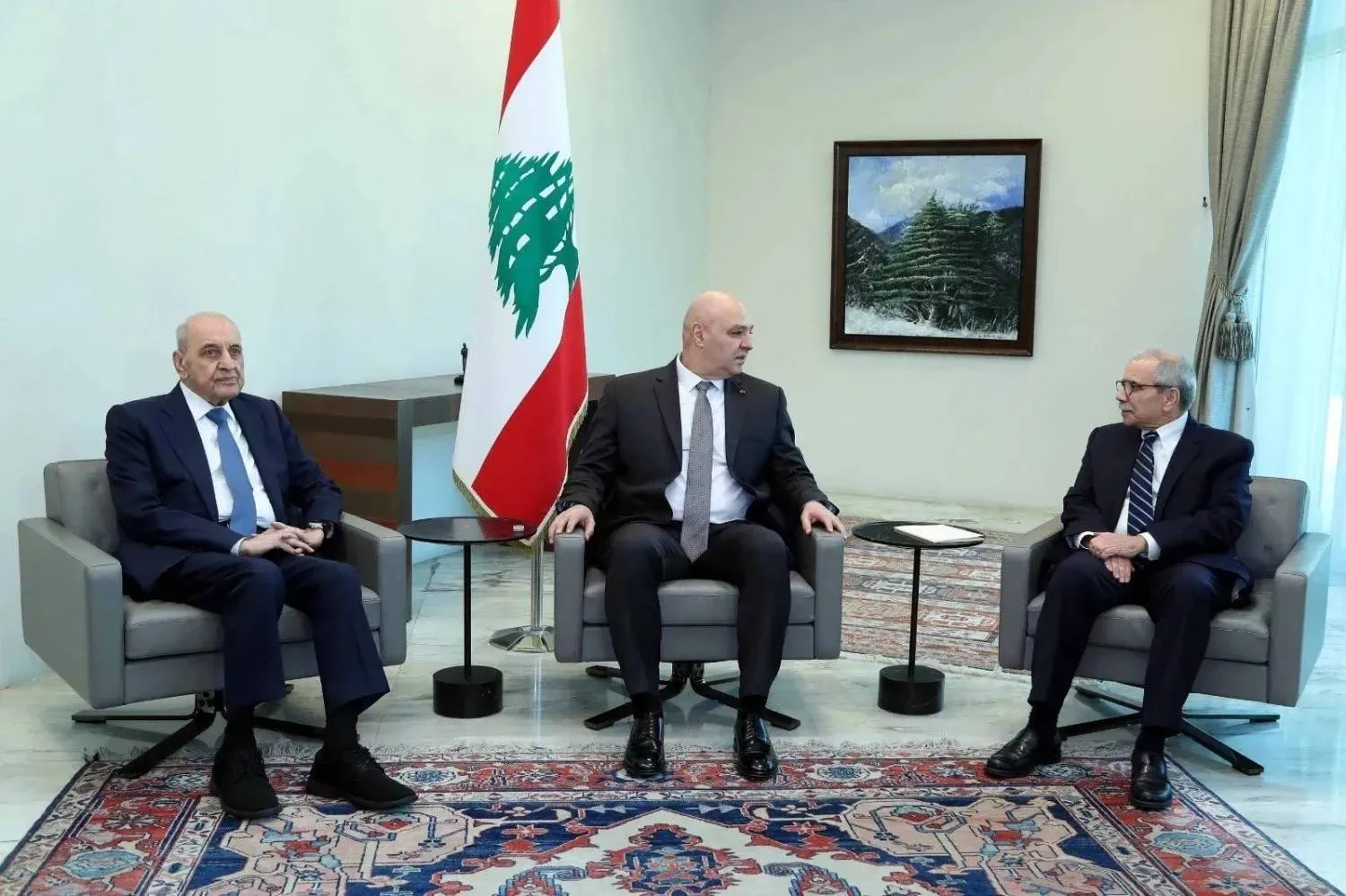
President Joseph Aoun between Prime Minister Nawaf Salam and Speaker Nabih Berri (Lebanese Presidency file photo)
TT

Lebanon Reaffirms Negotiations as Path to Resolve Dispute with Israel

President Joseph Aoun between Prime Minister Nawaf Salam and Speaker Nabih Berri (Lebanese Presidency file photo)

Senior Lebanese officials reaffirmed their commitment to negotiations with Israel through the international committee tasked with overseeing the November 2024 ceasefire agreement, known as the ceasefire monitoring mechanism, following Hezbollah’s statement on Thursday in which the group told them it rejects any form of political negotiation.

Communication between Lebanon and Israel is limited to a United Nations-backed monitoring mechanism involving France and the US. The two sides meet separately under UN auspices but do not engage in direct talks.

Berri: No to normalization

While President Joseph Aoun underscored Lebanon’s adherence to this mechanism, Parliament Speaker Nabih Berri said there is no alternative to it. Prime Minister Nawaf Salam responded to Hezbollah by saying that decisions of war and peace rest solely with the state.

Berri told Asharq Al Awsat that normalization with Israel is out of the question.

“Anyone calling for normalization should know it is impossible,” he said.

“I remain firm in my position on the mechanism, which brings together all parties, Lebanon, Israel, the United States, France and the United Nations. There is no objection to bringing in civilian specialists when needed, as happened during the demarcation of the Blue Line in 2000, when geological and mapping experts were involved.”

Berri added that Israel’s threats and airstrikes will not alter Lebanon’s stance.

On the electoral law, Berri said he has not yet received the draft. Once it reaches him, he will decide his position. The government had approved a draft law scrapping the six seats allocated to expatriates and allowing overseas voters to cast ballots in their place of residence, according to their electoral registration. Berri and Hezbollah oppose the changes.

Berri has insisted on implementing the current parliamentary election law, saying it remains technically and legally viable. He also questioned why some political actors are backtracking on previous positions “for maneuvers we all know are futile.” He said: “This law was once described by George Adwan (Lebanese Forces deputy leader) as his own. So what was valid in past elections is suddenly not valid today?”

Aoun: We are committed to the November agreement

The President reaffirmed “Lebanon’s commitment to the cessation of hostilities agreement reached in November 2024 under US and French sponsorship.”

Speaking during a meeting with a World Bank delegation, he said Israel had not complied.

“According to this deal, Israel was supposed to withdraw completely and fully from the South sixty days after the agreement, but it still occupies five hills and is escalating its attacks on Lebanon amidst increasing daily threats against the country and its people,” said Aoun.

Salam: Decisions of war and peace rest with the government

The Prime Minister said Lebanon is moving steadily toward reclaiming its natural role within the Arab region.

He voiced satisfaction at “Lebanon’s return to the Arabs and the Arabs’ return to Lebanon,” saying this renewed relationship forms “a foundation for national recovery in technology, the economy and security.”

Speaking at an event dedicated to technology and artificial intelligence, Salam recalled that the government has made a “clear decision” regarding the state’s monopoly over arms, stressing that the Lebanese Army’s plan to achieve this “is progressing according to well-defined stages.”

This plan is still in its first phase, Salam noted, alluding to the disarmament of Hezbollah south of the Litani River.

Responding to Hezbollah’s statement, Salam said that decisions of war and peace lie exclusively with the Lebanese government, which alone is responsible for protecting sovereignty and maintaining stability.

He described Israeli escalation as dangerous and a threat to regional security, saying the government is seeking Arab and international support to stop Israeli attacks on Lebanese territory and strengthen the state’s ability to assert full authority across its land.

On Lebanese-Syrian relations, Salam said the era of interference in Syria’s affairs has ended. Lebanon is committed to a policy of self-distancing and to mutual respect with all Arab states, he reaffirmed.



Lebanese President: We are Determined to Hold Parliamentary Elections on Time

President Joseph Aoun between Prime Minister Nawaf Salam and Speaker Nabih Berri (Lebanese Presidency file photo)
TT

Lebanese President: We are Determined to Hold Parliamentary Elections on Time

President Joseph Aoun between Prime Minister Nawaf Salam and Speaker Nabih Berri (Lebanese Presidency file photo)

Lebanese President Joseph Aoun reiterated on Thursday that the country’s parliamentary elections are a constitutional obligation that must be carried out on time.

Lebanon’s state-run National News Agency quoted Aoun as saying that he, alongside Prime Minister Nawaf Salam and Parliament Speaker Nabih Berri, is determined to hold the elections on schedule.

Aoun also emphasized that diplomatic efforts have continued unabated to keep the specter of war at bay, noting that "things are heading in a positive direction".

The agency also cited Berri reaffirming that the elections will take place as planned, with "no delays, no extensions".

The Lebanese parliamentary elections are scheduled for May next year.


Israel Calls Countries Condemning New West Bank Settlements ‘Morally Wrong’

Newly constructed buildings are pictured in the Israeli settlement of Givat Zeev near the Palestinian city of Ramallah in the occupied West Bank on October 24, 2025. (AFP)
TT

Israel Calls Countries Condemning New West Bank Settlements ‘Morally Wrong’

Newly constructed buildings are pictured in the Israeli settlement of Givat Zeev near the Palestinian city of Ramallah in the occupied West Bank on October 24, 2025. (AFP)

Israel reacted furiously on Thursday to a condemnation by 14 countries including France and Britain of its approval of new settlements in the occupied West Bank, calling the criticism discriminatory against Jews.

"Foreign governments will not restrict the right of Jews to live in the Land of Israel, and any such call is morally wrong and discriminatory against Jews," Foreign Minister Gideon Saar said.

"The cabinet decision to establish 11 new settlements and to formalize eight additional settlements is intended, among other things, to help address the security threats Israel is facing."

On Sunday, Israel's far-right Finance Minister Bezalel Smotrich announced that authorities had greenlit the settlements, saying the move was aimed at preventing the establishment of a Palestinian state.

Fourteen countries, including Britain, France, Germany, Spain and Canada, then issued a statement urging Israel to reverse its decision, "as well as the expansion of settlements".

Such unilateral actions, they said, "violate international law", and risk undermining a fragile ceasefire in Gaza in force since October 10.

They also reaffirmed their "unwavering commitment to a comprehensive, just and lasting peace based on the two-state solution... where two democratic states, Israel and Palestine, live side-by-side in peace and security".

Israel has occupied the West Bank following the 1967 Arab-Israeli war.

Excluding east Jerusalem, which was occupied and annexed by Israel in 1967, more than 500,000 Israelis live in the West Bank, along with about three million Palestinian residents.

Earlier this month, the United Nations said the expansion of Israeli settlements in the West Bank, all of which are illegal under international law, had reached its highest level since at least 2017.


Iraq Criminalizes Volunteering in Russia-Ukraine War

A photo circulated on social media shows a 24-year-old Iraqi who traveled to Russia to join its armed forces. (AFP)
TT

Iraq Criminalizes Volunteering in Russia-Ukraine War

A photo circulated on social media shows a 24-year-old Iraqi who traveled to Russia to join its armed forces. (AFP)

The Iraqi judiciary warned on Wednesday that people involved in the war between Russia and Ukraine will face jail as it attempts to crack down on the recruitment of Iraqis joining the conflict.

Faiq Zidan, the head of Iraq's Supreme Judicial Council, received on Wednesday National Security Advisor Qasim Al-Araji and members of a committee tasked with combating the recruitment of Iraqis.

Zaidan stressed that Iraq criminalizes any Iraqi who joins the armed forces of another nation without the approval of the government.

The judiciary does not have a fixed prison term for anyone accused of the crime, but a court in Najaf last week sentenced to life an Iraqi accused of human trafficking.

He was convicted of belonging to an international criminal gang that recruits Iraqis to fight for Russia in its war against Ukraine.

In November, Prime Minister Mohammed Shia al-Sudani ordered the formation of a committee, headed by Araji, to crack down on the recruitment of Iraqis to fight for the Russian and Ukrainian militaries.

Iraq does not have official figures detailing how many of its citizens have joined the war. Media reports said some 50,000 Iraqis have joined Russian ranks, while unofficial figures put the number at around 5,000, with 3,000 fighting for Russia and 2,000 for Ukraine.

The debate over the recruitment played out over the media between the Russian and Ukrainian ambassadors to Iraq.

Ukrainian Ambassador Ivan Dovhanych accused Russia of recruiting Iraqis. Last week, the Ukrainian government sent a letter to the Iraqi government about the recruitment.

It hailed Baghdad’s criminalization of such activity. The letter also revealed that Ukrainian authorities had arrested an Iraqi who was fighting for Russia.

Ukraine has denied that it has recruited Iraqis to join the conflict, but reports indicate otherwise.

Meanwhile, Russian Ambassador to Baghdad Elbrus Kutrashev acknowledged that Iraqi fighters had joined the Russian army.

Speaking to the media, he declined to give exact figures, but dismissed claims that they reached 50,000 or even 5,000, saying instead they number no more than a few hundred.

He confirmed that Iraqis had joined the Russian army and “that some four to five had lost their lives”.

He revealed that the Russian embassy in Baghdad had granted visas to Russia to the families of the deceased on humanitarian grounds.

Russian law allows any foreign national residing in Russia and who speaks Russian to join its army with a salary of around 2,500 to 3,000 dollars.

There have been mounting calls in Iraq for the authorities to crack down on human trafficking gangs.

Would-be recruits are often lured by the monthly salary and the possibility of gaining the Russian or Ukrainian nationality.

Critics of the authorities have said Iraqi youths are lured to join foreign wars given the lack of job opportunities in Iraq.