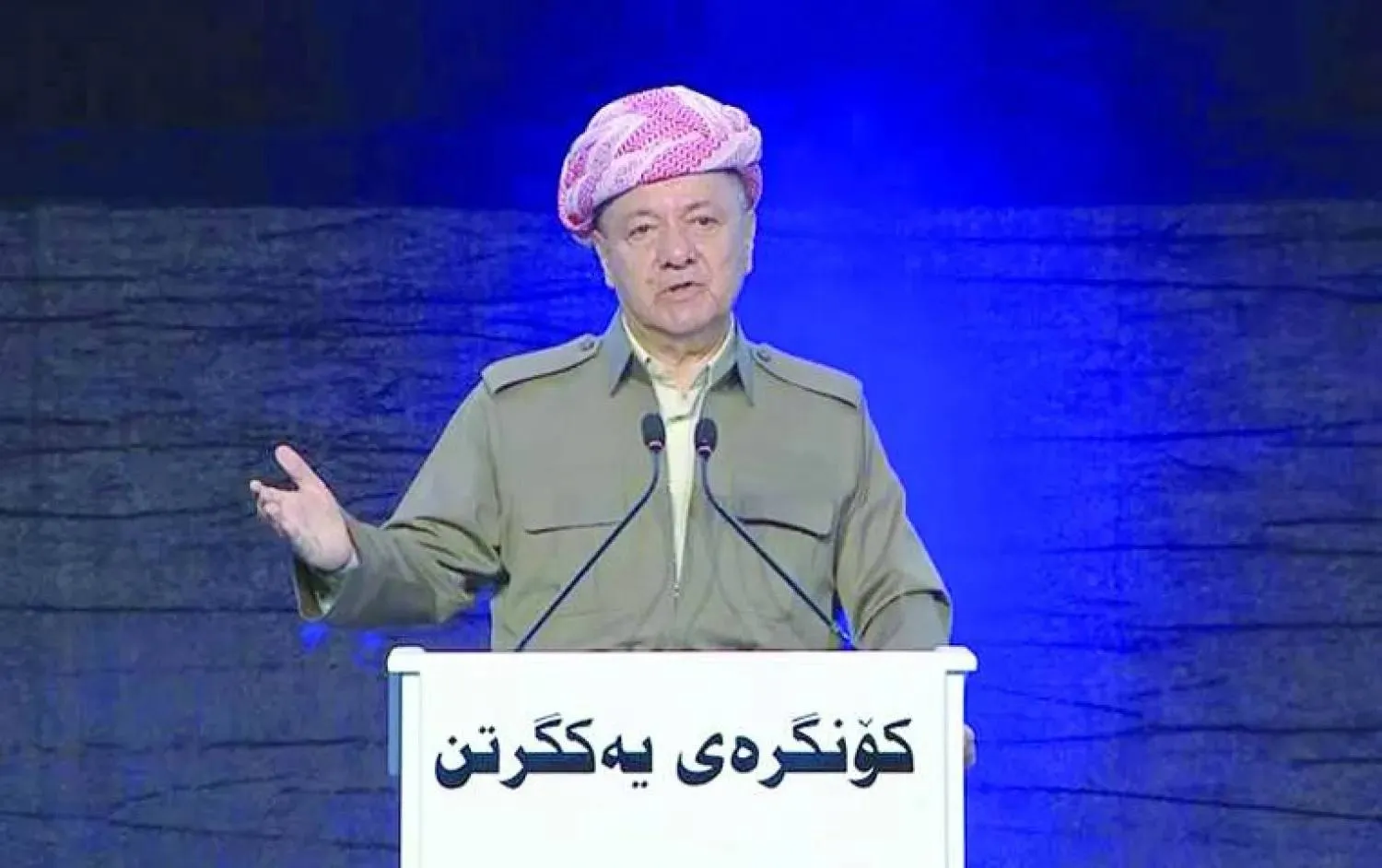

Kurdish leader Masoud Barzani said the Iraqi presidency carries symbolic weight for the Kurds under a political convention in place since 2005, and argued that Prime Minister Mohammed Shia al-Sudani lacks the ability to rein in armed factions that dominate political decision-making, in a situation he likened to Hezbollah’s hold over the Lebanese state.
‘Iraq’s mini-states’
In a televised interview aired on Thursday evening, the Kurdistan Democratic Party (KDP) leader said “every side in Iraq sees itself as a state”, adding that “there are mini-states within the state that control the constitution, the parliament and the government”, in reference to armed groups tied to powerful political blocs.
Barzani said the KDP had considered boycotting the elections in protest against what he called an “unjust law”, explaining that seat allocations based on the food-ration card system made the results “almost predetermined”.
He added that the party chose to participate after receiving signals from “genuine forces” in Baghdad that expressed readiness to pursue political reform after the vote.
The “ration card” system was created under Saddam Hussein’s rule to distribute food to Iraqi families during the economic embargo of the 1990s, and has long been used as a statistical reference in the post-2003 political order.
A settled entitlement
Barzani said the presidency had become “a customary entitlement for the Kurds”, given its symbolism after the region’s suffering during the Anfal campaigns and chemical attacks.
He said the post was “symbolic and largely non-executive”, noting that “the speaker of parliament holds wider powers under the current political system”.
He said “there is a Sunni individual aspiring to the presidency, as if not realizing that the speakership is more influential and more powerful, while the presidency is not a personal ambition for anyone, but a settled entitlement and convention for the Kurds”.
Former parliament speaker Mohammed al-Halbousi, leader of the Sunni Taqaddum (Progress) party, said earlier that “if the Sunni community, through its representatives, sees the presidency as its entitlement and the post it prefers, then we will move toward it”.
‘Sudani is unable’
On the debate over Iraq’s armed groups, Barzani said “Prime Minister Mohammed Shia al-Sudani does not have the ability to confront these factions”, warning that the situation is undermining state institutions and deepening political and sectarian divisions.
He said Iraq’s current reality resembles Lebanon, where Hezbollah wields power beyond that of the state.
“The factions in Iraq have become a force above the constitution, controlling political and economic decisions and imposing their will on the government”, he said, stressing that weapons “must be within the national defense system, not a tool for imposing political influence”.
Barzani said the Kurdistan Region helped build a “new Iraq” after 2003, but added that “circumstances imposed a separation between Kurdistan and Baghdad because of exclusionary and marginalizing policies”.
He said “some still treat the Kurds as outsiders”, adding that “cutting the region’s public sector salaries is an example of unfairly punishing the Kurdish people”. He said the region “will not bow and will not bargain over its constitutional rights”.
‘One of the best constitutions’
Barzani said Iraq’s constitution was “one of the best in the region despite its flaws”, but criticized the Federal Supreme Court, calling it “politicized and targeting the Kurdistan Region”.
He stressed the need to form the “Federation Council”, a body mandated by the constitution, to serve as the proper constitutional reference.
He added that the current Federal Supreme Court “dates back to the era of Paul Bremer, the former US civil administrator, and cannot be considered a constitutional institution”.
Barzani also warned that the withdrawal of the international coalition could pave the way for ISIS to return, recalling the experience of 2011 when US forces pulled out before the group expanded three years later.
“The coalition’s departure means the return of ISIS”, he said, adding that any foreign military presence must be based on “a clear agreement with Baghdad and Erbil”.