


Syria’s Sharaa: Trump Backs our Position on Israel’s Withdrawal to Pre-Dec. 8 Borders

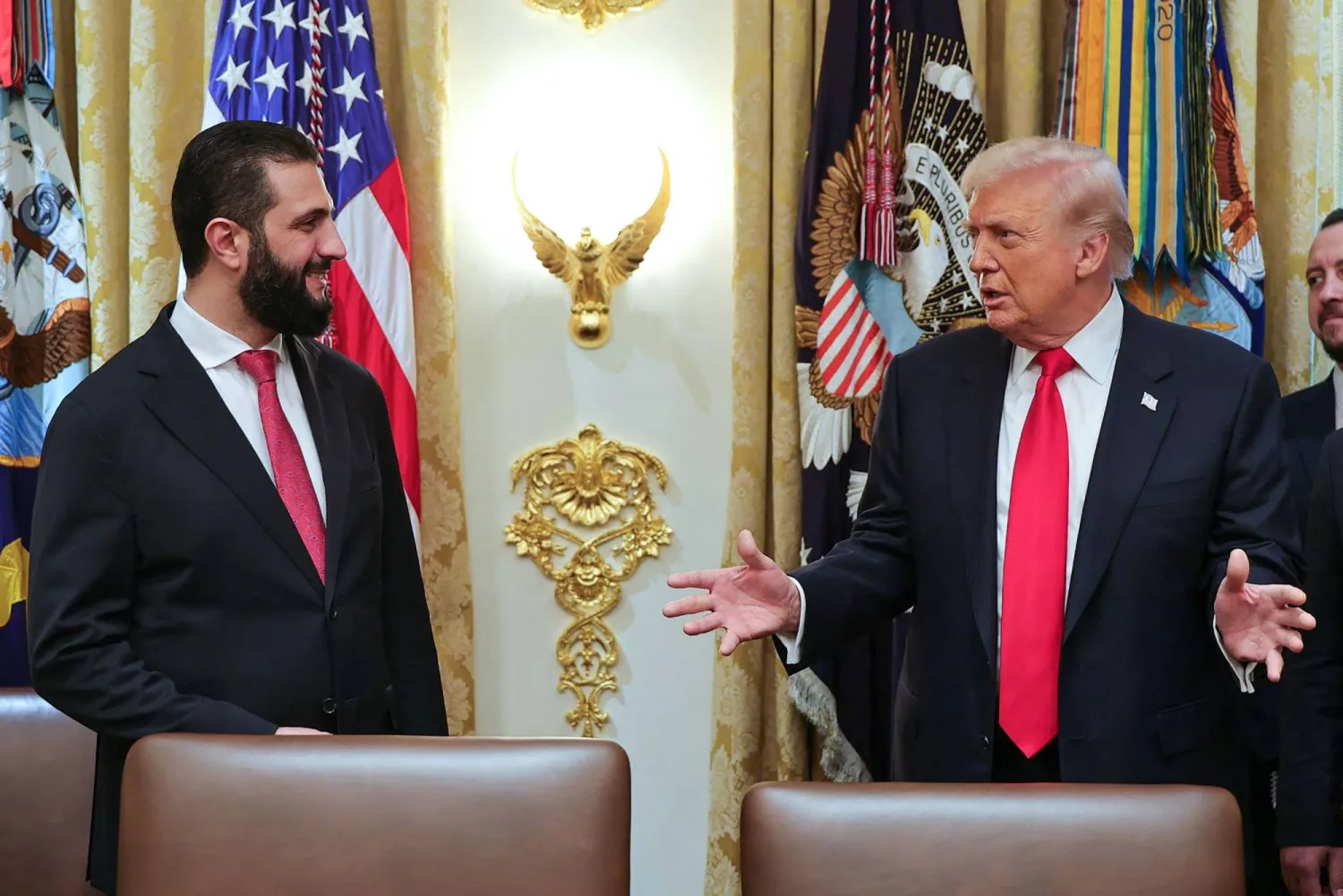
This handout photograph released by the official Syrian Arab News Agency (SANA) on November 10, 2025, shows Syria's President Ahmed al-Sharaa (L) meeting with US President Donald Trump at the White House in Washington DC. (Handout/SANA/AFP)
TT

Syria’s Sharaa: Trump Backs our Position on Israel’s Withdrawal to Pre-Dec. 8 Borders

This handout photograph released by the official Syrian Arab News Agency (SANA) on November 10, 2025, shows Syria's President Ahmed al-Sharaa (L) meeting with US President Donald Trump at the White House in Washington DC. (Handout/SANA/AFP)

Syrian interim President Ahmed al-Sharaa said on Monday he will preserve the right of the Syrian people to see ousted President Bashar al-Assad brought to justice.

Sharaa told the Washington Post that US President Donald Trump supports Syria’s position on the withdrawal of Israeli forces from Syrian territories it occupied after December 8, the date of the regime’s ouster.

Sharaa held a historic meeting with Trump at the White House on Monday, the first by a Syrian president since the country gained its independence in 1946.

Asked about Israel’s repeated attacks against Syria, he said: “Syria got into war with Israel 50 years ago. Then, in 1974, there was a disengagement agreement. This agreement lasted for 50 years, but when the regime fell, Israel revoked this agreement. They expanded their presence in Syria, expelled the UN peacekeeping mission and occupied new territory.”

“They have conducted over 1,000 airstrikes in Syria since December 8, and that included bombing the Presidential Palace and the Ministry of Defense. But because we want to rebuild Syria, we didn’t respond to these aggressions,” he added.

“The advances that Israel made into Syria are not coming from their security concerns, but from their expansionist ambitions,” Sharaa warned.

“Israel has always claimed that it has concerns about Syria because it is afraid of the threats that the Iranian militias and Lebanon’s Hezbollah represent. We are the ones who expelled those forces out of Syria,” he stressed.

He further continued: “We are engaged in direct negotiations with Israel, and we have gone a good distance on the way to reach an agreement. But to reach a final agreement, Israel should withdraw to their pre-December 8 borders.”

“The United States is with us in these negotiations, and so many international parties support our perspective in this regard. Today, we found that Trump supports our perspective as well, and he will push as quickly as possible in order to reach a solution for this,” he revealed.

Asked if Syria would agree to demilitarize the region south of Damascus, he replied: “To talk about an entire region demilitarized, it will be difficult, because if there is any kind of chaos, who will protect it? If this demilitarized zone was used by some parties as a launching pad for hitting Israel, who is going to be responsible for that?”

“And at the end of the day, this is Syrian territory, and Syria should have the freedom of dealing with their own territory,” Sharaa added.

“Israel occupied the Golan Heights in order to protect Israel, and now they are imposing conditions in the south of Syria in order to protect the Golan Heights. So, after a few years, maybe they will occupy the center of Syria in order to protect the south of Syria. They will reach Munich on that pathway,” he said.

Russia and Assad

Noting that Assad is in Moscow being essentially protected by the government of Vladimir Putin, Sharaa was asked if he had raised the issue with the Russians, to which he replied: “We were in war against Russia for 10 years, and it was a hard, difficult war. They announced that they killed me several times.”

However, “we need Russia because it’s a permanent member of the United Nations Security Council. We need their vote to be on our side in some issues, and we have strategic interests with them. We don’t want to push Russia to take alternative or other options in dealing with Syria,” he explained.

“The issue of Bashar al-Assad is troublesome for Russia, and our relationship with them... we’re still in the beginning. We will preserve our rights as Syrians to call for bringing Assad to justice,” he declared.

Common interests with US

On his landmark visit to the White House, he said: “The most important objective is starting on - building the relationship between Syria and the US, because in the past 100 years, it wasn’t a very good relationship.”

“We were looking for common interest between the US and Syria, and we found that we have a lot of common interests that we can build on, such as security interests and economic interests. The stability of Syria will impact the entire region, and the instability of Syria, as well, will impact the region,” he went on to say.

“Stability is linked with the economy, and the economy, or economic development, is linked with the lifting of sanctions. This discussion has been going on for months now, and I believe that we reached good results. But we are still waiting for the final decision,” he remarked.

ISIS fight

On his past as a fighter in Iraq and Syria, Sharaa said: “Fighting is not something shameful if it is done for noble objectives, especially if you are defending your own land and the people who are suffering from injustice. I believe this is something good that people should be commended for. I have fought so many wars, but I have never caused the death of an innocent person.”

“When somebody engages in fighting, they should have a very strong ethical background. The region was affected by the policies - western policies and US policies - and today, we have so many Americans who agree with us that some of these policies were a mistake and that they caused so many wars that were pointless,” he stressed.

On the fight against ISIS, Sharaa said: “We were in a war with the group for 10 years, and we did that without coordination with a Western force or any other country. Syria today is capable of shouldering this responsibility. Keeping Syria divided or having any military force that is not under control of the government, represents the best environment for ISIS to flourish.”

“The best solution is that the US troops present in Syria should supervise the integration of the Syrian Democratic Forces into the central government’s security forces. The task of protecting Syrian territory will be the responsibility of the state,” he explained.



Türkiye FM Says SDF Showing No Intent to Honor Deal to Integrate into Syrian State

Turkish Foreign Minister Hakan Fidan speaks during an interview with Reuters at the 23rd edition of the annual Doha Forum, in Doha, Qatar, December 6, 2025. REUTERS/Ibraheem Abu Mustafa
TT

Türkiye FM Says SDF Showing No Intent to Honor Deal to Integrate into Syrian State

Turkish Foreign Minister Hakan Fidan speaks during an interview with Reuters at the 23rd edition of the annual Doha Forum, in Doha, Qatar, December 6, 2025. REUTERS/Ibraheem Abu Mustafa

Türkiye's foreign minister said the Kurdish-led Syrian Democratic Forces (SDF) are signaling "no intention" of honoring their deal to integrate into Syrian state structures and are instead trying to circumvent it.

Hakan Fidan said in an interview with Reuters on the sidelines of the Doha Forum that Ankara was not giving the Syrian government a "blank cheque" to “oppress” minorities, adding that everyone in Syria "must feel safe and free".

The minister also said Israel’s "destabilization policies" in Syria were the main obstacle to efforts to rebuild unity in the country.


UN Security Council Delegation Visits South Lebanon, Urges All Sides to Stick to Truce

A convoy carrying a UN Security Council delegation, tours the border with Israel close to the southern Lebanese area of Naqura on December 6, 2025. (Photo by Mahmoud ZAYYAT / AFP)
TT

UN Security Council Delegation Visits South Lebanon, Urges All Sides to Stick to Truce

A convoy carrying a UN Security Council delegation, tours the border with Israel close to the southern Lebanese area of Naqura on December 6, 2025. (Photo by Mahmoud ZAYYAT / AFP)

A United Nations Security Council delegation on Saturday urged all parties to uphold a year-old ceasefire between Israel and Hezbollah, expressing support for a state weapons monopoly at the end of a Lebanon visit.

"We came to Beirut at a pivotal time for the implementation of... the cessation of hostilities agreement of November of last year," Slovenian UN ambassador Samuel Zbogar, whose country holds the rotating presidency of the UN body, told reporters.

"All parties must uphold the November 2024 cessation of hostilities agreement, and we recognize progress achieved by Lebanon this year," he said.

"We reaffirm the council's support for Lebanon's territorial integrity, sovereignty and political independence."

"We also reaffirm commitment to the full implementation of Resolution 1701 in support of Lebanon's -- as well as regional -- security and stability," he added, referring to a 2006 Security Council decision that forms the basis of the current truce.

The November 2024 ceasefire was supposed to end more than a year of hostilities between Israel and Hezbollah, but Israel has kept up strikes on Lebanon.

Israel has mainly said it is targeting the group, and has maintained troops in five south Lebanon areas it deems strategic.

The Lebanese government has committed to disarming Hezbollah, and the army is set to dismantle the group's military infrastructure near the border by year end before tackling the rest of the country.

"We support the Lebanese government's decision to ensure the state's monopoly of arms," Zbogar said, also urging "intensified international support" for Lebanon's army.

The delegation met senior officials including President Joseph Aoun, and on Saturday went to south Lebanon near the Israeli border, visiting UNIFIL peacekeepers.

In August, the Security Council voted to extend UNIFIL's mandate until the end of 2026 and then withdraw the force from Lebanon by the end of the following year.

The visit was a chance to "examine options for the implementation of Resolution 1701 following UNIFIL's departure from Lebanon", Zbogar said, adding that "this is a topic that will deserve a thorough conversation during 2026".

Zbogar also emphasized that the "safety of peacekeepers must be respected and that they must never be targeted", after Lebanon's army said it arrested six people following an attack by gunmen on UNIFIL personnel this week.


Egypt and Russia Discuss Developments in Sudan, Syria, Lebanon, Gaza

Egyptian President Abdel Fattah al-Sisi and Russian President Vladimir Putin during the launch of the installation of the pressure vessel for the first reactor at the El-Dabaa nuclear plant last month (Egyptian presidency)
TT

Egypt and Russia Discuss Developments in Sudan, Syria, Lebanon, Gaza

Egyptian President Abdel Fattah al-Sisi and Russian President Vladimir Putin during the launch of the installation of the pressure vessel for the first reactor at the El-Dabaa nuclear plant last month (Egyptian presidency)

Egypt and Russia discussed developments in Sudan, Syria, Lebanon and Gaza on Friday during a phone call between Egyptian Foreign Minister Badr Abdelatty and his Russian counterpart Sergei Lavrov, in the latest round of ongoing coordination and consultations between the two countries on bilateral ties and regional and international issues of mutual concern.

The Egyptian Foreign Ministry said the call covered the close relationship between Egypt and Russia, which it said has gained growing momentum across various areas of cooperation, particularly economic and trade fields.

Abdelatty expressed Egypt’s pride in the strategic partnership binding the two countries, describing it as the governing framework for bilateral cooperation across multiple sectors.

He stressed the need to continue joint work to advance ongoing projects, notably the Dabaa nuclear plant, in order to boost Russian investment in Egypt and expand cooperation between both sides.

Last month, Egyptian President Abdel Fattah al-Sisi and Russian President Vladimir Putin witnessed via video conference the installation of the pressure vessel for the first reactor unit at the nuclear plant, as well as the signing of the nuclear fuel procurement order.

Experts described the step as the first milestone toward nuclear energy production.

El-Dabaa plant is Egypt’s first nuclear power facility, located in the town of Dabaa in Marsa Matrouh governorate on the Mediterranean coast. Russia and Egypt signed a cooperation agreement in November 2015 to build the plant, with the contracts entering into force in December 2017.

Abdelatty underscored during Friday’s call the importance of implementing UN Security Council Resolution 2803 and moving ahead with the second phase of the US president’s peace plan for Gaza, noting the need to enable the international stabilization force to carry out its mandate and consolidate the ceasefire.

According to the Foreign Ministry, Abdelatty outlined Egypt’s efforts within the Quad mechanism to stop the conflict and preserve the unity and integrity of the Sudanese state. He also reiterated Egypt’s longstanding position supporting the unity, sovereignty, security and stability of Lebanon.

He renewed Cairo’s call for respecting the unity and sovereignty of Syrian territory and rejecting any actions or interventions that could undermine the country’s stability, urging the activation of a comprehensive political process that meets the aspirations of the Syrian people.

Egypt said in late November that it hoped to see the start of a political process in Sudan without exclusion and reaffirmed its respect for Sudanese sovereignty.

The Quad, which groups Saudi Arabia, Egypt, the United Arab Emirates and the United States, has been working to secure a ceasefire in Sudan.

It held a ministerial meeting in Washington in September and stressed the need to exert every effort to resolve the conflict. In August, it proposed a roadmap calling for a three-month humanitarian truce, followed by a permanent ceasefire, paving the way for a political process and the formation of an independent civilian government within nine months.

The call also touched on developments related to Iran’s nuclear program.

Abdelatty stressed the importance of continued efforts to de-escalate tensions, build confidence and create conditions that offer a real opportunity for diplomatic solutions and the resumption of talks aimed at reaching a comprehensive agreement that accommodates the interests of all parties and contributes to regional security and stability.

Separately, Abdelatty and Lavrov discussed the war in Ukraine.

The Egyptian foreign minister reiterated Cairo’s consistent position that efforts must continue to pursue peaceful settlements to crises through dialogue and diplomatic means in a way that preserves security and stability.