

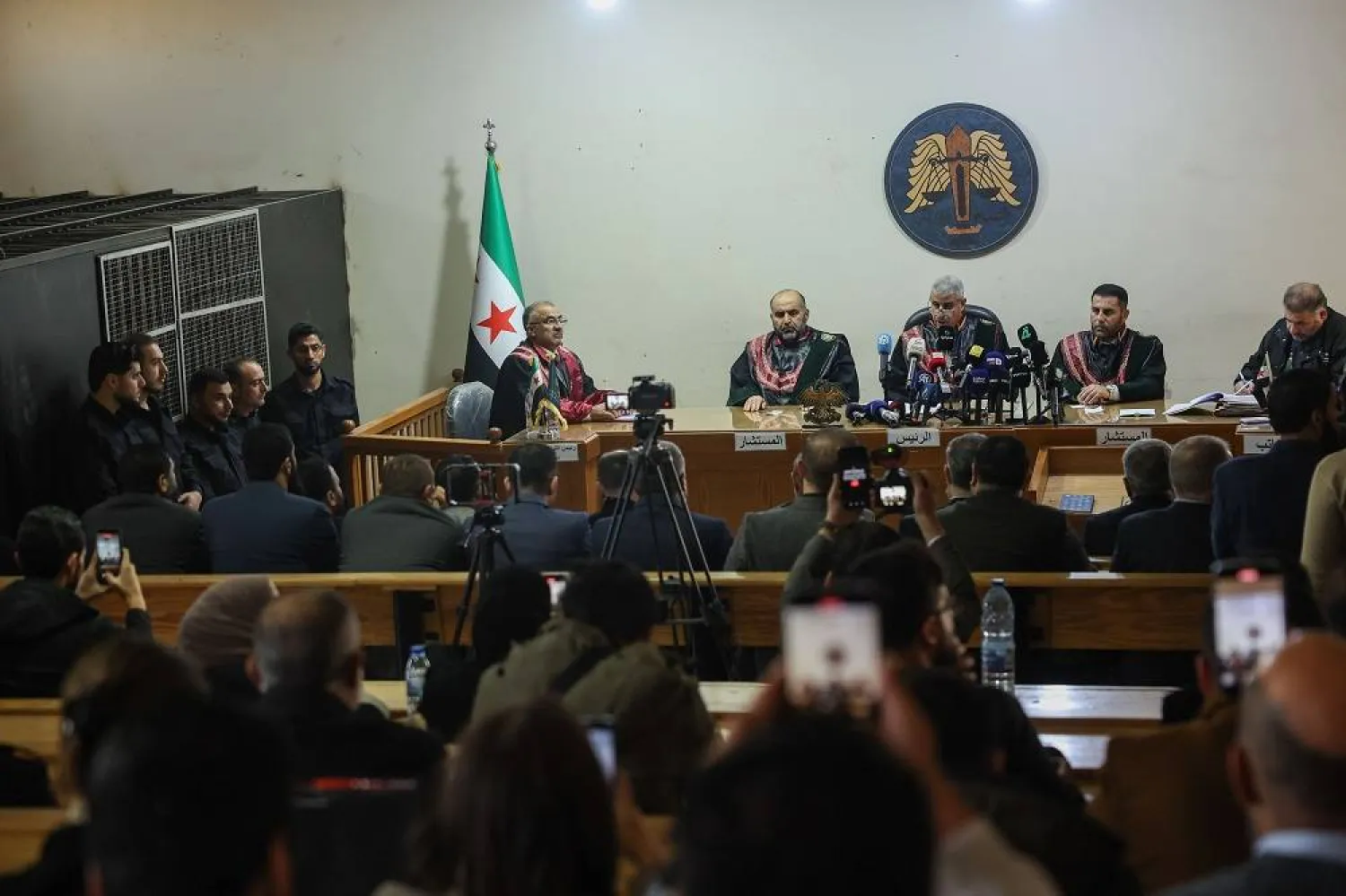

Syria Opens First Public Trial Over Deadly Coastal Violence 

Suspects stand inside a holding cell, left, as judges preside over Syria's first public trial related to deadly clashes in March along the country's coastal provinces, at the Palace of Justice in Aleppo, Syria, Tuesday, Nov. 18, 2025. (AP)
TT

Syria Opens First Public Trial Over Deadly Coastal Violence 

Suspects stand inside a holding cell, left, as judges preside over Syria's first public trial related to deadly clashes in March along the country's coastal provinces, at the Palace of Justice in Aleppo, Syria, Tuesday, Nov. 18, 2025. (AP)

The first trial was opened on Tuesday of some of the hundreds of suspects linked to deadly clashes in Syria’s coastal provinces earlier this year that quickly spiraled into sectarian attacks.

State media reported that 14 people were brought to Aleppo’s Palace of Justice following a monthslong, government-led investigation into the violence in March involving government forces and supporters of ousted Syrian President Bashar al-Assad. The investigating committee referred 563 suspects to the judiciary.

Seven of the defendants in the court were Assad loyalists, while the other seven were members of the new government's security forces. A judge was heard during the televised proceedings asking if they were military or civilian.

The trial follows pressure from local civil society and the international community for the country's new rulers to commit to judicial reform after decades under the autocratic rule of the Assad dynasty.

Despite initial reports from state media that charges could quickly be brought against the defendants, the judge closed the session and rescheduled the next hearing for December.

The charges could include sedition, inciting civil war, attacking security forces, murder, looting and leading armed gangs, state media reported.

Given the scale of the violence and number of suspects, it’s unclear how long the proceedings will take.

The clashes in March erupted after armed groups aligned with Assad ambushed the new government’s security forces. A counteroffensive then spiraled into sectarian revenge attacks against the Alawite minority that Assad belongs to.

The attacks mounted pressure on interim President Ahmed al-Sharaa. Since coming to power in December, his government has scrambled to step out from diplomatic isolation and convince the US to drop crippling sanctions and boost trade to rebuild the war-torn country.

The government's investigating committee in July concluded that over 1,400 people, mostly civilians, were killed during several days of sectarian violence. But the inquiry said there was no evidence that Syria’s new military leaders had ordered attacks on the Alawite community.



Strike on Western Iraq Kills Seven Security Personnel

Members of Iraq's PMF carry the coffin of the PMF operations commander for Al-Anbar, Saad Dawai alongside others during a mass funeral in Baghdad on March 24, 2026. (AFP)
TT

Strike on Western Iraq Kills Seven Security Personnel

Members of Iraq's PMF carry the coffin of the PMF operations commander for Al-Anbar, Saad Dawai alongside others during a mass funeral in Baghdad on March 24, 2026. (AFP)

A strike on a base in western Iraq killed seven security personnel, the defense ministry said Wednesday, a day after an attack on the same base targeted the Popular Mobilization Forces.

"This resulted in the death of seven of our heroic fighters and the injury of 13 others," the ministry said of the strike in Anbar province, saying it specifically targeted the base's military healthcare clinic.

Rescue operations were ongoing, it added.

The base hosts Iraqi police, soldiers from the regular army and PMF, a security official told AFP.

It was hit by a deadly strike on Tuesday that the former paramilitaries blamed on the United States.

Iraq said late on Tuesday it would summon the US charge d'affaires and the Iranian ambassador after deadly strikes blamed on their countries, as Iraqi authorities granted the targeted groups the "right to respond".

Iraq has been pulled into the war sparked by US and Israeli strikes on Iran on February 28, and which has since engulfed much of the region.

Iraq has long been a proxy battleground for the United States and Iran, and has struggled to balance diplomatic ties with both countries.

Since the war began, pro-Iran armed groups have claimed responsibility for attacks on US interests in Iraq and across the region, while strikes have also targeted these groups, including state-linked positions.

In the statement from the prime minister's office, however, Iraq granted former paramilitaries within the official armed forces the right to "respond to military attacks" by drones and aircraft that targeted their headquarters.


Spanish PM Says Israel Wants to Inflict on Lebanon ‘Same Destruction’ as in Gaza

A man walks along a street strewn with building debris at the site of an overnight Israeli airstrike that targeted a neighborhood in Beirut's southern suburbs on March 25, 2026. (AFP)
TT

Spanish PM Says Israel Wants to Inflict on Lebanon ‘Same Destruction’ as in Gaza

A man walks along a street strewn with building debris at the site of an overnight Israeli airstrike that targeted a neighborhood in Beirut's southern suburbs on March 25, 2026. (AFP)

Israeli Prime Minister Benjamin Netanyahu "seeks to inflict the same level of damage and destruction" on Lebanon as Israeli ‌forces had ‌wrought on ‌the Gaza ⁠Strip, Spanish Prime ⁠Minister Pedro Sanchez told lawmakers on Wednesday.

Sanchez, who appeared before the ⁠lower house ‌to ‌explain his government's stance ‌against the ‌US-Israeli war on Iran, added that Iran's new Supreme ‌Leader was more hardline than his predecessor.

"Mojtaba ⁠Khamenei ⁠is an equally dictatorial and even more bloodthirsty tyrant than his father," Sanchez said.

Sanchez warned that the Middle East war presented a "far worse" scenario than the invasion of Iraq in 2003.

"This is not the same scenario as the illegal war in Iraq. We are facing something far worse. Much worse. With a potential impact that is far broader and far deeper," he added.


Syria on Alert to Protect its Borders with Iraq, Wary of Intervening in Lebanon

 Syria's (L) and Iraq's national flags are pictured near the Iraqi-Syrian border, in Al-Qaim, western Iraq on January 23, 2026. (AFP)
Syria's (L) and Iraq's national flags are pictured near the Iraqi-Syrian border, in Al-Qaim, western Iraq on January 23, 2026. (AFP)
TT

Syria on Alert to Protect its Borders with Iraq, Wary of Intervening in Lebanon

 Syria's (L) and Iraq's national flags are pictured near the Iraqi-Syrian border, in Al-Qaim, western Iraq on January 23, 2026. (AFP)
Syria's (L) and Iraq's national flags are pictured near the Iraqi-Syrian border, in Al-Qaim, western Iraq on January 23, 2026. (AFP)

The Syrian armed forces said they were on full alert in wake of a rocket attack from Iraq against a Syrian military base in the Hasakeh province.

The army stressed that it will perform its duties in defending Syrian territories and deterring any attack.

Iraq arrested four people in connection with an earlier rocket attack launched against a military base in neighboring Syria, officials said late Tuesday.

Monday's attack targeted a northeastern Syrian military base in Hasakeh that had until recently hosted US forces with an international anti-ISIS coalition.

These are the first arrests announced in Iraq related to the Middle East conflict that broke out on February 28.

Monday’s attack took place hour after the bust of an Iraqi Popular Mobilization Forces (PMF) cell in Syria’s eastern Deir Ezzor province.

A Syrian security source told local radio that investigations are ongoing with the detainees to determine what they were planning. He revealed that they were collecting information and smuggling weapons in the area.

Assistant defense minister for the eastern region Sipan Hamo held Iraqi authorities fully and directly responsible for the attack on Hasakeh.

In a post on the X platform, he called on Baghdad to take the necessary measures to prevent a similar attack from taking place in the future.

The attack reflects the Iraqi authorities’ “inability” to impose control over their territories and failure “to prevent them from being used to launch attacks that threaten Syria’s security and safety,” he added.

Border with Lebanon

On the Syrian-Lebanese border, sources close to the Damascus government spoke of signs of an internal Lebanese escalation that is a “source of alarm for Syria.”

The sources told Asharq Al-Awsat: “It will be difficult for Syria to steer clear of any possible internal unrest in Lebanon. It will work on preventing any threat to Syria’s security.”

Hezbollah leaders had warned Lebanese authorities in recent days that the Iran-backed party would adopt a different approach towards them when the war is over.

Hezbollah has been critical of the government for banning its military operations, calling for its disarmament, calling for negotiations with Israel and recently for expelling the Iranian ambassador to Beirut.

Syrian Defense Ministry sources told Asharq Al-Awsat said Damascus was weighing three options. The first favors waiting for the end of the war before acting in Syria’s interests; the second believes in striking Hezbollah during the war because it is hostile to the Syrian people and its illegal weapons are tied to Iran and so, their presence is a threat to Lebanon and Syria; the third calls for coordination with Arab and regional parties, led by Saudi Arabia, Qatar and Türkiye, before any intervention can happen.

The unrest along the borders with Lebanon and Iraq will prompt Damascus to increase its coordination with those countries to prevent the smuggling of weapons and drugs and dry up the sources of support for Hezbollah and Iran-backed militias.

Military expert Abdul Jabbar al-Oqaidi told Asharq Al-Awsat that the possibility of Syria joining the conflict through intervening in Lebanon “is a very great challenge” and will have dire consequences for the security of the region and Syria that Iran can exploit.

Perhaps Iran is trying to lure Syria into the conflict “given that Tehran has been impatiently waiting for a moment to unleash its fury on the new Syria that expelled its forces, which marked the beginning of the end of the Iranian expansionist project in the region,” he added.

Al-Oqaidi said, however, it would be wise for Syria to stay out of the war. It should limit its role to securing borders and security coordination with the relevant parties.

He predicted that Syria would stay on the side and avoid becoming involved in a conflict that does not benefit it.

The Iranian and Zionist projects only have ill intentions towards the region and Syria, he warned.

The Defense Ministry sources noted the Lebanese government’s recent decision to ban Hezbollah’s military and security operations, saying it was a positive sign.

The Syrian state will “strike with force any attempt by the party to cross the border. At the same time, it is avoiding escalation and assuring Lebanese parties,” they added, underlining the importance of stability in Syria and Lebanon and the need to avert sectarian wars.