

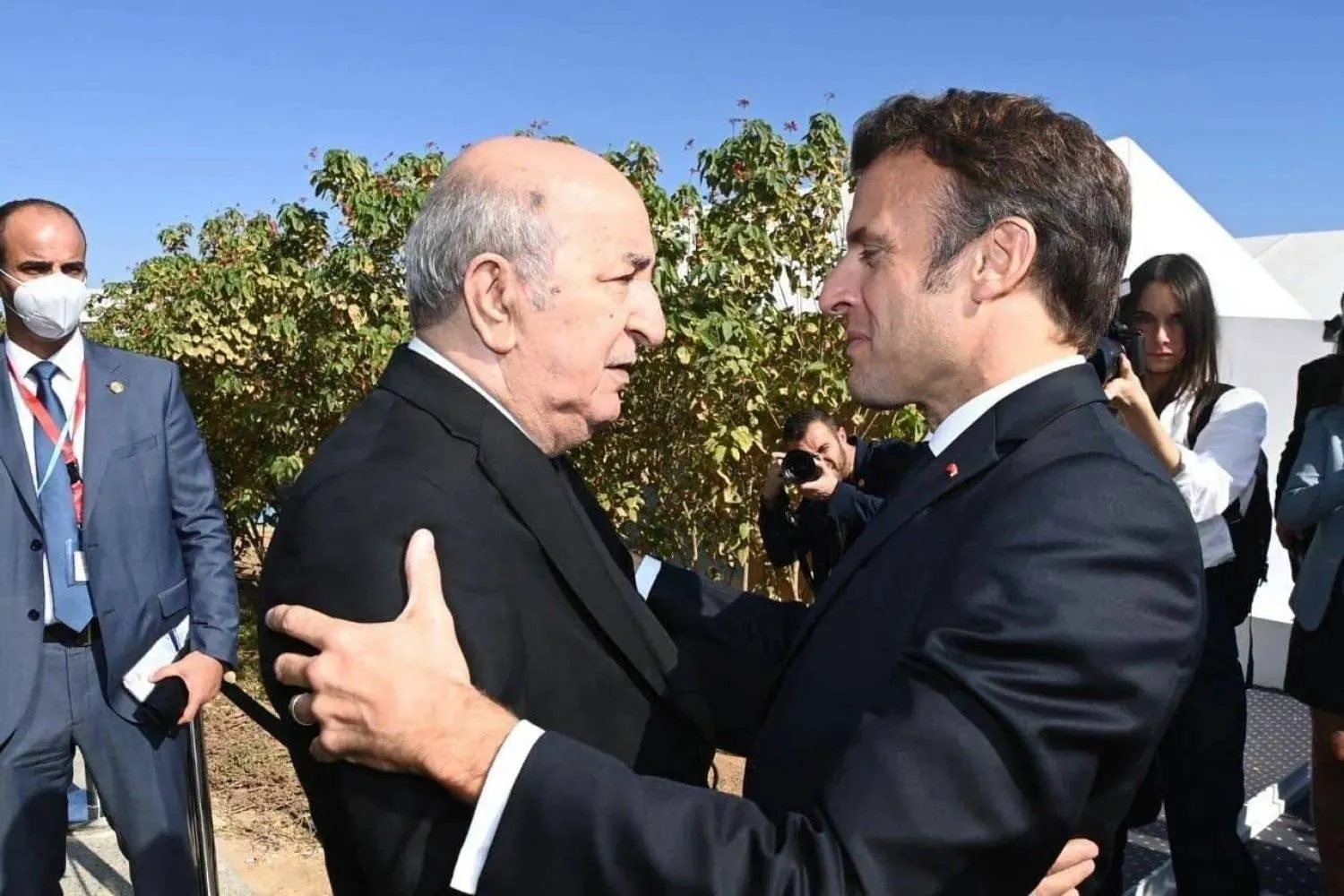

Algeria, France Resume Dialogue after Fifteen Months of Tensions

The Algerian and French Presidents at the 2022 Sharm el-Sheikh climate summit (Algerian Presidency)
TT

Algeria, France Resume Dialogue after Fifteen Months of Tensions

The Algerian and French Presidents at the 2022 Sharm el-Sheikh climate summit (Algerian Presidency)

A senior French official held talks in Algeria this week to revive political and security dialogue between the two countries, the first concrete step toward ending 15 months of tensions triggered by Paris’s recognition of Morocco’s sovereignty over Western Sahara in late July 2024.

Anne-Marie Descôtes, Secretary-General of the French Foreign Ministry, visited Algiers on Thursday. Her trip, which comes amid signs of a thaw, was also referenced the same day during the French Foreign Ministry’s daily press briefing by its spokesperson, Christophe Lemoine.

Restarting bilateral cooperation

Responding to questions about the easing tensions, according to the ministry’s published transcript, Lemoine addressed the release of Algerian French writer Boualem Sansal.

Sansal received a presidential pardon on humanitarian grounds on December 12, granted by Algerian President Abdelmadjid Tebboune at the request of German President Frank-Walter Steinmeier.

Lemoine said the Foreign Ministry was “deeply moved” by the return of two previously detained French citizens, Camilo Castro and Sansal.

Camilo Castro, a French yoga instructor, was abducted and held in Venezuela for more than four months before being released recently. His family and human rights organizations, including Amnesty International, said he had been detained by Venezuelan authorities in “extremely harsh” conditions, and Caracas never disclosed the reason for his arrest.

Lemoine said French diplomacy “spared no effort” to secure the release of both men, adding that the foreign minister had thanked all those in France and within its diplomatic network who contributed to the “happy outcome.”

Asked about Descôtes’ visit to Algeria, Lemoine said there was a “desire to deliver concrete results that benefit French women and men.”

He added that Descôtes was in Algeria for “a working visit to relaunch bilateral cooperation in the fields of migration, security and the economy, all within a dialogue that requires much effort and must produce results for our citizens.”

A symbolic handshake

Asked whether Presidents Tebboune and Emmanuel Macron might meet on the sidelines of the Group of Twenty summit, which opened Thursday in South Africa, Lemoine referred the question to the Élysée and to Algerian authorities.

“As for what may or may not happen at the G20, I refer you to the Élysée, which manages the agenda. I cannot comment on the Algerian president’s schedule, please refer to Algerian authorities,” he said.

According to Algerian political sources, both sides had worked to arrange a brief “handshake” between the two leaders during the summit, which Tebboune had been invited to attend, as a “strong symbolic signal” of reconciliation.

However, Tebboune did not travel to South Africa and instead sent Prime Minister Sifi Ghrieb to represent him. Tebboune had announced a month earlier that he would attend the summit. The reason for his absence remains unclear.

The Algerian news site Tout sur l’Algérie reported that Descôtes’ visit was intended to pave the way for the resumption of dialogue between the two countries ahead of an expected late-month or early-next-month visit by the French Interior Minister.

Citing its sources, the outlet said Algeria “does not want its relationship with France reduced to migration and security,” signaling that Algiers wants a broader approach encompassing politics, the economy, culture, education and regional cooperation.

According to the outlet, “strengthening bilateral partnerships” will be one of the key objectives of French Interior Minister Laurent Nuñez’s trip.

In recent weeks he has said he wants a more flexible approach toward Algeria, in contrast to his predecessor, Bruno Retailleau, who was at the center of the months-long tensions and had taken a hard line on deporting Algerians ordered to leave French territory, whom Algeria refused to accept.

Algerian authorities did not announce Descôtes’ visit, during which she met her Algerian counterpart for a few hours. Analysts said Algiers did not want to give the talks an official character, preferring to reserve that for Nuñez’s visit.



Abou Zaraa Al-Mahrami: PLC's Go-to Man in Handling Yemen's Challenging Files

Abdul Rahman Al-Mahrami. (Saba)
TT

Abou Zaraa Al-Mahrami: PLC's Go-to Man in Handling Yemen's Challenging Files

Abdul Rahman Al-Mahrami. (Saba)

Amid the tensions in Yemen's interim capital Aden rose the name of Vice President of the Presidential Leadership Council Abdul Rahman Al-Mahrami, also known as Abou Zaraa, as one of the main figures trying to restore calm in southern Yemen.

He was tasked with imposing security and preventing clashes in Aden, reflecting the confidence he enjoys inside the PLC and his rising role in handling sensitive military files.

Abou Zaraa Al-Mahrami was born in 1980 in the Yafaa region in the Abyan province.

He rose to prominence as a decisive field commander during the war in Yemen. In a short period of time, he managed to impose himself through the leadership of the southern Giants Brigades, which had turned into a mighty force in combating the Houthis.

In contrast to several military commanders, Abou Zaraa Al-Mahrami was actually involved in ground operations that helped reclaim strategic regions. He consequently gained a military and popular reputation, consolidating his standing in Yemen.

He was named a member of the PLC in April 2022 during one of the most complicated phases of Yemen's recent history. Since then, he has maintained his image as a disciplined military commander who balances between political and security duties.

In May 2023, he was named Vice President of the Southern Transitional Council (STC), placing him in a prominent position in both the PLC and on the southern scene. He remained committed to the work of the legitimate government and maintaining security.

Abou Zaraa Al-Mahrami has long held firm stances in combating terrorism and preventing the proliferation of weapons. These positions made him the go-to man for tackling sensitive security files.

He has been tasked with imposing security in Aden in wake of the latest tensions with the STC.

People familiar with his work said he is keen on protecting civilians and state institutions and preventing political disputes from turning into armed clashes - a challenging task in a city where weapons are everywhere and tensions are high.

Abou Zaraa Al-Mahrami has also represented Yemen at important regional meetings. He recently met with Saudi Defense Minister Prince Khalid bin Salman in Riyadh to discuss the security and political developments in Yemen, reflecting the trust he enjoys among regional partners.


Aidrous Al-Zubaidi Removed from Yemen's PLC for Committing 'High Treason'

Head of the Southern Transitional Council (STC) Aidrous Al-Zubaidi. (AP)
TT

Aidrous Al-Zubaidi Removed from Yemen's PLC for Committing 'High Treason'

Head of the Southern Transitional Council (STC) Aidrous Al-Zubaidi. (AP)

Head of the Southern Transitional Council (STC) Aidrous Al-Zubaidi has been removed from Yemen's Presidential Leadership Council (PLC) for high treason, announced PLC Chairman Dr. Rashad Al-Alimi on Wednesday.

In a decree, Al-Alimi referred Al-Zubaidi to the general prosecutor for committing high treason and harming the unity and security of the state.

The move stems from keenness on the security of all civilians and sovereignty of the republic, said the decree.

Moreover, it accused Al-Zubaidi of "harming the just southern cause and exploiting it to commit grave violations against civilians in southern governorates."

He was also accused of "harming the republic's political and economic interests, violating the constitution and obstructing state efforts to confront the Houthi coup."

Other charges include forming an armed gang and killing officers and members of the armed forces.

Earlier on Wednesday, Official Spokesperson of the Coalition to Restore Legitimacy in Yemen Major General Turki Al-Malki said that Al-Zubaidi had fled to an unknown location after distributing weapons to dozens of elements inside Aden, led by Mu'min Al-Saqqaf and Mukhtar Al-Nubi, with the aim of stoking unrest in Aden in the coming hours.


Arab Coalition: Aidrous Al-Zubaidi Flees to Unknown Location Amid Yemen Escalation

Coalition spokesman Major General Turki al-Malki. (SPA)
TT

Arab Coalition: Aidrous Al-Zubaidi Flees to Unknown Location Amid Yemen Escalation

Coalition spokesman Major General Turki al-Malki. (SPA)

Official Spokesperson of the Coalition to Restore Legitimacy in Yemen Major General Turki Al-Malki said on Wednesday that the head of the Southern Transitional Council (STC) Aidrous Al-Zubaidi has fled to an unknown location.

On January 4, the Joint Forces Command of the Coalition informed Al-Zubaidi that he must travel to Saudi Arabia within 48 hours to meet with Chairman of Yemen's Presidential Leadership Council (PLC) Dr. Rashad Al-Alimi, and the Coalition Forces Command to address the reasons behind the escalation and attacks by forces affiliated with the STC on the governorates of Hadhramaut and Al-Mahra.

On January 5, the Presidency of the STC reiterated its appreciation for the efforts led by Saudi Arabia in preparing for a comprehensive southern conference to discuss ways to resolve the southern issue, and confirmed its participation in ensuring the conference's success.

Al-Zubaidi informed the Kingdom of his intention to attend on January 6, and the delegation proceeded to the airport.

However, the departure of Yemenia Airways flight IYE 532, scheduled for 10:10 PM and carrying the delegation, was delayed for more than three hours. The legitimate government and the coalition received intelligence indicating that Al-Zubaidi had moved a large force, including armored vehicles, combat vehicles, heavy and light weapons, and ammunition, from the Jabal Hadid and Al-Solban camps towards Al-Dhaleh around midnight.

The aforementioned flight was allowed to depart, carrying a large number of STC leaders but excluding Al-Zubaidi, who fled to an unknown location.

He left the members and leaders of the STC without any details regarding his whereabouts. This occurred after he distributed weapons and ammunition to dozens of elements inside Aden, led by Mu'min Al-Saqqaf and Mukhtar Al-Nubi, with the aim of stoking unrest in Aden in the coming hours.

This prompted the National Shield Forces and the coalition to request Vice President of the Presidential Leadership Council Abdul Rahman Al-Mahrami, also known as Abu Zaraa, to impose security, prevent any clashes within Aden, spare its residents any disturbances, protect lives and property, and cooperate with the National Shield Forces.

The coalition forces monitored the movement of the military units as they emerged from the camps and took up positions in a building near Al-Zand camp in Al-Dhaleh Governorate. At 4:00 AM, coalition forces, in coordination with legitimate government forces and the National Shield Forces, launched limited preemptive strikes to disrupt these forces and thwart Al-Zubaidi's attempts to escalate the conflict and extend it into Al-Dhaleh.

The Joint Forces Command of the Coalition to Restore Legitimacy in Yemen stress that it is working with the Yemeni government and the local authority in Aden to support and maintain security efforts and confront any military forces targeting cities and civilians.

The command urges all residents to stay away from camps in Aden and Al-Dhaleh, avoid any gatherings of military vehicles for their own safety, and provide information to security agencies regarding any suspicious military movements.