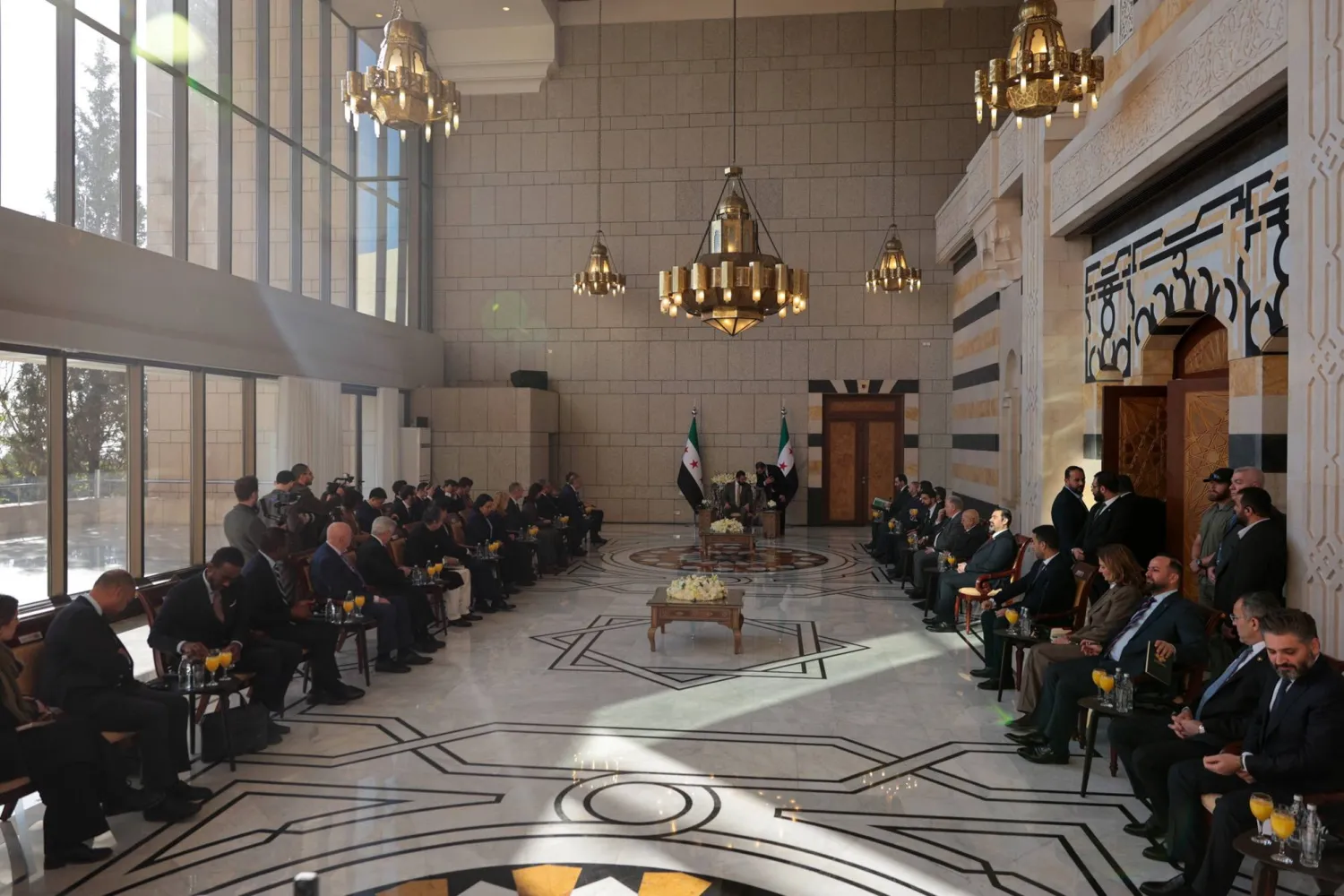

Syrian President Ahmad al-Sharaa received on Monday a UN Security Council delegation and several UN officials at the People’s Palace in Damascus.
“Al-Sharaa and the UN delegation discussed the Israeli aggressions on the country’s territory,” said Syria's permanent representative to the United Nations, Ibrahim Olabi.
Olabi described the delegation’s visit as a historic moment, marking the Council’s first unified stance in support of Syria.
He told the state-run news channel, Al-Ikhbariy, that the timing of the visit reflects the Security Council’s recognition of the significant achievements made during the first year of liberation that marked the fall of former Syrian president Bashar Assad.
“The Israeli aggression on Syrian territory was one of the main points discussed by the Syrian President with the UN delegation,” he said.
Olabi stressed that the shift from international division to consensus about Syria represents a major turning point that will move the country from being a source of crisis to a stable nation capable of restoring its role in supporting global peace and security.
The visit of the delegation of representatives from the 15 member states of the Security Council is the first since the council’s founding in 1945.
Syria’s state-run SANA news agency said the delegation visited the heavily war-damaged Damascus suburb of Jobar and historic sites in old Damascus, accompanied by Olabi and Deputy UN Special Envoy for Syria, Najat Rochdi.
The diplomats are to visit neighboring Lebanon on Friday and Saturday.
The visit comes as the UN is working to reestablish itself in Syria and after the Security Council has recently lifted sanctions against al-Sharaa, whose forces led the offensive that toppled Assad in December last year.
In brief remarks to journalists in Damascus, Samuel Zbogar, permanent representative of Slovenia to the UN and president of the Security Council, said the delegation came to Syria to build trust, to support Syria’s efforts toward a better future, and to strengthen the trust of the Syrian people in the work of the Security Council and the United Nations.”
“The international community stands ready to support you whatever you believe that we can be helpful,” Zbogar said, adding: “We want to help build a bridge to this better future for all Syrians.”
He also stressed that the presence of a UN team inside Syria helps provide the country with the necessary tools and expertise to advance toward a more stable and prosperous future.
ON Monday, Zbogar said that “the visit to Syria and Lebanon is the first official visit of the Security Council to the Middle East in six years, the first visit to Syria ever.”
The trip comes “at a crucial time for the region” and for both countries, Zbogar said, noting the new authorities' efforts towards Syria's transition as well as a year-old ceasefire in Lebanon between Israel and Hezbollah “which we see daily that is being challenged.”
He noted that “there's still a bit of lack of trust in the UN-Syria relationship, which we try to breach with this visit.”
UN Secretary-General Antonio Guterres's spokesman Stephane Dujarric said on Tuesday that “we very much hope that the visit will increase the dialogue between the United Nations and Syria.”