
'Land Without laws': Israeli Settlers Force Bedouins from West Bank Community

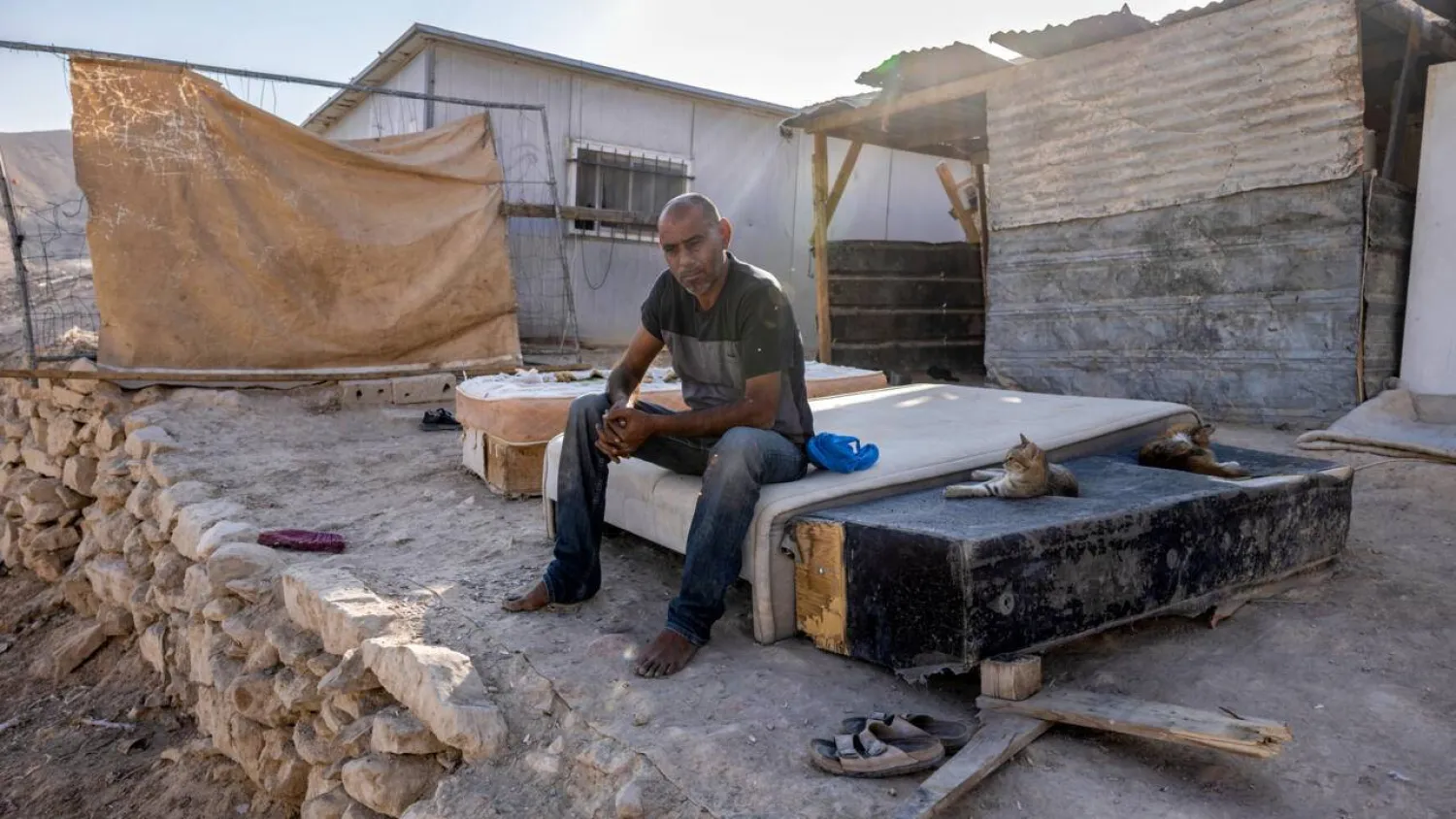
AFP visited Ahmed Kaabneh weeks before he was forced to flee his home in the al-Hathrura area. Menahem Kahana / AFP
TT

'Land Without laws': Israeli Settlers Force Bedouins from West Bank Community

AFP visited Ahmed Kaabneh weeks before he was forced to flee his home in the al-Hathrura area. Menahem Kahana / AFP

As relentless harassment from Israeli settlers drove his brothers from their Bedouin community in the central occupied West Bank, Ahmed Kaabneh remained determined to stay on the land his family had lived on for generations.

But when a handful of young settlers constructed a shack around 100 meters above his home and started intimidating his children, 45-year-old Kaabneh said he had no choice but to flee too.

As with scores of Bedouin communities across the West Bank, the small cluster of wood and metal houses where Kaabneh's father and grandfather had lived now lies empty.

"It is very difficult... because you leave an area where you lived for 45 years. Not a day or two or three, but nearly a lifetime," Kaabneh told AFP at his family's new makeshift house in the rocky hills north of Jericho.

"But what can you do? They are the strong ones and we are the weak, and we have no power."

Israel has occupied the West Bank since 1967, and violence there has soared since the Gaza war erupted in October 2023 following Hamas's attack on Israel.

Some 3,200 Palestinians from dozens of Bedouin and herding communities have been forced from their homes by settler violence and movement restrictions since October 2023, the UN's humanitarian agency OCHA reported in October.

The United Nations said this October was the worst month for settler violence since it began recording incidents in 2006.

Almost none of the perpetrators have been held to account by the Israeli authorities.

'Terrifying'

Kaabneh, four of his brothers and their families, now live together some 13 kilometers (eight miles) northeast of their original homes, which sat in the al-Hathrura area.

Outside his freshly constructed metal house, boys kicked a football while washing hung from the line. But Kaabneh said the area didn't feel like home.

"We are in a place we have never lived in before, and life here is hard," he said.

Alongside surging violence, the number of settler outposts has exploded in the West Bank.

While all Israeli settlements are illegal under international law, outposts are also prohibited under Israeli law. But many end up being legalized by the Israeli authorities.

AFP had visited Kaabneh in the al-Hathrura area weeks before he was forced to flee.

On the dirt road to his family's compound, caravans and an Israeli flag atop a hill marked an outpost established earlier this year -- one of several to have sprung up in the area.

On the other side of the track, in the valley, lay the wreckage of another Bedouin compound whose residents had recently fled.

While in Kaabneh's cluster of homes, AFP witnessed two settlers driving to the top of a hill to surveil the Bedouins below.

"The situation is terrifying," Kaabneh said at the time, with life becoming almost untenable because of daily harassment and shrinking grazing land.

Less than three weeks later, the homes were deserted.

Kaabneh said the settlers "would shout all night, throw stones, and walk through the middle of the houses."

"They didn't allow us to sleep at night, nor move freely during the day."

'Thrive on chaos'

These days, only activists and the odd cat wander the remnants of Kaabneh's former life -- where upturned children's bikes and discarded shoes reveal the chaotic departure.

"We are here to keep an eye on the property... because a lot of places that are abandoned are usually looted by the settlements," said Sahar Kan-Tor, 29, an Israeli activist with the Israeli-Palestinian grassroots group Standing Together.

Meanwhile, settlers with a quadbike and digger were busy dismantling their hilltop shack and replacing it with a sofa and table.

"They thrive on chaos," Kan-Tor explained.

"It is, in a way, a land without laws. There (are) authorities roaming around, but nothing is enforced, or very rarely enforced."

A report by Israeli settlement watchdogs last December said settlers had used shepherding outposts to seize 14 percent of the West Bank in recent years.

NGOs Peace Now and Kerem Navot said settlers were acting "with the backing of the Israeli government and military".

Some members of Israel's right-wing government are settlers themselves, and far-right ministers have called for the West Bank's annexation.

Kan-Tor said he believed settlers were targeting this stretch of the West Bank because of its significance for a contiguous Palestinian state.

But Kaabneh said the threat of attacks loomed even in his new location in the east of the territory.

He said settlers had already driven along the track leading to his family's homes and watched them from the hill above.

"Even this area, which should be considered safe, is not truly safe," Kaabneh lamented.

"They pursue us everywhere."


Nearly 25 ISIS Fighters Killed or Captured in Syria, US Military Says

A US military patrol is seen in northeastern Syria. (Reuters file)
TT

Nearly 25 ISIS Fighters Killed or Captured in Syria, US Military Says

A US military patrol is seen in northeastern Syria. (Reuters file)

The US military said Tuesday that nearly 25 operatives of the ISIS group were killed or captured in Syria this month following an ambush that killed two US troops and an American civilian interpreter.

The US Central Command, which oversees the Middle East, said in a statement on X that 11 missions were carried out over the past 10 days and followed initial strikes against ISIS weapons sites and infrastructure on Dec. 19, which hit 70 targets across central Syria.

In the operations since, the US military and other forces from the region, including Syria, killed at least seven ISIS members, captured others and eliminated four weapons caches, US Central Command said.

“We will not relent,” Adm. Brad Cooper, who leads the command, said in the statement. “We are steadfast in commitment to working with regional partners to root out the ISIS threat posed to US and regional security.”

Targets ranged from senior ISIS members who were being closely monitored by military officials to lower-level foot soldiers, according to a US official who spoke on the condition of anonymity to discuss sensitive military operations.

The official said a growing collaboration between the United States and Syria's relatively new government meant that US forces were able to attack ISIS in areas of the country where they previously did not operate. Syrian forces were the driving force behind some of the missions against the militant group this year, the official added.

The official compared the growing cooperation to that between the US and Iraq in fighting ISIS a decade ago and said the goal, like in Iraq, is to ultimately hand over the effort fully to the Syrians.

The latest operations followed a Dec. 13 ambush that occurred near the ancient city of Palmyra while American and Syrian security officials had gathered for a meeting over lunch. Two members of the Iowa National Guard and a civilian interpreter from Michigan were killed, while three other US troops and members of Syria’s security forces were wounded.

The gunman, who was killed, had joined Syria’s internal security forces as a base security guard and recently had been reassigned because of suspicions he might be affiliated with ISIS, Syrian officials said.

The initial retaliatory strike on ISIS targets in Syria, which included fighter jets from Jordan, was a major test for the warming ties between the US and Syria since last year's ouster of autocratic leader Bashar al-Assad.

President Donald Trump said Syria's new president, Ahmed al-Sharaa, was “extremely angry and disturbed by this attack."


Somali Ambassador to African Union Asharq Al-Awsat: Allies Consulted to Defend Country’s Unity

Somalia’s Ambassador to Addis Ababa and the African Union. Abdullahi Warfa. (Social media)
TT

Somali Ambassador to African Union Asharq Al-Awsat: Allies Consulted to Defend Country’s Unity

Somalia’s Ambassador to Addis Ababa and the African Union. Abdullahi Warfa. (Social media)

Somalia is weighing options to defend its unity and sovereignty and is consulting strategic allies and partners in the region and beyond to determine the best course of action, its ambassador to Ethiopia and the African Union said on Tuesday.

Abdullahi Warfa told Asharq Al-Awsat that the consultations aim to “choose the best ways to defend the country’s sovereignty and unity,” following an announcement by Israeli Prime Minister Benjamin Netanyahu that Israel had officially recognized “the Republic of Somaliland as an independent, sovereign state.”

The Israeli move drew condemnation from Arab, Islamic and African countries. Several Arab and Muslim states, the Arab League, the Gulf Cooperation Council and the African Union Commission issued statements rejecting the step.

Somali President Hassan Sheikh Mohamud rejected the recognition and told an emergency meeting of Arab League envoys on Sunday that Mogadishu has “the right to legitimate self-defense of its territory.”

Asked whether Somalia might pursue legal action against Somaliland’s separatist leader, Abdirahman Mohamed Abdullahi Irro, or whether military action was being considered, Warfa said several options were under review and would be discussed.

Somalia, he stressed, is consulting strategic allies and partners before choosing “the best option to defend Somalia, its unity and its sovereignty.”

Warfa said Israel’s recognition of northern Somalia’s breakaway region was “categorically rejected and unacceptable,” calling it “a blatant assault on the unity and sovereignty of the Somali people” and a violation of international law, international legitimacy and diplomatic norms.

The move “cannot be accepted by any political or legal logic”, he went on to say, adding that Israel, which he described as lacking international legitimacy, “cannot grant legitimacy to others.”

On the diplomatic front, Warfa noted that the Arab League, the African Union, the Organization of Islamic Cooperation and the Gulf Cooperation Council had all stood by Somalia against what he called the Israeli violation.

“The international community as a whole has almost entirely stood with international legitimacy,” he remarked, adding that blame lay with Israel, which he described as internationally isolated, for a gamble that would yield no results.

Warfa noted that the United Nations Security Council met on Monday at Somalia’s request and that all 15 members voted in support of Somalia, backing its rejection of Israel’s steps.

As for Israel’s motives, Warfa said the “reckless attempt” aimed to establish Israeli military bases to control the strategic Bab al-Mandab strait, a key artery for global shipping.

He warned that “even more dangerous” was what he described as an Israeli plan to use its presence in the area to relocate more than 1.8 million Palestinians from Palestinian territories to Somalia, stressing that Somalia’s unity is “sacred and untouchable,” and that any infringement is a red line.

On Somali public opinion, Warfa stressed that rejection of the Israeli move was unanimous across the country, in central, northern and southern regions alike. Residents of the breakaway region had also rejected their leader's action, pointing to large demonstrations in several areas.

Last week, Israeli Foreign Minister Gideon Saar announced that Israel had signed an agreement on mutual recognition and the establishment of full diplomatic relations with Somaliland. He added that he had spoken by phone with Somaliland’s leader, describing the day as “important for both sides.”


Lebanon Voices Official Anger at Hamas over Refusal to Hand over Weapons

Lebanese army soldiers stand next to a truck carrying weapons at the Burj al-Barajneh Palestinian refugee camp in southern Beirut, Lebanon, 29 August 2025. (EPA)
TT

Lebanon Voices Official Anger at Hamas over Refusal to Hand over Weapons

Lebanese army soldiers stand next to a truck carrying weapons at the Burj al-Barajneh Palestinian refugee camp in southern Beirut, Lebanon, 29 August 2025. (EPA)

As the Lebanese army presses ahead with efforts to seize weapons inside Palestinian refugee camps across the country, a key question remains unresolved: what will become of Hamas’s arsenal in Lebanon, as the group continues to defy a government decision and a Lebanese-Palestinian agreement requiring it to hand over its arms.

Official Lebanese frustration with Hamas and allied factions has reached unprecedented levels, driven by their refusal to hand over medium and heavy weapons located south of the Litani River, specifically in the Rashidieh Palestinian refugee camp.

The deadline set by the Lebanese army to complete the first phase of the government’s decision to impose state monopoly over arms, which covers the area between the Litani River and the Israeli border, expires at the end of 2025.

The government is expected to announce during a meeting in early 2026 the completion of the first phase and the move to implement the second one, in an effort to head off Israeli threats to launch a new round of war to counter what Israel describes as attempts by Hezbollah to rebuild its military capabilities.

The hardline stance taken by Hamas and other factions has raised questions, particularly as Hezbollah has complied and handed over its weapons south of the Litani. This has heightened concerns over the safety and stability of the Rashidieh camp if Israel decides to target weapons believed to include medium and heavy arms stored inside it.

External mediation efforts

A senior official told Asharq Al-Awsat that Lebanon has sought external mediation to address the issue of Hamas’s weapons, and that these countries have exerted pressure on the group, so far without success.

Sources following the file said that Fatah’s handover on Tuesday of a new batch of weapons from the Ain al-Hilweh camp was a renewed attempt to pressure Hamas into surrendering its arms.

Head of the Lebanese Palestinian Dialogue Committee Ambassador Ramez Dimashkieh openly expressed official Lebanese dissatisfaction with Hamas and allied factions and with their handling of the issue.

“As long as these factions declare that they operate under the authority of the Lebanese state, they are supposed to abide by the state’s decisions, not resort to stalling by linking the handover to the issue of rights,” Dimashkieh told Asharq Al-Awsat.

“We know there are rights and demands, and we are working seriously on this file, but we reject any bargaining between one file and another.”

He said there was no benefit in holding broad meetings with the factions, stressing that Hamas and its allies should instead contact the Lebanese army directly to set dates for handing over weapons, just as the Palestine Liberation Organization factions have done.

Hamas, Islamic Jihad and other allied factions reject the decisions of the Lebanese Palestinian summit that was held earlier this year, arguing that the Lebanese state should resolve the Palestinian file in Lebanon as a single package, and should not prioritize weapons over Palestinian rights and demands.

Sources in Hamas told Asharq Al-Awsat that the group is still waiting for Dimashkieh to invite all factions to dialogue on the weapons issue and outstanding files related to Palestinian rights, with the aim of agreeing on a framework paper for a solution.

They said Dimashkieh had promised during the last meeting to call for such talks, but no invitation has been made.

There appears to be no Lebanese political or military plan to forcibly collect Palestinian weapons.

Military sources told Asharq Al-Awsat that the army’s current role regarding the remaining weapons inside the camps is limited to preventing the entry or exit of arms, with security measures tightened at the main and secondary entrances to camps across Lebanon.

Fifth batch of Fatah weapons handed over

Meanwhile, the Lebanese army announced on Tuesday that, as part of the ongoing process to remove weapons from Palestinian camps, it had taken delivery of a quantity of Palestinian arms from the Ain al-Hilweh camp in southern Lebanon, in coordination with the relevant Palestinian authorities.

The army stated that the handover included various types of weapons and ammunition, which were received by specialized military units for inspection and further processing.

For its part, the Palestinian National Security Forces in Lebanon, the military wing of Fatah, said in a statement that its forces had completed on Tuesday the handover of the fifth batch of heavy weapons belonging to the Palestine Liberation Organization at the Ain al-Hilweh camp in Sidon.

The statement said the move was in implementation of the joint presidential statement issued by Palestinian President Mahmoud Abbas and Lebanese President Joseph Aoun in May, and the subsequent work of the joint Lebanese-Palestinian committee tasked with following up on camp conditions and improving living standards.

The total number of Palestinian refugees registered with UNRWA in Lebanon stands at 489,292. More than half live in 12 organized camps recognized by UNRWA.