


Egypt and Russia Discuss Developments in Sudan, Syria, Lebanon, Gaza

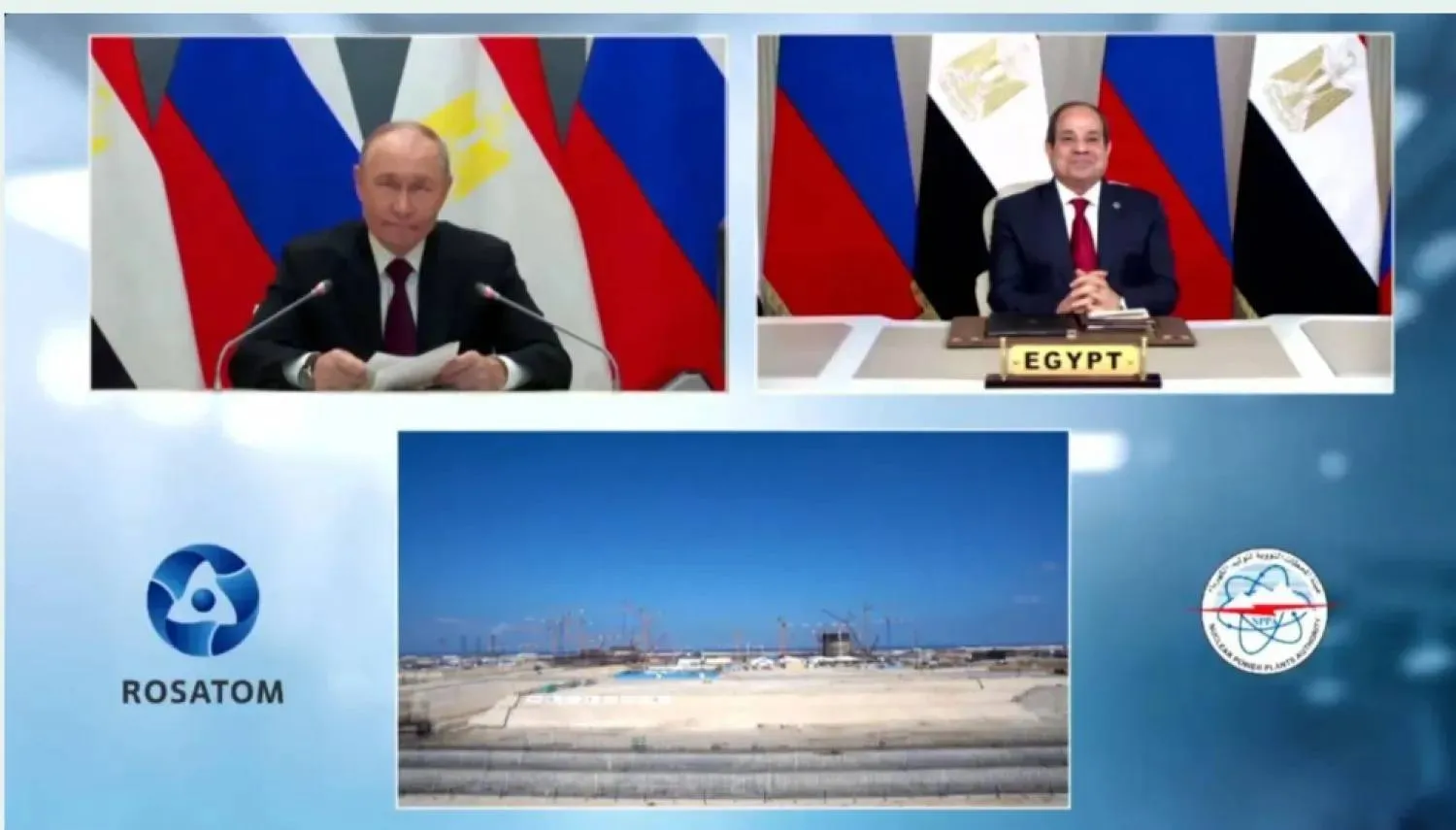
Egyptian President Abdel Fattah al-Sisi and Russian President Vladimir Putin during the launch of the installation of the pressure vessel for the first reactor at the El-Dabaa nuclear plant last month (Egyptian presidency)
TT

Egypt and Russia Discuss Developments in Sudan, Syria, Lebanon, Gaza

Egyptian President Abdel Fattah al-Sisi and Russian President Vladimir Putin during the launch of the installation of the pressure vessel for the first reactor at the El-Dabaa nuclear plant last month (Egyptian presidency)

Egypt and Russia discussed developments in Sudan, Syria, Lebanon and Gaza on Friday during a phone call between Egyptian Foreign Minister Badr Abdelatty and his Russian counterpart Sergei Lavrov, in the latest round of ongoing coordination and consultations between the two countries on bilateral ties and regional and international issues of mutual concern.

The Egyptian Foreign Ministry said the call covered the close relationship between Egypt and Russia, which it said has gained growing momentum across various areas of cooperation, particularly economic and trade fields.

Abdelatty expressed Egypt’s pride in the strategic partnership binding the two countries, describing it as the governing framework for bilateral cooperation across multiple sectors.

He stressed the need to continue joint work to advance ongoing projects, notably the Dabaa nuclear plant, in order to boost Russian investment in Egypt and expand cooperation between both sides.

Last month, Egyptian President Abdel Fattah al-Sisi and Russian President Vladimir Putin witnessed via video conference the installation of the pressure vessel for the first reactor unit at the nuclear plant, as well as the signing of the nuclear fuel procurement order.

Experts described the step as the first milestone toward nuclear energy production.

El-Dabaa plant is Egypt’s first nuclear power facility, located in the town of Dabaa in Marsa Matrouh governorate on the Mediterranean coast. Russia and Egypt signed a cooperation agreement in November 2015 to build the plant, with the contracts entering into force in December 2017.

Abdelatty underscored during Friday’s call the importance of implementing UN Security Council Resolution 2803 and moving ahead with the second phase of the US president’s peace plan for Gaza, noting the need to enable the international stabilization force to carry out its mandate and consolidate the ceasefire.

According to the Foreign Ministry, Abdelatty outlined Egypt’s efforts within the Quad mechanism to stop the conflict and preserve the unity and integrity of the Sudanese state. He also reiterated Egypt’s longstanding position supporting the unity, sovereignty, security and stability of Lebanon.

He renewed Cairo’s call for respecting the unity and sovereignty of Syrian territory and rejecting any actions or interventions that could undermine the country’s stability, urging the activation of a comprehensive political process that meets the aspirations of the Syrian people.

Egypt said in late November that it hoped to see the start of a political process in Sudan without exclusion and reaffirmed its respect for Sudanese sovereignty.

The Quad, which groups Saudi Arabia, Egypt, the United Arab Emirates and the United States, has been working to secure a ceasefire in Sudan.

It held a ministerial meeting in Washington in September and stressed the need to exert every effort to resolve the conflict. In August, it proposed a roadmap calling for a three-month humanitarian truce, followed by a permanent ceasefire, paving the way for a political process and the formation of an independent civilian government within nine months.

The call also touched on developments related to Iran’s nuclear program.

Abdelatty stressed the importance of continued efforts to de-escalate tensions, build confidence and create conditions that offer a real opportunity for diplomatic solutions and the resumption of talks aimed at reaching a comprehensive agreement that accommodates the interests of all parties and contributes to regional security and stability.

Separately, Abdelatty and Lavrov discussed the war in Ukraine.

The Egyptian foreign minister reiterated Cairo’s consistent position that efforts must continue to pursue peaceful settlements to crises through dialogue and diplomatic means in a way that preserves security and stability.


Israeli Soldiers Kill Palestinian Teen in West Bank

Israeli Soldiers Kill Palestinian Teen in West Bank
TT

Israeli Soldiers Kill Palestinian Teen in West Bank

Israeli Soldiers Kill Palestinian Teen in West Bank

Israeli soldiers shot dead a Palestinian hurling a rock at them in the occupied West Bank, the military said on Friday, and the Palestinian health ministry said the person killed was a 14-year-old boy.

There was no further comment from Palestinian officials about the fatal incident in the village of ⁠Al-Mughayyir. Official Palestinian news agency WAFA said the teen was killed during an Israeli military raid that led to confrontations, Reuters reported.

The Israeli military said its forces were called to the area after ⁠receiving reports that Palestinians were throwing stones at Israelis and blocking a road with burning tires.

The soldiers fired warning shots in an attempt to repel a person who was running at them with a rock, the military said, and then shot and killed him to eliminate the ⁠danger.

Violence has surged over the past year in the West Bank. Attacks by Israeli settlers on Palestinians have risen sharply, while the military has tightened movement restrictions and carried out sweeping raids in several cities.

Palestinians have also carried out attacks on Israeli soldiers and civilians, some of them deadly.


Israeli Strikes in South Lebanon Kill Two

Smoke rises from the site of an Israeli airstrike that targeted the village of Sohmor, in southern Lebanon on January 15, 2026. (Photo by Rabih DAHER / AFP)
TT

Israeli Strikes in South Lebanon Kill Two

Smoke rises from the site of an Israeli airstrike that targeted the village of Sohmor, in southern Lebanon on January 15, 2026. (Photo by Rabih DAHER / AFP)

An Israeli strike on south Lebanon killed one person on Friday, the health ministry in Beirut said a day after raids that Israel said had targeted Hezbollah.

Israel has kept up regular strikes in Lebanon despite a November 2024 ceasefire that sought to end more than a year of hostilities with Hezbollah, usually saying it is targeting members of the group or its infrastructure.

In a statement, the health ministry said an "Israeli enemy strike" on a vehicle in Mansuri in south Lebanon killed one person.

According to AFP, it also said that a strike on Mayfadun in south Lebanon the previous night killed one person.

Israel said Thursday's attack killed a Hezbollah member it alleged "took part in attempts to reestablish Hezbollah's infrastructure in the Zawtar al-Sharqiyah area.”

The attacks come a week after Lebanon's military said it had completed disarming Hezbollah south of the Litani River, the first phase of a nationwide plan, although Israel has called those efforts insufficient.

On Thursday, Israel carried out several strikes against eastern Lebanon's Bekaa region, north of the Litani, after issuing warnings to evacuate.

United Nations peacekeepers, deployed in the south to separate Lebanon from Israel, said on Friday that an Israeli drone "dropped a grenade" on its troops.

On Monday, the peacekeeping force said an Israeli tank fired near its troops, and warned that such incidents were becoming "disturbingly common".


Syria's Leader Sharaa in Berlin on Tuesday, Says German Presidency

Syria's President Ahmed al-Sharaa.
TT

Syria's Leader Sharaa in Berlin on Tuesday, Says German Presidency

Syria's President Ahmed al-Sharaa.

Syria's President Ahmed al-Sharaa will be visiting Berlin next Tuesday and meet his German counterpart Frank-Walter Steinmeier, the German presidency said.

The office of Chancellor Friedrich Merz has yet to announce whether they would also hold talks during the visit, which comes at a time when the German government is seeking to step up repatriations of Syrians to their homeland.
