


Anti-Hamas Groups Vow to Fight On as Movement Warns

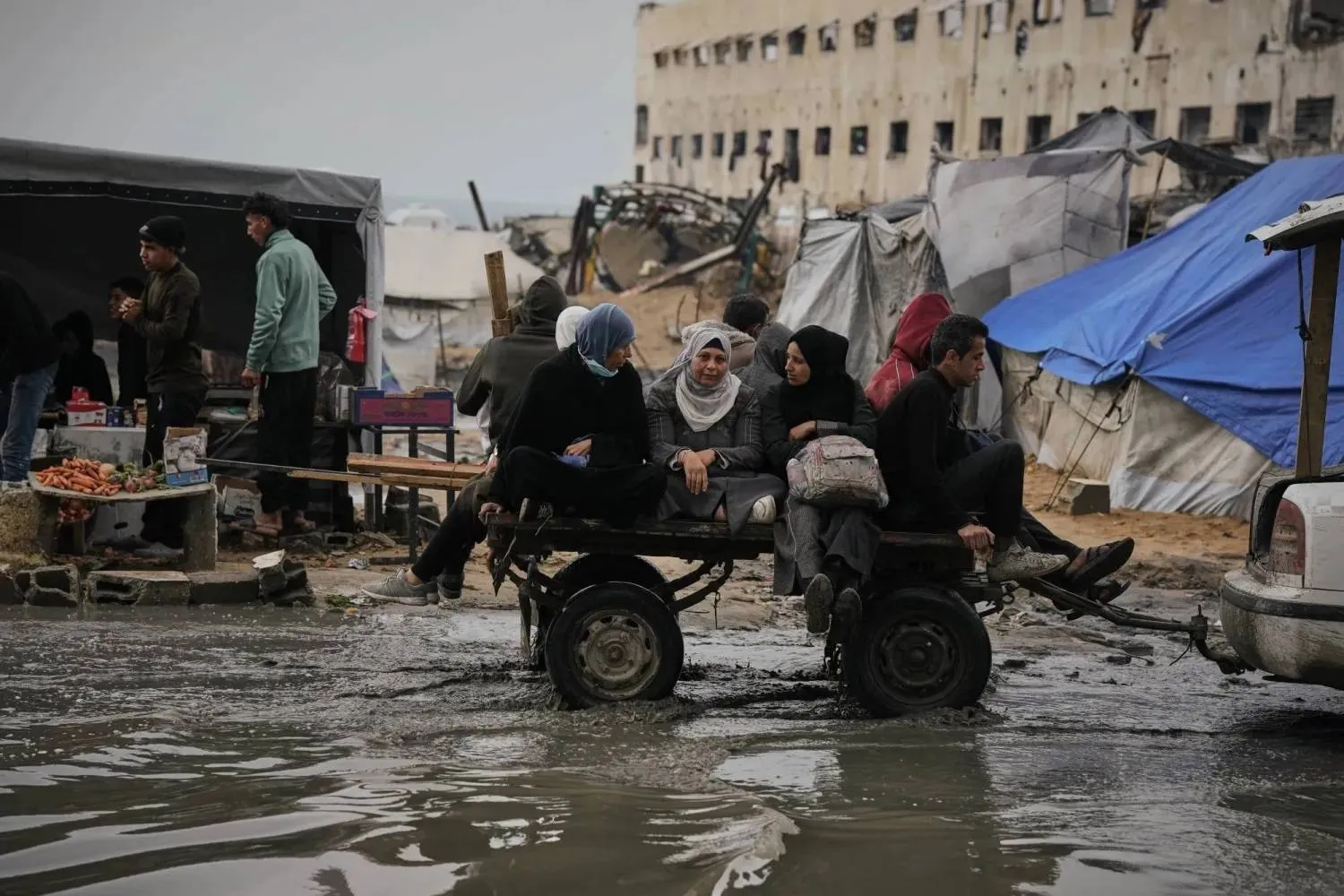
Palestinians ride in a car-drawn cart through a flooded street after a storm in Gaza City on Wednesday (AP)
TT

Anti-Hamas Groups Vow to Fight On as Movement Warns

Palestinians ride in a car-drawn cart through a flooded street after a storm in Gaza City on Wednesday (AP)

Groups operating in Israeli controlled pockets of the Gaza Strip say they will press ahead with their fight against Hamas despite the killing of their most senior commanders, insisting that they have expanded their ranks with new recruits since the October ceasefire as they seek a foothold in Gaza’s political future.

Their emergence, still modest in size and influence, has added a new layer of pressure on Hamas and threatens to complicate efforts to stabilise and reunify a territory battered and divided by two years of war.

Israeli Prime Minister Benjamin Netanyahu acknowledged in June that Israel had supported anti Hamas groups, saying Israel had “activated” some tribal linked factions, although Israeli authorities have given few details since then.

Hamas sources told Asharq Al-Awsat that the campaign against what they called “armed gangs collaborating with Israel” would continue through various means. One source said Israel’s attempt to promote and empower such groups “failed from the outset” because they had not posed any meaningful challenge capable of threatening the movement.

Last week, Yasser Abu Shabab, widely seen as the central figure in efforts to form anti-Hamas forces in the southern city of Rafah, was killed. The Popular Forces group he led said he died while trying to mediate a family dispute, without disclosing who shot him. His deputy, Ghassan al-Dahini, has taken charge and vowed to continue the same path.

Hamas, which has run Gaza since 2007, has so far refused to disarm under the ceasefire plan and has described its opponents as Israeli “agents”, a view that Palestinian analysts say enjoys broad public support.

The movement acted quickly against Palestinians who challenged its authority after the United States backed ceasefire took effect in October, killing dozens of people including some it accused of collaborating with Israel.

Hamas consolidates control

Almost all of Gaza’s roughly two million residents live in areas under full Hamas control, where the group is reasserting its hold. Four Hamas sources said it still commands thousands of fighters despite heavy losses during the war.

Hamas figures told Asharq Al-Awsat that Israel has failed to eliminate the movement during two years of war and that Hamas retains its manpower and much of its military infrastructure to varying degrees.

Residents in areas west of the yellow line that separates Hamas held zones from Israeli controlled territory say the group deploys security forces including police and other agencies, and at night members of the Qassam Brigades, to maintain order and prevent infiltration by Israeli special units.

One source stressed that preserving the group’s strength “does not mean we insist on keeping control of the Strip or prolonging the war. We are committed to completing the agreement stages through a Palestinian national consensus”.

Israel still controls more than half the enclave, areas where Hamas’s rivals are active outside the group’s reach. With implementation of President Donald Trump’s Gaza plan moving slowly, there are no signs of further Israeli withdrawals for now.

Anti-Hamas forces expand

Three Egyptian security and military sources said Israeli backed groups have stepped up activity since the ceasefire. They estimated their numbers at around one thousand fighters, up by four hundred since the truce began.

Egypt plays a central role in negotiations to end the conflict. The sources said these groups are likely to escalate operations in the absence of a comprehensive agreement on Gaza’s future.

A diplomat who requested anonymity said the factions lack any popular base but added that their emergence raises concerns about Gaza’s stability and heightens the risk of Palestinian infighting.

Since Abu Shabab’s death, his faction and two others have released videos showing gatherings of dozens of fighters.

On December 7, al-Dahini said two men were executed in late November. He described them as Hamas fighters and said they had killed a Popular Forces member.

A senior security official in the armed factions alliance led by Hamas in Gaza said the killing of a “collaborator”, along with the group’s public display of images, was an empty victory. “It will not change the facts on the ground,” he said.

Tactical motives

Witnesses said some Palestinians in nearby Khan Younis celebrated Abu Shabab’s death by handing out sweets.

Ghassan al-Khatib, a lecturer in international studies at Birzeit University in the occupied West Bank, said that although Hamas’s popularity has declined due to the impact of the war, the anti Hamas factions have no future because Palestinians view them as collaborators.

“Israel uses them only for tactical reasons, especially to undermine Hamas’s control,” he said.

A spokesman for Fatah, the movement led by Palestinian President Mahmoud Abbas and which Hamas ousted from Gaza, said it rejects any armed groups backed by Israel.

He said such factions have no connection “to our people or to our national institutions, neither directly nor indirectly”.

Coordination with Israel

Hussam al-Astal, who heads another anti-Hamas faction based in Khan Younis, said he and al-Dahini agreed to continue what he called the “war on terrorism” during a visit to Abu Shabab’s grave in Rafah. He added, “Our project, New Gaza, will continue”.

In a separate phone call with Reuters in late November, al-Astal said his group had received weapons, money and other support from international friends whose identities he declined to reveal.

He denied receiving military assistance from Israel but confirmed contacts with Israeli authorities for coordinating the entry of food and all the resources we need to survive.

He said he was speaking from inside Gaza in the Israeli controlled zone near the yellow line where Israeli forces have pulled back. Al-Astal said the group has recruited new members since the truce and now has several hundred personnel including fighters and civilians.

A source close to the Popular Forces also said the group had seen significant growth in its ranks but gave no figures.

The Popular Forces did not respond to messages seeking comment via its Facebook page. The group previously denied receiving Israeli support.

Housing complexes

Beyond the disarmament of Hamas, the Trump plan calls for the creation of a transitional authority, deployment of a multinational force and reconstruction of the enclave.

But with no clarity on next steps, concerns are growing over a de facto partition between an interior area under Israeli control with few inhabitants and a coastal zone packed with displaced Palestinians and largely reduced to rubble.

During a tour of Gaza on Sunday, Israeli army chief of staff Eyal Zamir said Israel “controls wide parts of the Gaza Strip and we will remain on those defensive lines”.

Anti-Hamas factions have said their objectives include creating safe zones for displaced Gazans.

In October, United States Vice President JD Vance and Trump’s son in law Jared Kushner said reconstruction funds could flow into Israeli controlled areas without waiting for the next phase of the plan, aiming to create model zones for Gazan residents.

According to two Israeli officials and three Western diplomats involved in planning for Gaza’s post war phase, Rafah is among the first sites identified by United States officials for such housing compounds, described as “alternative safe clusters”, although no timeline has been set.

A United States State Department spokesperson said Washington is working with partners “to provide housing and other services to the people of Gaza as quickly as possible”.

A United States official said Washington has had no formal contact with anti-Hamas groups and “provides no funding or support”.

They added that the US is not choosing winners or losers in Gaza. Aside from the exclusion of any future role for Hamas, it will be up to the people of Gaza to determine who governs Gaza.



Lebanon Moves to Reset Syria Ties With Envoy Appointment

Syrian President Ahmed al-Sharaa receives the credentials of Lebanese ambassador Henry Kastoun in Damascus, attended by Foreign Minister Asaad al-Shaibani - (Syrian presidency)
TT

Lebanon Moves to Reset Syria Ties With Envoy Appointment

Syrian President Ahmed al-Sharaa receives the credentials of Lebanese ambassador Henry Kastoun in Damascus, attended by Foreign Minister Asaad al-Shaibani - (Syrian presidency)

The appointment of Lebanese ambassador Henry Kastoun in Damascus, formalized Wednesday when he presented his credentials to Syrian President Ahmed al-Sharaa, signals a significant reset in relations between Lebanon and Syria.

It ends a four year diplomatic vacuum and opens a new chapter in which both governments are expected to confront long standing issues, including the fate of Syrian detainees in Lebanon, the refugee crisis, and cross border smuggling, in a bid to place the relationship on firmer and more transparent footing.

Representation after vacancy

The Syrian presidency said on Wednesday that al-Sharaa received the credentials of Ambassador Kastoun, Lebanon’s envoy to the Syrian Arab Republic, at the People’s Palace in Damascus, in the presence of Foreign Minister and Expatriates Asaad al Shibani.

Kastoun fills a four year vacancy, arriving seventeen years after the establishment of full diplomatic representation between the two countries. Diplomatic ties were formalized in 2008 when Michel el-Khoury was appointed Lebanon’s first ambassador to Syria since independence, a historic step that ended decades of uneven representation.

El-Khoury remained in the post until late 2013, after which the position remained vacant until 2017, when Saad Zakhia took over as the second ambassador and served until the end of 2021.

His term was followed by a second diplomatic void that lasted until Kastoun’s appointment in 2025, restoring the Lebanese diplomatic presence in Damascus.

Amending the relationship

While the appointment ushers in a new path for official engagement, Deputy Prime Minister Tarek Mitri had earlier said that diplomatic exchange would resume soon, noting that the past five decades witnessed an unequal relationship between Lebanon and Syria.

The current phase allows for opening a new diplomatic page based on reciprocity and mutual respect.

It follows the suspension of the Higher Council in October 2024, coinciding with a visit by Syrian Foreign Minister Asaad al-Shaibani to Beirut, during which he spoke of a historic opportunity to shift the relationship from a troubled security driven trajectory to a political and economic partnership.

At the time, authorities announced the suspension of the Lebanese-Syrian Higher Council, which for decades served as the central mechanism for managing joint issues during the period of Syrian influence in Lebanon, a sign of an evolving approach rather than a continuation of previous institutional frameworks.

Detainees

In parallel with the diplomatic step, a senior Lebanese judicial delegation visited Damascus on Wednesday to discuss a draft agreement that would allow the transfer of detainees and convicts to their home countries in a manner that does not conflict with Lebanese law, according to local media reports.

The delegation was headed by Government Commissioner to the Military Court Judge Claude Ghanem and included Judges Mona Hanqir and Jad Maalouf. They met Syrian Justice Minister Mazhar al-Weis and senior judicial officials.

Lebanon’s Al-Jadeed television said the two sides reached an initial draft that requires amendments before final approval. The talks did not cover the cases of convicts involved in fighting against the Lebanese army.


Bulgarian Court Rejects Lebanon's Extradition Request for Russian Over Beirut Blast

Igor Grechushkin, a Russian businessman based in Cyprus, is escorted by police before the start of his trial on the possible extradition to Lebanon, in Sofia, Bulgaria, December 10, 2025. REUTERS
TT

Bulgarian Court Rejects Lebanon's Extradition Request for Russian Over Beirut Blast

Igor Grechushkin, a Russian businessman based in Cyprus, is escorted by police before the start of his trial on the possible extradition to Lebanon, in Sofia, Bulgaria, December 10, 2025. REUTERS

A Bulgarian court has rejected Lebanon's request to extradite a Russian shipowner linked to the 2020 Beirut port blast, citing insufficient security guarantees from Lebanese authorities.

Igor Grechushkin, a Cyprus-based Russian businessman whose vessel transported the explosive material that detonated at Beirut port in August 2020, killing more than 220 people, was detained in Bulgaria in September for possible extradition to Lebanon, where he is wanted over his role in the disaster, Reuters reported.

"According to the court, Lebanon did not provide sufficient evidence to ensure that the death penalty will not be imposed on him or, if imposed, will not be carried out," Ekaterina Dimitrova, Grechushkin's lawyer, told reporters after the hearing which was closed to media.

The blast, one of the largest non-nuclear explosions in history, devastated large parts of Beirut and left tens of thousands homeless. Grechushkin was placed on Interpol’s wanted list at Lebanon's request in 2020.

PROSECUTOR TO APPEAL RULING

Angel Kanev, the supervising prosecutor, said he would appeal the ruling, arguing that Lebanon’s justice minister, Supreme Court and Prosecutor General had all provided the required guarantees.

"Given that they have been given by such an authority ... I believe that the grounds for extradition exist," Kanev told reporters.

In response to a question about Bulgaria's objection to a possible death penalty for Grechushkin, a Lebanese judicial source said Beirut "could not change its laws on a case-by-case basis", but that it was working on a way to reassure Bulgaria and that it intended to appeal Wednesday's decision.

The source said the investigative judge presiding over the probe would still have the opportunity to question Grechushkin in person in Bulgaria.

"It's a victory for the time being because the most important thing is that he is questioned so we can find out the truth and have accountability," the source told Reuters.

Lebanon's probe into the causes of the blast and possible negligence by top Lebanese officials has dragged on for years, with families of the explosion's victims blaming political interference.

The first investigative judge was removed after charging top officials. His successor, Tarek Bitar, also charged senior politicians, who refused questioning, denied wrongdoing and froze his probe.

Bitar resumed his investigation earlier this year and has questioned several officials in recent months but he has yet to issue a long-awaited preliminary indictment.


Israeli Druze Leader Seeks US Security Guarantees for Syrian Minority

Leader of the Druze community in Israel, Sheikh Mowafaq Tarif, speaks with Reuters at his house in Julis, northern Israel July 28, 2025. REUTERS/Ali Sawafta
TT

Israeli Druze Leader Seeks US Security Guarantees for Syrian Minority

Leader of the Druze community in Israel, Sheikh Mowafaq Tarif, speaks with Reuters at his house in Julis, northern Israel July 28, 2025. REUTERS/Ali Sawafta

Israeli Druze leader Sheikh Mowafaq Tarif urged the United States to guarantee the security of the Druze community in Syria to prevent a recurrence of intense violence earlier this year in Sweida.

Washington needed to fulfill its "duty" to safeguard the rights of Syria's minorities in order to encourage stability, Tarif told Reuters on Tuesday during an official visit to the UN in Geneva, adding that US support would also remove the need for Israeli intervention in Syria's south.

"We hope that the United States, President Trump, and America as a great power, we want it to guarantee the rights of all minorities in Syria ... preventing any further massacres," he said.
US President Donald Trump vowed in November to do everything he can to make Syria successful after landmark talks with Syrian President Ahmed al-Sharaa.

BLOODY CLASHES IN JULY

The Druze are a minority group whose faith is an offshoot of Islam and have followers in Israel, Syria and Lebanon.

In July, clashes between Druze and Bedouin residents broke out in Sweida after tit-for-tat kidnappings, leading to a week of bloodletting that shattered generations of fragile coexistence.

The violence worsened when government forces dispatched to restore order clashed with Druze militiamen, with widespread reports of looting, summary killings and other abuses. Israel entered the fray with encouragement from its Druze minority, attacking government forces with the stated aims of protecting Syrian Druze and keeping its borders free from militants. Tens of thousands of people from both communities were uprooted, with the unrest all but ending the Bedouins’ presence across much of Sweida.

In the aftermath, Druze leaders called for a humanitarian corridor from the Israeli-occupied Golan to Sweida and demanded self-determination, which the government rejects.

'NEED TO REBUILD TRUST'

Asked about proposals by influential Druze Sheikh Hikmat al-Hajari to separate Sweida from Syria, Tarif took a different stance, stressing the need for internal autonomy or self-governance within Syria as a way of protecting minorities and their rights and pointing to federal systems in Switzerland and Germany as examples.

It was inconceivable to ask the Druze to surrender their weapons, he said. Talks to bring Sweida's former police force onto Damascus' payroll — while allowing the Druze to retain wide local autonomy — had been making steady progress until July's bloodshed derailed them.

Al-Sharaa has vowed to protect the Druze. However, Hajari insists he poses an existential threat to his community and in September rejected a 13-point, US-brokered roadmap to resolve the conflict, according to Reuters.

Asked if talks should be revived, Tarif said trust had to be rebuilt by allowing residents to return to their homes, and permitting full humanitarian access to Sweida.

"There is no trust today ... Trust must be rebuilt," he said.