
Political Tensions between Lebanon and Iran Reach New Heights

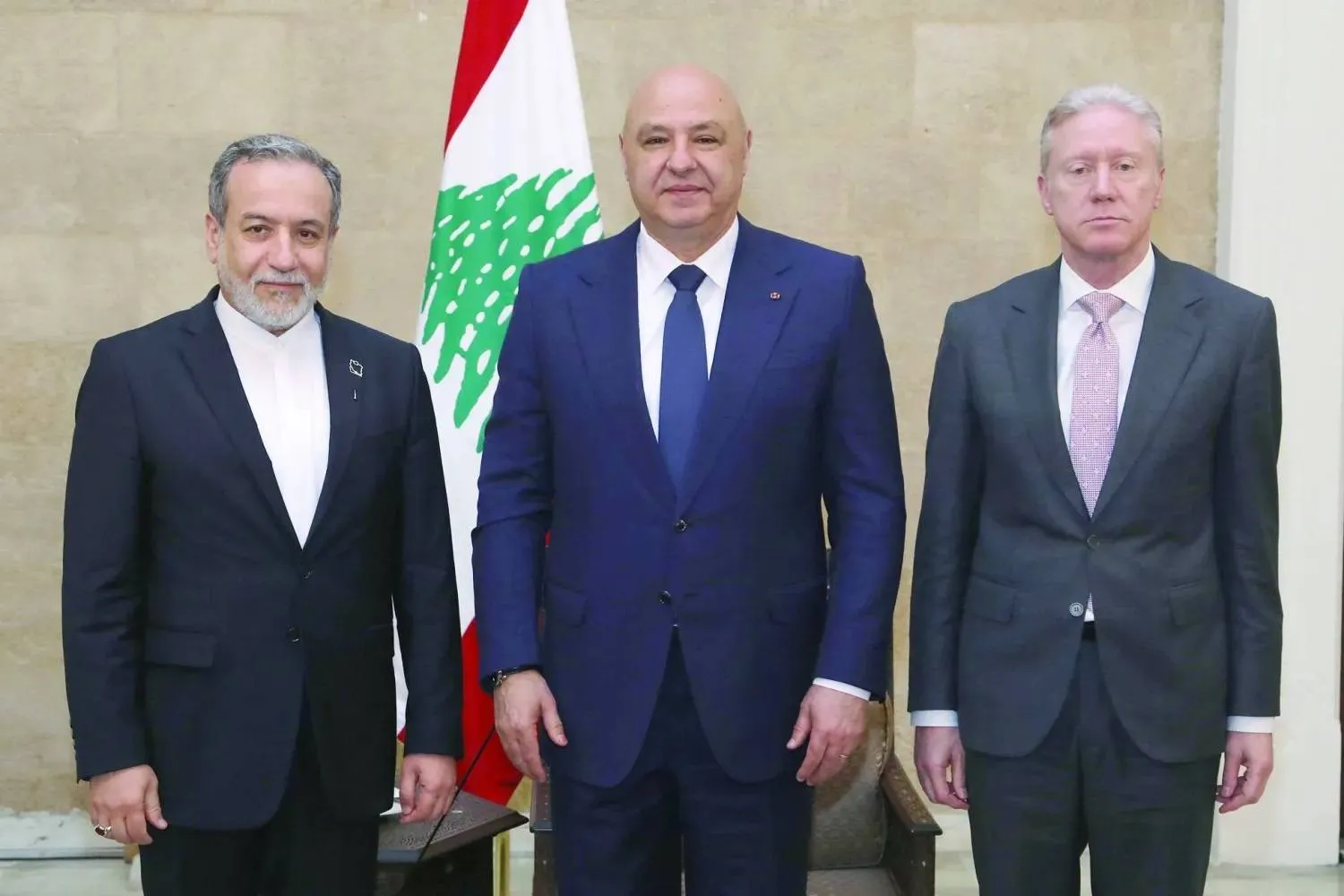
Lebanese President Joseph Aoun (center), Foreign Minister Youssef Raggi (left) and Iranian FM Abbas Araqchi meet in Lebanon in June. (Lebanese Presidency)
TT

Political Tensions between Lebanon and Iran Reach New Heights

Lebanese President Joseph Aoun (center), Foreign Minister Youssef Raggi (left) and Iranian FM Abbas Araqchi meet in Lebanon in June. (Lebanese Presidency)

Tensions between Lebanon and Iran have reached unprecedented levels, reflecting a shift in how Beirut views its ties with Tehran, especially when it comes to Hezbollah’s arsenal and Iranian meddling in Lebanese internal affairs.

The tensions are not just playing out in the media, but in official positions taken by Lebanon’s top officials.

The latest example was Lebanese Foreign Minister Youssef Raggi’s announcement last week that he was declining an invitation by his Iranian counterpart Abbas Araqchi to visit Tehran. He instead proposed meeting in a neutral country.

An official Lebanese source told Asharq Al-Awsat that Raggi’s position does not stem from his personal views, but from a “clear political stance that Lebanese-Iranian relations cannot go back on track if they are not based on equality.

Iran must only limit its dealings in Lebanon to the state and no other party, namely Hezbollah, it added.

The root of the crisis lies in Iran’s absolute support for Hezbollah and how Tehran views it as an extension of its Revolutionary Guards Corps, an entity that exists parallel to the Lebanese state and even violates its jurisdiction in taking decisions of war and peace.

Speaking on condition of anonymity, the source warned that Iran maintaining this position towards Lebanon, “complicates the situation inside Lebanon and exposes the country to a new war with Israel.”

Lebanon cannot withstand such a new conflict, it added.

Araqchi on Thursday said he would visit Lebanon after Raggi issued a formal invitation.

Raggi was not the only senior Lebanese official to take issue with Iran. Earlier this year, President Joseph Aoun refused to meet with Secretary of Iran's Supreme National Security Council Ali Larijani while he was visiting Beirut.

The source said the refusal was a “direct message that the Lebanese state no longer tolerates parallel channels or relations that go beyond formal and constitutional levels.”

“This is the Lebanese state’s official position,” it stressed. “Iran will be welcomed if its changes the way it approaches Lebanon, whereby relations should be between official and constitutional institutions. Both countries should be equals, not with one being subordinate to the other.”

Earlier in 2025, Aoun received Iranian Speaker of the Shura Council Mohammad Bagher Qalibaf, informing him that Lebanon has “grown weary” of other countries “waging their wars on its territory.”

“It is about time that the Lebanese people are relieved of wars and tragedies,” he said, referring to the “support war” Hezbollah had launched in 2023 in solidarity with Hamas in Gaza with Iran’s backing.

On Sunday, Iranian foreign ministry spokesman Esmaeil Baghaei renewed Tehran’s call on Beirut to hold dialogue.

“Iran would rather avoid making statements that would distract Lebanon from focusing on its sovereignty and territorial integrity. The real danger against Lebanon’s sovereignty and dignity are Israel’s ambitions and hegemony,” he remarked.

Meanwhile, a senior adviser to Iran's supreme leader, Ali Akbar Velayati, declared that Tehran will continue to support Hezbollah.

Meeting with Hezbollah representative in Tehran, Abdullah Safieddine, he described the party as one of “the most important pillars of the Resistance Axis.”

Hezbollah is playing a “fundamental role in confronting Zionism,” he added.

Such statements demonstrate how Iran views Hezbollah’s arsenal as part of Tehran's regional security system, not as an issue related to Lebanon’s sovereignty.

The Lebanese government earlier this year took a landmark decision to impose state monopoly over arms, which effectively calls on Hezbollah to lay down its weapons.

Another adviser to Iran’s supreme leader, Ali Shamkhani, had previously openly declared that efforts to disarm Hezbollah “will fail.”

“These arms are those of the Lebanese people to defend their territory against Israel,” he added, rejecting any discussions about handing them over to the Lebanese state.

The official Lebanese source stressed that “there can be no going back” from the decision to impose state monopoly over arms.

“The internal and external objections will not change the state’s policy that has taken the decision to impose its authority throughout Lebanon,” it continued.


UN: At Least 15 Children Killed in Sudan Drone Strike

The war in Sudan, ongoing since mid-April 2023, has caused extensive destruction across the country (AFP)
TT

UN: At Least 15 Children Killed in Sudan Drone Strike

The war in Sudan, ongoing since mid-April 2023, has caused extensive destruction across the country (AFP)

A drone strike on a displacement camp in Sudan killed at least 15 children earlier this week, the United Nations reported late on Wednesday.

"On Monday 16 February, at least 15 children were reportedly killed and 10 wounded after a drone strike on a displacement camp in Al Sunut, West Kordofan," the UN children's agency said in a statement.

Across the Kordofan region, currently the Sudan war's fiercest battlefield, "we are seeing the same disturbing patterns from Darfur -- children killed, injured, displaced and cut off from the services they need to survive," UNICEF's Executive Director Catherine Russell said.


MSF Will Keep Operating in Gaza 'as Long as We Can'

(FILES) A Palestinian man walks on his crutches to the Doctors Without Borders or Medecins Sans Frontieres (MSF) clinic, in the al-Rimal neighborhood of Gaza City on new year's Eve, December 31, 2025. (Photo by Omar AL-QATTAA / AFP)
TT

MSF Will Keep Operating in Gaza 'as Long as We Can'

(FILES) A Palestinian man walks on his crutches to the Doctors Without Borders or Medecins Sans Frontieres (MSF) clinic, in the al-Rimal neighborhood of Gaza City on new year's Eve, December 31, 2025. (Photo by Omar AL-QATTAA / AFP)

The head of Doctors Without Borders in the Palestinian territories told AFP the charity would continue working in Gaza for as long as possible, following an Israeli decision to end its activities there.

In early February, Israel announced it was terminating all the activities in Gaza by the medical charity, known by its French acronym MSF, after it failed to provide a list of its Palestinian staff.

MSF has slammed the move, which takes effect on March 1, as a "pretext" to obstruct aid.

"For the time being, we are still working in Gaza, and we plan to keep running our operations as long as we can," Filipe Ribeiro told AFP in Amman, but said operations were already facing challenges.

"Since the beginning of January, we are not anymore in the capacity to get international staff inside Gaza. The Israeli authorities actually denied any entry to Gaza, but also to the West Bank," he said.

Ribeiro added that MSF's ability to bring medical supplies into Gaza had also been impacted.

"They're not allowed for now, but we have some stocks in our pharmacies that will allow us to keep running operations for the time being," he said.

"We do have teams in Gaza that are still working, both national and international, and we have stocks."

In December, Israel announced it would prevent 37 aid organizations, including MSF, from working in Gaza from March 1 for failing to submit detailed information about their Palestinian employees, drawing widespread condemnation from NGOs and the United Nations.

It had alleged that two MSF employees had links with Palestinian militant groups Hamas and Islamic Jihad, which the medical charity has repeatedly and vehemently denied.

MSF says it did not provide the names of its Palestinian staff because Israeli authorities offered no assurances regarding their safety.

Ribeiro warned of the massive impact the termination of MSF's operations would have for healthcare in war-shattered Gaza.

"MSF is one of the biggest actors when it comes to the health provision in Gaza and the West Bank, and if we are obliged to leave, then we will create a huge void in Gaza," he said.

The charity says it currently provides at least 20 percent of hospital beds in the territory and operates around 20 health centers.

In 2025 alone, it carried out more than 800,000 medical consultations, treated more than 100,000 trauma cases and assisted more than 10,000 infant deliveries.


Egyptian-Turkish Military Talks Focus on Strengthening Partnership

The Commander of the Egyptian Air Force during his meeting with the Turkish Air Force chief in Cairo on Wednesday (Egyptian military spokesperson)
TT

Egyptian-Turkish Military Talks Focus on Strengthening Partnership

The Commander of the Egyptian Air Force during his meeting with the Turkish Air Force chief in Cairo on Wednesday (Egyptian military spokesperson)

Senior Egyptian and Turkish air force commanders met in Cairo on Wednesday for talks focused on strengthening military partnership and expanding bilateral cooperation, in the latest sign of warming defense ties between the two countries.

The meeting brought together the Commander of the Egyptian Air Force, Lt. Gen. Amr Saqr, and his Turkish counterpart, Gen. Ziya Cemal Kadioglu, to review a range of issues of mutual interest amid growing cooperation between the two air forces.

Egypt’s military spokesperson said the talks reflect the Armed Forces’ commitment to deepening military collaboration with friendly and partner nations.

Earlier this month, Egypt and Türkiye signed a military cooperation agreement during talks in Cairo between Egyptian President Abdel Fattah el-Sisi and his Turkish counterpart, President Recep Tayyip Erdogan.

Sisi highlighted similar viewpoints on regional and international issues, while Erdogan noted that enhanced cooperation and forthcoming joint steps would help support regional peace.

Cairo and Ankara also signed an agreement last August on the joint production of vertical take-off and landing (VTOL) drones. Production of unmanned ground vehicles has also begun under a partnership between the Turkish firm HAVELSAN and Egypt’s Kader Factory.

During the talks, Saqr underscored the importance of coordinating efforts to advance shared interests and expressed hope for closer ties that would benefit both air forces.

Kadioglu, for his part, stressed the depth of bilateral partnership and the strong foundations of cooperation between the two countries’ air forces.

According to the military spokesperson, Kadioglu also toured several Egyptian Air Force units to review the latest training and armament systems introduced in recent years.

Military cooperation between Egypt and Türkiye has gained momentum since 2023, following the restoration of full diplomatic relations and reciprocal presidential visits that reflected positively on the defense sector.

In September last year, the joint naval exercise “Sea of Friendship 2025” was held in Turkish territorial waters, aimed at enhancing joint capabilities and exchanging expertise against a range of threats.