


Shaibani: Syrian-Russian Ties Entering New Phase

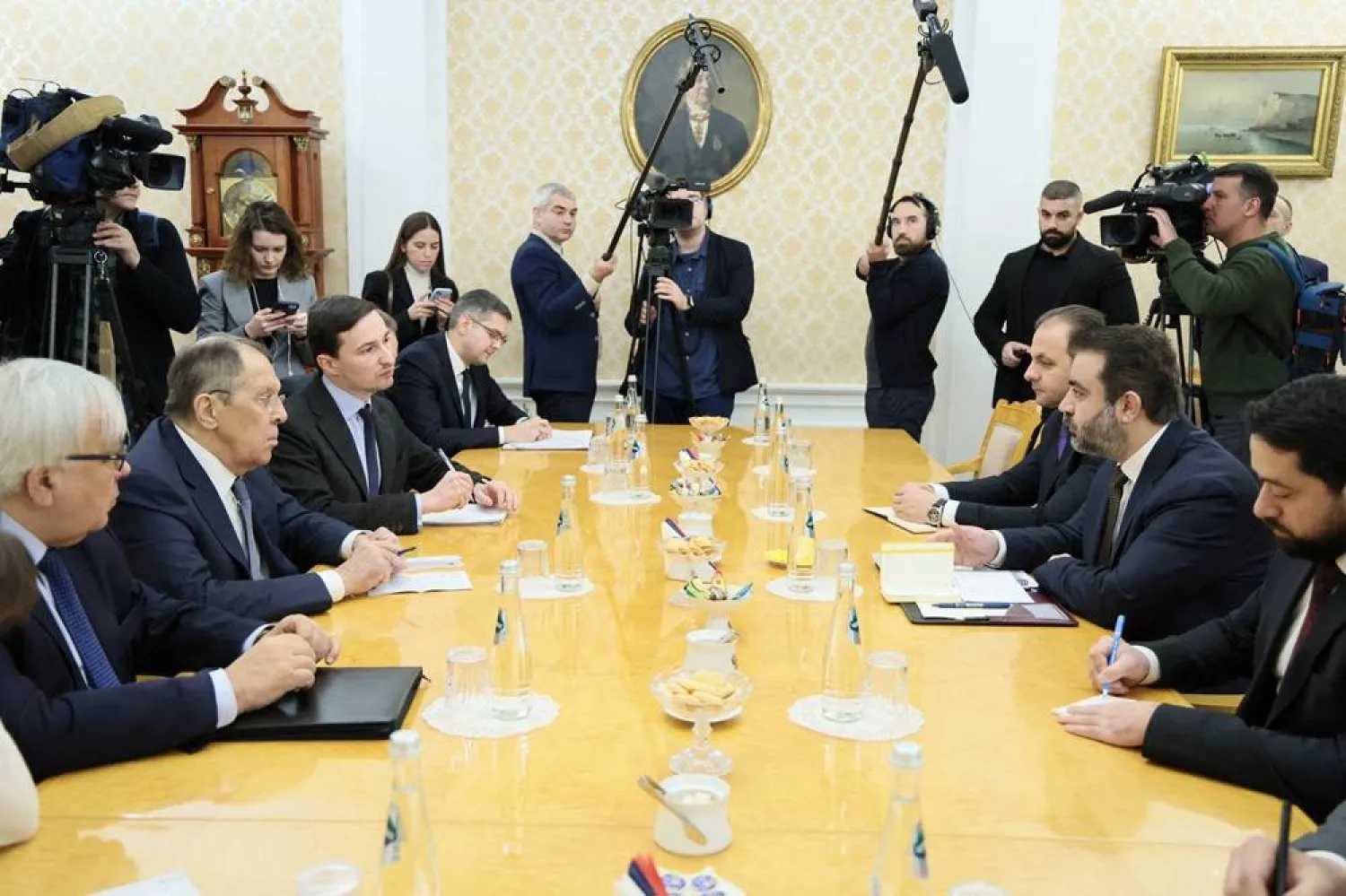
Russia's Foreign Minister Sergei Lavrov and Syria's Foreign Minister Asaad al-Shaibani attend a meeting in Moscow, Russia December 24, 2025. (Russian Foreign Ministry/Handout via Reuters)
TT

Shaibani: Syrian-Russian Ties Entering New Phase

Russia's Foreign Minister Sergei Lavrov and Syria's Foreign Minister Asaad al-Shaibani attend a meeting in Moscow, Russia December 24, 2025. (Russian Foreign Ministry/Handout via Reuters)

Syrian Foreign Minister Asaad al-Shaibani stressed on Wednesday that relations between Damascus and Moscow were entering a new phase based on mutual respect.

He met in Moscow with his Russian counterpart Sergei Lavrov, saying: “We aspire to establish balanced relations with everyone.”

“We are working on attracting investments to Syria to improve the economy,” he added, remarking: “We are forging ahead in rebuilding the country.”

For his part, Lavrov said the meeting tackled various issues, underlining the importance of maintaining Syria’s territorial integrity and bolstering bilateral ties between Damascus and Moscow.

On Tuesday, Shaibani and Defense Minister Major General Murhaf Abu Qasra met with Russian President Vladimir Putin to discuss political, military, and economic issues of mutual interest, with particular emphasis on strategic cooperation in the defense industry sector, reported Syria’s state news agency SANA.

They reviewed ways to advance military and technical partnership in a manner that strengthens the defensive capabilities of the Syrian army and keeps pace with modern developments in military industries.

Discussions focused on upgrading military equipment, transferring technical expertise and know-how, and expanding cooperation in research and development to boost Syria’s national defense system and support security and stability in Syria and the region.

On the political front, the two sides exchanged views on regional and international developments, underscoring the importance of continued political and diplomatic coordination between Damascus and Moscow in international forums.

They stressed the need to respect international law, rejecting all forms of external interference in the internal affairs of states.

Economically, the meeting addressed prospects for expanding economic and trade cooperation, including support for reconstruction projects, development of infrastructure sectors, and encouragement of investment in Syria.

The talks also covered boosting trade exchange and facilitating partnerships in ways that positively impact the Syrian economy and contribute to improving living conditions.

Putin underscored Russia’s steadfast support for Syria, stressing the importance of preserving Syria’s unity, territorial integrity, and full sovereignty, and rejecting “any projects aimed at partitioning the country or undermining its independent national decision”.

He also renewed Moscow’s condemnation of repeated Israeli violations of Syrian territory, describing them as “a direct threat to regional security and stability”.


Russian Mariner Held After Houthi Red Sea Attack Leaves Yemen for Home

A vessel said to be Greek-operated, Liberia-flagged Eternity C sinks in a footage released by Yemen's Houthis, in the Red Sea, in this screen grab taken from a handout video released on July 9, 2025. (Handout via Reuters)
TT

Russian Mariner Held After Houthi Red Sea Attack Leaves Yemen for Home

A vessel said to be Greek-operated, Liberia-flagged Eternity C sinks in a footage released by Yemen's Houthis, in the Red Sea, in this screen grab taken from a handout video released on July 9, 2025. (Handout via Reuters)

A Russian ‌mariner detained for around eight months after being on board a ship attacked by Yemen's Houthi militants has left the country for Russia following medical treatment in Sanaa, the Houthi-run foreign ministry said on Thursday.

The mariner, identified by Russian media as Aleksei Galaktionov, was a crew member of a ‌Greek-operated cargo ‌ship that was sunk by ‌the ⁠Houthis in July ⁠2025. He was wounded in the attack.

"The Russian citizen was transported on a United Nations aircraft, in coordination with the UN envoy," the foreign ministry said, according to the ⁠Houthi-run news agency, adding that his ‌departure was ‌arranged after he had completed treatment.

It said the ‌move followed contacts with Russian ‌officials and with counterparts in Iran.

The crew of the ship was released in December, an official with the ship's operator and ‌a maritime security source told Reuters.

The Iran-aligned Houthis sank the ⁠Liberia-flagged ⁠Eternity C, which had 22 crew and three armed guards on board, after attacking it with sea drones and rocket-propelled grenades over two consecutive days.

The Houthis have attacked more than 100 ships in what they said was a campaign of solidarity with Palestinians during the Gaza war. They halted attacks after a ceasefire was announced in October last year.


Pro-Palestinian Flotilla’s New Gaza Mission to Start in Spain on April 12

The Global Sumud Flotilla's first weeks-long journey across the Mediterranean Sea to Gaza, blockaded by Israel during the war against Hamas, drew worldwide attention. (Reuters)
TT

Pro-Palestinian Flotilla’s New Gaza Mission to Start in Spain on April 12

The Global Sumud Flotilla's first weeks-long journey across the Mediterranean Sea to Gaza, blockaded by Israel during the war against Hamas, drew worldwide attention. (Reuters)

A flotilla of pro-Palestinian activists who attempted to reach Gaza last year said on Thursday they would launch a new mission to the devastated territory from Barcelona on April 12.

The Global Sumud Flotilla's first weeks-long journey across the Mediterranean Sea to Gaza, blockaded by Israel during the war against Palestinian group Hamas, drew worldwide attention.

Israel's interception of their boats and arrests of the activists as they approached Gaza, which suffered severe shortages of food, water, medicine and fuel, sparked international condemnation.

The group, which described its first attempt as a humanitarian mission, said the latest trip starting in Spain's second city would gather more than 80 boats and 1,000 international participants.

"The cost of inaction is too high to bear," it said in a statement, adding that a land-based movement would join the maritime action to create pressure in multiple countries.

"As Gaza endures intensifying blockade, violence, and deprivation, the mission is a principled, nonviolent intervention: a defense of human dignity, a call for humanitarian access, and a demand for international accountability," the group said.

Gaza is under a fragile ceasefire agreed last October, which followed two years of devastating conflict sparked by the October 7, 2023 Hamas attack on Israel.

The attack resulted in the deaths of 1,221 people Israel, mostly civilians, according to official Israeli figures tallied by AFP. Palestinian fighters also abducted 251 hostages.

The retaliatory Israeli military campaign killed more than 70,000 people in Gaza, also mostly civilians, according to the Hamas-run territory's health ministry whose figures the United Nations considers reliable.

Both sides have repeatedly accused each other of violating the ceasefire.

Gaza's health ministry says Israeli strikes have killed more than 700 Palestinians since the truce. Israel says five of its soldiers have been killed in the same period.


Israel Says It Has Struck Over 3,500 Targets in Lebanon in Past Month

This picture taken from the southern Lebanese area of Tyre shows smoke rising from the site of an Israeli airstrike that targeted the area of Naqoura on March 31, 2026. (AFP)
TT

Israel Says It Has Struck Over 3,500 Targets in Lebanon in Past Month

This picture taken from the southern Lebanese area of Tyre shows smoke rising from the site of an Israeli airstrike that targeted the area of Naqoura on March 31, 2026. (AFP)

The Israeli military said Friday it had struck more than 3,500 targets across Lebanon in the month since fighting with the Hezbollah group began.

Lebanon was drawn into the Middle East war on March 2 after Iran-backed Hezbollah launched rockets at Israel to avenge the US-Israeli attack that killed Iran's supreme leader Ali Khamenei.

Israel has responded with massive strikes across Lebanon and a ground offensive.

The Israeli military said Friday it had killed approximately 1,000 militants in Lebanon over the past month, with strikes targeting what it described as "terrorist infrastructure, weapons storage facilities, launch positions, and command and control headquarters" belonging to Hezbollah.

Lebanon's health ministry said on Thursday that 1,345 people had been killed and 4,040 wounded since the start of the war, including 1,129 men, 91 women and 125 children.

The ministry said the toll also included 53 healthcare workers.

Hezbollah has so far not announced its losses.

On Thursday, Israeli Defense Minister Israel Katz warned that Hezbollah chief Naim Qassem would pay an "extraordinarily heavy price" for escalating attacks during the ongoing Jewish holidays.

"The Hezbollah terrorist organization you now lead, and its supporters in Lebanon, will bear the full and severe consequences," Katz said.

His warning followed claims by Hezbollah that it had carried out a series of rocket attacks on northern Israel late Wednesday and early Thursday, as Israeli Jews began marking Passover.

Katz also reiterated that Israeli forces "will clear Hezbollah and its supporters from southern Lebanon, maintain Israeli security control throughout the Litani area, and dismantle Hezbollah's military capabilities across Lebanon".

Eighteen European countries on Thursday urged Israel and Hezbollah to stop fighting as their latest conflict reached one month and with fears over Israeli plans to occupy part of southern Lebanon post-war.

"Israeli military operations in Lebanon and Hezbollah's attacks must cease," the foreign ministers of the countries including Italy, Spain, Belgium, Poland and Ireland said in a joint statement.

"We urge Israel to fully respect Lebanon's sovereignty and territorial integrity, and call on all parties, both Hezbollah and Israel, to halt military action," the statement said.

The countries include Spain, Austria, Belgium, Croatia, Cyprus, Estonia, Finland, Iceland, Italy, Ireland, Latvia, Luxembourg, Moldova, Norway, Poland, San Marino, Slovenia and Sweden.
