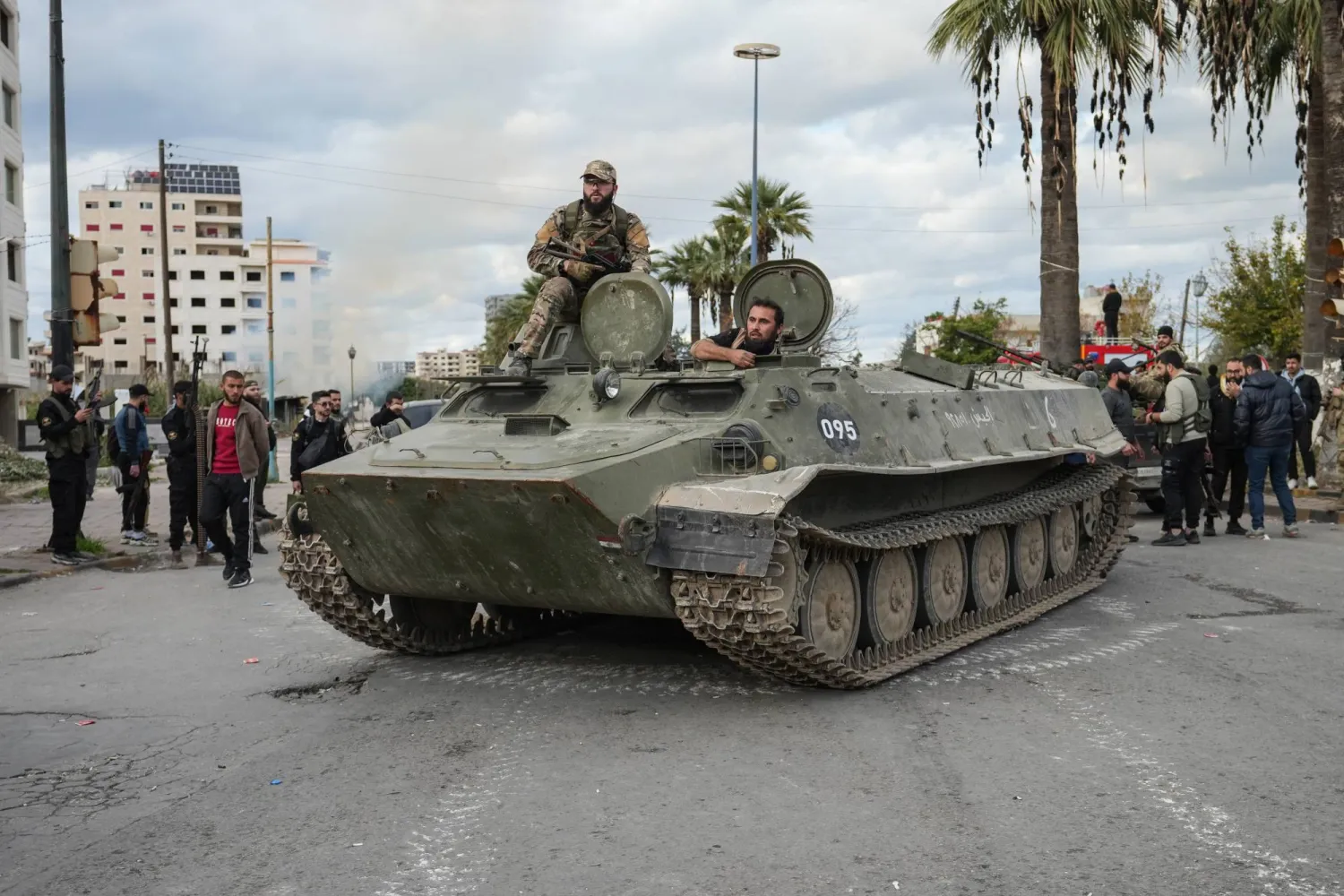
Syrian Army Enters Latakia, Tartus after Attacks by Regime Remnants

Syrian Security forces stand atop a military vehicle in the city of Latakia, Syria, 28 December 2025. (EPA)
TT

Syrian Army Enters Latakia, Tartus after Attacks by Regime Remnants

Syrian Security forces stand atop a military vehicle in the city of Latakia, Syria, 28 December 2025. (EPA)

The Syrian Defense Ministry announced on Sunday the deployment of military forces in the coastal cities of Latakia and Tartus in wake of an armed attack against security forces and civilians during recent protests.

Syrian television said the deployment was happening after "outlawed groups" carried out attacks against security forces and the people.

The military will work on preserving security and restoring calm in cooperation with the internal security forces, it added.

Earlier, local media reported that three people were killed and 48 wounded when gunmen affiliated with the ousted regime opened fire at civilians and security forces during protests in Latakia and Tartus.

State television said a member of the security forces was killed and others were injured while they were protecting protests in Latakia.

Head of the security forces in the Latakia province Abdulaziz al-Ahmed said the attack was carried out by terrorist members of the former regime.

The protests in Latakia were called for by Ghazal Ghazal.

Al-Ahmed added that masked gunmen were spotted at the protests and they were identified as members of Coastal Shield Brigade and Al-Jawad Brigade terrorist groups, reported the official SANA news agency.

The groups were responsible for bombings on the M1 highway and extrajudicial killings, it added.

A member of the groups was arrested in the Jableh countryside during a security operation, announced the Interior Ministry. Three other members were killed, while explosives and various weapons and ammunition were seized during the operation.

The Al-Jawad Brigade is affiliated with Suheil al-Hassan, a notorious former Syrian military officer.

In a statement, the Interior Ministry said the group was involved in assassinations, bombings and attacks against the Interior Ministry forces and the army.

It was planning attacks on New Year celebrations, it revealed. The detainee also revealed the locations of weapons caches used by the group.


Houthis Step Up Pressure on Front Lines by Shelling Residential Areas

Residents walk amid debris from their homes after a missile strike in Seina, Taiz, Yemen, Tuesday, Oct. 20, 2026. (AP Photo/Marzouq Al Jabri)
TT

Houthis Step Up Pressure on Front Lines by Shelling Residential Areas

Residents walk amid debris from their homes after a missile strike in Seina, Taiz, Yemen, Tuesday, Oct. 20, 2026. (AP Photo/Marzouq Al Jabri)

The humanitarian consequences of the Houthi escalation in Yemen have intensified as the group steps up attacks on residential areas in rural Lahj Governorate and around the city of Taiz, according to government sources. Growing numbers of families are fleeing the fighting, while relief organizations struggle to meet mounting needs in a country already facing one of the world's worst humanitarian crises.

Sources told Asharq Al-Awsat that the Houthis had intensified near-daily missile and drone attacks on villages in Lahj's Al-Mudarabah district after failing to make advances on the battlefield.

The attacks have forced hundreds of families to flee, adding to waves of displacement from the western coast and the outskirts of Lahj.

The sources said they believed the attacks were intended to pressure local tribesmen into withdrawing their support for government forces.

Around Taiz, the sources reported that the Houthis had targeted villages on Mount Sabr with drones and mortar shells in an attempt to weaken resistance from government troops and local volunteers, who have repelled repeated attempts by the group to breach the front lines in recent days.

The developments come as Taiz has been under siege for 20 days, according to the sources. The fighting has made it increasingly difficult for civilians to access essential services and supplies, placing additional strain on local authorities and humanitarian organizations.

Humanitarian Warnings

Amid the humanitarian consequences of the Houthi attacks, the International Federation of Red Cross and Red Crescent Societies (IFRC) warned that the latest escalation had deepened Yemen's prolonged humanitarian crisis.

The IFRC said 22.3 million people across Yemen require humanitarian assistance, including approximately 5.2 million who had already been internally displaced before the latest escalation.

In a recent report, the federation said fighting and insecurity had disrupted access to healthcare, education, markets and essential supplies.

Displaced families are arriving in host communities with few belongings and urgently need shelter, household essentials, food, clean water and healthcare.

The report noted that host communities are also facing severe pressure on services and resources, while repeated displacement is eroding livelihoods, increasing protection risks and raising the likelihood that more families will be forced to leave their homes.

The IFRC stressed the importance of maintaining humanitarian access and ensuring a flexible response that can adapt to changing needs on the ground, particularly in areas where insecurity restricts the movement of people and supplies.

According to the report, displaced households face overlapping barriers to obtaining shelter, food, clean water, sanitation, education and healthcare.

Insecurity and road closures have disrupted markets, supply routes and aid deliveries, while lost income, depleted assets and rising prices have further reduced families' ability to purchase basic necessities.

The federation warned that isolated communities face even greater restrictions, as maintaining commercial supplies and essential services becomes increasingly difficult.

Food insecurity is further exacerbating the vulnerability of households already struggling with inadequate access to food.

Highlighting the scale of the crisis, the report said approximately 2.2 million children under the age of five suffer from acute malnutrition across Yemen.

It warned that continued sieges and interruptions to humanitarian assistance could further worsen conditions, particularly for young children and pregnant and breastfeeding women.

The report added that repeated displacement is exhausting families' ability to cope with successive crises.

A rapid assessment conducted at three displacement sites found that approximately 45% of the households surveyed had previously experienced displacement.

The IFRC emphasized that this figure reflected only the households assessed at those three sites and should not be generalized to Yemen's entire displaced population.

Additional Risks

The IFRC also warned that the loss of property and unstable livelihoods are undermining families' resilience and increasing the risk that they will resort to harmful coping strategies, including child labor.

The federation noted that the humanitarian toll extends beyond shortages of food and shelter to additional challenges facing female-headed households, children separated from their families, older people, persons with disabilities and patients requiring regular medical treatment.

Women and girls face heightened protection risks in areas lacking adequate shelter and sanitation facilities.

Meanwhile, people with limited mobility or financial resources may be unable to leave isolated areas or reach essential services.

The warnings highlight the widening gap between humanitarian needs and the capacity to meet them as fighting continues, families are repeatedly displaced, and roads and supply routes remain disrupted.

Together, these pressures are leaving vulnerable households increasingly exposed to hardship and placing additional burdens on communities receiving displaced families.



Arab Parties in Israel Signal Readiness to Help Oust Netanyahu

27 October 2026, Israel, Nazareth: Palestinian candidate Yousef Jabareen of the Joint List party speaks as he celebrates early exit poll results, at the party's headquarters in Nazareth, during Israel's legislative election. Photo: Jamal Awad/dpa
TT

Arab Parties in Israel Signal Readiness to Help Oust Netanyahu

27 October 2026, Israel, Nazareth: Palestinian candidate Yousef Jabareen of the Joint List party speaks as he celebrates early exit poll results, at the party's headquarters in Nazareth, during Israel's legislative election. Photo: Jamal Awad/dpa

An alliance of predominantly Arab parties in Israel has signaled its willingness to help oust Prime Minister Benjamin Netanyahu's far-right and religious coalition following the country's parliamentary elections, according to dpa.

Yousef Jabareen, chairman of the Joint List, said Wednesday that Netanyahu's government had made life unbearable for Arab citizens.

"The government of Netanyahu and [far-right National Security Minister Itamar] Ben-Gvir has made life hell for every Arab citizen," Jabareen said.

He described the support for Arab parties in Tuesday's elections as "historic."

With most votes counted, the Joint List and the conservative Islamist Ra'am party were projected to win a combined 19 seats in the 120-member Knesset.

The Arab parties could play a decisive role in determining the next government, as neither Netanyahu's bloc nor the opposition camp led by former military chief Gadi Eisenkot is expected to secure a majority.

"We will know how to leverage our political strength to advance the values we believe in," Jabareen said.

He added that his party was prepared to "pave the way for ousting the government of Netanyahu, Ben Gvir and Smotrich, and send them home."

Arab citizens account for approximately one-fifth of Israel's population.


Iraqi PM Visits Syria as Neighbors Seek to Boost Economic Ties

Syrian President Ahmad al-Sharaa and Iraqi Prime Minister Ali al-Zaidi meet at Damascus airport on Wednesday. (INA)
TT

Iraqi PM Visits Syria as Neighbors Seek to Boost Economic Ties

Syrian President Ahmad al-Sharaa and Iraqi Prime Minister Ali al-Zaidi meet at Damascus airport on Wednesday. (INA)

Iraqi Prime Minister Ali al-Zaidi arrived in Damascus on Wednesday and was met by President Ahmad al-Sharaa, Syrian state media said, as the neighbors seek to bolster economic and energy cooperation.

It is the first visit by an Iraqi prime minister since the new authorities took power after toppling longtime Syrian ruler Bashar al-Assad in December 2024 following more than 13 years of civil war.

Baghdad had initially dealt cautiously with the new Syrian authorities, though senior Iraqi political, intelligence and judicial officials have visited Damascus since Assad's ouster.

Al-Sharaa received al-Zaidi and his accompanying delegation at Damascus international airport, Syrian state television reported.

Iraq is seeking to strengthen ties with a neighbor with whom it shares a 600-kilometer (370-mile) border, while Syria is working to become a transit hub for global trade, particularly as countries look for alternatives to the Strait of Hormuz.

Al-Sharaa and al-Zaidi also met last month in New York on the sidelines of the United Nations General Assembly.

In an interview broadcast on Tuesday by Iraqi television channel Dijlah, al-Sharaa welcomed al-Zaidi's visit and said that "in the past year and a half, something positive has been built in Syrian-Iraqi relations, particularly in economic matters".

He said his country sees ties with Iraq in terms of their "great historical and economic commonalities" rather than sectarian terms.

Iraq recently began exporting limited quantities of oil through Syria, after maritime traffic through the Strait of Hormuz was disrupted following the outbreak of the Middle East war earlier this year.

In July, Damascus and Baghdad signed a memorandum of understanding to revive a pipeline for transporting oil from Iraq to Syria's coast, linking Iraqi production to export markets in the Mediterranean and beyond.

In February, the United States transferred over 5,700 ISIS group detainees from more than 60 countries to Iraq, after they had been held for years at prisons in north and northeast Syria administered by Kurdish forces.

In Tuesday's interview, al-Sharaa said some of the around 3,000 Syrian detainees transferred to Iraq had "no connection" to ISIS, with efforts underway to categorize them, examine Syria's responsibility and possibilities for repatriation.