


Lebanon Voices Official Anger at Hamas over Refusal to Hand over Weapons

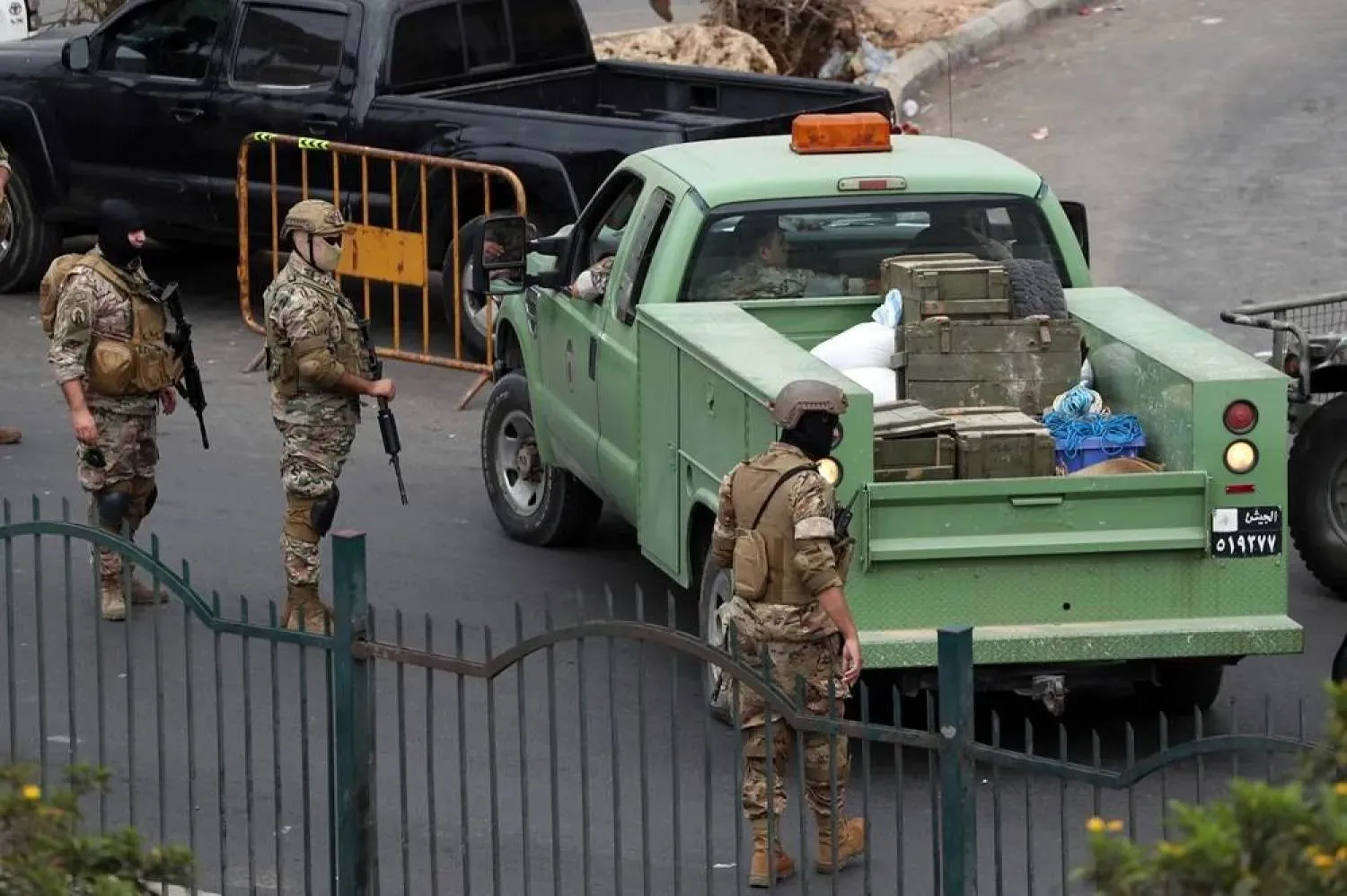
Lebanese army soldiers stand next to a truck carrying weapons at the Burj al-Barajneh Palestinian refugee camp in southern Beirut, Lebanon, 29 August 2025. (EPA)
TT

Lebanon Voices Official Anger at Hamas over Refusal to Hand over Weapons

Lebanese army soldiers stand next to a truck carrying weapons at the Burj al-Barajneh Palestinian refugee camp in southern Beirut, Lebanon, 29 August 2025. (EPA)

As the Lebanese army presses ahead with efforts to seize weapons inside Palestinian refugee camps across the country, a key question remains unresolved: what will become of Hamas’s arsenal in Lebanon, as the group continues to defy a government decision and a Lebanese-Palestinian agreement requiring it to hand over its arms.

Official Lebanese frustration with Hamas and allied factions has reached unprecedented levels, driven by their refusal to hand over medium and heavy weapons located south of the Litani River, specifically in the Rashidieh Palestinian refugee camp.

The deadline set by the Lebanese army to complete the first phase of the government’s decision to impose state monopoly over arms, which covers the area between the Litani River and the Israeli border, expires at the end of 2025.

The government is expected to announce during a meeting in early 2026 the completion of the first phase and the move to implement the second one, in an effort to head off Israeli threats to launch a new round of war to counter what Israel describes as attempts by Hezbollah to rebuild its military capabilities.

The hardline stance taken by Hamas and other factions has raised questions, particularly as Hezbollah has complied and handed over its weapons south of the Litani. This has heightened concerns over the safety and stability of the Rashidieh camp if Israel decides to target weapons believed to include medium and heavy arms stored inside it.

External mediation efforts

A senior official told Asharq Al-Awsat that Lebanon has sought external mediation to address the issue of Hamas’s weapons, and that these countries have exerted pressure on the group, so far without success.

Sources following the file said that Fatah’s handover on Tuesday of a new batch of weapons from the Ain al-Hilweh camp was a renewed attempt to pressure Hamas into surrendering its arms.

Head of the Lebanese Palestinian Dialogue Committee Ambassador Ramez Dimashkieh openly expressed official Lebanese dissatisfaction with Hamas and allied factions and with their handling of the issue.

“As long as these factions declare that they operate under the authority of the Lebanese state, they are supposed to abide by the state’s decisions, not resort to stalling by linking the handover to the issue of rights,” Dimashkieh told Asharq Al-Awsat.

“We know there are rights and demands, and we are working seriously on this file, but we reject any bargaining between one file and another.”

He said there was no benefit in holding broad meetings with the factions, stressing that Hamas and its allies should instead contact the Lebanese army directly to set dates for handing over weapons, just as the Palestine Liberation Organization factions have done.

Hamas, Islamic Jihad and other allied factions reject the decisions of the Lebanese Palestinian summit that was held earlier this year, arguing that the Lebanese state should resolve the Palestinian file in Lebanon as a single package, and should not prioritize weapons over Palestinian rights and demands.

Sources in Hamas told Asharq Al-Awsat that the group is still waiting for Dimashkieh to invite all factions to dialogue on the weapons issue and outstanding files related to Palestinian rights, with the aim of agreeing on a framework paper for a solution.

They said Dimashkieh had promised during the last meeting to call for such talks, but no invitation has been made.

There appears to be no Lebanese political or military plan to forcibly collect Palestinian weapons.

Military sources told Asharq Al-Awsat that the army’s current role regarding the remaining weapons inside the camps is limited to preventing the entry or exit of arms, with security measures tightened at the main and secondary entrances to camps across Lebanon.

Fifth batch of Fatah weapons handed over

Meanwhile, the Lebanese army announced on Tuesday that, as part of the ongoing process to remove weapons from Palestinian camps, it had taken delivery of a quantity of Palestinian arms from the Ain al-Hilweh camp in southern Lebanon, in coordination with the relevant Palestinian authorities.

The army stated that the handover included various types of weapons and ammunition, which were received by specialized military units for inspection and further processing.

For its part, the Palestinian National Security Forces in Lebanon, the military wing of Fatah, said in a statement that its forces had completed on Tuesday the handover of the fifth batch of heavy weapons belonging to the Palestine Liberation Organization at the Ain al-Hilweh camp in Sidon.

The statement said the move was in implementation of the joint presidential statement issued by Palestinian President Mahmoud Abbas and Lebanese President Joseph Aoun in May, and the subsequent work of the joint Lebanese-Palestinian committee tasked with following up on camp conditions and improving living standards.

The total number of Palestinian refugees registered with UNRWA in Lebanon stands at 489,292. More than half live in 12 organized camps recognized by UNRWA.


Israel Military Says Soldier Killed in Gaza 

A drone view shows the destruction in a residential neighborhood, after the withdrawal of the Israeli forces from the area, amid a ceasefire between Israel and Hamas in Gaza, in Gaza City, October 21, 2025. (Reuters)
TT

Israel Military Says Soldier Killed in Gaza 

A drone view shows the destruction in a residential neighborhood, after the withdrawal of the Israeli forces from the area, amid a ceasefire between Israel and Hamas in Gaza, in Gaza City, October 21, 2025. (Reuters)

The Israeli military announced that one of its soldiers had been killed in combat in southern Gaza on Wednesday, but a security source said the death appeared to have been caused by "friendly fire".

"Staff Sergeant Ofri Yafe, aged 21, from HaYogev, a soldier in the Paratroopers Reconnaissance Unit, fell during combat in the southern Gaza Strip," the military said in a statement.

A security source, however, told AFP that the soldier appeared to have been "killed by friendly fire", without providing further details.

"The incident is still under investigation," the source added.

The death brings to five the number of Israeli soldiers killed in Gaza since a ceasefire took effect on October 10.


Syria: SDF’s Mazloum Abdi Says Implementation of Integration Deal May Take Time

People sit outdoors surrounded by nature, with the Tigris river flowing in the background, following a long atmospheric depression, near the Syrian-Turkish border in Derik, Syria, February 16, 2026 REUTERS/Orhan Qereman
TT

Syria: SDF’s Mazloum Abdi Says Implementation of Integration Deal May Take Time

People sit outdoors surrounded by nature, with the Tigris river flowing in the background, following a long atmospheric depression, near the Syrian-Turkish border in Derik, Syria, February 16, 2026 REUTERS/Orhan Qereman

Mazloum Abdi, commander of the Syrian Democratic Forces, said the process of merging the SDF with Syrian government forces “may take some time,” despite expressing confidence in the eventual success of the agreement.

His remarks came after earlier comments in which he acknowledged differences with Damascus over the concept of “decentralization.”

Speaking at a tribal conference in the northeastern city of Hasakah on Tuesday, Abdi said the issue of integration would not be resolved quickly, but stressed that the agreement remains on track.

He said the deal reached last month stipulates that three Syrian army brigades will be created out of the SDF.

Abdi added that all SDF military units have withdrawn to their barracks in an effort to preserve stability and continue implementing the announced integration agreement with the Syrian state.

He also emphasized the need for armed forces to withdraw from the vicinity of the city of Ayn al-Arab (Kobani), to be replaced by security forces tasked with maintaining order.


Israeli Far-Right Minister to Push for ‘Migration’ of West Bank, Gaza Palestinians 

A Palestinian man checks leather belts as people prepare for Ramadan, in the old city of Hebron in the Israeli-occupied West Bank, February 17,2026. (Reuters)
TT

Israeli Far-Right Minister to Push for ‘Migration’ of West Bank, Gaza Palestinians 

A Palestinian man checks leather belts as people prepare for Ramadan, in the old city of Hebron in the Israeli-occupied West Bank, February 17,2026. (Reuters)

Israel's far-right Finance Minister Bezalel Smotrich said he would pursue a policy of "encouraging the migration" of Palestinians from the occupied West Bank and Gaza Strip, Israeli media reported Wednesday.

"We will eliminate the idea of an Arab terror state," said Smotrich, speaking at an event organized by his Religious Zionism Party late on Tuesday.

"We will finally, formally, and in practical terms nullify the cursed Oslo Accords and embark on a path toward sovereignty, while encouraging emigration from both Gaza and Judea and Samaria.

"There is no other long-term solution," added Smotrich, who himself lives in a settlement in the West Bank.

Since last week, Israel has approved a series of measures backed by far-right ministers to tighten control over the West Bank, including in areas administered by the Palestinian Authority under the Oslo Accords, in place since the 1990s.

The measures include a process to register land in the West Bank as "state property" and facilitate direct purchases of land by Jewish Israelis.

The measures have triggered widespread international outrage.

On Tuesday, the UN missions of 85 countries condemned the measures, which critics say amount to de facto annexation of the Palestinian territory.

"We strongly condemn unilateral Israeli decisions and measures aimed at expanding Israel's unlawful presence in the West Bank," they said in a statement.

"Such decisions are contrary to Israel's obligations under international law and must be immediately reversed.

"We underline in this regard our strong opposition to any form of annexation."

UN Secretary-General Antonio Guterres on Monday called on Israel to reverse its land registration policy, calling it "destabilizing" and "unlawful".

The West Bank would form the largest part of any future Palestinian state. Many on Israel's religious right view it as Israeli land.

Israeli NGOs have also raised the alarm over a settlement plan signed by the government which they say would mark the first expansion of Jerusalem's borders into the occupied West Bank since 1967.

The planned development, announced by Israel's Ministry of Construction and Housing, is formally a westward expansion of the Geva Binyamin, or Adam, settlement situated northeast of Jerusalem in the West Bank.

The current Israeli government has fast-tracked settlement expansion, approving a record 52 settlements in 2025.

Excluding Israeli-annexed east Jerusalem, more than 500,000 Israelis live in West Bank settlements and outposts, which are illegal under international law.
