


Latest Israeli Escalation in Lebanon Raises Questions about All-out War

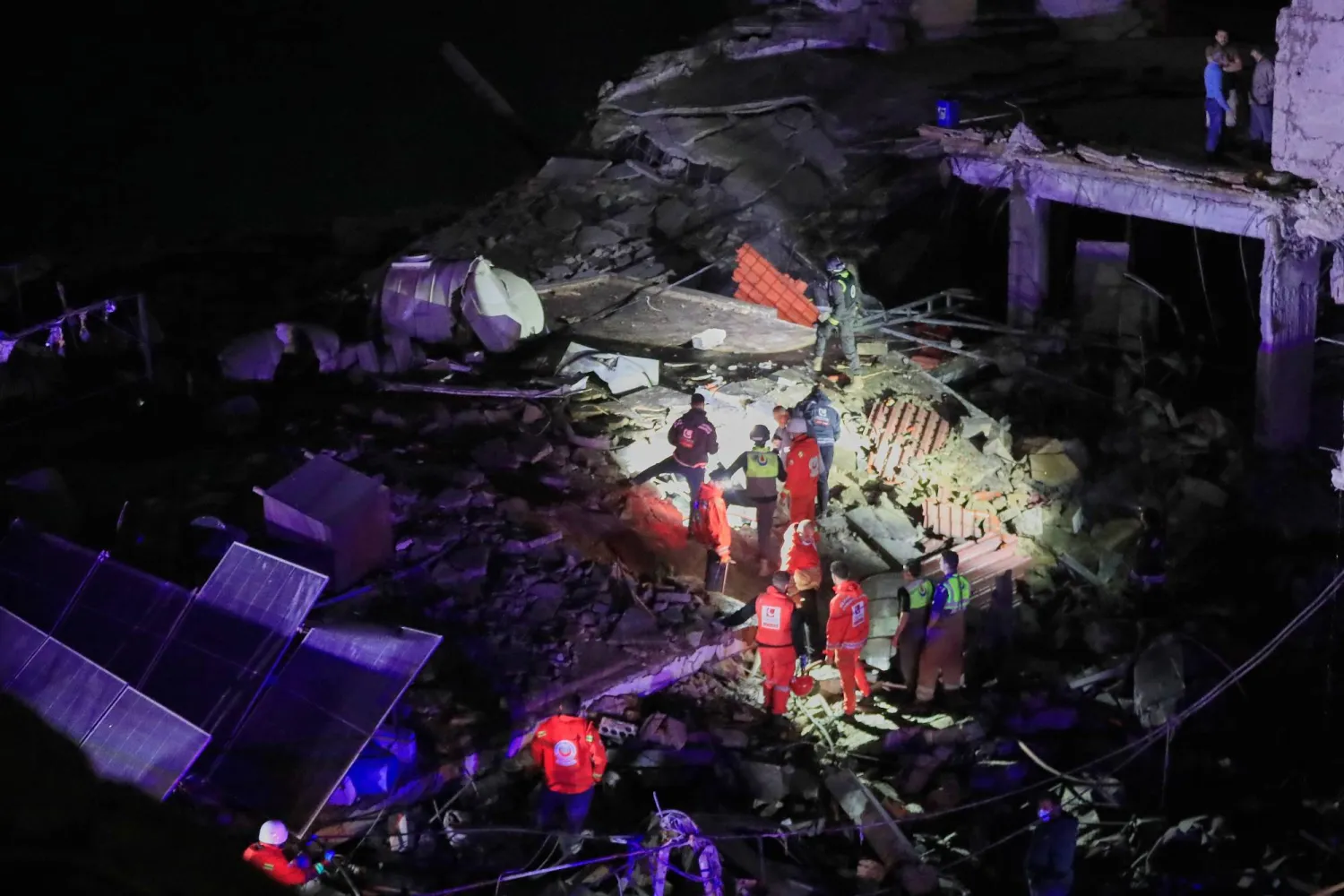
Rescue workers search for possible victims in a building destroyed by an Israeli strike in the southern port city of Sidon, Lebanon, early Tuesday, Jan. 6, 2026. (AP)
TT

Latest Israeli Escalation in Lebanon Raises Questions about All-out War

Rescue workers search for possible victims in a building destroyed by an Israeli strike in the southern port city of Sidon, Lebanon, early Tuesday, Jan. 6, 2026. (AP)

The Israeli airstrike that struck a three-storey building on Tuesday in the industrial zone of Sainiq, in the Sidon district in southern Lebanon, was part of a broader wave of attacks that on Monday targeted the western Bekaa Valley, Jezzine, and areas around Sidon.

With intensive drone flights over Baalbek and its outskirts, followed by surveillance over Tyre and Zahrani, the picture pointed to a new wave of escalation extending beyond the South that stretches from north of the Litani River to the Awali basin and parts of the Bekaa.

Timing

The escalation raises serious questions, Lebanese President Joseph Aoun said, particularly as the “Mechanism” committee is set to meet on Wednesday.

The committee is tasked with halting hostilities and identifying practical steps to restore security and stability in the South, including Israel’s withdrawal to the international border, the release of Lebanese detainees, and the completion of the Lebanese Army’s deployment in line with UN Security Council Resolution 1701.

In a statement, Aoun stressed that Israel’s continued attacks aim to derail local, regional, and international efforts to contain the escalation, despite Lebanon’s cooperation and the measures adopted by the government to extend state authority south of the Litani.

He added that these steps were implemented by the Lebanese Army “with professionalism, discipline, and precision.”

He renewed his call for effective international intervention to curb Israel’s actions and to enable the Mechanism committee to fulfill its mandate with the consensus of the parties concerned and sustained international support.

On Monday, Israel launched a series of strikes across eastern and southern Lebanon after issuing evacuation warnings to residents. Overnight, it continued air raids without warning on Zahrani and Sarafand.

At dawn on Tuesday, it struck a three-storey building in an industrial area in Ghazieh, near the coastal city of Sidon — about 40 kilometres south of Beirut — wounding one person, levelling the building, damaging nearby structures, and sparking a fire.

Later on Tuesday, an Israeli drone struck an area near a house in the village of Kfardounine, followed by another strike on a home in Khirbet Selm that killed two people, according to Lebanon’s National News Agency.

The Israeli army said it had targeted “multiple military infrastructures” belonging to Hezbollah and Hamas, including weapons depots and military facilities above and below ground.

The statement said Hezbollah used these sites to advance “terrorist plans” and rebuild its capabilities. It also cited strikes on Hamas weapons-production sites in southern Lebanon allegedly used to arm the Palestinian group and plan attacks against Israeli forces and Israel.

Signals on the ground

The latest strikes carry several overlapping signals: a clear return to escalation; an expansion of operations to include areas north of the Litani, the Awali basin, and parts of the Bekaa; and a shift beyond targeting Hezbollah’s military infrastructure alone, with attacks on sites Israel says belong to Hamas.

This has brought strikes into predominantly Sunni areas, such as Manara in the western Bekaa.

Beyond the South

Retired Brigadier Khalil Helou told Asharq Al-Awsat that the recent developments reflect a broader Israeli strategy aimed at increasing pressure on the Lebanese government and state institutions, particularly the army, to accelerate implementation of the second phase of the plan to impose state monopoly over arms, especially north of the Litani, effectively across all of Lebanon.

He said Israel’s approach in Lebanon cannot be separated from the situation in Gaza and Iran, arguing that these arenas are interconnected within a single strategic vision that also intersects with US policy.

“What we are witnessing today is the outcome of wider political and security understandings that emerged after the meeting between Benjamin Netanyahu and Donald Trump, even if the details were never made public,” he said. The leaders met in late December.

Intelligence-driven operations

Helou described Israel’s recent strikes as “limited military operations with an intelligence-driven character rather than open political signaling.”

The absence of prior warnings in some cases, he added, points to targeted assassinations or precision strikes on sites believed to have particular military importance.

Dahiyeh a possible target, war unlikely

On potential escalation scenarios, Helou said strikes on Beirut’s southern suburb of Dahiyeh have become more conceivable than before within Israel’s margin of maneuver.

He nonetheless ruled out a full-scale war, arguing that Hezbollah is currently unable to mount a response even if the scope of attacks widens.

Iran

Turning to Iran, Helou said internal developments and debates within the Iranian regime play a decisive role in shaping Tehran’s regional behavior.

Any major decision by Hezbollah remains directly tied to Iranian guidance, he added.

“The Lebanese scene cannot be read in isolation from what is unfolding daily in Iran, where the broader strategic picture is being drawn,” he remarked.

Meanwhile, Israel’s Walla news site reported that there is no intention to scale back Israeli military presence along the Lebanese border and that operations will continue as required, even if this entails expanding their geographic scope to include areas north of the Litani, the Awali basin, parts of the Bekaa, and Beirut’s southern suburbs.

The escalation comes ahead of a military meeting of the Mechanism committee and before a Cabinet session Thursday devoted to reviewing the Lebanese Army’s final report on arms control south of the Litani and preparations for a second phase north of the river.

Haaretz, meanwhile, reported that Trump told Netanyahu he was granting him limited leeway for any military operation against Hezbollah.

Helou said the next phase is likely to see intensified strikes and mounting pressure aimed at enforcing the second phase of disarmament across Lebanon without sliding into a comprehensive war, describing the current trajectory as a “calculated escalation serving broader political and military objectives.”



Lebanese Military Moves to New Phase of Disarming Non-state Groups like Hezbollah

Lebanese soldiers stand in front of a building targeted by an Israeli airstrike in the village of Deir Kifa in south Lebanon last month. (AFP file)
TT

Lebanese Military Moves to New Phase of Disarming Non-state Groups like Hezbollah

Lebanese soldiers stand in front of a building targeted by an Israeli airstrike in the village of Deir Kifa in south Lebanon last month. (AFP file)

The Lebanese military said Thursday it had concluded the first phase of their plan to fully deploy across southern Lebanon and disarm non-state groups, notably Hezbollah. Israel said it is encouraging but “far from sufficient.”

The effort to disarm Hezbollah comes after a Washington-brokered ceasefire ended a war between the group and Israel in 2024.

The military's statement didn't name Hezbollah or other armed groups in particular, but it comes before President Joseph Aoun is set to meet with Prime Minister Nawaf Salam and his government to discuss the deployment and disarmament plans. Both said disarming non-state groups was a priority upon beginning their terms not long after the ceasefire went into effect, according to The AP news.

Lebanon's top officials have endorsed the military announcement.

A statement by Aoun’s office ahead of the meeting called on Israel to stop its attacks, withdraw from areas it occupies, and release Lebanese prisoners. He called on friendly countries not to send weapons to Lebanon unless it's to state institutions — an apparent reference to Iran which for decades has sent weapons and munitions to Hezbollah.

Speaker Nabih Berri, a key ally of Hezbollah who played a leading role in ceasefire talks, issued a statement saying the people of southern Lebanon are “thirsty for the army's presence and protection."

Israel maintains that despite Lebanon’s efforts, Hezbollah is still attempting to rearm itself in southern Lebanon.

“The ceasefire agreement brokered by the United States between Israel and Lebanon states clearly, Hezbollah must be fully disarmed," a statement from Israeli Prime Minister Benjamin Netanyahu’s office read. “This is imperative for Israel’s security and Lebanon’s future.”

Military says disarmament plan in ‘advanced stage’ The text of the ceasefire agreement is vague as to how Hezbollah’s weapons and military facilities north of the Litani river should be treated, saying Lebanese authorities should dismantle unauthorized facilities starting with the area south of the river.

Hezbollah insists that the agreement only applies south of the Litani, while Israel maintains that it applies to the whole country. The Lebanese government has said it will eventually remove non-state weapons throughout the country.

The Lebanese military has been clearing tunnels, rocket-launching positions, and other structures since its disarmament proposal was approved by the government and went into effect in September.

The government had set a deadline of the end of 2025 to clear the area south of the Litani River of non-state weapons.

“The army confirms that its plan to restrict weapons has entered an advanced stage, after achieving the goals of the first phase effectively and tangibly on the ground,” the military statement read.

“Work in the sector is ongoing until the unexploded ordnance and tunnels are cleared ... with the aim of preventing armed groups from irreversibly rebuilding their capabilities,” it said.

Hezbollah did not immediately comment on the Lebanese military’s announcement.

Officials have said the next stage of the disarmament plan is in segments of southern Lebanon between the Litani and the Awali River, which include Lebanon’s port city of Sidon, but they have not set a timeline for that phase.

Israeli strikes continue Israel still strikes Lebanon near daily and occupies five strategic hilltop points along the border, the only areas south of the Litani where the military said it has yet to control.

Regular meetings have taken place between the Lebanese and the Israelis alongside the United States, France, and the UN peacekeeping forces in southern Lebanon, known as UNIFIL, to monitor developments after the ceasefire.

Lebanon’s cash-strapped military has since been gradually dispersing across wide areas of southern Lebanon between the Litani River and the UN-demarcated “Blue Line” that separates the tiny country from Israel. The military has also been slowly confiscating weapons from armed Palestinian factions in refugee camps.

Israel accuses Hezbollah of trying to rebuild its battered military capacity and has said that the Lebanese military’s efforts are not sufficient, raising fears of a new escalation. Lebanon, meanwhile, said Israel's strikes and control of the hilltops were an obstacle to the efforts.

Lebanon also hopes that disarming Hezbollah and other non-state groups will help to bring in money needed for reconstruction after the 2024 war.

Hezbollah says it has been cooperative with the army in the south but will not discuss disarming elsewhere before Israel stops its strikes and withdraws from Lebanese territory.


Israel Strikes Gaza Rocket Launch Site, Ceasefire Deal under Strain

Rockets are fired by Palestinian militants into Israel, amid Israeli-Palestinian fighting, in Gaza City August 5, 2022. REUTERS/Mohammed Salem
TT

Israel Strikes Gaza Rocket Launch Site, Ceasefire Deal under Strain

Rockets are fired by Palestinian militants into Israel, amid Israeli-Palestinian fighting, in Gaza City August 5, 2022. REUTERS/Mohammed Salem

Israel's military said on Thursday it had carried out a targeted strike on a rocket launch site near Gaza City after identifying a failed launch, as questions mount over when the next phase of the Gaza ceasefire will begin.

The military said the projectile did not cross into Israeli territory and that the launch site was struck shortly after the attempt was detected.

It accused Hamas of violating the ceasefire twice in the past ‌24 hours. A ‌source from the Palestinian militant group told Reuters it ‌was ⁠checking ​the ‌allegation.

Further highlighting the fragility of the ceasefire deal, local Palestinian health authorities said two people, a woman and a boy, had been injured on Thursday in two separate shooting incidents by Israeli forces in southern and northern Gaza.

There was no immediate Israeli comment on the report.

Israel is awaiting the handover of the final body due under the current stage of the truce. An Israeli official close to Prime Minister Benjamin Netanyahu has said Israel ⁠will not move to the next phase of the ceasefire until Hamas returns the remains of the last Israeli ‌hostage still held in Gaza.

Israel has yet to open ‍the Rafah crossing between Gaza and Egypt, ‍which is another condition of the US-backed plan, saying it will only do ‍so once the remains are returned.

CEASEFIRE LOOKING FRAGILE

Israel and Hamas have accused each other of major breaches of the ceasefire deal and remain far apart on the more difficult steps envisaged for the next phase.

Israel has continued to carry out air strikes and targeted operations across Gaza. ​The Israeli military said it views "with utmost severity" any attempts by militant groups in Gaza to attack Israel.

A Hamas official told Reuters on ⁠Thursday the group had documented more than 1,100 Israeli violations of the ceasefire since October and had urged mediators to intervene.

The violations include killings, injuries, artillery and aerial strikes, home demolitions and detention of people, he said.

Hamas has refused to disarm and has been reasserting its control as Israeli troops remain entrenched in about half the Gaza Strip. Israel has said it will resume military action if Hamas is not disarmed peacefully.

More than 400 Palestinians, mostly civilians, have been killed since the truce, according to Gaza health officials, as well as three Israeli soldiers.

Hamas-led militants killed some 1,200 people and abducted 251 others in an assault on Israel on October 7, 2023, according to Israeli figures. More than 71,000 Palestinians ‌have been killed in Israel's offensive in Gaza since then, according to the territory's health ministry.


Libya’s Presidential Council Adopts National Reconciliation Charter Amid Rising Divisions

Menfi during the adoption of the National Reconciliation Charter in Tripoli (Presidential Council)
TT

Libya’s Presidential Council Adopts National Reconciliation Charter Amid Rising Divisions

Menfi during the adoption of the National Reconciliation Charter in Tripoli (Presidential Council)

Libya’s Presidential Council Chairman Mohamed al-Menfi on Wednesday adopted the National Reconciliation Charter, describing it as “the beginning of a new phase of serious work toward achieving social peace and justice,” despite escalating political tensions and deepening divisions.

The announcement comes as disputes persist between the House of Representatives and the High Council of State. The latter has urged the United Nations mission to maintain neutrality, defending its unilateral move to reconstitute the board of the High National Elections Commission and warning against any “reproduction of past crises.”

Speaking at a ceremony in Tripoli, Menfi said the charter was the result of national efforts grounded in dialogue and tolerance, and marked the start of translating reconciliation principles into daily practice.

He voiced support for the High Council for Peace and Reconciliation to implement the charter, rebuild trust, and address grievances. Menfi also declared January 7 a National Day for Peace and Reconciliation, calling reconciliation a religious, national, and strategic obligation that ensures the future of coming generations.

Under the 2021 Geneva agreement, the national reconciliation file formally falls under the Presidential Council’s authority. However, little tangible progress has been made over the past five years amid political fragmentation, despite multiple preparatory meetings and conferences sponsored by the African Union.

Renewed talk of reconciliation has coincided with intensified political escalation between the House of Representatives and the High Council of State, following the latter’s unilateral election of a new board for the High National Elections Commission. The move prompted sharp criticism from the UN mission, which expressed serious concern over rising tensions between the two bodies over the commission’s leadership.

In response, the High Council of State expressed surprise at the UN statement. While reaffirming the mission’s role in supporting Libya’s political process, it stressed that the sovereign powers of Libyan institutions, as defined by the constitutional declaration and its amendments, must not be bypassed or handled outside established constitutional and legal frameworks.

The council said reconstituting the elections commission falls within its core competencies and is consistent with constitutional procedures and the 2015 Skhirat Political Agreement, noting that the House of Representatives had taken similar steps in the past without drawing international criticism.

Observers say the dispute reflects an escalating struggle between Libya’s rival institutions over sovereign posts and the electoral track, highlighting growing tensions between national ownership of the political process and international involvement, as elections remain central to the contest for power and legitimacy.