


Kurdish Fighters Refuse to Leave Syria's Aleppo after Ceasefire

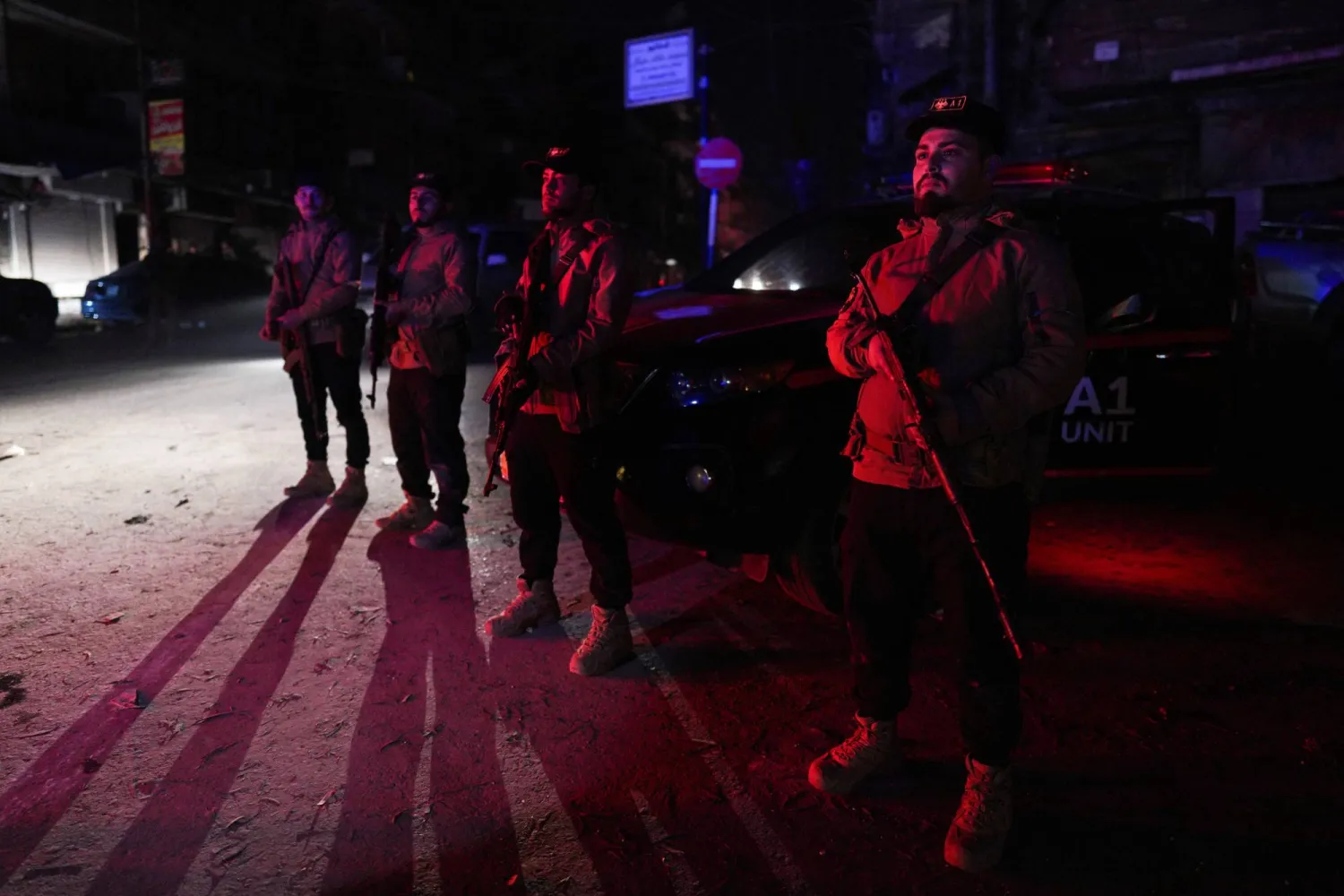
Security forces affiliated with the Ministry of the Interior stand guard in the Ashrafieh neighborhood, which they have taken control of, according to the Ministry of the Interior, following battles with the Syrian Democratic Forces, in Aleppo, Syria, January 9, 2026. (Reuters)
TT

Kurdish Fighters Refuse to Leave Syria's Aleppo after Ceasefire

Security forces affiliated with the Ministry of the Interior stand guard in the Ashrafieh neighborhood, which they have taken control of, according to the Ministry of the Interior, following battles with the Syrian Democratic Forces, in Aleppo, Syria, January 9, 2026. (Reuters)

Kurdish fighters rejected a call to leave Syria's Aleppo on Friday after the government announced a truce in deadly fighting that forced thousands of civilians to flee. 

Since Tuesday, government forces had been fighting the US-backed Kurdish-led Syrian Democratic Forces (SDF) in Aleppo, the country's second city, said AFP. 

The violence killed 21 people and was the latest challenge for a country still struggling to forge a new path after authorities ousted longtime ruler Bashar al-Assad just over a year ago. 

It also forced around 30,000 families to flee their homes, according to the UN. 

Both sides traded blame over who started the fighting, which came as they struggled to implement a deal to merge the Kurds' administration and military into the country's new government. 

On Friday, the defense ministry announced a ceasefire in the fighting with the SDF, which controls swathes of Syria's oil-rich north and northeast, and was key to the defeat of the ISIS group in 2019. 

"To prevent any slide towards a new military escalation within residential neighborhoods, the Ministry of Defense announces ... a ceasefire in the vicinity of the Sheikh Maqsud, Ashrafiyeh and Bani Zeid neighborhoods of Aleppo, effective from 3:00 am," the ministry wrote in a statement. 

Kurdish fighters were given until 9:00 am Friday (0600 GMT) to leave the three neighborhoods, while the Aleppo governorate said the fighters would be sent, along with their light weapons, to Kurdish areas further east. 

Hours later, the local councils of Sheikh Maqsud and Ashrafiyeh said the Kurdish fighters would not leave. 

"We have decided to remain in our districts and defend them," the statement said, rejecting any "surrender". 

An AFP photographer located on the edge of Ashrafiyeh saw members of the security forces enter the area, as well as vehicles that appeared to be preparing to evacuate Kurdish fighters. 

The United States welcomed the ceasefire in a post on X by its envoy Tom Barrack. 

He said Washington hoped for "a more enduring calm and deeper dialogue" and was "working intensively to extend this ceasefire and spirit of understanding". 

- 'Children were terrified' - 

An AFP correspondent reported fierce fighting across Ashrafiyeh and Sheikh Maqsud districts into Thursday night. On Friday morning, the truce appeared to be holding. 

Syria's military had instructed civilians in those neighborhoods to leave through humanitarian corridors ahead of launching the operation. 

State television reported that around 16,000 people had fled on Thursday alone. 

"We've gone through very difficult times... my children were terrified," said Rana Issa, 43, whose family left Ashrafiyeh on Thursday. 

"Many people want to leave", but are afraid of the snipers, she told AFP. 

Mazloum Abdi, who leads the SDF, said attacks on Kurdish areas "undermine the chances of reaching understandings", days after he visited Damascus for talks on the March integration deal. 

The agreement was meant to be implemented last year, but differences, including Kurdish demands for decentralized rule, have stymied progress. 

Sheikh Maqsud and Ashrafiyeh have remained under the control of Kurdish units linked to the SDF, despite Kurdish fighters agreeing to withdraw from the areas in April. 

Türkiye, which shares a 900-kilometer (550-mile) border with Syria, has launched successive offensives to push Kurdish forces from the frontier. 

Aron Lund, a fellow at the Century International research center, told AFP that "Aleppo is the SDF's most vulnerable area". 

"Both sides are still trying to put pressure on each other and rally international support," he said. 

He warned that if the hostilities spiral, "a full Damascus-SDF conflict across northern Syria, potentially with Turkish and Israeli involvement, could be devastating for Syria's stability". 

Israel and Türkiye have been vying for influence in Syria since Assad was toppled in December 2024. 

In Qamishli in the Kurdish-held northeast, hundreds of people have protested the Aleppo violence. 

"We call on the international community to intervene," said protester Salaheddin Sheikhmous, 61, while others held banners reading "no to war" and "no to ethnic cleansing". 


Lebanon FM Urges Iran to Find ‘New Approach’ on Hezbollah Arms

Iranian Foreign Minister Abbas Araghchi (L) shakes hands with Lebanese Minister of Foreign Affairs and Emigrants Youssef Raggi (R) at the Foreign Ministry in downtown Beirut, Lebanon, 09 January 2026. (EPA)
TT

Lebanon FM Urges Iran to Find ‘New Approach’ on Hezbollah Arms

Iranian Foreign Minister Abbas Araghchi (L) shakes hands with Lebanese Minister of Foreign Affairs and Emigrants Youssef Raggi (R) at the Foreign Ministry in downtown Beirut, Lebanon, 09 January 2026. (EPA)

Lebanese Foreign Minister Youssef Raggi on Friday urged his visiting Iranian counterpart to find a "new approach" to the thorny issue of disarming the Iran-backed Hezbollah group.

Lebanon is under heavy US pressure to disarm Hezbollah, which was heavily weakened in more than a year of hostilities with Israel that largely ended with a November 2024 ceasefire, but Iran and the group have expressed opposition to the move.

Iran has long wielded substantial influence in Lebanon by funding and arming Hezbollah, but as the balance of power shifted since the recent conflict, officials have been more critical towards Tehran.

"The defense of Lebanon is the sole responsibility of the Lebanese state", which must have a monopoly on weapons, Raggi told Iranian Foreign Minister Abbas Araghchi, a Lebanese foreign ministry statement said.

Raggi called on Iran to engage in talks with Lebanon to find "a new approach to the issue of Hezbollah's weapons, drawing on Iran's relationship with the party, so that these weapons do not become a pretext for weakening Lebanon".

He asked Araghchi "whether Tehran would accept the presence of an illegal armed organization on its own territory".

Last month, Raggi declined an invitation to visit Iran and proposed meeting in a neutral third country.

Lebanon's army said Thursday that it had completed the first phase of disarming Hezbollah, doing so in the south Lebanon area near the border with Israel, which called the efforts "far from sufficient".

Araghchi also met President Joseph Aoun on Friday and was set to hold talks with several other senior officials.

After arriving on Thursday, he visited the mausoleum of former Hezbollah leader Hassan Nasrallah, who was killed in a massive Israeli air strike on south Beirut in September 2024.

Last August, Lebanese leaders firmly rejected any efforts at foreign interference during a visit by Iran's security chief Ali Larijani, with the prime minister saying Beirut would "tolerate neither tutelage nor diktat" after Tehran voiced opposition to plans to disarm Hezbollah.


Hamas Says Israeli Strikes on Gaza ‘Cannot Happen without American Cover’

 Palestinians inspect damaged tents at a displacement camp following an Israeli strike in Gaza City, Friday, Jan. 9, 2026. (AP)
Palestinians inspect damaged tents at a displacement camp following an Israeli strike in Gaza City, Friday, Jan. 9, 2026. (AP)
TT

Hamas Says Israeli Strikes on Gaza ‘Cannot Happen without American Cover’

 Palestinians inspect damaged tents at a displacement camp following an Israeli strike in Gaza City, Friday, Jan. 9, 2026. (AP)
Palestinians inspect damaged tents at a displacement camp following an Israeli strike in Gaza City, Friday, Jan. 9, 2026. (AP)

A Hamas official said Friday that Israeli strikes on Gaza "cannot happen without American cover", the day after Israeli attacks killed at least 13 people according to the Palestinian territory's civil defense agency.

Since October 10, a fragile US-sponsored truce in Gaza has largely halted the fighting between Israeli forces and Hamas, but both sides have alleged frequent violations.

Gaza's civil defense agency -- which operates as a rescue force under Hamas authority -- said Israeli attacks across the territory on Thursday killed at least 13 people, including five children.

In a statement on Friday morning, the Israeli military said it "precisely struck Hamas terrorists and terror infrastructure" in response to a "failed projectile" launch.

"Just yesterday, 13 people were killed in different areas of the Strip on fabricated pretexts, in addition to the hundreds of killed and wounded who preceded them after the ceasefire," Hamas political bureau member, Bassem Naim, wrote on Telegram.

"This cannot happen without American cover or a green light."

Israeli forces have killed at least 439 Palestinians in Gaza since the ceasefire took effect, according to the health ministry in the Hamas-run territory.

The Israeli military said gunmen have killed three of its soldiers during the same period.

Media restrictions in Gaza and difficulties in accessing many areas mean AFP is unable to independently verify the tolls and details provided by both sides.

Naim also accused Israeli Prime Minister Benjamin Netanyahu of "evading his commitments and escalating in order to sabotage the agreement and return to war".

He said the Palestinian movement had "complied with all its obligations under the agreement" and was "ready to engage positively and constructively with the next steps of the plan".

Israel has previously said it is awaiting the return of the last hostage body held in Gaza before beginning talks on the second phase of the ceasefire and has insisted that Hamas disarm.

Hamas officials told AFP that search operations for the remains of deceased hostage Ran Gvili resumed on Wednesday after a two-week pause due to bad weather.


Germany Calls on Israel to Halt E1 Settlement Plan

A view of Israeli settlement of Maale Adumim, in the West Bank, Sunday, June 18, 2023. (AP)
TT

Germany Calls on Israel to Halt E1 Settlement Plan

A view of Israeli settlement of Maale Adumim, in the West Bank, Sunday, June 18, 2023. (AP)

Germany calls on Israel to halt its controversial ​E1 settlement project, said a foreign ministry spokesperson in Berlin on Friday, warning that construction carries the risk of ‌creating more ‌instability in the ‌West ⁠Bank ​and ‌the region.

"The plans for the E1 settlement project, it must be said, are part of a comprehensive ⁠intensification of settlement policy in ‌the West Bank, ‍which ‍we have recently ‍observed," said the spokesperson at a regular government press conference.

"It carries the ​risk of creating even more instability, as it ⁠would further restrict the mobility of the Palestinian population in the West Bank," as well as jeopardize the prospects of a two-state solution, the spokesperson added.
