


Southern Transitional Council Dissolution Paves Way for Calm South Yemen Talks

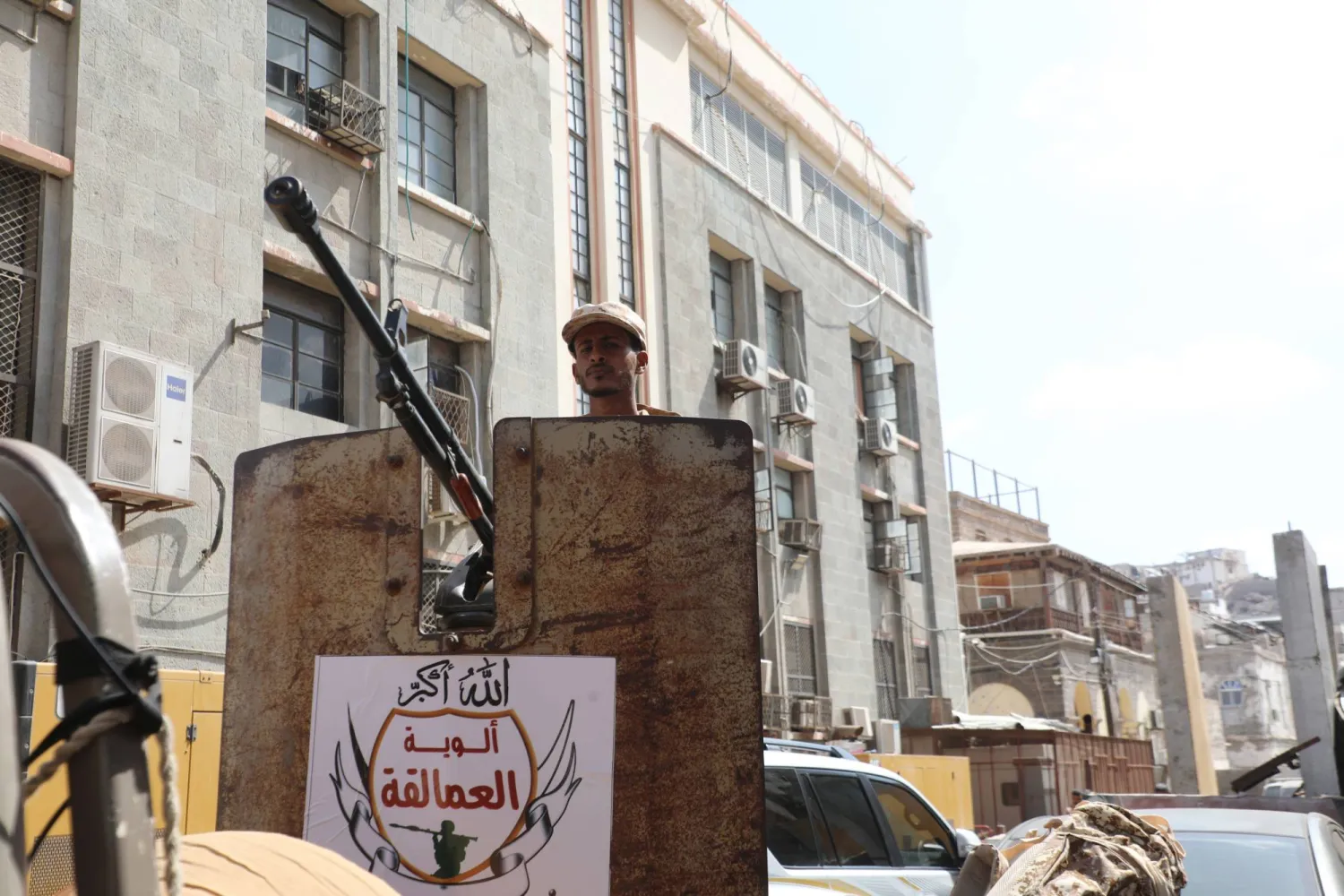
A member of Yemeni government forces mans a machine gun on a pick-up truck while on patrol outside the headquarters of the Central Bank of Yemen in the southern port city of Aden, Yemen, 08 January 2026. (EPA)
TT

Southern Transitional Council Dissolution Paves Way for Calm South Yemen Talks

A member of Yemeni government forces mans a machine gun on a pick-up truck while on patrol outside the headquarters of the Central Bank of Yemen in the southern port city of Aden, Yemen, 08 January 2026. (EPA)

As Yemen’s government, led by the Presidential Leadership Council, moves to consolidate military and security authority in the south under the defense and interior ministries, it is seeking to contain the fallout from recent turmoil, prevent a return to rebellion, and avert a slide back into violence.

At the same time, political and social forces across the south face mounting pressure to revive a stalled political process capable of delivering practical and equitable solutions to crises, foremost among them the southern issue.

Recent developments, foremost among them the dissolution of the Southern Transitional Council itself, which occurred days after its head, Aidrous al-Zubaidi, fled Yemen have brought about a shift in the political and security power balances.

They have opened the way for a phase marked by the absence of major divisions, allowing space for calm arrangements and dialogue, with focus on the southern issue, amid fears of renewed unrest.

While Zubaidi’s exit and the folding of the Southern Transitional Council mark the end of a project that lasted more than eight years before sliding into chaos and violence in recent weeks, the legitimate government and the Saudi-led Arab coalition have shown significant flexibility toward its leaders.

Atiq Bahuqayba, a leader in the Socialist Party in Hadhramaut, has called for the implementation of what Rashad al-Alimi, chairman of the Presidential Leadership Council, stated during his visit to Hadhramaut in mid-2023, when he promised that the province would manage its own affairs fully.

Flexible governance

No southern settlement can pass without Hadhramaut playing an active role and having the most prominent voice in shaping it, especially in light of the events and developments it has witnessed, which explains the intensified political and security activity there in recent weeks.

Bahuqayba told Asharq Al-Awsat that the Hadhramaut Tribes Alliance remains committed to self-rule for the province, describing it as one of the core demands of its residents and its various political and social forces.

He said recent events involving forces from outside the province nearly dragged it into security and military chaos, were it not for the firmness of presidential decisions and Saudi intervention.

He added that the southern dialogue conference called for by Riyadh carries major importance for Hadhramaut and the south at this sensitive juncture, requiring all Hadhrami forces to participate effectively, while aligning with the local authority led by Governor Salem al-Khanbashi and the commander of the Nation Shield Forces in the province.

Once again, following the dissolution of the Southern Transitional Council, the southern issue has been returned to the fore. It opens the door to tangible gains on the ground, provided there is southern leadership capable of managing reality rather than retreating into violent rhetoric.

Developments over the years in Yemen have shown that engaging seriously with southern demands is more effective than ignoring or confronting them. Flexible governance enables stability and prevents the opening of new fronts, without undermining calls for justice and fairness.

Ali al-Khawlani, a Yemeni academic and political researcher, told Asharq Al-Awsat that the opportunity is now available for political action away from unilateral actions, after recent events demonstrated that there would be no tolerance for attempts to divide Yemen or for practices that harm the national security of neighboring countries, particularly those resembling the behavior of the Houthi group, which required a forceful response.

Al-Khawlani, who heads the Independent Yemeni Center for Strategic Studies, said that the dissolution of the Southern Transitional Council, following its leaders' agreement to participate in a south-to-south dialogue, places all southern forces under the responsibility of participating in decision-making.

He warned against any adventurism that could harm regional security or involve cooperation with forces seeking to sow chaos and instability.

Promoting a model

Political and social forces in Hadhramaut have pushed toward formulating solutions that are more sustainable, rejecting both the dismantling of the Yemeni state and a full return to pre-war centralization.

This has been prompted by calls for self-administration in southern provinces, led by the country’s largest province.

Hadhramaut plays a pivotal role in the country’s future, both generally and in the south in particular, as the province that has seen more stability than others during the war, despite complex circumstances. It is also the most attractive to governance models that move away from rigid centralization.

Ahlam Jaber, a political activist in the city of Mukalla, expects the upcoming dialogue conference in Riyadh to lead to a reordering of the southern political landscape on fair foundations that recognize realities on the ground, with Hadhramaut playing an effective role.

Jaber told Asharq Al-Awsat that Hadhramaut represents a model that could extend to other provinces, not only in the south, but across Yemen.

This, she said, would help untangle long-standing challenges and adjust approaches to managing crises. She pointed to the presence of a local authority that represents the province, a tribal alliance with significant social and security influence, as well as social, economic, academic, and administrative figures capable of shaping visions and setting strategies.

The post-Southern Transitional Council phase does not represent a political vacuum, but a repositioning. Backed by the firmness of the legitimate authority and support from the Saudi-led coalition, the south is moving toward a phase of stability that awaits a political resolution and a comprehensive settlement without renewed security tensions.



Mohammad Mahdi Shamseddine to Shiites: Integrate Into Your States

Sheikh Mohammad Mahdi Shamseddine during an event with Amal Movement military commander Akel Hamiyeh (Getty). 
TT

Mohammad Mahdi Shamseddine to Shiites: Integrate Into Your States

Sheikh Mohammad Mahdi Shamseddine during an event with Amal Movement military commander Akel Hamiyeh (Getty). 

Asharq Al-Awsat begins publishing an extended text in the form of a dialogue held in 1997 between the late Sheikh Mohammad Mahdi Shamseddine, then head of Lebanon’s Higher Islamic Shiite Council, and figures close to Hezbollah’s milieu.

The text is of exceptional importance, as it addresses the situation of Shiites in their countries and the need for them to integrate into their states rather than become part of a project subordinate to Iran.

As is well known, Shamseddine was marginalized for many years by supporters of Hezbollah and the Amal Movement. He was displaced from Haret Hreik in Beirut’s southern suburbs and lived outside it because of positions that conflicted with those of Iran-aligned forces in Lebanon.

The dialogue is scheduled to be published by Ibrahim Mohammad Mahdi Shamseddine, the cleric’s son, in a book titled Lebanese Shiites and Arab Shiites: The Relationship with Others and the Relationship with the Self. Asharq Al-Awsat is publishing lengthy excerpts from the text on the occasion of the 25th anniversary of the Lebanese Shiite cleric’s death, which falls today, Saturday, January 10.

Ibrahim Shamseddine: Why now?

Ibrahim Shamseddine introduces the publication with a preface explaining why he chose to reveal the contents of the dialogue after all these years. He writes that he decided to publish the text marking 25 years since his father’s passing in order to honor him, revive his thought, and recall his deep insight, courage and firmness in expressing what he believed to be the truth — truth that safeguards people and preserves the nation and the state for all.

Central to this vision, he notes, was placing the unity of the national political community above any particularism, without exception, including that of Lebanese Shiites and Arab Shiites, who are part of the broader national, Arab and Islamic collectives.

The text is the outcome of a dialogue session, preserved on audio recordings, lasting more than four hours on the night of Tuesday, March 18, 1997. It brought together Sheikh Shamseddine and a large group of cadres from the “Islamic movement” in Lebanon, closely linked to the party-based Shiite political current that emerged in the mid-1980s under direct and sustained Iranian sponsorship.

Ibrahim Shamseddine explains that he was especially motivated to publish this previously unpublished text because it addresses highly sensitive and contentious issues — particularly relations between Lebanese Shiites and their fellow citizens, their national framework, their Arab and Islamic surroundings, and, most notably, their relationship with Iran.

He adds that these same issues remain at the heart of today’s debates, charged with urgency and tension, and continue to interact with shifting regional and global geopolitical dynamics. For this reason, he argues that the document is not a relic of the past but a living text that speaks directly to a volatile and uncertain present. The full text, with an expanded summary, will later be published in the aforementioned book.

Lebanese Shiites and Arab Shiites

The dialogue opens with a question from one of the young participants, who tells Shamseddine that he had long been regarded as a leading figure of the Islamist movement, but that over time a distance had emerged between him and part of its base. The questioner suggests this may be due to Shamseddine’s position and proximity to official authority, and asks whether he now speaks in the name of state necessities or the choices of the people.

Shamseddine replies that he remains in his original position, unchanged “by even a hair’s breadth,” but rather deeper, broader and more mature. What some perceive as distance, he insists, did not originate from him but from certain clerics and those influenced by them, driven by a purely partisan spirit he describes as almost idolatrous. Barriers were erected, through suspicion or inducement, leaving him personally surprised by developments he had not planned.

He speaks of hidden maneuvering rooted in the pursuit of status and influence, noting that such dynamics have existed within Shiism since the era of the infallible imams. He recounts how the Lebanese Union of Muslim Students, which he helped establish and nurture, was later taken out of his hands, eventually aligning with partisan currents that later fed into Hezbollah. He stresses that many were innocent or misled, while responsibility for others he leaves to divine judgment.

Shamseddine affirms that assuming the presidency of the Higher Islamic Shiite Council did not alter his religious understanding or commitments formed since the 1950s. He reiterates his well-known formulation distinguishing between “the necessities of regimes and the choices of Al-Umma (the community),” stressing that the council has always expressed the latter. Disagreement over whether a given stance falls under necessity or choice, he says, is legitimate.

He laments deliberate distortions portraying him and the council as aligned with the state, exploiting Shiite sensitivities toward authority. While a few acted knowingly, he says the majority were misled. He declares that he harbors no personal grievance, leaving judgment to God.

The relationship with regimes

Responding to a question about the cordiality shown during his visits to Arab states and whether it served the interest of avoiding escalation, Shamseddine dismisses the premise. Affection, he says, is natural and mutual among Muslims, whether in Egypt, Saudi Arabia, the Gulf, India or Pakistan. He notes that during his visits he met governments and oppositions alike, including Islamist groups critical of their own states.

He rejects the suggestion that cordiality implies submission, stressing that shared causes, above all the broader Islamic cause and opposition to the Zionist project, create common ground and understanding.

Shamseddine then addresses what he calls a deep-seated Shiite psychological complex: the belief of being universally rejected. While acknowledging that Shiites do face hostility at times, he argues that the deeper problem is self-isolation rooted in a siege mentality cultivated through poor social and political upbringing. This mindset, he says, has been cynically exploited by some Shiite leaders, particularly after the rise of Islamist movements, to mobilize followers without ethical restraint.

He adds that conflict is not unique to Shiites. Sunnis fight Sunnis in Algeria, Sudan and Afghanistan, just as Shiites have fought Shiites in Iraq and Lebanon. Social struggle, he says, is a universal reality.

“Integrate into your states”

Shamseddine then lays out his central message. His overriding concern, he says, is for the blood, dignity, freedom and honor of Shiites. To protect these, Shiites must be accepted within their homelands and not perceived as a threat or contagion.

“I say this openly,” he declares. “Integrate into your states. Integrate into your societies. Integrate into your systems of shared interests. Do not create a separate system of interests. Do not arouse suspicion. Respect your laws.”

He insists this position is grounded in firm religious conviction, stressing that stealing public funds is forbidden regardless of whether a state is Sunni or Shiite. He argues that acceptance should come from being a constructive citizen, not from acting as a proxy or protected extension of another state.

Shamseddine warns against behavior that seeks to intimidate others through transnational partisan threats, recounting instances where individuals exploited partisan affiliations to evade accountability abroad. Such conduct, he says, ultimately harms the broader Shiite community.

He concludes that his mission is to make Shiites accepted within their societies and the wider Islamic world, accepted as they are, in their religious practices and traditions. Portraying Shiites as a distinct, abnormal case within Islam, he argues, is both false and dangerous. He says that his religious and intellectual duty is to pull Shiites out of this predicament, a task he believes he had already achieved to a significant extent.

Below are some of the key issues addressed by Shamseddine in the dialogue, revealed for the first time:

• When you do not threaten others’ system of interests with your own, few people will stand in your way.

• I say: integrate into your states, integrate into your societies, integrate into your systems of interests. Do not create a separate system of interests. Do not arouse the suspicions of others. Respect your laws.

• My message is to make Shiites acceptable within their societies and within the wider Muslim community. I want them to be accepted in their own right, not because they represent a “protectorate” of another state, meaning to be accepted because Iran protects me.

• The secret group that was formed in Egypt as the nucleus of a party or grouping, including that wretched creature “Shehata” and others like him, does not concern us, whether they are sincere or charlatans.

• The psychological complex among Shiites, that they are ostracized, stems from the fact that they themselves ostracize others. The world is not against us. We are against the world. One of the tasks of my mission is to remove Shiites from a posture of being against the world.

• If Iran is building a party for itself in Egypt and wants to build work upon it, that is not my business. Iran manages its own affairs.

• Shiites make up one-fifth of Muslims compared with four-fifths. My role is to create a state of friendship between them and their societies, far from any political sectarianism.

• I am not speaking only about Arab Shiites. Shiites in Türkiye or Azerbaijan belong to Türkiye and Azerbaijan, not to Iran. Shiites in the Indian subcontinent belong to their homelands, ethnicities and peoples. Iran represents neither a political nor a religious authority for them.

• It is impermissible for there to be a separate project for Shiites within their homelands.

• What interest do Shiites have in killing the emir of Kuwait? Why do we conspire against this or that regime or official? Managing Shiite affairs begins with integration.

• I moved into besieged Beirut in 1982 and said: Shiites will not leave Beirut. Their glory and dignity lie in being besieged alongside Sunnis and Palestinians inside it.

• Shiites are not in danger. If there is any danger to them, it comes from themselves, not from others.

• Had I wanted to flatter the Iranians, I would have mentioned them, praised and lauded them, and you would then have heard applause from Iran and Hezbollah.

• The state cannot deal with secret systems of interests, as some are trying to create here or elsewhere.

• Shiites have no interest, regionally or nationally, in establishing a separate system of interests and linking it to Iran.

• Shiite strength lies in integrating into the body of Islam, not in becoming a special community affiliated with Iranians.

• I call for citizenship without deceit. If one of the turbaned pretenders issues a fatwa saying that stealing the property of a Sunni or a Christian is permissible, absolutely not. This is forbidden.

• The concept of an unjust system or an unjust ruler no longer exists. The modern state has legitimate ownership. We issue religious rulings forbidding the embezzlement of public funds, the betrayal of laws and the undermining of public order.


Video Shows Masked, Armed Men Beating a Palestinian in the Occupied West Bank

 01 January 2026, Palestinian Territories, Nablus: Israeli forces raid shops in the central market and opened fire toward a residential building, detaining several Palestinians in the Old City of Nablus in the West Bank. (dpa)
01 January 2026, Palestinian Territories, Nablus: Israeli forces raid shops in the central market and opened fire toward a residential building, detaining several Palestinians in the Old City of Nablus in the West Bank. (dpa)
TT

Video Shows Masked, Armed Men Beating a Palestinian in the Occupied West Bank

 01 January 2026, Palestinian Territories, Nablus: Israeli forces raid shops in the central market and opened fire toward a residential building, detaining several Palestinians in the Old City of Nablus in the West Bank. (dpa)
01 January 2026, Palestinian Territories, Nablus: Israeli forces raid shops in the central market and opened fire toward a residential building, detaining several Palestinians in the Old City of Nablus in the West Bank. (dpa)

Dozens of masked men armed with sticks attacked a plant nursery and beat and injured a Palestinian in the occupied West Bank, according to people who saw the attack and video footage obtained by The Associated Press.

Video filmed by security cameras shows men dressed mostly in black, faces covered, with several hitting and kicking a man on the ground.

Two people who witnessed the attack and are members of the family that own the facility said Israeli settlers beat 67-year-old Basim Saleh Yassin as he was trying to flee the nursery located in the northern West Bank village of Deir Sharaf. Both spoke on condition of anonymity for fear of reprisal.

They said Yassin is in the hospital and has broken bones in his hand and other injuries on his face, chest and back. Four cars were burned and destroyed at the nursery.

The attack is the latest in rising settler violence in the West Bank. Settler attacks ramped up during the Palestinian olive harvest season in October and early November and have continued since.

Israeli Prime Minister Benjamin Netanyahu has called the perpetrators “a handful of extremists” and urged law enforcement to pursue them for “the attempt to take the law into their own hands.” But rights groups and Palestinians say the problem is far greater than a few bad apples, and attacks have become a daily phenomenon across the territory.

Israel's army said that it dispatched soldiers to the Shavei Shomron junction — close to the area of the attack — following reports of dozens of masked Israelis vandalizing property. The army said it apprehended three suspects who were transferred to the police station for questioning. It said security forces condemn violence of any kind.

According to one of the family members that owns the German-Palestinian run nursery, it was the third time in a year that the facility was attacked.

The previous incident was in September and cost the business more than $600,000 as offices and facilities were damaged, he said.

When workers saw the settlers coming on Thursday, they fled, but as Yassin is deaf he couldn't hear people warning him to leave, said the family member.

In the video, Yassin runs from a group of masked people before falling to the ground.

One man kicks him and another hits him twice with what appears to be a stick. Yassin stays on his knees as he's struck again and then places his hands on the ground on all fours. As the men are leaving, one kicks him in the head while others strike him again until he's seen lying on the pavement.


Unified Arab, Islamic Stances ‘Tighten the Noose’ on Israel’s Moves in Somaliland

Somalis demonstrate in support of their country’s territorial unity in Mogadishu on January 7, 2026. (AP)
TT

Unified Arab, Islamic Stances ‘Tighten the Noose’ on Israel’s Moves in Somaliland

Somalis demonstrate in support of their country’s territorial unity in Mogadishu on January 7, 2026. (AP)

Arab and Islamic positions continued to express a firm rejection of Israel’s recognition of Somaliland as an independent state, reaffirming Somalia’s unity and territorial integrity.

This wave of coordinated diplomacy coincides with heightened engagement within international and UN-affiliated bodies, raising questions about the extent to which such positions can effectively constrain Israel’s recent moves, most notably the visit by Israeli Foreign Minister Gideon Saar to the self-declared breakaway region.

On Friday, Arab and Islamic states issued strong condemnations of what they described as Saar’s illegal visit to Somaliland earlier in the week, saying it constituted a blatant violation of Somalia’s sovereignty and territorial integrity and undermined established international norms and the UN Charter.

The condemnation came in a joint statement by the foreign ministers of Saudi Arabia, Egypt, Algeria, Bangladesh, Comoros, Djibouti, Gambia, Indonesia, Iran, Jordan, Kuwait, Libya, the Maldives, Nigeria, Oman, Pakistan, Palestine, Qatar, Somalia, Sudan, Türkiye and Yemen, along with the Organization of Islamic Cooperation (OIC).

The ministers reiterated their unwavering support for Somalia’s sovereignty and territorial integrity and rejected any encouragement of separatist agendas, warning that such moves risk exacerbating tensions in an already fragile region.

They stressed that respect for international law, non-interference in the internal affairs of sovereign states, and adherence to diplomatic norms are essential pillars of regional and international stability.

The statement came on the eve of an emergency ministerial meeting of the OIC on Saturday at the organization’s headquarters in Jeddah, aimed at forging a unified Islamic position in response to Israel’s recognition of Somaliland.

Analysts told Asharq Al-Awsat that coordinated collective action could “tighten the noose” around Israel’s recent steps in the breakaway region, discouraging other countries from following Israel’s lead and seeking to isolate Israel internationally. Such pressure, they said, could also create space for possible measures by the Somali government or open the door to intra-Somali dialogue.

Since Israel announced its recognition of Somaliland on Dec. 26, Egypt, Türkiye, Djibouti and Somalia have acted collectively, issuing a joint statement condemning the move and rejecting any unilateral measures that undermine Somali sovereignty or promote parallel entities that threaten the unity of the Somali state.

The following day, 21 Arab and Islamic countries, together with the OIC, warned that recognizing the independence of parts of sovereign states sets a dangerous precedent and threatens international peace and security.

Egyptian diplomat Salah Halima said the unified Arab and Islamic positions are active and effective, aligning with stances taken by the Arab League, the African Union, the European Union and the United Nations.

He noted that while the United States has expressed support for Somalia’s unity, its position on Israel’s step remains ambiguous, raising concerns about the possibility of further recognitions.

Former Egyptian assistant foreign minister for African affairs Mona Omar noted that Israel has a record of disregarding international appeals and resolutions, but broad collective opposition deepens its isolation and complicates efforts to advance its plans in Somaliland.

She added that stronger US backing for Somalia’s unity would leave Israel facing genuine isolation in the region, even if it does not ultimately reverse its recognition.

African affairs expert Rami Zahdi stressed that unified positions can have tangible impact if embedded in a comprehensive strategy to counter Israeli moves, protect stability in the Horn of Africa, and prevent the fragmentation of national states.

He described the explicit demand for Israel to withdraw its recognition as a form of measured, escalatory diplomacy that moves beyond symbolic condemnation toward organized political and legal pressure.