

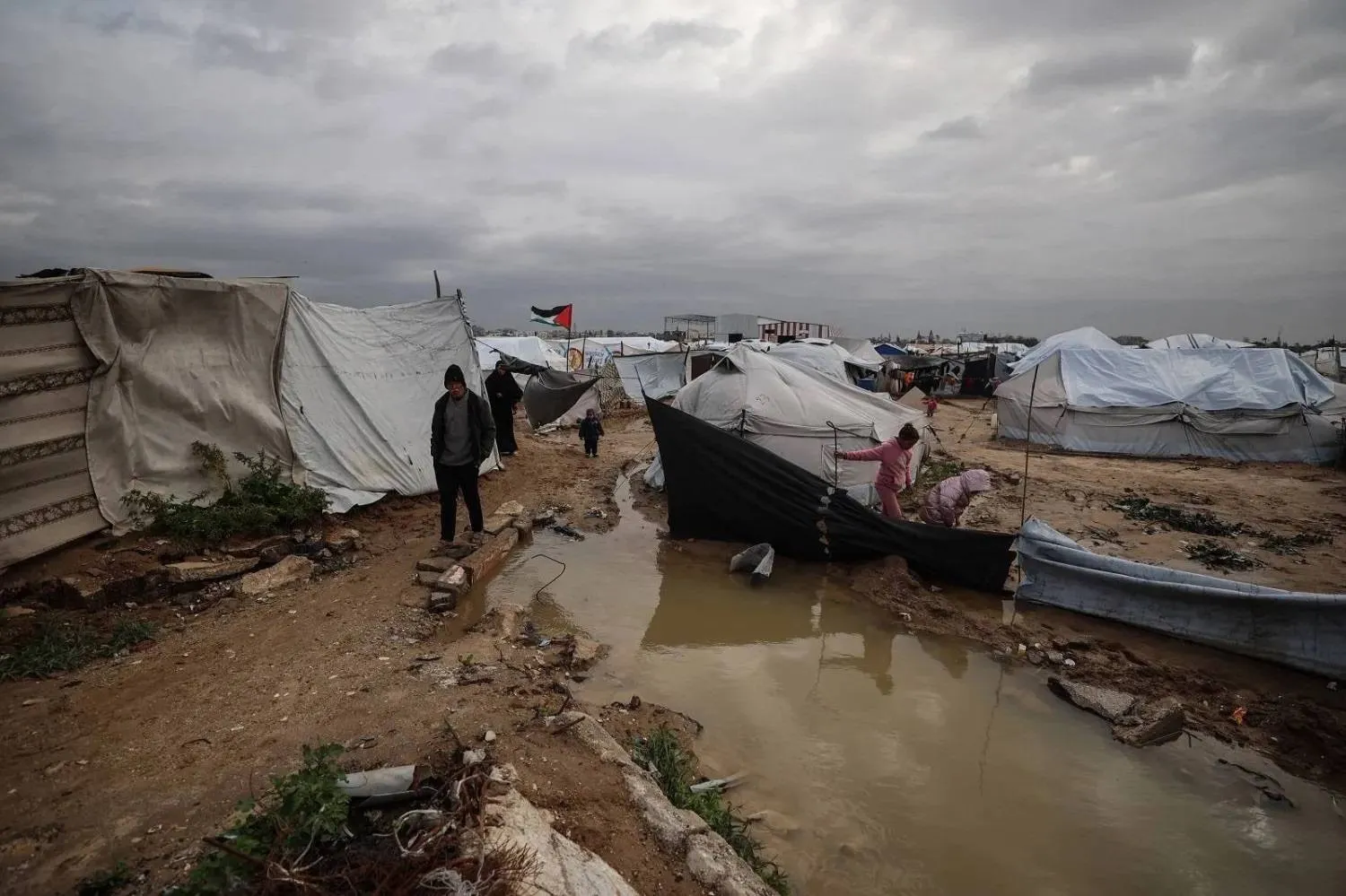

Gaza Deal: Cairo Talks Aim to Settle Sector’s ‘Administrative Committee’

Displaced Palestinians stand beside a pool of rainwater amid makeshift shelters at the Bureij refugee camp in central Gaza (AFP). 
TT

Gaza Deal: Cairo Talks Aim to Settle Sector’s ‘Administrative Committee’

Displaced Palestinians stand beside a pool of rainwater amid makeshift shelters at the Bureij refugee camp in central Gaza (AFP). 

Cairo is hosting renewed consultations on the Gaza ceasefire agreement, which entered into force on Oct. 10, following the arrival of a delegation from Hamas and amid anticipation of an announcement on the committee that will administer the territory.

Experts told Asharq Al-Awsat that the talks provide an important boost at a critical moment for the second phase of the Gaza agreement, which has been stalled for some time. They stressed that moving forward hinges largely on US will and pressure on Israel.

A Palestinian source said Monday that a Hamas delegation headed by the movement’s leader, Khalil al-Hayya, arrived in Cairo to discuss the second phase and push ahead with the ceasefire deal. The source added that indications suggest the Gaza administration committee will be finalized during the Cairo round, with factions briefed on the names, particularly after recent changes prompted by Israeli objections.

Hamas Political Bureau member Mohammed Nazzal said in televised remarks Sunday night that the delegation would discuss follow-up on implementing the ceasefire amid “major difficulties hindering its application and continued Israeli violations.”

He said the delegation would hold meetings with Palestinian factions and forces, as well as with Egyptian officials, to discuss several files linked to the agreement.

These include ways to consolidate the ceasefire and move to subsequent phases, alongside key issues - foremost the formation of a Palestinian technocratic committee to administer Gaza - aimed at preventing Israeli Prime Minister Benjamin Netanyahu from reneging on or delaying the deal.

Former Egyptian assistant foreign minister and member of the Egyptian Council for Foreign Affairs, Ambassador Rakha Ahmed Hassan, said the Cairo consultations are highly significant and could revive the stalled agreement.

He pointed to anticipation surrounding US President Donald Trump’s announcement of a Peace Council, followed by the Gaza administration committee, adding that discussions would also cover approaches to dealing with weapons in Gaza to undercut Netanyahu’s justifications.

He suggested Hamas would press for full implementation of the first phase first, including opening the Rafah crossing from the Palestinian side, increasing aid, maintaining the ceasefire, and Israel’s withdrawal from Gaza in parallel with any later steps.

On the Egyptian front, Foreign Minister Badr Abdelatty stressed, during a Cairo meeting with Irish Minister for Migration, Trade and Defense Helen McEntee, the importance of announcing a temporary Palestinian technocratic committee to manage daily affairs in Gaza and forming an international stabilization force.


Lebanon PM Says Won’t Allow Country to Be Dragged into New Conflict

Smoke and flames rise from a building after an Israeli airstrike in Ain Qana village, in southern Lebanon, 02 February 2026. (EPA)
TT

Lebanon PM Says Won’t Allow Country to Be Dragged into New Conflict

Smoke and flames rise from a building after an Israeli airstrike in Ain Qana village, in southern Lebanon, 02 February 2026. (EPA)

Lebanon's prime minister said Tuesday he will not allow his country to be dragged into a new conflict, after Hezbollah warned any attack on its Iranian backer would be an attack on the group.

"We will never allow anyone to drag the country into another adventure," Nawaf Salam said during the World Governments Summit in Dubai, in response to a question about comments made by Hezbollah chief Sheikh Naim Qassem last week.

Qassem had responded to American threats of military action against Iran, saying: "We will choose at that time how to act... but we are not neutral."

Salam said Hezbollah's decision to enter the Gaza war in support of its ally Hamas had "very big" consequences for Lebanon and that "no one is willing to expose the country to adventures of this kind".


Syria Kurds Impose Curfew in Qamishli Ahead of Govt Forces Entry

02 February 2026, Syria, Saran: Syrian internal security forces are preparing near the village of Saran to enter the Kobane region northeast of Aleppo, following an agreement between the SDF and the Syrian government stipulating the entry of a number of Syrian security forces into the cities of Hasakeh, Qamishli, and Kobane to take over government institutions. (dpa)
TT

Syria Kurds Impose Curfew in Qamishli Ahead of Govt Forces Entry

02 February 2026, Syria, Saran: Syrian internal security forces are preparing near the village of Saran to enter the Kobane region northeast of Aleppo, following an agreement between the SDF and the Syrian government stipulating the entry of a number of Syrian security forces into the cities of Hasakeh, Qamishli, and Kobane to take over government institutions. (dpa)

Kurdish forces imposed a curfew on Kurdish-majority Qamishli in northeastern Syria on Tuesday, ahead of the deployment of government troops to the city, an AFP team reported.

The curfew came after Syrian security personnel entered the mixed Kurdish-Arab city of Hasakeh and the countryside around the Kurdish town of Kobane on Monday, as part of a comprehensive agreement to gradually integrate the Kurds' military and civilian institutions into the state.

The Kurds had ceded territory to advancing government forces in recent weeks.

An AFP correspondent saw Kurdish security forces deployed in Qamishli and found the streets empty of civilians and shops closed after the curfew came into effect early on Tuesday.

It will remain in force until 6:00 am (0300 GMT) on Wednesday.

The government convoy is expected to enter the city later on Tuesday and will include a limited number of forces and vehicles, according to Marwan al-Ali, the Damascus-appointed head of internal security in Hasakeh province.

The integration of Kurdish security forces into the interior ministry's ranks will follow, he added.

Friday's deal "seeks to unify Syrian territory", including Kurdish areas, while also maintaining an ongoing ceasefire and introducing the "gradual integration" of Kurdish forces and administrative institutions, according to the text of the agreement.

It was a blow to the Kurds, who had sought to preserve the de facto autonomy they exercised after seizing vast areas of north and northeast Syria in battles against the ISIS extremist group during the civil war, backed by a US-led coalition.

Mazloum Abdi, head of the Kurdish-led Syrian Democratic Forces (SDF), had previously said the deal would be implemented on the ground from Monday, with both sides to pull forces back from frontline positions in parts of the northeast, and from Kobane in the north.

He added that a "limited internal security force" would enter parts of Hasakeh and Qamishli, but that "no military forces will enter any Kurdish city or town".


Sudan Army Breaks Siege on Key Southern City of Kadugli

A volunteer fills water containers at a free distribution point, due to water outages in Khartoum, Sudan, Friday, Jan. 30, 2026. (AP Photo/Marwan Ali)
TT

Sudan Army Breaks Siege on Key Southern City of Kadugli

A volunteer fills water containers at a free distribution point, due to water outages in Khartoum, Sudan, Friday, Jan. 30, 2026. (AP Photo/Marwan Ali)

Sudanese army forces broke Tuesday a siege by the Rapid Support Forces on the South Kordofan state capital Kadugli, two army sources told AFP.

"Our forces have entered Kadugli and lifted the siege," one said on condition of anonymity because they were not authorized to brief the media.

Famine-hit Kadugli was long besieged by the RSF and their local allies, at war with Sudan's regular army since April 2023.
