


Oil to Fabric: Middle East Crises Reshape Global Fashion

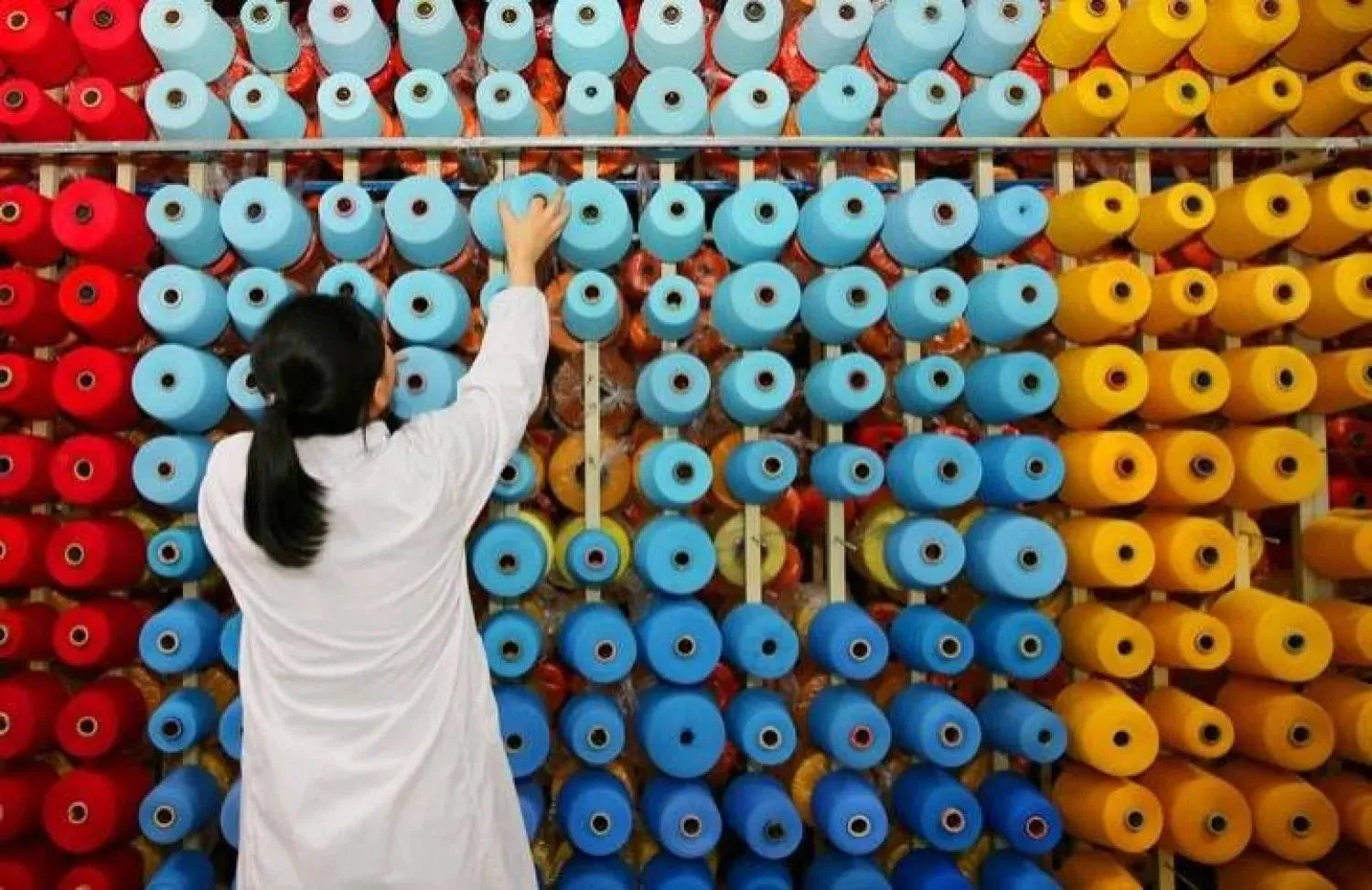
A worker arranges spools of thread at a textile factory in Haiyan, Jiangsu province, China (Reuters)
TT

Oil to Fabric: Middle East Crises Reshape Global Fashion

A worker arranges spools of thread at a textile factory in Haiyan, Jiangsu province, China (Reuters)

Rising oil prices are no longer just an energy market story; they are feeding directly into the cost of clothing. From petrochemical plants to fabric mills and retail racks, a complex supply chain is passing on higher costs, pushing up the final price consumers pay.

According to the “Materials Market 2025” report by the Organization for Textile Exchange, polyester makes up about 59% of global fabric output, with roughly 88% produced from non-recycled petroleum sources, leaving the industry exposed to energy price swings.

Oil prices have surged about 32% since the start of the US-Israeli war on Iran on Feb. 28, approaching $100 per barrel.

Fabrics under oil pressure

Amal Saqr, a textile design consultant, said the sector is highly sensitive to shifts in oil prices because of its reliance on synthetic fibers.

More than 60% of fabrics used in global clothing production depend on petroleum-based materials such as polyester, nylon and acrylic, she said, adding that any rise in oil prices feeds directly into fabric costs.

She pointed to 2008, when polyester prices jumped about 30% within three months as oil hit record highs, forcing Asian spinning mills to cut output by 20% to 25%.

Disruptions in the Red Sea between 2023 and 2024 also drove shipping costs up by about 300%, raising raw material costs and straining supply chains.

Yemen’s Iran-aligned Houthis began targeting ships linked to Israel on Nov. 19, 2023, using drones and missiles.

Natural fabrics not immune

Natural fibers such as cotton and linen avoid direct reliance on oil, but are still exposed to energy costs, Saqr said, noting that farming depends on fertilizers, fuel and transport.

The global fertilizer crisis in 2021 pushed prices up about 80%, driving cotton prices higher by roughly 40%. Later disruptions in the Strait of Hormuz added another 40% increase in fertilizer costs due to shipping delays.

Global cotton production reached about 24.5 million tons in 2024, or roughly 19% of total fiber output, making it less dominant than synthetic fibers but relatively more stable in pricing, according to the Textile Exchange report.

Rising production costs

Higher energy prices are hitting every stage of production, from spinning to dyeing and drying, Saqr said.

With already thin margins, textile factories face a stark choice: raise prices or cut output, both of which ultimately hit consumers.

World Bank data shows operating costs for textile factories in several countries have risen by about 18% following recent energy price increases.

Import markets feel it fast

Import-dependent markets are quick to absorb shocks from shipping or energy disruptions, Saqr said.

Shipping costs from Asia have lifted synthetic fabric prices by 10% to 18%, while imported cotton prices have climbed by 15% to 25%.

Rerouting shipments from the Strait of Hormuz to the Cape of Good Hope has added 10 to 14 days to transit times, leading to shortages and swings in the availability of fabrics and garments.

Value chains under rethink

Burak Cakmak, chief executive of the Saudi Fashion Commission, said the impact of oil prices is not immediate, as final pricing reflects a full value chain including production, marketing and distribution.

Instead of passing costs on, many brands are rethinking how to create value, improving efficiency and working more closely with suppliers, he said.

He also pointed to a shift toward localized production, with brands operating closer to their markets and managing inventory more tightly to control costs and improve flexibility.

Sustainability gains urgency

Sustainability is no longer just an environmental concern; it is tied to efficiency and long-term economic viability, Cakmak said.

The sector is moving toward circular models, including recycling and waste reduction, practices that are becoming essential to improving operations.

Designers double down

Anna Zinola, director of Istituto Marangoni in Riyadh, said rising oil prices are reinforcing, not reshaping, designers’ shift toward more conscious material choices.

Sustainability is embedded in the curriculum as a core approach guiding every design decision, she said.

Students are trained to balance cost, sustainability and consumer demand, while exploring material innovations that combine environmental and commercial goals.

Prices set to rise

Reports by McKinsey and Euratex expect global clothing prices to rise by 8% to 12% over the next year, as supply chain pressure persists and shipping costs remain elevated.



Britain's Pound, Stocks and Bonds Fall on Political Uncertainty, Global Inflation Angst

A view of 10 Downing Street in London, Britain, 14 May 2026. EPA/NEIL HALL
TT

Britain's Pound, Stocks and Bonds Fall on Political Uncertainty, Global Inflation Angst

A view of 10 Downing Street in London, Britain, 14 May 2026. EPA/NEIL HALL

British government bonds, stocks and sterling fell on Friday, as domestic political uncertainty clashed with global worries about an inflationary shock, leaving UK assets in the mire.

Sterling fell to a five-week low and is down almost 2% against the dollar this week, set for its biggest weekly drop since November 2024.

British Prime Minister Keir Starmer was in a battle to hold on to power after his health minister Wes Streeting resigned from government, while others positioned themselves to challenge his leadership, following disastrous local election results last week.

Markets are concerned that a ⁠new leader may ⁠be willing to loosen fiscal policy more, with British government borrowing costs up sharply again and UK bank stocks selling off on Friday.

Greater Manchester Mayor Andy Burnham has been offered a path for a possible leadership challenge after another Labour lawmaker said he would resign his parliamentary seat. If Burnham were to win the seat, he could then challenge for ⁠the party leadership.

"Market's fear is that Burnham would be more left leaning, and we could see further increase in deficits," Reuters quoted Jefferies economist Mohit Kumar as saying.

"Our base case is one of a managed exit for Starmer and Burnham likely becoming the next PM," he added.

The domestic political drama has coincided with another rise in energy prices on Friday and growing evidence that the economic damage from the Iran war is hurting.

US inflation data this week has shown consumers and factories are starting to see big increases in price pressures as a result of the war, which has ⁠pushed up the ⁠price of crude by over 50%.

The pound has tended to suffer against the dollar when tensions between Washington and Tehran flare or oil prices rise, given Britain's dependence on energy imports and the economy's sensitivity to higher fuel costs.

It was last down 0.3% on the day at $1.3364 after earlier touching $1.3335, its lowest level in over five weeks.

British bond yields jumped across the curve. The 10-year yield was last up almost 12 basis points (bps) at around 5.11%. Bond yields move inversely with prices.

Stocks also fell. The blue-chip FTSE 100 was last down 0.6%, while the more domestic-oriented FTSE 250 index of midcap stocks was down 1.1%.

UK banks were also down sharply, with Barclays and Lloyds down over 2% each.


Oil Gains after Trump Says Xi Agrees Iran Cannot Have Nuclear Weapons

The current price of gasoline is shown at a gas station in Encinitas, California, US, May 11, 2026.  REUTERS/Mike Blake
The current price of gasoline is shown at a gas station in Encinitas, California, US, May 11, 2026. REUTERS/Mike Blake
TT

Oil Gains after Trump Says Xi Agrees Iran Cannot Have Nuclear Weapons

The current price of gasoline is shown at a gas station in Encinitas, California, US, May 11, 2026.  REUTERS/Mike Blake
The current price of gasoline is shown at a gas station in Encinitas, California, US, May 11, 2026. REUTERS/Mike Blake

Oil prices gained about 2% after US President Donald Trump said he and China's Xi Jinping agree Iran cannot have nuclear weapons and as concerns persisted over ship attacks and seizures despite Tehran saying about 30 vessels crossed the Strait of Hormuz.

Brent crude oil futures were up $1.77, or 1.67%, to $107.49 a barrel at 0642 GMT. Prices hit a session high of $107.99 earlier in the day.

US West Texas Intermediate futures were up $2.13, or 2.11%, ‌to $103.30 a ‌barrel.

For the week, Brent has climbed nearly 6%, ‌while ⁠WTI has jumped more ⁠than 7%, on uncertainty over the shaky ceasefire in the Iran conflict.

Trump said his patience with Iran is running out and he had agreed in talks with Xi that Tehran cannot be allowed to have a nuclear weapon and must re-open the Strait of Hormuz.

Xi did not comment on his discussions with Trump about Iran, although China's foreign ministry issued a statement.

"This conflict, which ⁠should never have happened, has no reason to continue," ‌the ministry said.

"With the Beijing summit not ‌delivering any breakthrough on Iran, market focus is back on the deadlock and ‌a blockaded Strait, with a tail risk of renewed military escalation," said Vandana ‌Hari, founder of oil market analysis provider Vanda Insights.

Among deals the market was looking for from the summit, Trump said China wants to buy oil from the United States.

In incidents around the Strait of Hormuz, a ship was reported seized by Iranian ‌personnel off the United Arab Emirates and headed for Iranian waters on Thursday, and an Indian cargo vessel carrying ⁠livestock from ⁠Africa to the UAE was sunk on Wednesday in waters off the coast of Oman.

The White House said Trump and Xi had agreed on the need to keep the shipping lane open.

Iran's Revolutionary Guards said 30 vessels had crossed the Strait of Hormuz since Wednesday evening, still far short of 140 that were typical daily before the war, but a substantial increase if confirmed.

Yang An, analyst at Haitong Futures, said the main driver of oil prices was still tight supply.

"Oil prices swung several times yesterday but still closed near the day's high," he said.

"Ships passing through the strait eased some market concerns, but not enough to change the strong trend driven by tight supply."


China Stocks Drift as Trump-Xi Summit Offers Little to Excite Investors

 President Donald Trump talks with China's President Xi Jinping at the Zhongnanhai leadership compound, Friday, May 15, 2026, in Beijing. (AP Photo/Mark Schiefelbein, Pool)
President Donald Trump talks with China's President Xi Jinping at the Zhongnanhai leadership compound, Friday, May 15, 2026, in Beijing. (AP Photo/Mark Schiefelbein, Pool)
TT

China Stocks Drift as Trump-Xi Summit Offers Little to Excite Investors

 President Donald Trump talks with China's President Xi Jinping at the Zhongnanhai leadership compound, Friday, May 15, 2026, in Beijing. (AP Photo/Mark Schiefelbein, Pool)
President Donald Trump talks with China's President Xi Jinping at the Zhongnanhai leadership compound, Friday, May 15, 2026, in Beijing. (AP Photo/Mark Schiefelbein, Pool)

China stocks wavered on Friday as a summit between US President Donald Trump and China's Xi Jinping entered its last day, having produced few deals between the world's top two economies to excite investors so far.

China’s blue-chip CSI300 Index was largely flat and the Shanghai Composite Index rose 0.1% by the lunch break. Both indexes swung between gains and losses through the morning session but remain close to recent peaks.

Hong Kong’s benchmark Hang Seng fell 0.9% amid a risk-off mood in broader Asian markets, as investors' euphoria over tech stocks gave way to inflation fears amid rising wagers of US rate hikes this year.

Trump and Xi met at the ‌walled-off Zhongnanhai complex, a former imperial garden that houses the offices of Chinese ‌leaders, ⁠before Trump departed.

Traders ⁠were closely watching for any positive signals from the meeting, including a potential easing of tariffs, with the focus on whether a fragile trade truce struck when the leaders last met in October is extended.

"I think we were optimistically looking at the meeting and maybe half expecting some huge trade agreement to be proposed or announced and from that view, it has disappointed," said Nick Twidale, chief market analyst at ATFX Global.

Investor attention will be on whether there are detailed agreements announced after the two-day summit is over.

It ⁠was undecided whether the trade truce will be extended after it expires later ‌this year, US Trade Representative Jamieson Greer told Bloomberg TV ‌on Friday, but added that deals had been firmed up on Chinese purchases of farm goods and beef.

"This (summit) ‌was not a meeting aimed at a full reset of US-China relations," said Cliff Zhao, chief ‌economist at CCB International.

It was more about promoting high-level communication, reducing near-term uncertainty, and setting clearer boundaries for competition, he added.

THORNY GEOPOLITICS

Investors are focusing on geopolitical issues such as Iran and Taiwan, but it’s hard to make substantive progress, said Lynn Song, chief economist for Greater China at ING.

"Actions will speak louder than words, and if we ‌see progress on Iran negotiations or shifts in stance on US arms sales to Taiwan, it may suggest that progress was made at this summit," ⁠said Song.

Trump told Fox ⁠News Channel that China has agreed to buy 200 Boeing jets, a number that was far fewer than analysts had expected. That sent shares of Boeing lower and China's aviation stocks fell more than 2%.

Chip stocks, meanwhile, jumped 4% after China's SMIC said foreign clients were shifting orders back to China. Shares in chip equipment maker Advanced Micro-Fabrication Equipment (AMEC) surged 17% on its strong order expectation.

Data showed China's new yuan loans contracted in April for the first time in nine months, sharply undershooting forecasts as seasonal factors and weak household credit demand dragged on lending in the world's second-largest economy.

In currencies, China's yuan remained close to the three-year high against the dollar it hit on Thursday.

The yuan retreated slightly after the People's Bank of China set the midpoint rate at 6.8415 per dollar, 439 pips weaker than a Reuters' estimate.

The yuan "isn’t likely to be impacted too much by the summit, nor is it likely to be a topic of conversation given the CNY has been on an appreciation trajectory," said ING's Song.