

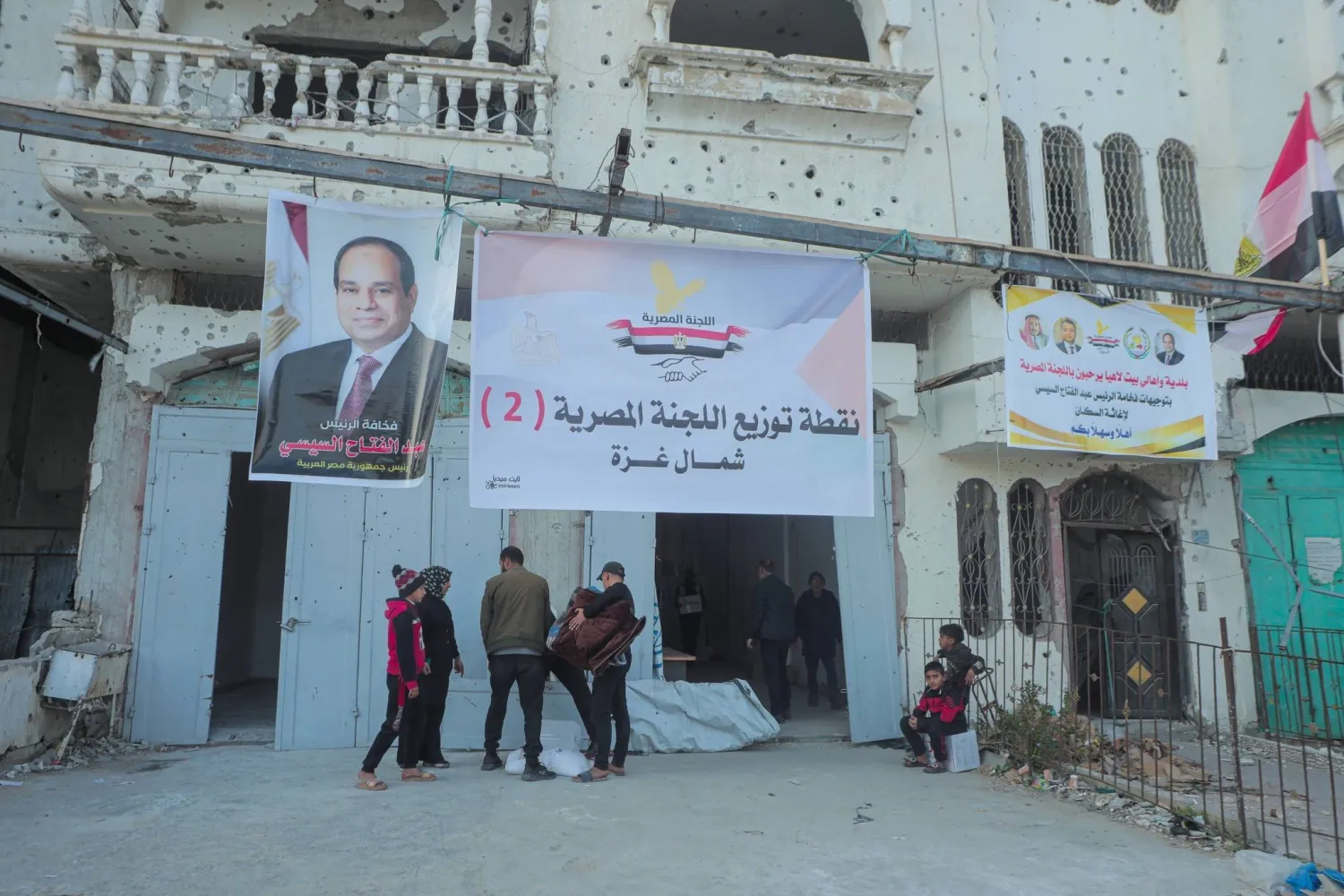

Egyptian Gaza Relief Group Says Israeli Strike on Photographers Was Deliberate

An aid distribution point in northern Gaza operated by the Egyptian Relief Committee (Egyptian Relief Committee)
TT

Egyptian Gaza Relief Group Says Israeli Strike on Photographers Was Deliberate

An aid distribution point in northern Gaza operated by the Egyptian Relief Committee (Egyptian Relief Committee)

The spokesperson for the Egyptian Relief Committee in Gaza, Mohamed Mansour, said Israel deliberately targeted three photojournalists while they were carrying out a humanitarian mission inside the Netzarim camp, an area located about six kilometers away from Israeli army forces.

Mansour told Asharq Al-Awsat that the attack was “a continuation of Israeli pressure on the committee’s work since it began operating, as part of the occupation’s efforts to tighten restrictions on anyone attempting to provide relief work and humanitarian services to the people of Gaza.”

The Israeli army killed three photojournalists on Wednesday who were working as a media team for the Egyptian Relief Committee for Gaza.

Field sources told Asharq Al-Awsat that the victims were Mohammed Salah Qashta, Abdul Raouf Shaat, and Anas Ghneim.

They were carrying out a filming mission using a small drone and cameras to document stages of work at camps that the Egyptian committee is helping to establish.

Mansour stressed that “the targeting of the photographers will only increase the committee’s determination to provide relief services and shelter to the Palestinian people.”

He said the committee would continue its work as usual to be “a genuine support for the people of the Strip, amid extremely complex security conditions.”

Israeli Army Radio reported, citing sources, that Egypt sent an angry message to Israel following the attack in Gaza in which Palestinians working for the Egyptian committee for the reconstruction were killed.

According to the radio report, Egypt expressed its protest that the attack took place outside the boundaries of the so-called yellow line, in an area that does not pose a threat to Israeli forces.

For its part, the Israeli army claimed it had targeted suspects operating a “Hamas-affiliated drone” in central Gaza.

In a statement on Wednesday, the army said: “Following the identification of the drone and due to the threat it posed to the forces, the Israeli army precisely struck the suspects who were operating the drone.”

The army said the details were under review.


Village in Southern Lebanon Buries a Child and Father Killed in Israeli Drone Strike 

Lebanese special forces policemen carry the coffins of their comrade Hassan Jaber, who was killed on Monday with his son Ali, by an Israeli drone attack, during their funeral procession in Yanouh village, south Lebanon, Tuesday, Feb. 10, 2026. (AP)
TT

Village in Southern Lebanon Buries a Child and Father Killed in Israeli Drone Strike 

Lebanese special forces policemen carry the coffins of their comrade Hassan Jaber, who was killed on Monday with his son Ali, by an Israeli drone attack, during their funeral procession in Yanouh village, south Lebanon, Tuesday, Feb. 10, 2026. (AP)

Mourners in southern Lebanon on Tuesday buried a father and his young son killed in an Israeli drone strike that targeted a Hezbollah member.

Hassan Jaber, a police officer, and his child, Ali, were on foot when the strike on Monday hit a passing car in the center of their town, Yanouh, relatives said. Lebanon's health ministry said the boy was 3 years old. Both were killed at the scene along with the car driver, Ahmad Salami, who the Israeli military said in a statement was an artillery official with the Lebanese armed group.

It said it was aware of a “claim that uninvolved civilians were killed” and that the case is under review, adding it “makes every effort to reduce the likelihood of harm” to civilians.

Salami, also from Yanouh, was buried in the village Tuesday along with the father and son.

“There are always people here, it’s a crowded area,” with coffee shops and corner stores, a Shiite religious gathering hall, the municipality building and a civil defense center, a cousin of the boy’s father, also named Hassan Jaber, told The Associated Press.

When the boy and his father were struck, he said, they were going to a bakery making Lebanese breakfast flatbread known as manakish to see how it was made. They were standing only about 5 meters (5.5 yards) from the car when it was struck, the cousin said.

“It is not new for the Israeli enemy to carry out such actions,” he said. “There was a car they wanted to hit and they struck it in the middle of this crowded place.”

Jaber said the little boy, Ali, had not yet entered school but “showed signs of unusual intelligence.”

“What did this innocent child do wrong, this angel?” asked Ghazaleh Haider, the wife of the boy’s uncle. “Was he a fighter?”

Attendees at the funeral carried photos of Ali, a striking child with large green eyes and blond hair. Some also carried flags of Hezbollah or of its ally, the Amal party.

Lebanon’s Internal Security Forces, of which the child’s father was a member, said in a statement that the 37-year-old father of three had joined in 2013 and reached the rank of first sergeant.

The strike came as Israel has stepped up its campaign against Hezbollah and its allies in Lebanon.

The night before the strike in Yanouh, Israeli forces launched a rare ground raid in the Lebanese village of Hebbarieh, several kilometers from the border, in which they seized a local official with the Jamaa al-Islamiya group. The group is allied with Hezbollah and the Palestinian group Hamas.

After the Oct. 7, 2023, Hamas-led attack on Israel triggered war in Gaza, Hezbollah began firing rockets from Lebanon into Israel in support of Hamas and the Palestinians.

Israel responded with airstrikes and shelling. The low-level conflict escalated into full-scale war in September 2024, later reined in but not fully stopped by a US-brokered ceasefire two months later.

Since then, Israel has accused Hezbollah of trying to rebuild and has carried out near-daily strikes in Lebanon that it says target Hezbollah members and facilities.

Israeli forces also continue to occupy five hilltop points on the Lebanese side of the border. Hezbollah has claimed one strike against Israel since the ceasefire.


US Sanctions Target Alleged Hezbollah Gold Exchange 

Hezbollah supporters raise their group's flags during a protest condemning recent Israeli military actions in Lebanon and calling on the international community to intervene as tensions escalate along the southern border, outside the headquarters of the UN Economic and Social Commission for Western Asia, ESCWA, in Beirut, Lebanon, Wednesday, Feb. 4, 2026. (AP)
TT

US Sanctions Target Alleged Hezbollah Gold Exchange 

Hezbollah supporters raise their group's flags during a protest condemning recent Israeli military actions in Lebanon and calling on the international community to intervene as tensions escalate along the southern border, outside the headquarters of the UN Economic and Social Commission for Western Asia, ESCWA, in Beirut, Lebanon, Wednesday, Feb. 4, 2026. (AP)

The United States on Tuesday imposed sanctions against a gold exchange it said facilitates Iranian financial support to Lebanon’s Hezbollah.

The Treasury Department said the targeted gold exchange was part of Al-Qard al-Hassan, a Hezbollah financial institution already under US sanctions and whose branches were bombed by Israel in 2024 strikes.

"Hezbollah is a threat to peace and stability in the Middle East," Treasury Secretary Scott Bessent said in a statement.

"Treasury will work to cut these terrorists off from the global financial system to give Lebanon a chance to be peaceful and prosperous again."

The Treasury Department imposed sanctions on the gold exchange, Jood Sarl, which it said "masquerades as a non-governmental organization" and is used to ensure Hezbollah's cash flow from Iran.

It also said it was imposing sanctions on a number of individuals or entities, including a Russian national, for working on Hezbollah's finances.

The sanctions freeze any assets in the United States and make financial transactions with the listed entities a crime.

Israel struck a major blow against Hezbollah in the 2024 war, killing its longtime leader Hassan Nasrallah, a year after Hamas, another group backed by Iran, carried out a devastating attack against Israel.

In accordance with a truce, the Lebanese army said it had disarmed Hezbollah in an area close to the Israeli border. But Hezbollah has refused to surrender further arms and Israel says progress is insufficient, keeping up periodic attacks.


US Response Muted on New Israeli West Bank Measures

Israeli machinery levels land ahead of settlement construction near Jenin in the occupied West Bank, Dec. 23, 2025 (EPA)
TT

US Response Muted on New Israeli West Bank Measures

Israeli machinery levels land ahead of settlement construction near Jenin in the occupied West Bank, Dec. 23, 2025 (EPA)

Days ahead of Israeli Prime Minister Benjamin Netanyahu’s visit to Washington, his government moved on measures framed as procedural but laden with far-reaching sovereign implications.

Decisions by Israel’s security cabinet have made it easier for Israelis to purchase land in the West Bank and expanded Israeli enforcement tools in areas formally administered by the Palestinian Authority under the Oslo Accords.

A White House official reiterated President Donald Trump’s opposition to annexing the West Bank, but Washington’s response stopped short of any concrete measures.

The position, attributed to an unnamed official and unaccompanied by deterrent action, prompted speculation that the US stance amounted to tacit acquiescence rather than active opposition.

On the eve of Netanyahu’s arrival, Reuters cited a White House source as saying Trump continues to oppose Israeli annexation of the West Bank and views “stability” there as consistent with the goals of peace and Israel’s security.

The manner in which the position was conveyed, however, left room for interpretation. The issue, analysts say, is less whether Washington rejects annexation in principle than whether it opposes the cumulative steps that could lead to it.

Israeli officials have framed the measures as administrative, but critics view them as part of a broader pattern aimed at gradually altering conditions in the West Bank. Such steps, they argue, create facts on the ground that are later treated as irreversible.

In this reading, formal opposition to annexation does not preclude policies that effectively advance it without an explicit declaration, a process some observers describe as incremental annexation.

Limited US response

Restricting the US reaction to an unattributed statement suggests an effort to balance competing priorities: signaling continuity in Washington’s stated position while avoiding a confrontation with Netanyahu ahead of his visit.

Diplomats note that this approach indicates US objections are being managed through messaging rather than through policy leverage.

Even when the US language is explicit, its impact is limited unless it is accompanied by political cost. Governments typically adjust behavior in response to incentives or penalties, not statements alone.

In this context, the absence of measures reduces the deterrent effect of US opposition, leaving Israel with room to maneuver.

The timing of the Israeli decisions sends parallel messages. Domestically, they signal continued commitment to policies favored by right-wing constituencies and settler groups. Internationally, they suggest that reversing on-the-ground changes is becoming increasingly complex.

The approach reflects a familiar strategy of establishing new realities ahead of any renewed political process.

The moves also highlight the influence of Finance Minister Bezalel Smotrich within the governing coalition and his stated objective of undermining the practical foundations of a Palestinian state, even if the concept remains part of official rhetoric.

Measures described as technical adjustments thus take on broader political significance.

Impact on the two-state framework

The West Bank remains central to any viable Palestinian state. Steps that weaken Palestinian administrative authority or alter control over land are therefore assessed primarily by their effect on the feasibility of statehood.

Critics argue the latest measures move in the opposite direction, further blurring the distinction between Israeli control and Palestinian self-governance.

From Washington’s perspective, the situation underscores a broader contradiction. An administration that has shown limited engagement with the international consensus on a two-state solution is, in practice, also narrowing the range of alternative outcomes.

As prospects for two states diminish, analysts warn that other scenarios become more likely, including prolonged security control or recurring instability, complicating the US's assertions that current policies promote stability.

Reports in the US press citing Arab and Islamic condemnation, as well as concern at the United Nations, indicate that the West Bank remains a sensitive issue for many governments, including those maintaining ties with Israel.

Any perception of US leniency risks weakening those partners’ positions domestically.

At the United Nations, repeated warnings from international bodies have reaffirmed legal frameworks that Israel views as restrictive, but which others consider essential to any settlement.

While this divide is longstanding, critics note that developments on the ground are advancing faster than diplomatic efforts to address them.

As Washington emphasizes the importance of stability in the West Bank, the debate increasingly centers on what that stability entails: a temporary calm sustained by existing realities, or one underpinned by a credible political horizon.

For now, analysts say, each new Israeli step is being viewed less as an isolated decision than as a test of the credibility of the US's stated opposition.
