


Russia Withdrawing Troops from Airport in Northeast Syria

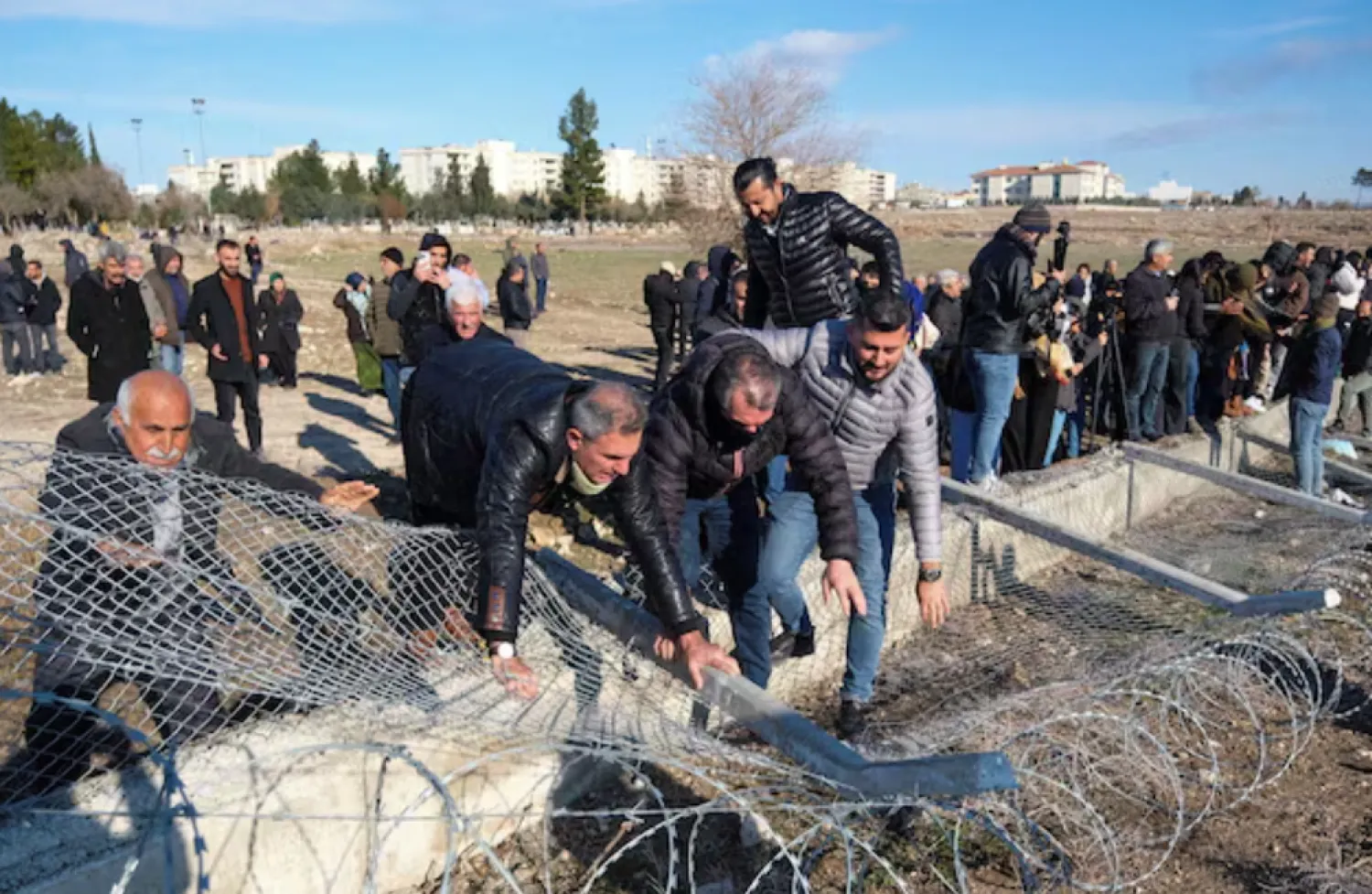
Pro-Kurdish protesters tear down a border fence as they attempt to cross to the Kurdish-controlled northeastern Syrian city of Qamishli during a demonstration in support of Syrian Kurds and against recent military clashes between the Syrian army and Kurdish forces, in Nusaybin, southeastern Turkey, January 20, 2026. REUTERS/Ensar Ozdemir
TT

Russia Withdrawing Troops from Airport in Northeast Syria

Pro-Kurdish protesters tear down a border fence as they attempt to cross to the Kurdish-controlled northeastern Syrian city of Qamishli during a demonstration in support of Syrian Kurds and against recent military clashes between the Syrian army and Kurdish forces, in Nusaybin, southeastern Turkey, January 20, 2026. REUTERS/Ensar Ozdemir

Russia is withdrawing forces from an airport in northeastern Syria, moving to end its military presence in a corner ​of the country where the Damascus government is trying to seize control from Kurdish forces, five Syrian sources said, according to Reuters.

Russia has stationed forces at Qamishli airport in the northeast since 2019, a relatively small deployment compared to its air base and a naval facility on Syria's Mediterranean coast, both of which it is expected to maintain.

Government forces under ‌President Ahmed ‌al-Sharaa have taken swathes of northern ‌and ⁠eastern ​Syria from ‌the Kurdish-led Syrian Democratic Forces this month, as Damascus aims to assert its authority over the entire country.

A fragile ceasefire between the sides was extended on Saturday for 15 days. Two of the sources said Russian forces had begun a gradual withdrawal from Qamishli airport last week. Some of the forces were expected ⁠to move to Russia's Hmeimim air base in western Syria while others ‌would return to Russia, one of ‍the sources said.

Another Syrian security source ‍on Syria's western coast said Russian military vehicles and ‍heavy weaponry had been transported from Qamishli to the Hmeimim military airport over the last two days.

There was no immediate comment from Russia's defense ministry. Russian daily Kommersant reported last week, citing an unnamed ​Syrian source, that the Syrian government might ask Russian forces to leave the base once it had ⁠pushed the Kurds out because "there’s nothing for them (the Russians) to do there".

A Reuters journalist saw Russian flags still flying at Qamishli airport on Monday, where two planes bearing Russian markings were parked on the runway.

Russia, a close ally of Syria's ousted President Bashar al-Assad, has established ties with Sharaa since he seized power some 14 months ago.

Sharaa told Russian President Vladimir Putin last year he would honor all past deals struck between Damascus and Moscow, a pledge suggesting Moscow's two main military ‌bases in Syria are safe.


Syria, Jordan Sign Gas Supply Deal to Bolster Syrian Power Grid

Syrian soldiers raise the Syrian national flag in front of the Syrian Defense Ministry building, which was heavily damaged by Israeli airstrikes last Wednesday, in Damascus, Syria, Saturday, July 19, 2025. (AP)
TT

Syria, Jordan Sign Gas Supply Deal to Bolster Syrian Power Grid

Syrian soldiers raise the Syrian national flag in front of the Syrian Defense Ministry building, which was heavily damaged by Israeli airstrikes last Wednesday, in Damascus, Syria, Saturday, July 19, 2025. (AP)

Syria and Jordan signed an agreement on Monday to supply natural gas to Syria via Jordanian territory, ​aiming to bolster Syria's fragile electricity grid, officials said.

The deal between the Syrian Petroleum Company and Jordan's National Electric Power Company, which was signed at Syria's Ministry of Energy in Damascus, provides for the delivery of about 4 million ‌cubic metres ‌of gas per ‌day — ⁠roughly ​140 million ‌cubic feet, Reuters reported.

The agreement builds on a broader energy arrangement signed last year to supply gas to Syria through Jordan, which is being financed by Qatar, part of regional efforts to ease Syria's acute power ⁠shortages after years of war and infrastructure damage, Syrian ‌and Jordanian officials have ‍said.

Jordan's energy minister, ‍Saleh al-Kharabsheh was quoted by Syrian state ‍media on Monday as saying deliveries began on January 1, with current volumes ranging between 30 million and 90 million cubic feet ​per day.

The deal would help Syria diversify its energy supply sources, the ⁠country's energy minister Mohamed al-Bashir said.

Supplies are being delivered via the Energos Force regasification vessel, leased from Egypt and docked at Jordan's Red Sea port of Aqaba until the end of March.

Jordan's National Electric Power Company has started procedures to lease a new floating storage and regasification unit to replace the existing vessel, ‌ensuring a continuous gas supply beyond March, Kharabsheh added.


UN Says Over 3 Million Sudanese Displaced by War Return Home

A Sudanese men who fled the conflict in Sudan's Darfur region, and was previously internally displaced in Sudan, walks past makeshift shelters near the border between Sudan and Chad, while taking refuge in Borota, Chad, May 13, 2023. © Zohra Bensemra, Reuters
TT

UN Says Over 3 Million Sudanese Displaced by War Return Home

A Sudanese men who fled the conflict in Sudan's Darfur region, and was previously internally displaced in Sudan, walks past makeshift shelters near the border between Sudan and Chad, while taking refuge in Borota, Chad, May 13, 2023. © Zohra Bensemra, Reuters

More than three million Sudanese people displaced by nearly three years of war have returned home, the United Nations migration agency said on Monday, even as heavy fighting continues to tear through parts of the country.

Since April 2023, Sudan has been locked in a devastating war pitting the regular army against the Rapid Support Forces (RSF).

The conflict has killed tens of thousands of people and created what the UN describes as the world's largest displacement and hunger crisis. At its peak, the war had displaced around 14 million people both internally and across borders.

In a report released on Monday, the International Organization for Migration (IOM) said an estimated 3.3 million displaced Sudanese had made their way back home by November of last year, AFP reported.

The rise in returns follows a sweeping offensive launched by the Sudanese army in late 2024 to retake central regions seized earlier in the conflict by the RSF.

The campaign culminated in the recapture of Khartoum in March 2025, prompting many displaced families to try to go back.

According to the IOM, more than three-quarters of those returning came from internal displacement sites, while 17 percent travelled back from abroad.

Khartoum saw the largest number of returns -- around 1.4 million people -- followed by the central state of Al-Jazira, where roughly 1.1 million have gone back.

Earlier this month, the army-backed government announced plans to return to the capital after nearly three years of operating from the Red Sea city of Port Sudan in the country's east.

Reconstruction work in Khartoum has been underway since the army retook the city.

Although Khartoum and several army-held cities in central and eastern Sudan have seen a relative lull in fighting, the RSF has continued to launch occasional drone strikes, particularly targeting infrastructure.

Elsewhere, violence remains intense.

In the country's south, RSF forces have pushed deeper into the Kordofan region after seizing the army's final stronghold in Darfur last October.

Reports of mass killings, rape, abductions and looting emerged after El-Fasher's RSF takeover, and the International Criminal Court launched a formal investigation into "war crimes" by both sides.


Hezbollah Chief Says Any Attack on Iran also Targets Group

29 July 2024, Iran, Tehran: Then Hezbollah deputy leader Sheikh Naim Qassem is pictured during a meeting in Tehran. (Iranian Presidency/dpa)
TT

Hezbollah Chief Says Any Attack on Iran also Targets Group

29 July 2024, Iran, Tehran: Then Hezbollah deputy leader Sheikh Naim Qassem is pictured during a meeting in Tehran. (Iranian Presidency/dpa)

Hezbollah chief Naim Qassem said Monday that any attack on the group's backer Tehran would also target the militants, and warned that any new war on Iran would ignite the region.

"Faced with aggression that does not distinguish between us... we are targeted by any potential aggression and determined to defend ourselves," he said in a televised address to supporters at a solidarity rally for Iran, AFP reported.

"We will choose at that time how to act... but we are not neutral," he said, warning that "a war on Iran this time will ignite the region".
