


Paris Calls on 50 Countries to Support Lebanese Army

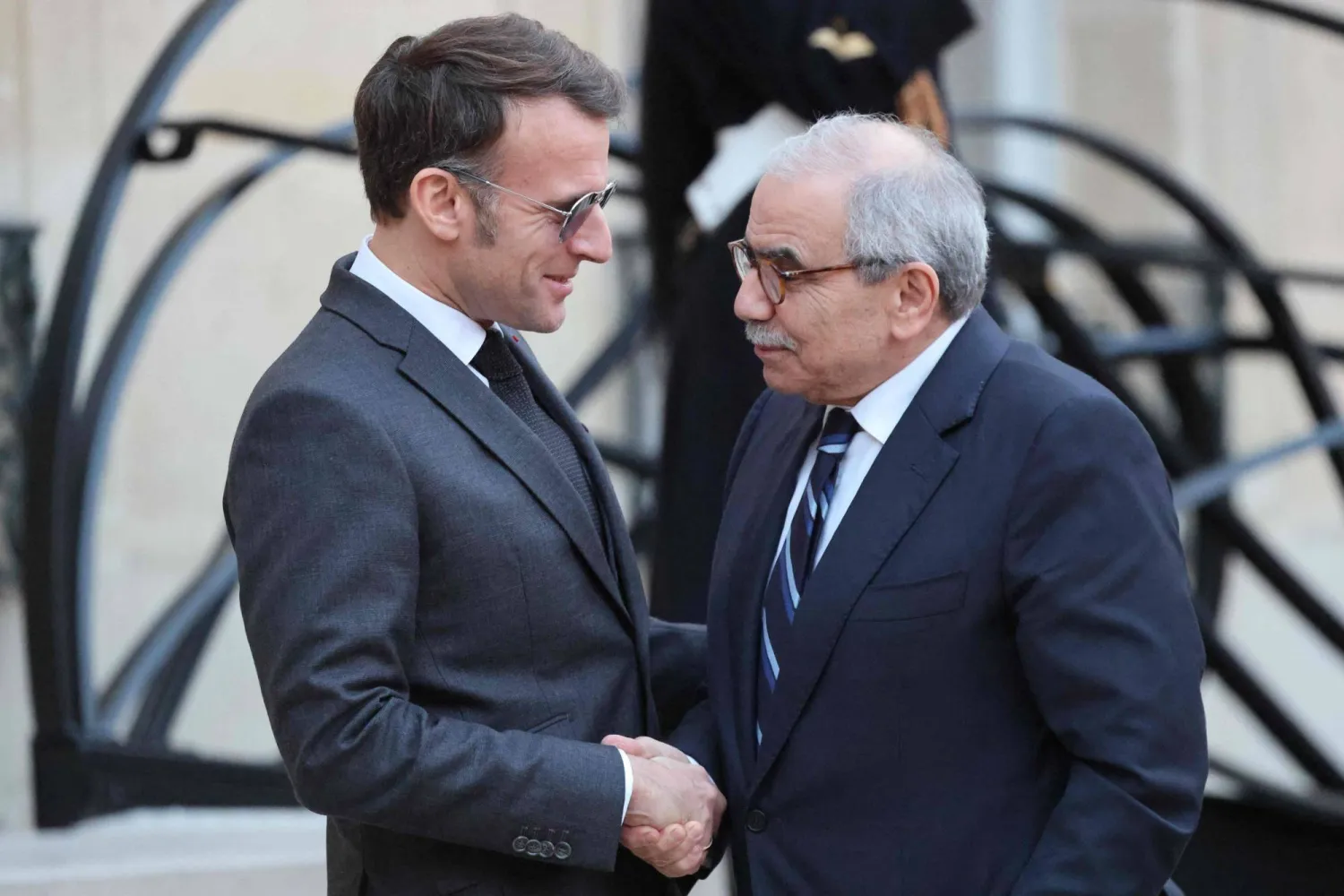
French President Emmanuel Macron welcomes Lebanese Prime Minister Nawaf Salam at the Élysée Palace in Paris on January 23 during the latter’s official visit to France (AFP) 
TT

Paris Calls on 50 Countries to Support Lebanese Army

French President Emmanuel Macron welcomes Lebanese Prime Minister Nawaf Salam at the Élysée Palace in Paris on January 23 during the latter’s official visit to France (AFP) 

Less than a month before it convenes, Paris is betting on the success of a conference to support the Lebanese Armed Forces, scheduled for March 5 and chaired by French President Emmanuel Macron.

French officials expect the meeting to draw representatives from around 50 countries and some 10 international and regional organizations. The numbers, if confirmed, would underscore the scale of international investment in the role of the Lebanese army and the priority given to bolstering its capabilities.

The conference coincides with the launch of the second phase of Lebanon’s plan to bring all weapons under the state’s control, beginning north of the Litani River in southern Lebanon and extending to the Awali River. Preparations are underway for a preliminary meeting to be held in two weeks. Paris says the conference itself will take place either in Riyadh or Doha.

France has asked the Lebanese army to update its projected needs in arms, equipment and funding for the coming years, enabling participating states to respond with targeted support.

French Foreign Minister Jean-Noël Barrot will discuss preparations for the conference and Lebanon’s complex domestic and regional context during his visit to Beirut this week, part of a regional tour that also includes Baghdad, Erbil and Damascus. This is Barrot’s third visit to Lebanon, but the first since President Joseph Aoun took office and Prime Minister Nawaf Salam formed a new government.

At the forefront of Barrot’s meetings with Lebanon’s senior leadership will be the issue of Hezbollah’s weapons. French officials point to the group’s continued refusal to disarm and to statements by its secretary-general, Naim Qassem, expressing readiness to join a war against Iran should Tehran be targeted by the United States or Israel.

Paris warns that Iran - amid strained relations with France and other European countries - may seek to draw its allies into such a conflict, a scenario that would directly implicate Hezbollah. According to officials who spoke to Asharq Al-Awsat, Paris insists that Lebanon’s national interest lies in remaining outside any Iranian–American–Israeli confrontation, in order to preserve its stability, sovereignty and internal security.

While France assesses that Hezbollah’s military and financial capabilities have been weakened following what it describes as its “defeat” in the war with Israel, it believes the group still retains the capacity to resist disarmament by force if it chooses, despite having accepted the handover of weapons south of the Litani.

Paris argues, however, that outright refusal would exact a “heavy price,” both on Hezbollah and on Lebanon as a whole, while providing Israel - already accusing the group of violating the Nov. 2024 ceasefire - with further justification for escalation. French officials also noted signs of unease within Hezbollah’s support base, even if dissenting voices remain muted.

Moreover, officials said that Paris views positively the Lebanese army’s performance in the first phase south of the Litani and insists on completing the plan.

Economically, France takes a cautiously positive view of the government’s draft law addressing the financial gap, seeing it as an essential step toward an agreement with the International Monetary Fund, without which international aid and reconstruction support will not materialize.

French officials have called on parliament to pass the bill swiftly, saying it would protect around 85 percent of small depositors. France also anticipates a technical postponement of parliamentary elections for several months, most likely until next summer.



Dozen People Entered Egypt from Gaza on First Day of Rafah Opening

02 February 2026, Palestinian Territories, Khan Yunis: Palestinian patients wait in the grounds of the Red Crescent Hospital to be evacuated from the Gaza Strip via the Rafah border crossing with Egypt for treatment abroad. Photo: Abed Rahim Khatib/dpa
TT

Dozen People Entered Egypt from Gaza on First Day of Rafah Opening

02 February 2026, Palestinian Territories, Khan Yunis: Palestinian patients wait in the grounds of the Red Crescent Hospital to be evacuated from the Gaza Strip via the Rafah border crossing with Egypt for treatment abroad. Photo: Abed Rahim Khatib/dpa

A handful of injured Palestinians and their companions entered Egypt from Gaza on Monday, the first day of a limited reopening of the Rafah border crossing, a source at the border told AFP.

"Five injured people and seven companions" crossed the border, the source said on Tuesday.

The number of patients allowed to enter Egypt through the crossing was limited to 50 on Monday, each accompanied by two companions, according to three officials at the Egyptian border.


Morocco Evacuates 50,000 as Flooding Threatens City After Weeks of Heavy Rain

Flooding in Ksar el-Kebir, Morocco, 01 February 2026, amid ongoing heavy rainfall and rising water levels in the Loukkos River. (EPA)
TT

Morocco Evacuates 50,000 as Flooding Threatens City After Weeks of Heavy Rain

Flooding in Ksar el-Kebir, Morocco, 01 February 2026, amid ongoing heavy rainfall and rising water levels in the Loukkos River. (EPA)

Morocco has evacuated more than 50,000 people, nearly half the population of the northwestern city of Ksar el-Kebir, as flooding driven by weeks of heavy rain threatened to inundate the city, state media said on Monday.

"The city has become a ghost town," local resident Hicham Ajttou told Reuters by phone. "All markets and shops are closed and most residents have either left voluntarily or been evacuated."

Authorities set up shelters and temporary camps and ‌barred entry into ‌Ksar el-Kebir as rising water ‌levels ⁠in the ‌Loukkos River spread across several neighborhoods. Only departures from the city were permitted, while electricity was cut in parts of it and schools were ordered to remain closed until Saturday.

Officials said the floods were partly triggered by water released from the nearby Oued Makhazine dam, which ⁠had reached full capacity. Ksar el-Kebir lies about 190 km (120 miles) ‌north of Rabat.

Ajttou said he moved his ‍family to Tangier last ‍week and returned to Ksar el-Kebir to volunteer ‍in relief efforts.

"The question that worries us is what comes next. The dam is full and we don't know how long this situation will last," he said.

The army has deployed rescue units, trucks, equipment and medics to support evacuation and rescue operations and buses evacuated ⁠people from the city.

State TV Al Oula showed a helicopter rescuing four people trapped by rising waters in Oued Ouargha in the nearby province of Ouezzane.

Further south, rising levels of the Sebou River prompted authorities to evacuate several villagers in Sidi Kacem and reinforce riverbanks with sandbags and barriers.

The heavy rainfall has brought an end to a seven-year drought that pushed Morocco to invest heavily in desalination plants. The national dam-filling rate ‌is now close to 62%, with several major reservoirs reaching full capacity, according to official data.


Halt to MSF Work Will Be ‘Catastrophic’ for People of Gaza, Warns MSF Chief

 Buildings that were destroyed during the Israeli ground and air operations stand in the northern Gaza Strip as seen from southern Israel, Monday, Feb. 2, 2026. (AP)
Buildings that were destroyed during the Israeli ground and air operations stand in the northern Gaza Strip as seen from southern Israel, Monday, Feb. 2, 2026. (AP)
TT

Halt to MSF Work Will Be ‘Catastrophic’ for People of Gaza, Warns MSF Chief

 Buildings that were destroyed during the Israeli ground and air operations stand in the northern Gaza Strip as seen from southern Israel, Monday, Feb. 2, 2026. (AP)
Buildings that were destroyed during the Israeli ground and air operations stand in the northern Gaza Strip as seen from southern Israel, Monday, Feb. 2, 2026. (AP)

Israel's ban on Doctors Without Borders' humanitarian operation in Gaza spells deeper catastrophe for the Palestinian territory's people, the head of the medical charity told AFP on Monday.

Israel announced on Sunday that it was terminating all the activities in Gaza and the West Bank by the organization, known by its French acronym MSF, after it failed to provide a list of its Palestinian staff.

MSF slammed the move, which takes effect on March 1, as a "pretext" to obstruct aid.

"This is a decision that was made by the Israeli government to restrict humanitarian assistance into Gaza and the West Bank at the most critical time for Palestinians," MSF secretary-general Christopher Lockyear warned in an interview with AFP at the charity's Geneva headquarters.

"We are at a moment where Palestinian people need more humanitarian assistance, not less," he said. "Ceasing MSF activities is going to be catastrophic for the people of the Gaza Strip and the West Bank".

MSF has been a key provider of medical and humanitarian aid in Gaza, particularly since war broke out after Hamas's October 7, 2023 attack on Israel.

The charity says it currently provides at least 20 percent of hospital beds in the territory and operates around 20 health centers.

In 2025 alone, it carried out more than 800,000 medical consultations, treated more than 100,000 trauma cases and assisted more than 10,000 infant deliveries.

It also provided more than 700 million liters of water, Lockyear pointed out.

- 'Impossible choice' -

Israel announced in December that it planned to prevent 37 aid organizations, including MSF, from working in Gaza for failing to submit detailed information about their Palestinian employees. The move drew widespread condemnation from NGOs and the United Nations.

It had alleged that two MSF employees had links with Palestinian armed groups Hamas and Islamic Jihad, which the medical charity vehemently denies.

"If Israel has any evidence of such things, then they should share that evidence," Lockyear said, insisting that "there's been no proof given to us".

He decried "an orchestrated campaign to delegitimize us", calling on other countries to defend efforts to bring desperately-needed humanitarian aid into Gaza.

"They should be speaking to Israel, pressuring Israel to ensure that there is a reverse of any banning of humanitarian organizations."

Lockyear said MSF, which counts around 1,100 staff inside Gaza, had been trying to engage with Israeli authorities for nearly a year over the requested lists.

But it had been left with "an impossible choice", he said.

"We've been forced to choose between the safety and security of our staff and being able to reach patients."

- 'Can only get worse' -

The organization said it decided not to hand over staff names "because Israeli authorities failed to provide the concrete assurances required to guarantee our staff's safety, protect their personal data, and uphold the independence of our medical operation".

Lockyear insisted that was a "very rational" decision, pointing out that 15 MSF staff had been killed in Gaza during the war, out of more than 500 humanitarian workers and more than 1,700 medical workers killed in the Strip.

Lockyear highlighted that without independent humanitarian organizations in Gaza, an already "catastrophic" situation "can only get worse".

"We need to increase massively the humanitarian assistance that's going into Gaza," he said, "not restrict it, not block it."
