

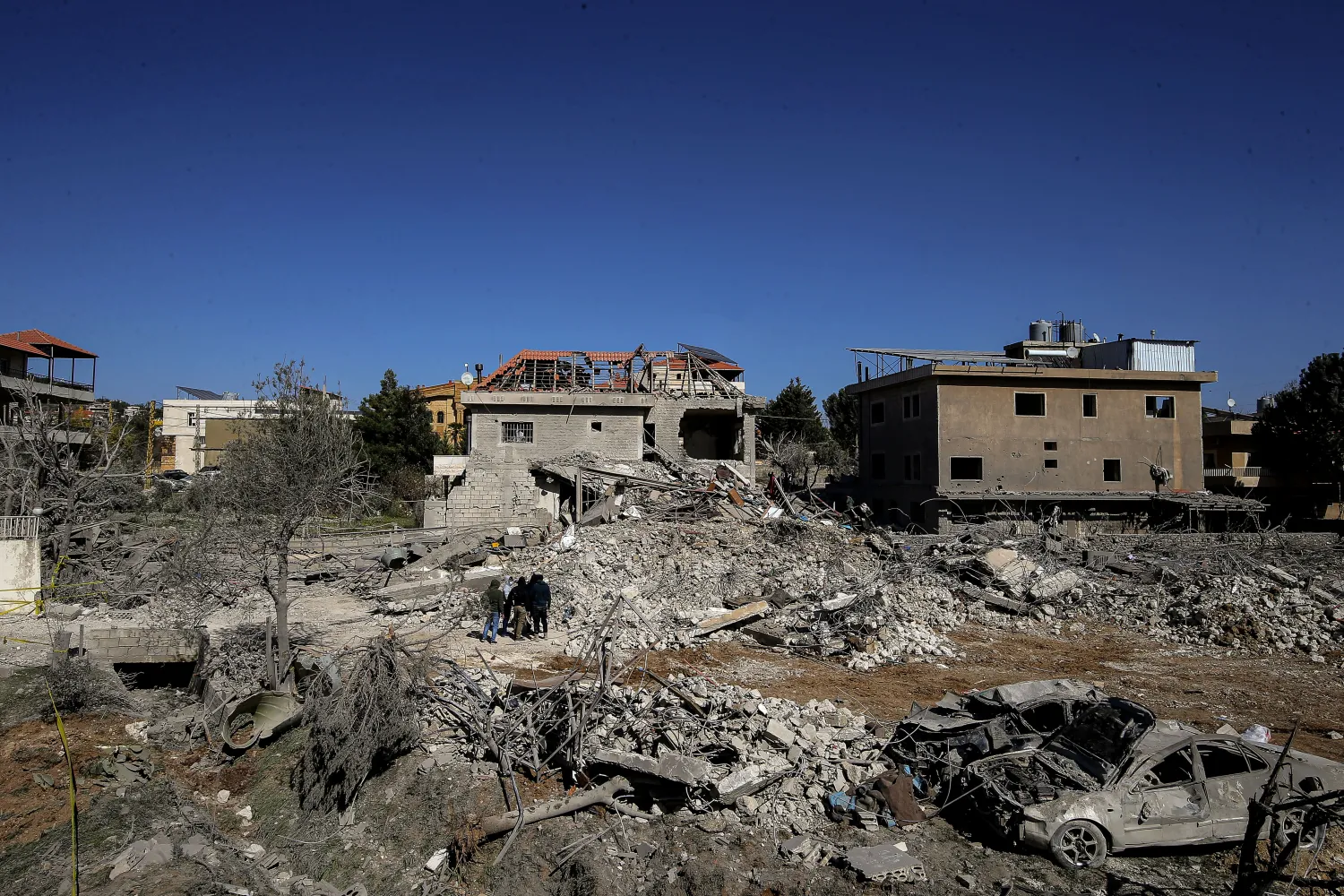

State Department Orders Nonessential US Diplomats to Leave Lebanon as Tensions with Iran Soar

21 February 2026, Lebanon, Bednayel: Pro-Iranian Hezbollah supporters inspect damage of house that was hit by an Israeli air strike in the village of Bendayel in Lebanon's Bekaa valley. (dpa)
TT

State Department Orders Nonessential US Diplomats to Leave Lebanon as Tensions with Iran Soar

21 February 2026, Lebanon, Bednayel: Pro-Iranian Hezbollah supporters inspect damage of house that was hit by an Israeli air strike in the village of Bendayel in Lebanon's Bekaa valley. (dpa)

The United States has ordered nonessential diplomats and their family members at the US Embassy in Beirut to leave Lebanon, the State Department said Monday, as tensions over Iran rise with the threat of a potentially imminent military strike. 

The department said in an updated travel alert for US citizens in Lebanon that it “ordered the departure of non-emergency US government personnel and family members of government personnel due to the security situation in Beirut.” 

The alert, which was formally released several hours after word began to circulate about the move, said US personnel remaining in Lebanon would have their in-country travel restricted. 

A department official said earlier that a continuous assessment of the regional security environment determined it was “prudent” to draw down the US Embassy Beirut's footprint so that only essential personnel remain at their posts. 

The official, who spoke on the condition of anonymity before the move was formally announced, said that it is a temporary measure and that the embassy will remain operational. 

Lebanon has been the site of numerous Iran-related retaliatory attacks against US facilities, interests and personnel for decades given Tehran's support for and influence with the Hezbollah group, which is held responsible for the deadly bombings of the Marine barracks in Beirut in 1983 and an embassy annex in 1984. 

As such, changes in the staffing status of the embassy in Beirut have often been seen as a bellwether for potential US or Israeli military action in the region, particularly against Iran. A similar ordered departure was imposed for Beirut and other embassies in the region, including in Iraq, shortly before President Donald Trump ordered military strikes against Iranian nuclear facilities last June. 

It was unclear if other American embassies in the Middle East would implement similar orders. 

Tensions have escalated between the US and Iran as Trump has built up the largest military presence in the Middle East in decades and repeatedly threatened action if Tehran does not negotiate a deal to constrain its nuclear program. A second aircraft carrier is heading to the region to join a surge of other American warships and aircraft, offering the Republican president several options for a potential strike even as talks may continue. 

Oman’s foreign minister, Badr al-Busaidi, said the US and Iran plan to hold their next round of nuclear talks Thursday in Geneva. A US official, who was not authorized to comment publicly and spoke on the condition of anonymity, confirmed the meeting. 

Iran’s top diplomat, Abbas Araghchi, told CBS on Sunday that he expected to meet US envoy Steve Witkoff then and said a “good chance” remained for a diplomatic solution on the nuclear issue. 

Araghchi has said a proposed deal would be ready to share within days, and he told CBS that Iran was still working on it. 

Asked Friday whether the US could take limited military action as the countries negotiate, Trump said, “I guess I can say I am considering that.” He also told reporters later that Iran “better negotiate a fair deal.” 

Indirect talks between the longtime adversaries in recent weeks have made little visible progress. Beyond the nuclear program, Iran has refused to discuss wider US and Israeli demands that it scale back its missile program and sever ties to armed groups. 

A second State Department official, also speaking on the condition of anonymity to discuss plans that had not been formally announced, said Secretary of State Marco Rubio may delay his intended visit to Israel this weekend. 


Israeli Minister Says Army will Occupy All Gaza if Hamas Does Not Disarm

Israeli Finance Minister Bezalel Smotrich visits Nariman House to pay his respects to the victims of the 26/11 Mumbai terror attacks, in Mumbai, India, 09 September 2025. EPA/DIVYAKANT SOLANKI
TT

Israeli Minister Says Army will Occupy All Gaza if Hamas Does Not Disarm

Israeli Finance Minister Bezalel Smotrich visits Nariman House to pay his respects to the victims of the 26/11 Mumbai terror attacks, in Mumbai, India, 09 September 2025. EPA/DIVYAKANT SOLANKI

Israeli far-right Finance Minister Bezalel Smotrich said Monday that Palestinian Islamist group Hamas may soon be given a deadline to lay down its weapons.

"We estimate that in the coming days, Hamas will be given an ultimatum to disarm and completely demilitarise Gaza," Smotrich said in an interview with public broadcaster Kan, AFP reported.

Israel invaded the Gaza Strip in 2023, in retaliation for Hamas's unprecedented October 7 attack.

Under the first phase of a US-sponsored ceasefire in Gaza intended to halt two years of war, the Israeli army withdrew to positions behind a so-called Yellow Line, but still controls over half of the territory.

Both Hamas and Israel accuse each other of near-daily ceasefire violations, with the health ministry in Gaza reporting 615 people killed by Israeli forces since the truce started.

The Israeli military says it has lost five of its soldiers during the same period.

If Hamas does not comply with the Israeli ultimatum to disarm, the army "will have international legitimacy and American backing to do it itself, and the (military) is already preparing for this and is making plans", said the minister, who is a member of Israel's security cabinet charged with approving large-scale military operations.

The second ceasefire phase, which officially began last month, calls for a gradual withdrawal of the Israeli army and the disarmament of Hamas, which the militant group has vehemently opposed.

"The (Israeli military) will definitely enter and occupy Gaza if Hamas does not disarm," Smotrich said.

Asked how the military would do this, he said "there are two or three alternatives right now that we are examining".

The peace plan put forward by US President Donald Trump also calls for the establishment of a 20,000-strong peacekeeping force, called the International Stabilisation Force (ISF), to which several countries have committed troops.

Asked how the Israeli army would operate against Hamas when foreign soldiers were deployed on the ground, Smotrich said the latter would "pull out very quickly and allow the (Israeli military) to enter. This is coordinated with the Americans."

"By the way, I don't yet see them going in that fast," he added of the ISF.

A security source in Gaza, meanwhile, said on Monday that Israeli forces shelled Beit Lahia in the north.

The source also said that Israeli tanks opened fire in the south Gaza city of Khan Younis, where at least two air strikes were also conducted.

Israel's military said Monday that Israeli troops "eliminated" a fighter who had crossed the Yellow Line into Israeli-held territory the previous day.


Four Syrian Security Personnel Killed in ISIS Attack

FILE PHOTO: A member loyal to the Islamic State waves an ISIS flag in Raqqa, Syria June 29, 2014. REUTERS/Stringer/Files
TT

Four Syrian Security Personnel Killed in ISIS Attack

FILE PHOTO: A member loyal to the Islamic State waves an ISIS flag in Raqqa, Syria June 29, 2014. REUTERS/Stringer/Files

Four Syrian security personnel were killed in ISIS terrorist group attack in the northern city of Raqa, which was recently taken by Damascus from Kurdish forces, state media reported on Monday.

Syria's interior ministry said in a statement that the "terrorist attack" targeted a checkpoint in the area, adding that one of the assailants was killed, AFP reported.

In its spokesperson's first audio message in two years, ISIS had called on its militants Saturday to fight Syrian authorities.


Israeli Settlers Torch and Deface a West Bank Mosque during Ramadan

People check a fire-damaged area in the Abu Bakr al-Siddiq Mosque following, according to Palestinian authorities, an attack by Israeli settlers on the West Bank village of Tell, near Nablus, Monday, February 23, 2026. (AP Photo/Majdi Mohammed)
TT

Israeli Settlers Torch and Deface a West Bank Mosque during Ramadan

People check a fire-damaged area in the Abu Bakr al-Siddiq Mosque following, according to Palestinian authorities, an attack by Israeli settlers on the West Bank village of Tell, near Nablus, Monday, February 23, 2026. (AP Photo/Majdi Mohammed)

Israeli settlers vandalized a mosque in the Israeli-occupied West Bank early Monday, spray-painting offensive phrases and setting a fire, according to the Palestinian Authority’s Ministry of Religious Affairs.

Worshippers arriving for the day's first prayers found the damage and a smoldering fire that spewed black smoke across the entrance of the Abu Bakr Al-Siddiq Mosque in the town of Tell, near Nablus, and stained the ornate doorway.

“I was shocked when I opened the door," said Munir Ramdan, who lives nearby. "The fire had been burning here in the area, the glass was broken here and the door was broken.”

Security camera footage showed two people walking toward the mosque carrying gasoline and a can of spray paint, and running away a few minutes later, Ramdan said, The AP news reported.

The attackers spray-painted graffiti denigrating the Prophet Muhammad, as well as the words “revenge” and “price tag.” In “price tag” attacks, hard-line Israeli nationalists attack Palestinians and vandalize their property in response to Palestinian militant attacks or perceived efforts by Israeli authorities to limit settlement activity.

The ministry said settlers vandalized or attacked 45 mosques in the West Bank last year.

The latest incident occurred as Muslims observe the holy month of Ramadan.

“The provocation is directed especially at the person who is fasting, because you are fasting and entering a month of mercy and forgiveness from God,” said Salem Ishtayeh, a resident of Tell. “So they like to provoke you with words. It’s not that they are attacking you personally, they are attacking your religion, the Islamic faith.”

The Israeli military and police said they responded to the incident and were searching for suspects. The military said it “strongly condemns” harm done to religious institutions.

Palestinians and rights groups say Israeli authorities routinely fail to prosecute settlers or hold them accountable for violence.

There has been a recent surge in violence by settlers against Palestinians in the West Bank. Last week, settlers killed a Palestinian-American man, Nasrallah Abu Siyam.

According to information released by Israel's military last month, there were 867 attacks by settlers against Palestinians and security forces in 2025, an increase of 27% over 2024.

The number of serious settler attacks including shootings, arson and other violent crimes has increased sharply each year since far-right politician Itamar Ben-Gvir, who spent his law career defending Jews who attacked Palestinians, became national security minister. The number of serious attacks increased from 54 in 2023 to 83 in 2024 and 128 in 2025.
