


Asharq Al-Awsat Details Israeli Commando Raid in Lebanon’s Nabi Sheet

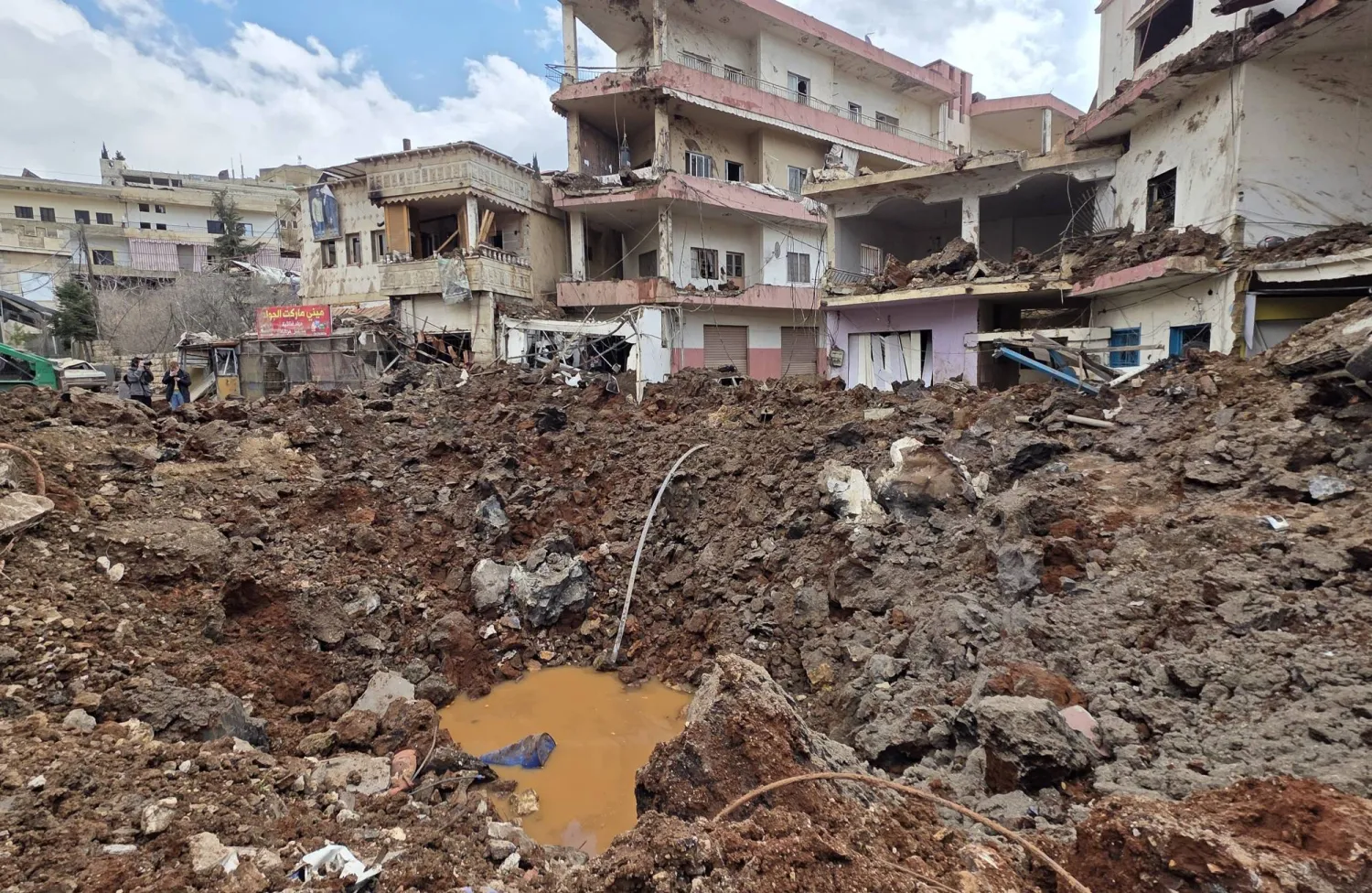
A huge crater left by an Israeli airstrike in the village of Nabi Sheet, eastern Lebanon late Friday, March 6, 2026. (AP Photo/Ali Salem)
TT

Asharq Al-Awsat Details Israeli Commando Raid in Lebanon’s Nabi Sheet

A huge crater left by an Israeli airstrike in the village of Nabi Sheet, eastern Lebanon late Friday, March 6, 2026. (AP Photo/Ali Salem)

The town of Nabi Sheet in Lebanon’s northern Bekaa is in shock after an Israeli military operation that left dozens of residents and people from nearby villages dead and wounded.

The operation involved an Israeli commando raid backed by more than 40 air strikes carried out by fighter jets, attack helicopters and drones, causing widespread destruction across the town and its surroundings.

Attempt to recover Arad’s remains

The Israeli force, made up of about 50 paratroopers, entered the town from three directions, residents said: The Qouz axis toward Serghaya, the Khraibeh axis, and the main western road linking the town entrance to Nabi Sheet square.

Hamm mayor Mohammad Hassan said the infiltration had been preceded by movement through the Eastern Mountain Range from two axes — Abu Fares field and the Shaara area — suggesting multiple routes of advance during the operation.

Residents told Asharq Al-Awsat the force appeared to be attempting to recover the remains of Israeli pilot Ron Arad, missing since 1986 and believed to be buried in the Shokr family cemetery near the mountain road linking Nabi Sheet to the towns of Khraibeh, Janta and Shaara near Serghaya on the Lebanese-Syrian border.

Helicopter landing

During the operation, Israeli troops deployed observation and security positions inside the town, particularly in the Shokr neighborhood near the cemetery entrance and close to the Shokr mosque and husseiniya. Other troops spread along the town’s main street in anticipation of possible clashes.

Information obtained by Asharq Al-Awsat said the force landed by three helicopters in the Qouz area before moving into the town through the surrounding highlands.

Residents also said ambulances and vehicles carrying Lebanese license plates were used, along with personnel wearing the uniforms of Hezbollah’s Islamic Health Authority and Lebanese Army military attire — raising questions about how the force reached the town.

Operation exposed

The operation was uncovered when members of the force opened fire with silenced rifles on a Hezbollah member passing through the area, killing him instantly.

The shooting alerted residents and Hezbollah members, who moved quickly to surround the Israeli force and engage it.

Before being exposed, the force had dug a narrow pit at the cemetery measuring about one-meter-long, 50 centimeters deep and 40 centimeters wide. Heavy gunfire across the town forced the force to withdraw before reaching its objective.

Hamda Assad al-Halbawi woke to the sound of digging near the cemetery. When she stepped outside to see what was happening, commando members fired at her from the direction of the graveyard, hitting her in the head. When her son tried to rescue her, a drone struck their car, killing them both.

Air strikes and ambushes

After the force was exposed, Israeli aircraft launched intense strikes on roads leading to the town to prevent reinforcements from nearby villages.

The strikes targeted the Nabi Sheet–Nasiriyah road, the Nabi Sheet–Sarein secondary road, the plain road, the Nabi Sheet–Khodr road and the Aqabeh–Baalbek road. The mountain road and the main road were left open to facilitate the force’s withdrawal.

Missiles fired during the strikes created a massive crater estimated to be about 10 meters deep and roughly 80 meters wide. The bombardment caused extensive destruction, with cars hurled onto building rooftops, particularly in Nabi Sheet square.

As the force withdrew, it came under ambush along the Khraibeh–Janta–Shaara road, where the fiercest clashes took place.

Heavy toll

The clashes and withdrawal left many dead, including about 35 people from Nabi Sheet, nine from Khraibeh, one from Sarein and another from Ali al-Nahri. Three Lebanese Army soldiers and one member of General Security were also killed.

Residents said Israeli forces used 16 mm rifles fitted with silencers.

Questions remain

Residents remain stunned by the scale of the operation and the destruction it caused, while questioning how the force managed to infiltrate an area they say is under constant surveillance.

They say the Israeli force ultimately failed to achieve its objective and withdrew under heavy fire and pressure from the clashes.

That account does not contradict Israel’s version of events. Israeli army spokesman Avichay Adraee said no evidence linked Arad was found at the search site.



Drone Strikes on Sudan Markets Kill 33

Smoke billows over buildings in Khartoum on May 1, 2023 as deadly clashes between rival generals' forces have entered their third week.(Photo by AFP)
TT

Drone Strikes on Sudan Markets Kill 33

Smoke billows over buildings in Khartoum on May 1, 2023 as deadly clashes between rival generals' forces have entered their third week.(Photo by AFP)

A drone attack hit two markets in RSF-controlled towns in southwest Sudan, killing 33 people, a medical source told AFP on Sunday.

The strikes targeted the markets of Abu Zabad and Wad Banda in West Kordofan state -- part of the resource-rich Kordofan region that is currently the fiercest battlefield in the nearly three-year war between Sudan's army and the Rapid Support Forces.

A doctor at Abu Zabad hospital, one of the few medical facilities still serving the area, said two drones struck the markets on Saturday, injuring 59 people.

Speaking via a Starlink connection and requesting anonymity, the doctor said 30 of the wounded remain receiving treatment. The two towns lie roughly 15 kilometres (9 miles) apart.

A resident of Abu Zabad town, Hamad Abdullah, said he helped bury 20 people on Saturday following what he described as an army drone strike on the town's market.

"Four of them were my relatives who worked in the market," he told AFP.

A military source rejected the accusations, telling AFP that the "armed forces do not bombard civilian areas".

"This is a lie with no basis. We only target rebels, their equipment and their weapons depots," the source said, requesting anonymity because they are not authorised to brief the media.

Since war broke out in April 2023, both sides have been accused of war crimes including targeting civilians and indiscriminately shelling residential areas.

The war has killed tens of thousands of people, displaced more than 11 million and fuelled what the United Nations describes as the world's largest displacement and hunger crises.


Lebanese Health Ministry Says Death Toll from Israeli Strikes up to 394

The son of a Lebanese soldier, cries as he sits on his father's coffin who was killed by Israeli airstrikes, during a funeral procession in Khraibeh village, eastern Lebanon, Sunday, March 8, 2026. (AP Photo/Bilal Hussein)
TT

Lebanese Health Ministry Says Death Toll from Israeli Strikes up to 394

The son of a Lebanese soldier, cries as he sits on his father's coffin who was killed by Israeli airstrikes, during a funeral procession in Khraibeh village, eastern Lebanon, Sunday, March 8, 2026. (AP Photo/Bilal Hussein)

Israeli strikes on Lebanon have killed 394 people over the past week, including 83 children and 42 women, the health minister said Sunday, after Israel expanded its attacks to a hotel in central Beirut.

Health minister Rakan Nassereddine said at a press conference that nine rescue workers were among the 394 dead in Lebanon, condemning attacks on medical teams and ambulances.

"These are civilians being targeted, not, as they claim, military personnel and military installations. They are targeting homes, paramedics and the health sector," Nassereddine said, adding "the pace of the massacres has increased in the past 48 hours".

"Medical teams and ambulances are under attack, this is unacceptable."

A previous toll announced on Saturday by the minister had put the number of dead at 294.

Israel never fully halted its strikes targeting Hezbollah despite a 2024 ceasefire that sought to end their last round of fighting, which broke out in 2023 when the group attacked Israel in support of its Palestinian ally Hamas in Gaza.

Since Hezbollah's latest attack on Monday, Israel has launched multiple waves of strikes across Lebanon and sent ground troops into border areas.

Early Sunday, the Lebanese health ministry said an Israeli airstrike hit a hotel room in Beirut's city center, killing four people and wounding 10 others.

Israel's military said it had "conducted a precise strike targeting key commanders" in the Iranian Revolutionary Guards' Quds Force, its foreign operations arm.

In Ghazieh, southern Lebanon, an Israeli attack flattened a building, with an AFP correspondent seeing destroyed solar panels above it and rescuers searching through the debris.

In Sir al-Gharbiyeh, the health ministry said at least 11 people were killed in Israeli morning strikes on the village.

The toll included children, with the minister adding that "there are still people trapped under the rubble".

Standing next to a destroyed home, resident Ali Youssef Taha told AFP that "a family was sleeping inside" before "Israeli warplanes bombed the building, resulting in a massacre".

Mayor Saadallah Mohammed Maatouk said around 500 families were staying in the town.

"What happened will not deter us, and we remain steadfast," he said.

On Sunday, the Israeli military reiterated its call for residents south of Lebanon's Litani river, around 30 kilometres (20 miles) north of the Israeli border, to flee the area.

Sir al-Gharbiyeh is located just above the river, and Ghazieh is further north on the coast.

Israel's military, meanwhile, said Sunday that two of its soldiers were killed in combat in southern Lebanon, the first of its troops to have died since the latest offensive began on March 2.


Arab League Chief Says Iran Attacks on Member States 'Reckless'

A general view shows the opening session of the meeting of Arab foreign ministers at the Arab League Headquarters (Reuters)
TT

Arab League Chief Says Iran Attacks on Member States 'Reckless'

A general view shows the opening session of the meeting of Arab foreign ministers at the Arab League Headquarters (Reuters)

The Arab League's secretary-general said Sunday that Iranian attacks on several member states were "reckless", urging Tehran to reverse what he called a "massive strategic mistake".

Addressing an emergency videoconference of Arab foreign ministers in Cairo, Ahmed Aboul Gheit said the strikes "cannot be justified under any pretext or excuse", and repaid peace efforts by Gulf countries with "treacherous rockets and drone strikes".