


The Full Story of Lebanon’s Initiative for Negotiations with Israel and its Challenges

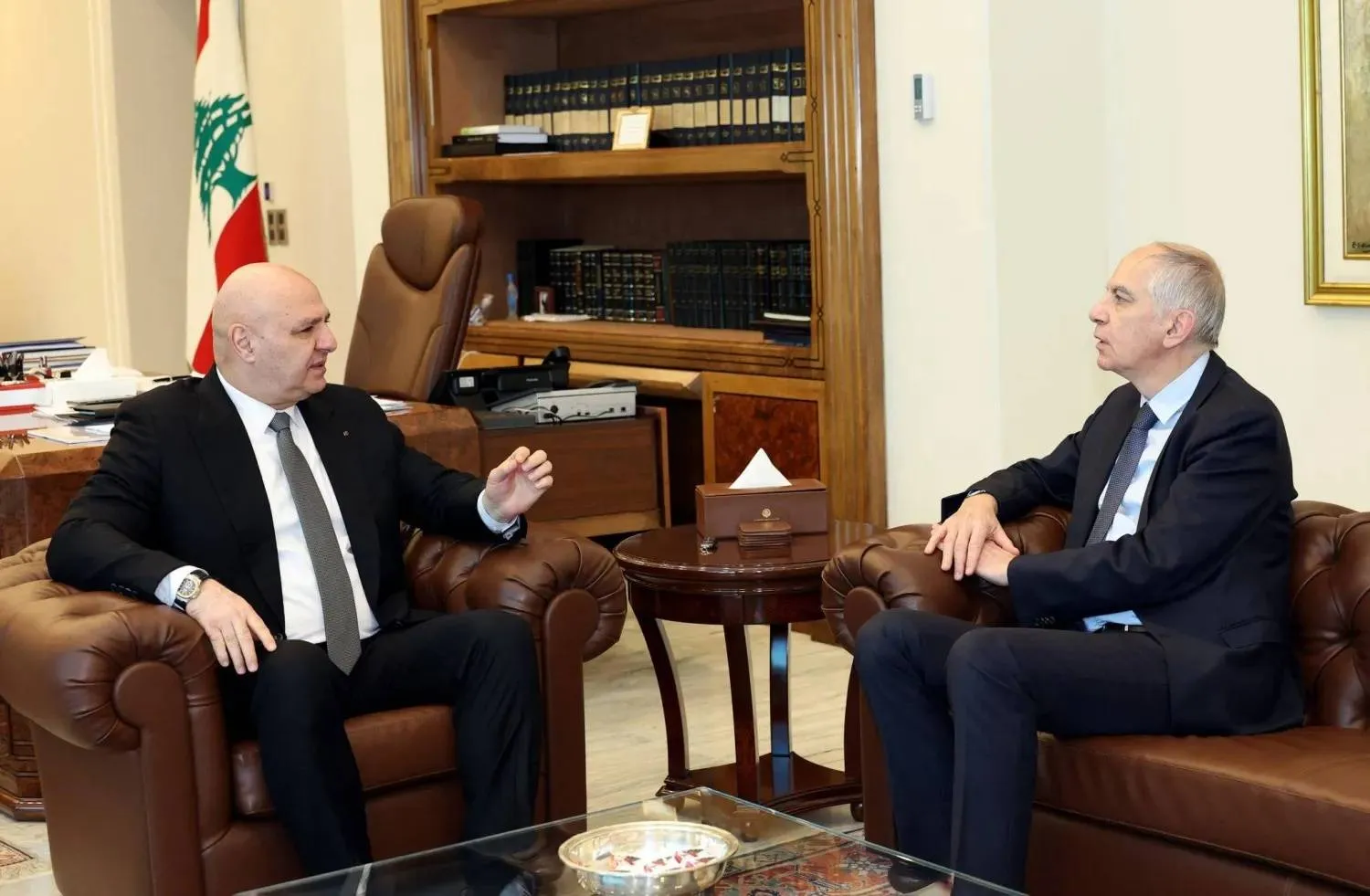
President Joseph Aoun meets with French Ambassador to Lebanon Herve Magro at the Baabda presidential palace. (Lebanese Presidency)
TT

The Full Story of Lebanon’s Initiative for Negotiations with Israel and its Challenges

President Joseph Aoun meets with French Ambassador to Lebanon Herve Magro at the Baabda presidential palace. (Lebanese Presidency)

Authorities in Lebanon now see little option but to seek a humanitarian truce during the upcoming Eid al-Fitr, after ceasefire efforts in the war between Israel and Hezbollah collapsed against entrenched positions on both sides.

Israel is demanding Hezbollah’s “complete surrender” before halting operations in Lebanon. The party, in turn, has tied its stance to Iran’s position, after entering the wider conflict involving Tehran, Washington, and Tel Aviv.

A senior Lebanese official told Asharq Al-Awsat that Israeli Prime Minister Benjamin Netanyahu sent a ceasefire proposal, relayed by French President Emmanuel Macron, to Lebanese President Joseph Aoun 10 days ago.

Hezbollah’s decision to cut communication channels, followed by its launch of its “Al-Asf Al-Maakoul” (Eaten Straw) a wide military operation, derailed the initiative and led to Israel hardening its position.

Hezbollah’s posture remains the main domestic obstacle to ending the war. The group has yet to present a clear political position outlining its readiness to stop the fighting or its objectives, even as it escalates militarily in parallel with diplomatic efforts.

Lebanese delegation

The Lebanese source said no date or venue has been set for talks with Israel, and no formal Israeli response has been received. Messages conveyed through Macron and United Nations Special Coordinator for Lebanon Jeanine Hennis-Plasschaert have, however, raised a central question still unanswered by Beirut: if fighting stops, will Hezbollah stop firing rockets?

Lebanon, the source said, cannot afford a delay. Aoun is moving to finalize a negotiating delegation expected to include four figures representing the country’s main sects.

Named so far are former ambassador Simon Karam, a Christian who took part in “mechanism” committee meetings, Foreign Ministry Secretary-General Ambassador Abdel Sattar Issa, a Sunni nominated by Prime Minister Nawaf Salam, and Shawki Bou Nassar, a Druze figure named by senior Druze leader Walid Jumblatt.

Parliament Speaker Nabih Berri is still refusing to name a Shiite representative, conditioning this on a ceasefire and the return of displaced people.

He has also yet to respond to a proposal to appoint a member to a parallel “shadow delegation” to accompany the talks. The source said Israel is insisting, through indirect messages, on the inclusion of a Shiite member.

The source said Berri could prove pivotal, as the only figure capable of exerting pressure on Hezbollah at this stage and beyond.

Israel’s Maariv newspaper, citing Israeli sources, said Tel Aviv sees Berri as able to either back or block any move. While he opposes negotiations under fire and insists on a ceasefire first, Israeli assessments suggest he could later endorse any understandings that align with Lebanon’s interests and internal balance, providing political cover for Hezbollah to accept them.

United States

The source said Washington’s silence should not be read as negative. The US is fully focused on its conflict with Iran, but has not given Israel a free hand in Lebanon, otherwise the situation would look different.

He added that Aoun’s initiative has been well received in Washington, with President Donald Trump’s adviser for African affairs, Massad Boulos, and the president’s son-in-law, Jared Kushner, officially tasked with following the file and leading the expected negotiations.

Negotiations under fire

The source ruled out a near-term end to Israeli operations, saying Aoun is pressing ahead on the basis that negotiations under fire are better than negotiations after devastation.

The president fears what Israel may be preparing for Lebanon in the coming period and is seeking to avert it before it is too late, the source said.

The displacement crisis is placing severe strain on state institutions amid a lack of external support. The source questioned who would fund reconstruction given regional instability and global economic pressures.

During a visit to Beirut last week, United Nations Secretary-General Antonio Guterres launched a $308 million humanitarian appeal for displaced people, but only about $100 million has been raised, far short of the needs of 1.3 million displaced.

Hezbollah's weapons

Aoun’s initiative does not aim at a peace deal with Israel, but at technical talks starting with a ceasefire, an Israeli withdrawal, prisoner releases, and border demarcation, the source said.

Hezbollah’s weapons would then become an inevitable issue, with no remaining justification, to be handled firmly in line with government decisions and Lebanon’s interest that arms be held exclusively by the state.

Aoun and the government had opted to address the issue through dialogue, but tougher measures would be a last resort if Hezbollah fails to respond to what serves Lebanon’s interests, particularly those of the Shiite community, which the source said has paid a heavy price for entering a new “support war” with an unfavorable balance of power and no clear military horizon.

The Lebanese army has already begun tightening its grip on armed Hezbollah members, who can no longer move weapons or fighters freely through checkpoints in the south. The army is now aware of multiple sites it could target after the war ends.

The source rejected claims that the war is existential for Lebanon’s Shiites, describing them as a founding community with strong representation across state institutions and parliament, never marginalized.

He said they are expected to play a central role in rebuilding Lebanon and supporting its stability and prosperity, adding that reducing the community to a single party or movement is not realistic.



Is Hamas Counting on Iran Talks to Resolve the Disarmament Crisis?

Palestinians inspect damage after an Israeli strike in Gaza City on Monday (Reuters)
TT

Is Hamas Counting on Iran Talks to Resolve the Disarmament Crisis?

Palestinians inspect damage after an Israeli strike in Gaza City on Monday (Reuters)

As Iranian officials link any halt in fighting with the US and Israel to all fronts of the so-called “axis of resistance,” with a focus on Hezbollah in Lebanon, Hamas and other Palestinian factions in Gaza are negotiating a disarmament plan while pushing to retain part of their arsenal.

Israel and the United States insist on full disarmament. The al-Qassam Brigades, Hamas’s armed wing, reject that demand.

A two-week ceasefire announced by Washington and Tehran, meant to pave the way for a final deal, has raised questions over whether Hamas will use it to delay or reshape disarmament.

Field sources in Hamas and other factions say they fear Israel could escalate again in Gaza, increasing targeted killings and possibly striking new targets, whether the war with Iran ends temporarily or permanently.

Two field sources from Hamas and Palestinian Islamic Jihad said there are signs of Israeli escalation, but without large-scale ground operations, adding that factions are on heightened alert.

Limited reliance

A senior Hamas official said the group’s stance is rooted in “national constants,” including keeping its weapons to deter any aggression, a duty it cannot abandon.

He described Iran’s call to link all fronts as “important,” but said Hamas does not fully rely on it and sees no such option for now. Israel and the United States, he said, have worked for more than two years to separate the fronts.

Three Hamas sources said the group had previously counted on linking fronts, during talks on Lebanon and Yemen and during the 12-day war on Iran in June 2025, but “circumstances imposed a different reality.”

A Hamas source in Gaza said tying Gaza talks to other fronts had failed before, leaving no clear reliance on that approach now.

He added Iran’s position may relate more to Lebanon than Gaza, stressing that relying on it is misplaced, as Israel and the US would reject it, as they have before.

“What Hamas is relying on now is its own position, alongside the Palestinian factions, as it enters the most difficult phase of negotiations,” he said.

Two Hamas sources said the group’s strategy is to remove any pretext for Israel to resume the war, while rejecting proposals from the “Board of Peace” or mediators as fixed terms without amendments.

Core demands

Hamas and other factions said they had told mediators in a unified position that they want “full Israeli commitment” to the first phase before moving to the second, including the issue of weapons.

They also demand that reconstruction and aid not be tied to other files, a full Israeli withdrawal, a complete halt to violations, guarantees against interference in Palestinian political affairs, particularly governance in Gaza, and an end to restrictions on movement through the Rafah crossing and on the entry of goods.

New meetings between Hamas and mediators are expected early next week as disarmament talks continue.

A senior Hamas delegation met in Cairo about a week ago with Nickolay Mladenov, the high representative for Gaza at the “Board of Peace,” for the second time in two weeks.

The group’s leadership also met Turkish President Recep Tayyip Erdogan earlier this week on the same issue.


Lebanon Rejects Iran Negotiating on Its Behalf

People gather at the scene of an Israeli airstrike in the Corniche al-Mazraa neighborhood of Beirut, Lebanon 08 April 2026. (EPA)
TT

Lebanon Rejects Iran Negotiating on Its Behalf

People gather at the scene of an Israeli airstrike in the Corniche al-Mazraa neighborhood of Beirut, Lebanon 08 April 2026. (EPA)

Lebanon was left outside contacts that produced a US-Iran ceasefire deal, despite reports it would be included and moves by Iran and Hezbollah suggesting otherwise.

Hezbollah halted its military operations before the deal was announced early on Wednesday, while Lebanese officials scrambled to contact countries involved in the issue to clarify the situation.

Prime Minister Nawaf Salam told Asharq Al-Awsat that Lebanon would not accept anyone negotiating on its behalf.

President Joseph Aoun welcomed the US-Iran announcement of a 15-day ceasefire and praised efforts by all parties that helped secure the agreement, particularly Pakistan, Egypt, and Türkiye.

He said he hoped it would mark a first step toward a final, comprehensive deal that addresses the drivers of conflict in the region, safeguarding the sovereignty of all states.

Aoun said violence was not an effective means to resolve disputes and that governments should work to ensure a free and dignified life for their people, not push them toward futile and needless death.

He added that the Lebanese state would continue efforts to ensure any regional calm extends to Lebanon on a firm and lasting basis.

Aoun affirmed that the efforts are in line with principles agreed upon by the Lebanese: full sovereignty over all territory, liberation from any occupation, and the exclusive right to wage war, maintain peace, and use legitimate force, resting with constitutional institutions alone.

Responsibility for any negotiations to secure Lebanon’s national interest lies solely with the Lebanese state, he said.

Berri: Lebanon included

Parliament Speaker Nabih Berri told Asharq Al-Awsat that Lebanon was covered by the ceasefire agreement with Iran, but said Israel had not complied with it across Lebanon so far, in breach of the deal.

Berri said the agreement clearly included Lebanon and that this was what should be implemented. He said he had contacted the Pakistani side to inform it of Tel Aviv’s failure to abide by the ceasefire and asked it to engage the United States to pressure Israel.

He said he remained in contact with several parties involved and had received assurances that Lebanon was part of the agreement, though he did not rule out that Israel could seek to “undermine this agreement as the party most harmed by it.”

Salam: The state alone negotiates

In his first comment on the ceasefire and the debate over whether Lebanon was included, Salam said: “No one negotiates over Lebanon except the Lebanese state.”

He declined to elaborate on ongoing contacts to secure a ceasefire in Lebanon, saying only that the state was carrying out its duties and mobilizing all its capabilities to pull the country out of a crisis imposed on it.

“With the announcement of an agreement between the US and Iran, through appreciated Pakistani efforts, we are intensifying our contacts and our political and diplomatic efforts to secure a ceasefire in Lebanon,” said Salam.

“I also stress that no one negotiates in the name of Lebanon except the Lebanese state, through its constitutional institutions, in a way that safeguards its sovereignty and the interests of its people,” he added.

Foreign Ministry: One voice

For its part, Lebanon’s Foreign Ministry welcomed the announcement of the two-week ceasefire between Iran and the US as a step toward de-escalation and regional stability, but stressed that no party has the right to negotiate on the country’s behalf.

“Lebanon unequivocally affirms that it speaks with one voice — its own — and that no party has the right to negotiate on its behalf except the Lebanese state,” the ministry said in a statement.

“Any such action constitutes a direct violation of its sovereignty and national decision-making,” it added, noting that Lebanon has previously announced its readiness for direct negotiations with Israel, with civilian participation and under international auspices.

The ministry reiterated that Lebanon’s sovereignty is indivisible and not negotiable, and that its national choices, security, and political future are determined exclusively by its constitutional institutions, free from any external interference.


Iran Guards Threaten Response if Israel Does Not Cease Lebanon ‘Aggression’

 First responders work at the site of an Israeli airstrike that struck an apartment building in Beirut, Lebanon, Wednesday, April 8, 2026. (AP)
First responders work at the site of an Israeli airstrike that struck an apartment building in Beirut, Lebanon, Wednesday, April 8, 2026. (AP)
TT

Iran Guards Threaten Response if Israel Does Not Cease Lebanon ‘Aggression’

 First responders work at the site of an Israeli airstrike that struck an apartment building in Beirut, Lebanon, Wednesday, April 8, 2026. (AP)
First responders work at the site of an Israeli airstrike that struck an apartment building in Beirut, Lebanon, Wednesday, April 8, 2026. (AP)

Iran's Revolutionary Guards warned on Wednesday they would respond if Israel did not cease attacks on Lebanon as deadly strikes killed hundreds of people a day after a ceasefire was agreed between the United States and Iran.

"We issue a firm warning to the United States, which violates treaties, and to its Zionist ally, its executioner: if the aggression against beloved Lebanon does not cease immediately, we will fulfil our duty and deliver a response," the Guards said in a statement carried on state TV, using a reference to Israel.

Israel says the US-Iran truce does not include Lebanon, which was drawn into the war after Iran-backed group Hezbollah launched attacks on Israel.

Israeli strikes hit several dense commercial and residential areas in central Beirut without warning on Wednesday afternoon, hours after the ceasefire was announced. Lebanon’s health ministry said at least 250 people were killed and 700 were wounded.

US President Donald Trump told PBS News Hour that Lebanon was not included in the deal because of Hezbollah. When asked about Israel’s latest strikes, he said, "That’s a separate skirmish."