


Iraq’s Gas Imports from Iran Halted Due to War

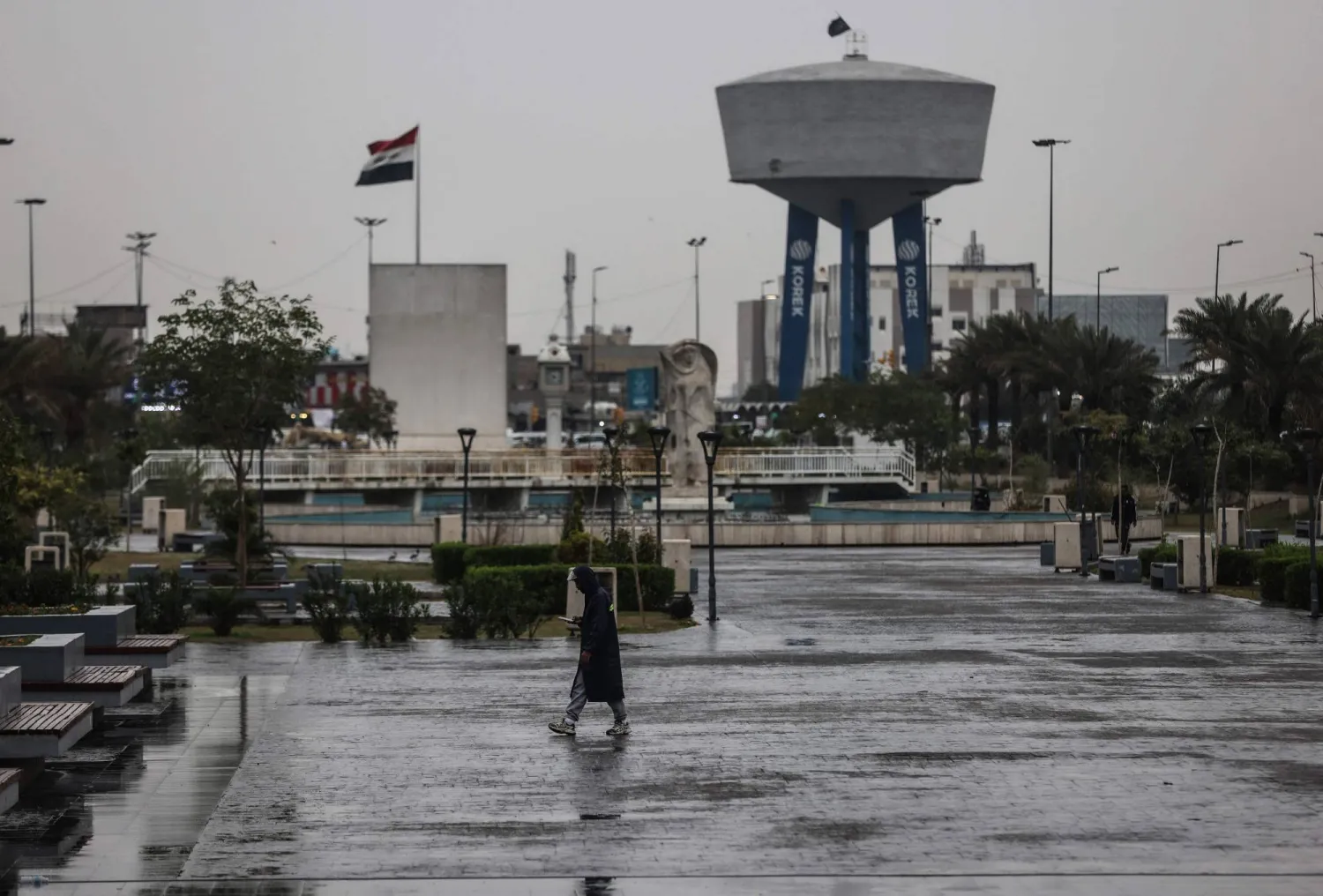
An Iraqi man walks through Al-Umma Park during rainfall in Baghdad on March 15, 2026. (AFP)
TT

Iraq’s Gas Imports from Iran Halted Due to War

An Iraqi man walks through Al-Umma Park during rainfall in Baghdad on March 15, 2026. (AFP)

Iraq's gas imports from Iran were completely halted on Wednesday, authorities said, the latest blow to the country's battered economy reeling from the impact of the Middle East war.

The country has been unwillingly drawn into the conflict triggered by the US-Israel attack on its neighbor Iran on February 28.

The cutoff came as Baghdad had barely had time to celebrate a deal to export a fraction of its oil production through Türkiye after disruptions to shipments through the Strait of Hormuz.

Ahmed Moussa told the Iraqi News Agency (INA) that "due to regional developments, Iranian gas supplies to Iraq completely halted an hour ago," cutting about 3,100 megawatts of power, which will "certainly affect the grid".

He sought, however, to calm fears of more frequent blackouts, saying the ministry will instead use "alternative fuels and domestic gas reserves".

News of the gas stoppage came after Tehran denounced a US-Israeli strike on Iranian facilities exploiting the vast South Pars/North Dome gas field.

Despite its abundant oil and gas reserves, Iraq's power plants are highly dependent on gas imported from Iran, which supplies about a third of the country's needs.

Electricity shortages are already a frequent complaint in Iraq, which suffers from endemic corruption and dilapidated public infrastructure.

Most households rely on private generators to compensate for daily power cuts.

Early Wednesday, Iraq said it resumed oil exports from its fields in the northern province of Kirkuk in agreement with the autonomous Kurdistan Region, through which the pipeline to Türkiye's port of Ceyhan runs.

But it will export 250,000 barrels per day (bpd), only a fraction of the 3.5 million before the war.

However, Iraq, whose crude sales make up 90 percent of its foreign revenue, had few options after Iran effectively shuttered the Strait of Hormuz, through which Iraq previously shipped most of its oil from the southern Basra fields.

- Fighters killed -

The impact of the war is not solely economic. Strikes have targeted Iran-backed groups, which in turn have claimed daily attacks on US interests in Iraq and across the region.

A strike near Iraq's western border with Syria on Wednesday killed three fighters from the former paramilitary coalition Popular Mobilization Forces (PMF), the alliance said.

The fighters from the alliance -- now part of Iraq's regular armed forces -- were hit in an US or Israeli strike that targeted their main command center in Anbar province.

Pro-Iran factions have also brigades that operate within the alliance, but have a reputation for acting on their own.

On Wednesday morning, an AFP journalist reported at least four explosions in the city of Erbil, the capital of the Kurdistan region.

It was unclear what the target was, and the projectiles were intercepted over the city, home to a major US consulate complex, while its airport houses US-led coalition troops.

Kurdish armed forces also reported that three soldiers were wounded in drone attacks on their positions in Erbil and the city of Sulaimaniyah.


Israeli Military Publishes Map of South Lebanon Territory Under Its Control

 Israeli military vehicles drive in southern Lebanon, near the Israel-Lebanon border, amid a 10-day ceasefire between Lebanon and Israel, as seen from Israel, April 19, 2026. (Reuters)
Israeli military vehicles drive in southern Lebanon, near the Israel-Lebanon border, amid a 10-day ceasefire between Lebanon and Israel, as seen from Israel, April 19, 2026. (Reuters)
TT

Israeli Military Publishes Map of South Lebanon Territory Under Its Control

 Israeli military vehicles drive in southern Lebanon, near the Israel-Lebanon border, amid a 10-day ceasefire between Lebanon and Israel, as seen from Israel, April 19, 2026. (Reuters)
Israeli military vehicles drive in southern Lebanon, near the Israel-Lebanon border, amid a 10-day ceasefire between Lebanon and Israel, as seen from Israel, April 19, 2026. (Reuters)

The Israeli military published ‌for the first time a map of its new deployment line inside Lebanon on Sunday, bringing dozens of mostly abandoned Lebanese villages under its control, days after a ceasefire with Hezbollah took effect.

There was no immediate comment from Lebanese officials or from Iran-backed Hezbollah.

Israel and Lebanon agreed on Thursday to a US-backed ceasefire in fighting between Israel and Hezbollah. The deal, which followed the first direct talks in decades between Israel and Lebanon on April 14, is meant to enable broader US-Iran negotiations but with Israeli forces maintaining positions deep inside southern Lebanon.

Stretching east to west, the deployment line on the ‌map runs 5-10 km ‌deep from the border into Lebanese territory, where Israel ‌has ⁠said that it ⁠plans to create a so-called buffer zone. Israeli forces have destroyed Lebanese villages in the area, saying their aim is to protect northern Israeli towns from Hezbollah attacks.

It has created buffer zones in Syria and in Gaza, where it controls more than half the enclave.

"Five divisions, alongside Israeli Navy forces, are operating simultaneously south of the forward defense line in southern Lebanon in ⁠order to dismantle Hezbollah terror infrastructure sites and to ‌prevent direct threats to communities in northern ‌Israel," the military said in a statement accompanying the map.

Asked whether people who fled ‌the Israeli strikes would be allowed to return to their homes, ‌the Israeli military declined to comment.

Lebanese civilians have been able to access some of the villages that fall on or beyond the Israeli-set line, but Israeli forces still prevent people from accessing most of those south of the line, a Lebanese security ‌source said.

Israeli Defense Minister Israel Katz said on Sunday that homes on the border exploited by Hezbollah would ⁠be demolished and ⁠that "any structure threatening our soldiers and any road suspected of (being planted with) explosives must be immediately destroyed".

Lebanon was dragged into the war on March 2, when Hezbollah opened fire in support of Tehran, prompting an Israeli offensive that has killed more than 2,100 people, including 177 children, and forced more than 1.2 million to flee, Lebanese authorities say.

Hezbollah has not disclosed its casualty figures. At least 400 of its fighters had been killed by the end of March, according to sources close to the group.

Hezbollah has fired hundreds of rockets and drones at Israel. Its attacks killed two civilians in Israel while 15 Israeli soldiers have died in Lebanon since March 2, Israel says.


Israel Re-Establishes Evacuated West Bank Settlement

Israeli Defense Minister Israel Katz, (3rd-L), Yossi Dagan, Head of the Shomron Regional Council (4th-L), and Israel's far-right Finance Minister Bezalel Smotrich (4th-R) stand for the national anthem as they attend the resettlement ceremony of Sa-Nur, south of Jenin, in the Israeli-occupied West Bank on April 19, 2026. (AFP)
TT

Israel Re-Establishes Evacuated West Bank Settlement

Israeli Defense Minister Israel Katz, (3rd-L), Yossi Dagan, Head of the Shomron Regional Council (4th-L), and Israel's far-right Finance Minister Bezalel Smotrich (4th-R) stand for the national anthem as they attend the resettlement ceremony of Sa-Nur, south of Jenin, in the Israeli-occupied West Bank on April 19, 2026. (AFP)

Israeli ministers on Sunday officially reopened Sa-Nur, a settlement in the occupied West Bank that was evacuated 20 years ago, marking the occasion with defiant declarations against Palestinian statehood and calls to resettle Gaza.

Several cabinet members and lawmakers attended the ceremony near a cluster of white prefabricated homes arranged in rows on a hilltop.

Excluding east Jerusalem, more than 500,000 Israelis now live in the West Bank in settlements that are illegal under international law, among some three million Palestinians.

"On this exciting day, we celebrate a historic correction to the criminal expulsion from Northern Samaria," Finance Minister Bezalel Smotrich said, using the Israeli biblical term for part of the West Bank.

Sa-Nur's settlers were evicted in 2005 as part of Israel's so-called disengagement policy that also saw the country withdraw troops and settlers from the Gaza Strip.

The policy promoted by then-prime minister Ariel Sharon was framed as a security measure intended to reduce Israel's civilian and military footprint in densely populated Palestinian areas.

Israel's current government, considered one of the most right-wing in the country's history, approved the reconstruction of all four northern West Bank settlements evacuated in 2005.

Authorities have approved 126 housing units in Sa-Nur alone.

"We are cancelling the shame of the disengagement, burying the idea of a Palestinian state and returning to the settlement of Sa-Nur," Smotrich said.

Smotrich, a far-right minister in the ruling coalition and a settler himself, also called for the resettlement of the Gaza Strip as a "security belt" for the State of Israel.

Israeli media reported that 16 families had moved into the re-established settlement in recent days, adding that the new residents included Yossi Dagan, head of the northern West Bank Settlements Council.

Dagan was among those evacuated from Sa-Nur in 2005.

"For me, this is both a national and a personal closing of a circle," Dagan said after cutting the ribbon at the ceremony.

"No more uprootings, no more retreats. We have returned to stay."

Israel has occupied the West Bank since 1967 and since then settlement expansion has been a policy under successive Israeli governments.

But it has accelerated significantly under the current coalition government of Prime Minister Benjamin Netanyahu.

More than 100 settlements have been approved since the government came to power in 2022, according to activists and authorities.


France’s Macron to Meet with Lebanon’s PM in Paris on Tuesday

16 February 2026, Lebanon, Beirut: Lebanese Prime Minister Nawaf Salam is pictured during a meeting at the Prime Minister's office. (dpa)
TT

France’s Macron to Meet with Lebanon’s PM in Paris on Tuesday

16 February 2026, Lebanon, Beirut: Lebanese Prime Minister Nawaf Salam is pictured during a meeting at the Prime Minister's office. (dpa)

French President Emmanuel Macron will on Tuesday meet with Lebanese Prime Minister Nawaf Salam in Paris, his office announced, amidst a fragile 10-day truce between Israel and Iran-backed Hezbollah.

The visit highlights Macron's commitment to seeing "full and complete respect for the ceasefire in Lebanon" as well as France's support for Lebanon's "territorial integrity", the president's office said on Sunday.

Israel and Lebanon on Thursday agreed to a 10-day ceasefire to give time to negotiate an end to six weeks of fighting between Israel and the group.

The visit was announced a day after France blamed Hezbollah for an ambush on UN peacekeepers which left one French soldier dead and three others wounded.

Macron is to urge Lebanese authorities to "shed full light on the incident" and "identify and prosecute those responsible without delay," his office added.

An initial assessment by the United Nations Interim Force in Lebanon (UNIFIL) found the attack was carried out by Hezbollah, according to UN Secretary-General Antonio Guterres.

"UNIFIL soldiers, who are carrying out their missions in difficult conditions and supporting the delivery of humanitarian aid to southern Lebanon, must under no circumstances be targeted," the Elysee said.

Hezbollah -- which strongly opposes to the planned Lebanon-Israel talks -- denied involvement in the attack that killed the French peacekeeper.

The fighting in Lebanon has seen UNIFIL positions repeatedly targeted by Israeli and Hezbollah forces.