


War Deepens Lebanon’s Economic Collapse

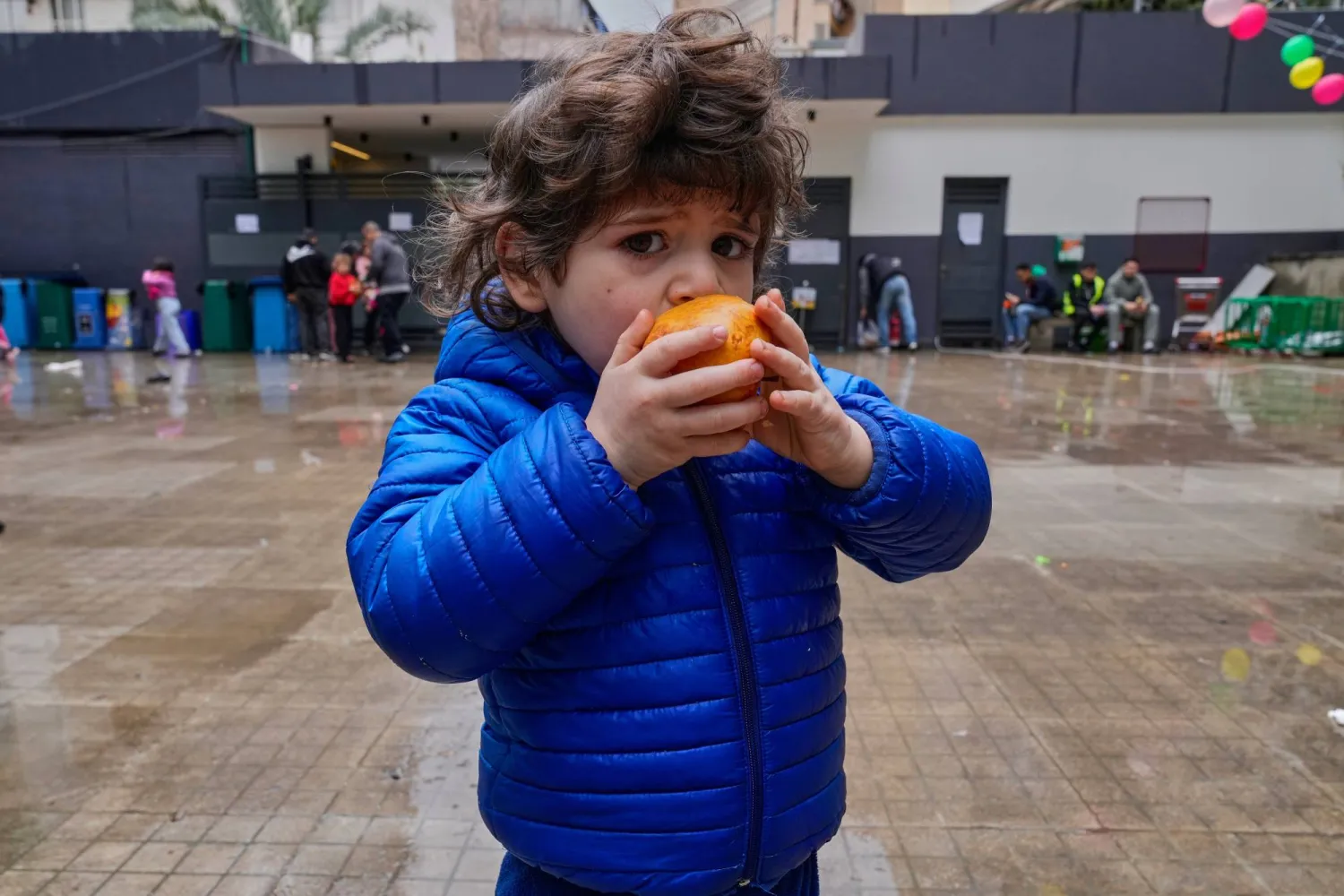
A displaced young girl who fled with her family Israeli airstrikes in southern Lebanon, eats an apple at a playground school that turned into a shelter in Beirut, Saturday, March 21, 2026. (AP Photo/Hussein Malla)
TT

War Deepens Lebanon’s Economic Collapse

A displaced young girl who fled with her family Israeli airstrikes in southern Lebanon, eats an apple at a playground school that turned into a shelter in Beirut, Saturday, March 21, 2026. (AP Photo/Hussein Malla)

Lebanon’s economy barely catches its breath before another crisis hits, tightening the squeeze and deepening its fragility.

The current war has wiped out efforts to revive it, as the country still reels from the 2019 financial collapse, the coronavirus pandemic, the Beirut port blast, and the 2023-2024 war.

After successive governments failed to resolve its structural crisis, the latest military escalation has further weakened the economy and stalled reform efforts, despite the current government's attempts to lay out recovery plans and legislation.

Since the first week of the war, some businesses have halved employees’ working hours to cut wages, while others have shut down entirely, aside from those destroyed in Beirut’s southern suburbs and the south.

The impact has been immediate, with many workers still earning less than half their pre-2019 salaries.

Losses of $100 million a day

Nicolas Chammas, secretary-general of the Lebanese Economic Organizations and head of the Beirut Traders Association, described the war’s impact as “huge,” compounded by years of strain since 2019.

“In 2025, economic growth reached 5%, but that followed a 7% contraction in 2024,” Chammas told Asharq Al-Awsat. “We had already started this year on a negative footing, and the current war has worsened conditions.”

According to the World Bank, the 2024 war cost $14 billion, or about $225 million a day.

“Using that as a benchmark, the current war is costing roughly $100 million a day,” he said, citing damage to infrastructure, reduced economic activity, and the cost of sheltering and assisting displaced people.

Chammas said tourism and travel were among the hardest-hit sectors, with travel down by more than 80%.

“Hotel occupancy is now below 10%, and declines are also severe in car rentals, furnished apartments, and resorts,” he said. “The industrial and commercial sectors are also affected, with the latter down around 50%.”

If the war continues, he warned, growth could flip into a contraction of up to 10%.

Structural contraction

Economist Jassem Ajaka said the war has shifted the downturn from “monetary” to “structural.”

“Under full dollarization, the shock no longer shows in a currency collapse, but in paralyzed economic activity and higher operating costs,” he told Asharq Al-Awsat.

He put total losses from the previous and current wars at about $15 billion, direct and indirect, based on World Bank estimates and updated research for 2026.

With Brent crude above $115, production and dollarized service costs have risen by more than 40%, eroding companies' profit margins, he said.

The agricultural sector has been the hardest hit geopolitically, with losses of about $2.5 billion due to destroyed land and disrupted supply chains. Tourism revenues have fallen 74% compared with the 2024 season, depriving the economy of a key source of foreign currency.

Ajaka said recent Banque du Liban data showed external assets holding at about $12.07 billion, supported by liquid foreign securities.

But he warned that a prolonged war and high oil prices would gradually drain those assets to cover fuel and essential imports, threatening this “artificial stability” in the second half of the year if reserves fall below safe levels.

Latest figures

Ajaka said 30% of small and medium-sized businesses had shut down permanently by the first quarter of 2026, unable to cover dollarized operating costs amid weak demand.

Those still operating have shifted to “emergency cash flow management,” with some paying half salaries or flat dollar wages worth no more than 40% of previous levels.

Unemployment has surged to between 46% and 48%, driven not only by business closures but also by the inability of productive sectors to absorb labor costs amid rising global energy and input prices.



First Israeli Civilian Killed in Lebanon Border War Was Hit by Israeli Fire

Smoke rises after an Israeli strike, following an escalation between Hezbollah and Israel amid the US-Israeli conflict with Iran, as seen from Marjayoun, Lebanon, March 22, 2026. REUTERS/Karamallah Daher
TT

First Israeli Civilian Killed in Lebanon Border War Was Hit by Israeli Fire

Smoke rises after an Israeli strike, following an escalation between Hezbollah and Israel amid the US-Israeli conflict with Iran, as seen from Marjayoun, Lebanon, March 22, 2026. REUTERS/Karamallah Daher

Israel said on Monday its own forces had misfired artillery that killed an Israeli farmer near the Lebanese frontier, the first Israeli civilian killed in a border conflict being waged in parallel with the war in Iran.

Ofer Moskovitz, 60, an avocado farmer in the town of Misgav Am, had spoken with Reuters just last week and said he was worried about the fighting at the border.

In a ⁠statement, Major General ⁠Rafi Milo, who heads the military's northern command, said: "Moskovitz was killed by our own forces’ fire during an operation whose entire purpose was to protect them."

The military had initially blamed cross-border fire from Lebanon when it first reported the incident on Sunday.

Israel has ⁠launched a major ground assault and air campaign into Lebanon to root out Hezbollah, a powerful Iran-backed militia, which fired into Israel in support of Tehran two days after the start of the Israeli-US air attacks on Iran.

Lebanese authorities say more than a thousand people have been killed and more than a million driven from their homes in Lebanon. The death of Moskovitz was the first reported in Israel. The ⁠military ⁠says two Israeli soldiers have been killed in combat.

"Every five minutes you can hear the bombs," Moskovitz told Reuters last week.

The military's statement said troops had opened fire to support soldiers operating in southern Lebanon, but "severe issues and operational errors" had taken place.

"The artillery fire was carried out at an incorrect angle and did not follow required protocols," it said. "As a result, five artillery shells were fired at the Misgav Am ridge instead of toward the enemy target."


Iraqi PM Says Accelerating Withdrawal of Anti-ISIS Coalition Forces

13 January 2023, Berlin: Iraqi Prime Minister Mohammed Shia al-Sudani speaks during a press conference. (dpa)
TT

Iraqi PM Says Accelerating Withdrawal of Anti-ISIS Coalition Forces

13 January 2023, Berlin: Iraqi Prime Minister Mohammed Shia al-Sudani speaks during a press conference. (dpa)

Iraqi Prime Minister Mohammed Shia al-Sudani said he would accelerate the dismantling of a US-led international anti-ISIS coalition, in an interview with an Italian newspaper published Monday.

The prime minister's comments come as the country finds itself unwillingly drawn into the conflict in the Middle East, which began with Israeli and US strikes on Iran on February 28.

Pro-Iran armed groups have claimed responsibility for near-daily attacks on US interests in Iraq and across the region, while strikes have also targeted these groups.

The end of the international anti-ISIS coalition's mission was initially planned for September 2026 in Iraq, with the drawdown launching in 2024.

The end of the mission was intended to pave the way for bilateral security partnerships with member countries of the alliance, formed in 2014 to fight the extremist ISIS group.

"With our allies we have now decided to bring forward the end of the international coalition, which was supposed to continue until September 2026," Sudani told Italian newspaper Corriere Della Sera.

"Once there are no more foreign military contingents on Iraqi soil, it will be easier to break up the armed factions," he said, referring to pro-Iran groups in the country.

The presence of foreign troops -- particularly American advisers -- is a long-running point of contention between the government and the pro-Iran armed factions.

Baghdad has demanded a monopoly on weapons and called for the dismantling of the groups' arsenals, which the factions justify by pointing to the presence of foreign soldiers.

Both the government and the coalition insist the coalition deploys military advisers -- who provide expertise and support, aiming to prevent a resurgence of ISIS -- to Iraq at the invitation of the authorities.

These advisers are currently only deployed in northern Iraqi Kurdistan and were scheduled to remain there until September 2026.

In January, the first phase of the coalition withdrawal agreement was completed, with personnel leaving the Iraqi military bases.

The coalition is also in the process of withdrawing from neighboring Syria, where it also deployed, having recently handed over its bases to Syrian government forces.


Indonesia Says No to $1bn Fee for Trump's 'Board of Peace' Seat

Indonesia's President Prabowo Subianto attends the 56th annual World Economic Forum (WEF) meeting in Davos, Switzerland, January 22, 2026. (Reuters)
TT

Indonesia Says No to $1bn Fee for Trump's 'Board of Peace' Seat

Indonesia's President Prabowo Subianto attends the 56th annual World Economic Forum (WEF) meeting in Davos, Switzerland, January 22, 2026. (Reuters)

Indonesia's president, under fire at home for signing up to US counterpart Donald Trump's so-called "Board of Peace", has insisted his country would not pay the $1 billion joining fee for permanent membership.

Jakarta had only committed peacekeeping troops for the initiative, Prabowo Subianto said in a statement published on the presidential YouTube channel Sunday, AFP reported.

The "Board of Peace" came together after the Trump administration, teaming up with Qatar and Egypt, negotiated a ceasefire in October to halt two years of devastating war in Gaza.

Countries that want to be permanent members must pay $1 billion -- sparking criticism the board could become a "pay-to-play" version of the UN Security Council.

Prabowo, a former general, has come under criticism from Indonesian Muslim groups for joining the board and pledging to send 8,000 peacekeeping troops to Gaza.

Prabowo attended the inaugural meeting of the "Board of Peace" in Washington last month.

But he later said he would withdraw from the board if it does not bring benefits to Palestinians or align with Indonesia's national interests.

"We never said that we wanted to contribute $1 billion," Prabowo said in statements broadcast on his YouTube channel Sunday.

He said he did not make any financial commitments "at all".

Prabowo signed a tariff deal with the US last month, but insisted Sunday that Indonesia could withdraw from any agreement if its conditions or execution threatens the national interest.

Talks with Washington about any peacekeeping mission to Gaza have been put "on hold", according to state news agency Antara, citing Foreign Ministry spokesman Vahd Nabyl Achmad Mulachela.