Iraqi PM Says Accelerating Withdrawal of Anti-ISIS Coalition Forces

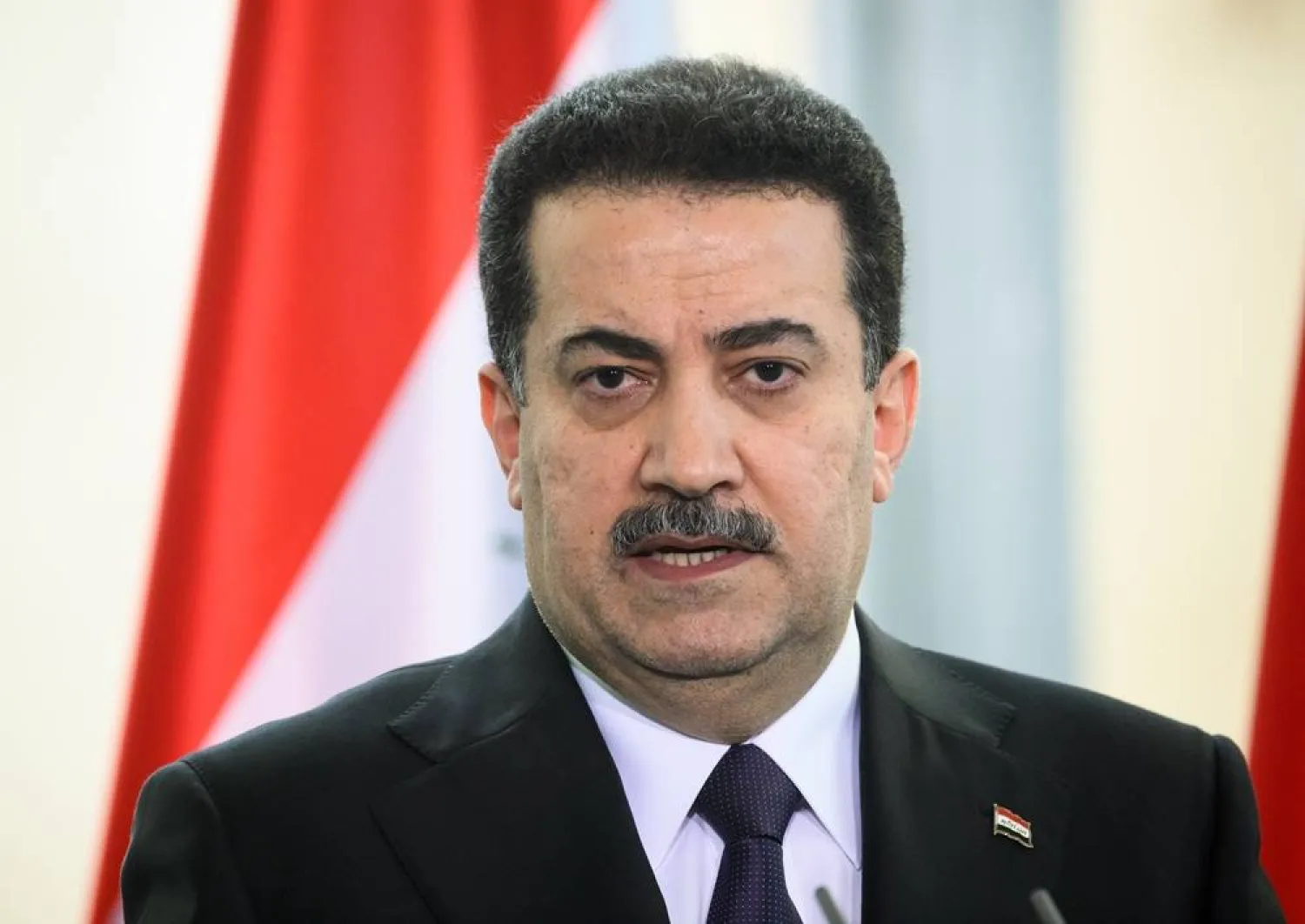
13 January 2023, Berlin: Iraqi Prime Minister Mohammed Shia al-Sudani speaks during a press conference. (dpa)
TT

Iraqi PM Says Accelerating Withdrawal of Anti-ISIS Coalition Forces

13 January 2023, Berlin: Iraqi Prime Minister Mohammed Shia al-Sudani speaks during a press conference. (dpa)

Iraqi Prime Minister Mohammed Shia al-Sudani said he would accelerate the dismantling of a US-led international anti-ISIS coalition, in an interview with an Italian newspaper published Monday.

The prime minister's comments come as the country finds itself unwillingly drawn into the conflict in the Middle East, which began with Israeli and US strikes on Iran on February 28.

Pro-Iran armed groups have claimed responsibility for near-daily attacks on US interests in Iraq and across the region, while strikes have also targeted these groups.

The end of the international anti-ISIS coalition's mission was initially planned for September 2026 in Iraq, with the drawdown launching in 2024.

The end of the mission was intended to pave the way for bilateral security partnerships with member countries of the alliance, formed in 2014 to fight the extremist ISIS group.

"With our allies we have now decided to bring forward the end of the international coalition, which was supposed to continue until September 2026," Sudani told Italian newspaper Corriere Della Sera.

"Once there are no more foreign military contingents on Iraqi soil, it will be easier to break up the armed factions," he said, referring to pro-Iran groups in the country.

The presence of foreign troops -- particularly American advisers -- is a long-running point of contention between the government and the pro-Iran armed factions.

Baghdad has demanded a monopoly on weapons and called for the dismantling of the groups' arsenals, which the factions justify by pointing to the presence of foreign soldiers.

Both the government and the coalition insist the coalition deploys military advisers -- who provide expertise and support, aiming to prevent a resurgence of ISIS -- to Iraq at the invitation of the authorities.

These advisers are currently only deployed in northern Iraqi Kurdistan and were scheduled to remain there until September 2026.

In January, the first phase of the coalition withdrawal agreement was completed, with personnel leaving the Iraqi military bases.

The coalition is also in the process of withdrawing from neighboring Syria, where it also deployed, having recently handed over its bases to Syrian government forces.


UN Force Says HQ Struck in South Lebanon

United Nations peacekeepers with the UN Interim Force in Lebanon (UNIFIL) drive past a destroyed healthcare centre building in the aftermath of an Israeli strike in the southern Lebanese town of Burj Qalawiya on March 14, 2026. Photo by Kawnat HAJU / AFP)
TT

UN Force Says HQ Struck in South Lebanon

United Nations peacekeepers with the UN Interim Force in Lebanon (UNIFIL) drive past a destroyed healthcare centre building in the aftermath of an Israeli strike in the southern Lebanese town of Burj Qalawiya on March 14, 2026. Photo by Kawnat HAJU / AFP)

The UN peacekeeping force in Lebanon (UNIFIL) announced Monday that its headquarters in Naqura had been hit by a projectile, probably launched by a "non-state actor", after Hezbollah declared it had targeted Israeli forces in the same town.

Since Saturday, the coastal town in Lebanon's far south on the border with Israel, has been one of the flashpoints between Hezbollah and the Israeli army, AFP reported.

"Just before noon today, a projectile hit a building inside our headquarters," UNIFIL said in a statement.

"Peacekeepers with expertise in explosive ordinance disposal are working to deal with it. We believe it was fired by a non-state actor."

UNIFIL's statement came after Hezbollah claimed at least two attacks on Monday against Israeli forces in Naqura.

The first, at 11:00 am (0900GMT), targeted "a gathering of Israeli enemy soldiers in the vicinity of the Naqura municipality building". and the second, at 1:00 pm, targeted a similar gathering "near the Naqura school".

After a November 2024 ceasefire to end a previous war with Hezbollah, Israel kept forces in five positions, including the village of Labbouneh, just three kilometres away from Naqura.

On Saturday, Hezbollah said its members had targeted Israeli soldiers along the border, including in Naqura.

In its Monday statement, UNIFIL said it had observed over the past 48 hours "intense gunfire and explosions" in and around Naqura, close to its headquarters.

"Bullets, fragments, and shrapnel have hit buildings and open areas inside our headquarters, putting peacekeepers at risk."

The force reminded "all actors of their responsibility to ensure the safety and security of peacekeepers".

"We reiterate that there is no military solution to this conflict and urge the actors to put down their weapons and commit to working toward a long-term solution, before more people get hurt."


Lebanon Says One Killed Near Beirut, as Israel Says Struck Iran Guards Member

A Middle East Airlines plane takes off from Rafik Hariri International Airport as smoke rises from the site of an Israeli airstrike in Dahiyeh, Beirut's southern suburbs, Lebanon, Tuesday, March 17, 2026. (AP Photo/Hassan Ammar)
TT

Lebanon Says One Killed Near Beirut, as Israel Says Struck Iran Guards Member

A Middle East Airlines plane takes off from Rafik Hariri International Airport as smoke rises from the site of an Israeli airstrike in Dahiyeh, Beirut's southern suburbs, Lebanon, Tuesday, March 17, 2026. (AP Photo/Hassan Ammar)

An Israeli strike on Hazmieh east of Beirut killed at least one person, Lebanon's health ministry said, the second strike on the residential Christian area in the ongoing Israel-Hezbollah war, according to AFP.

The Israeli military said around the same time that it had "struck an IRGC Quds Force terrorist in Beirut", referring to the foreign operations arm of Iran's Revolutionary Guards.

Hazmieh, which is near Lebanon's presidential palace, hosts several foreign embassies.


Israeli Minister Calls for Annexation of Southern Lebanon

Israeli soldiers stand next to tanks near the Israeli side of the border with Lebanon, March 23, 2026. REUTERS/Tyrone Siu
TT

Israeli Minister Calls for Annexation of Southern Lebanon

Israeli soldiers stand next to tanks near the Israeli side of the border with Lebanon, March 23, 2026. REUTERS/Tyrone Siu

Israel should extend its border with Lebanon up to the Litani River deep inside the country's south, Israel's finance minister said on Monday as Israeli troops bombed bridges and destroyed homes in the area in an escalating military assault.

The comments by Finance Minister Bezalel Smotrich were the most explicit yet by a senior Israeli official on seizing Lebanese territory in a fight Israel says targets Iran-backed Hezbollah militants.

Lebanon was pulled into the regional war on March 2 when Hezbollah fired missiles into Israel. Since then, Israel has ordered all residents to leave the area south of the Litani River as it pummels the area with air strikes, viewing it as a Hezbollah stronghold.

Lebanese authorities say the Israeli air and ground assault has killed more than 1,000 people, and more than a million have been driven from their homes with Israel having ordered residents to flee swathes of the country.

'THE NEW ISRAELI BORDER MUST BE THE LITANI'

Smotrich told an Israeli radio program that the military campaign in Lebanon "needs to end with a different reality entirely, both with the Hezbollah decision but also with the change of Israel's borders."

"I say here definitively...in every room and in every discussion, too: the new Israeli border must be the Litani," Smotrich said.

Smotrich, leader of a small far-right party in Prime Minister Benjamin Netanyahu's cabinet, often makes comments that go beyond official Israeli policy.

Netanyahu's office did not immediately respond to a request for comment on the remarks. Defenسe Minister Israel Katz hinted earlier this month at plans to capture land, saying Lebanon could face "loss of territory" if it did not disarm Hezbollah.

Smotrich's remarks were deeply resonant in Lebanon, which is trying to emerge from a decades-old cycle of invasions and occupations by its neighbor. Israeli forces have launched repeated assaults on Lebanon since 1978 and occupied the south from 1982-2000.

A Lebanese official told Reuters that Beirut was still counting on foreign powers to put enough pressure on Israel to put an end to the war, through an offer from President Joseph Aoun to hold direct talks.

Smotrich also called for Israel to annex territory it now controls in the Gaza Strip, up to an armistice line with Hamas. A ceasefire signed in October left Israel in control of 53% of Gaza, where it has ordered residents out and bulldozed buildings.

The Israeli military says its troops in Lebanon are carrying out ground maneuvers and targeted raids on Hezbollah militants and weapons stores, aimed at protecting residents in northern Israel from Hezbollah fire.

The Lebanese government has outlawed Hezbollah military activity and said it wants to engage in direct talks with Israel.

ROUTES TO NORTH BEING CUT OFF

Over the weekend, Israel struck a main bridge linking south Lebanon with the rest of the country after ordering its military to destroy all crossings over the Litani River and to step up the demolition of homes near the southern border.

International law generally prohibits militaries from attacking civilian infrastructure, and the United Nations human rights chief has criticized Israel's actions in Lebanon, particularly its use of widespread evacuation orders.

Israeli strikes hit two more crossings on the Litani River on Monday -- a road running near a main bridge hit on Sunday and another small bridge on another section of the river.

Hanna Amil, the mayor of Christian border town Rmeish whose residents have refused to leave their homes, told Reuters that it was getting increasingly difficult to move around.

"Once or twice a week, a convoy from the Lebanese army accompanies us as we try to get basic goods from nearby areas," he said.

"Already, we have no state electricity, no water and we have diesel shortages. If all the routes to the north get cut off, who knows what the future could hold for us," Amil said.